2026/6/28 · 7:27
MW tea lowered meal glucose in 20 adults
A small randomized crossover trial found that a 95:5 mulberry leaf and water chestnut husk tea lowered post-meal interstitial glucose after a rice breakfast and showed a moderate second-meal effect at lunch. The practical takeaway is conservative: unsweetened mulberry-leaf tea may be reasonable to try before high-starch meals, but the evidence is limited to a 20-person acute study in healthy young adults.

A small randomized trial gives one clear, limited dietary idea: an unsweetened mulberry-leaf and water chestnut husk tea taken just before a rice-heavy meal may blunt the glucose rise that follows. The study tested MW tea in 20 healthy Japanese university students, using a randomized, double-blind, placebo-controlled crossover design. 1
The result is stronger than a vague "tea is healthy" claim. After breakfast, total incremental glucose area under the curve was lower with MW tea than with placebo by a mean difference of -1,837 mg·min/dL, with p<0.001 and a large Wilcoxon effect size of r=0.74. 1 The same single drink also carried into lunch: after the second meal, the difference was -682 mg·min/dL, with p=0.017 and a moderate Cohen dz of 0.58. 1
The decision for today is narrower. If a patient or client already wants a caffeine-free, unsweetened drink before a high-starch meal, mulberry-leaf tea is a plausible option. The new study does not justify treating MW tea as a diabetes therapy, a substitute for medication, or proof that any herbal tea will lower glucose.
What was actually tested
MW tea is a specific blend, not a generic green drink. In the trial, each serving used 3 g of powder in 200 mL of hot water, with 95% mulberry leaf powder and 5% roasted water chestnut husk powder by weight. 1 The participants drank the tea within 3 minutes before breakfast, then ate the assigned breakfast within 7 minutes. 1
The comparator was designed to look and taste similar. The placebo tea used corn powder, barley tea powder, and food coloring, and a pretest judged it indistinguishable from MW tea in appearance, taste, and aroma. 1 That matters because a tea study can easily be biased if participants can tell which drink they received.
The meals were intentionally simple and carbohydrate-heavy. Breakfast was 200 g of packaged rice, providing 294 kcal and 67.8 g of carbohydrate. 1 Lunch, eaten 180 minutes after breakfast, was 200 g of rice plus 180 g of ready-to-eat curry, providing 571 kcal and 101.3 g of carbohydrate. 1
The study used FreeStyle Libre Pro continuous monitoring to measure interstitial glucose every 15 minutes, with 120 minutes of monitoring after breakfast and 90 minutes after lunch. 1 Each participant completed both the MW tea and placebo conditions, separated by at least a 1-week washout period. 1
For readers who want the original paper, the main entry points are the DOI page and the PubMed record.
The results were acute, but not trivial
The main glucose curve result favored MW tea after both meals. The authors reported the breakfast result as total ΔIAUC median 3,266 [2,102-3,825] mg·min/dL with MW tea versus 4,800 [3,966-6,023] mg·min/dL with placebo. 1 For lunch, the reported total ΔIAUC values were mean 1,840 (715) mg·min/dL with MW tea and 2,522 (1,173) mg·min/dL with placebo. 1
| Outcome | MW tea versus placebo | Interpretation |
|---|---|---|
| Breakfast total ΔIAUC | Mean difference -1,837 mg·min/dL; p<0.001; r=0.74. 1 | Large acute reduction in post-breakfast glucose exposure. |
| Lunch total ΔIAUC | Mean difference -682 mg·min/dL; p=0.017; Cohen dz=0.58; power 1-β=0.69. 1 | Moderate second-meal effect, with less statistical power than breakfast. |
| Breakfast timing | Differences were largest at 30 and 60 minutes: -603 and -624 mg·min/dL, both p<0.001. 1 | The effect appears concentrated in the early post-meal window. |
The lunch result is the part dietitians may care about most. A second-meal effect means the first intervention changes the glucose response to a later meal, not just the meal immediately paired with the tea. The authors wrote, "These findings suggest that a single intake of MW tea may attenuate postprandial and second-meal glycaemic responses in healthy adults." 1
That sentence should not be stretched into a long-term claim. The trial measured about 300 minutes after one dose, not weeks of intake, HbA1c, diabetes incidence, medication reduction, or cardiovascular outcomes. 1
Why this tea might work
The proposed mechanism is plausible because mulberry leaves contain 1-deoxynojirimycin, usually abbreviated 1-DNJ, a natural alpha-glucosidase inhibitor. Alpha-glucosidase is an intestinal enzyme involved in breaking down carbohydrates into absorbable glucose. 1 Water chestnut husk adds hydrolyzable polyphenols, including eugeniin, 1,2,3,6-tetra-O-galloyl-D-glucopyranose, and trapain, that have been linked to alpha-glucosidase inhibitory activity. 1
The authors described the mechanism this way: "The hypoglycaemic effect is thought to result from the inhibition of α-glucosidase by 1-DNJ contained in mulberry leaves and polyphenols in water chestnut husk, which delay the absorption of glucose in the intestinal tract." 1
The broader mulberry evidence points in the same direction, but it also sets a boundary. A 2022 systematic review and meta-analysis of 13 randomized controlled trials found that Morus alba lowered postprandial glucose iAUC by a mean difference of -76.66 and postprandial insulin iAUC by -14.89, while fasting glucose and HbA1c did not significantly change. 2 In plain English, the best-supported target is the glucose rise after a meal, not overnight glucose or long-term glycemic control.
A prior 5-week crossover study in 31 non-diabetic adults reported that MW tea containing 5.10 mg of DNJ and 87.3 mg of polyphenols per 3 g bag reduced continuous glucose monitoring coefficient of variation, with p=0.0006. 3 That background makes the new trial less isolated, but the new trial still needs replication in larger and more varied groups.
Who should be careful with the takeaway
The participant profile was narrow. The study enrolled 20 healthy Japanese university students, with 10 men and 10 women, a median age of 21.0 years, and a mean BMI of 20.3 kg/m². 1 The eligibility criteria excluded people with diabetes, impaired glucose tolerance history, food allergies, regular medication or supplement use, pregnancy, lactation, overweight, and obesity. 1
The trial also used rice-based test meals in a controlled laboratory setting. 1 That is a strength for isolating the effect, but it leaves open how MW tea performs with mixed meals that include more vegetables, protein, fat, or different starches.
The safety signal was reassuring but small. The study reported no adverse events and no dropouts. 1 A 20-person, single-dose experiment cannot establish long-term safety for daily use, use during pregnancy, use with glucose-lowering medication, or use in people with diabetes.
The authors were direct about the limits: "These findings should be interpreted with caution and require further confirmation." 1 They also noted limitations including the small sample, the simple standard meals, interstitial rather than blood glucose measurement, no post-meal insulin data, and unclear contribution from each active component. 1
The dietary decision
For a healthy adult, the practical move is modest: if you enjoy unsweetened mulberry-leaf tea and tolerate it well, it is reasonable to try it before a high-rice or high-starch meal and watch whether your own post-meal response improves. The closest match to the study protocol is 3 g of the MW tea powder in 200 mL hot water, consumed within 3 minutes before the meal. 1
For dietitians, the counseling line should stay conservative. MW tea can be discussed as a possible meal-pairing strategy for postprandial glucose, especially around high-glycemic starches, but the evidence does not support replacing established tools: carbohydrate quality and portioning, protein and fiber at meals, exercise, sleep, weight management when relevant, and prescribed medication.
For people with diabetes, impaired glucose tolerance, pregnancy, or glucose-lowering medication use, this study is not enough to self-prescribe MW tea as a therapeutic intervention. Those groups were not tested. 1
One final practical wrinkle: the exact MW tea blend was commercialized in Japan by Kanzaki M&M and packaged as 3 g stick sachets. 1 A plain mulberry-leaf tea may be easier to find outside Japan, but it is not the same as the 95:5 mulberry leaf and water chestnut husk formula tested here.
The best same-day takeaway is simple: choose an unsweetened pre-meal drink if you want to experiment, keep the claim limited to post-meal glucose, and do not let a promising 20-person acute trial outrun the evidence.
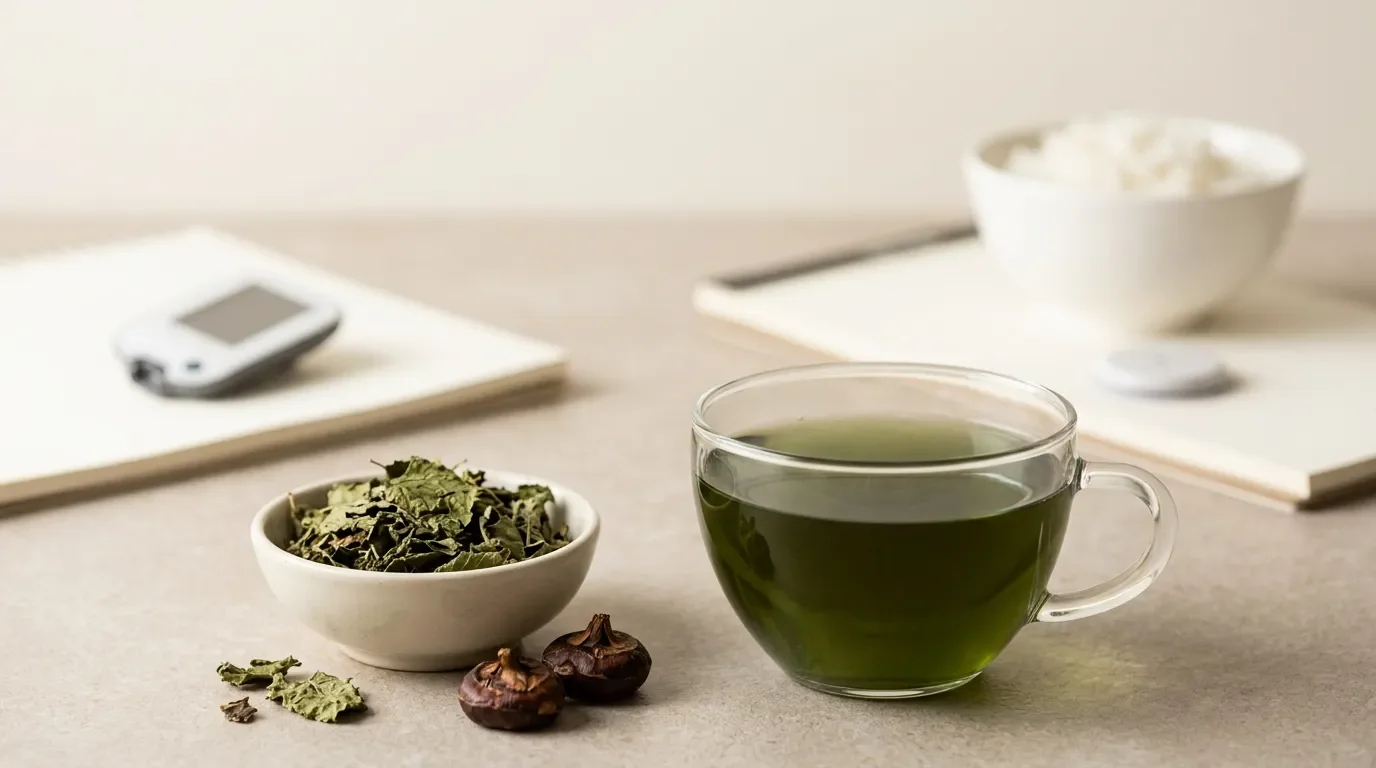
Cover image: AI-generated illustration.
围绕这条内容继续补充观点或上下文。