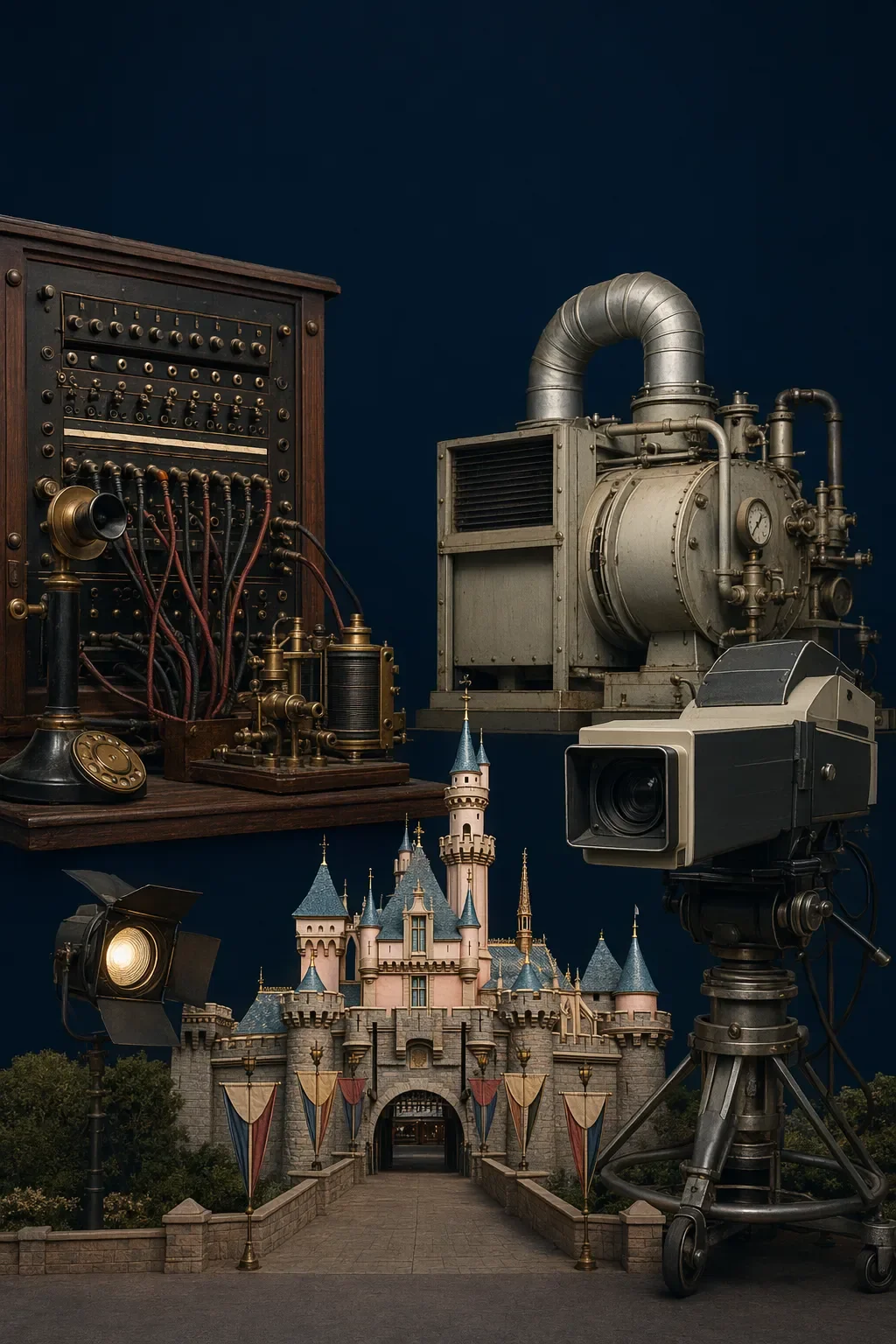
July 17 in Business History: The First Move Is Not the Whole Bet
Four July 17 decisions—from NEC's capability-building joint venture to CBS's retirement of a still-winning franchise—show how to test what a launch, partnership, or exit is really buying you next.
The short version
July 17 offers four different answers to the same management question: what is the first move supposed to unlock? NEC used a foreign joint venture to import capability and then build its own. Willis Carrier solved a printer's production problem before anyone had a consumer category called air conditioning. Walt Disney exposed a still-rough theme park to the public and used the resulting chaos as operating feedback. Seventy years later, CBS made the opposite move: it retired a successful show because the economics of the surrounding system no longer worked.
The mirror for today is not to copy any of these bets. It is to identify what your launch, partnership, product, or exit is buying you next.
1899: NEC used a partner as a bridge, not a permanent crutch
On July 17, 1899, Nippon Electric Company, Limited was established in Tokyo by W.T. Carleton, head of the Tokyo branch of Western Electric, and Kunihiko Iwadare, the Japanese agent for Western Electric products. Western Electric officially owned shares in the new company and participated in its management. NEC's own history describes the company as Japan's first foreign-affiliated company after a revision to the treaties that opened the door to foreign economic activity. 1
This was more than a capital transaction. It was a capability transaction. Japan had demand for communications equipment, while Western Electric had technology, manufacturing knowledge, and access to a global operating model. The joint venture made the missing pieces available without requiring either side to build an entirely new route to market.
The important part of the story is what happened after the bridge was built. NEC's timeline records domestic production of a large-scale common-battery switching system in 1919. In 1928, its engineers developed a phototelegraphic system that newspapers adopted after tests showed performance better than overseas equipment. The company later moved into computers, integrated circuits, satellite communications, and personal computers. 1 The outcome was not a company that remained a reseller of somebody else's technology. It became an increasingly capable technology institution in its own right.
That distinction matters for today's partnerships. A strategic alliance can be a shortcut to capability, but it can also become a comfortable substitute for learning. Before signing, an executive should be able to answer three questions: Which capability is the partner transferring? Which decisions will remain ours? What evidence will show that we are becoming less dependent over time?
If the answer is only access to a product or distribution channel, the arrangement may be useful but it is not yet a capability-building strategy. NEC's early structure worked because the partnership created a path from imported know-how to domestic competence.
1902: Carrier sold the removal of a bottleneck before he sold comfort
On July 17, 1902, Willis Haviland Carrier initialed the drawings for the first modern air-conditioning system. The design addressed a specific production problem at Sackett & Wilhelms, a Brooklyn lithography and printing company: humidity changed the dimensions of paper, throwing multicolor printing out of register. The immediate costs were scrap, poor quality, and lost production days. 2
The first system was not a lifestyle product. Carrier's coils, fans, ducts, heaters, steam pipes, and controls were designed to hold humidity at 55 percent, with a cooling effect the company later described as equivalent to melting 108,000 pounds of ice per day. The installation was completed in the summer of 1902; a 1903 report from Buffalo Forge's sales chief said the cooling coils had delivered excellent results. 2
That sequence is a useful product strategy lesson. Carrier did not begin by persuading the public that it deserved a new kind of comfort. He began where the economic pain was measurable and the buyer already had a reason to act. The printing plant supplied a test environment, a performance metric, and a customer who could judge the result.
The commercial arc then widened. The Library of Congress records that Carrier and colleagues founded Carrier Engineering Corporation in 1915 to manufacture and sell heating, ventilation, and air-conditioning systems. Early customers included candy makers, and the technology spread to hotels, restaurants, department stores, theaters, trains, ships, hospitals, and homes. The company first focused on large business and industrial systems before developing smaller units for residential use. 3
The mirror is straightforward: when a new product feels expensive or unfamiliar, start with the operational failure it removes. A strong beachhead customer does more than generate revenue. It gives the product a place where the value can be measured, the design can be improved, and a reference case can lower the next buyer's perceived risk.
For a new AI system, industrial tool, or workflow product, the question is not only, "Who might want this?" It is, "Which customer is already paying for the problem this solves, and what observable result would make the next sale easier?" Carrier's breakthrough was technical. Its business was built by turning that breakthrough into a sequence of increasingly legible use cases.
1955: Disneyland launched an experience, then let operations argue back
On July 17, 1955, Walt Disney unveiled Disneyland in Anaheim at a dedication and International Press Preview that was broadcast on ABC. D23, Disney's official fan and archive organization, describes the day as the unveiling of Disney's original theme park and notes that more than 750 million guests from roughly 200 nations have visited since. 4
There is a date detail worth preserving. The Walt Disney Family Museum notes that July 17 was largely a dedication and preview for the press, Disney employees and their families, and invited guests; the first public ticketed day was July 18. It also records the operational problems that led some contemporary observers to call the opening "Black Sunday." General admission in the first year was $1 for adults and 50 cents for children. 5
The business decision was not simply to build a park. Disney assembled a media event around an unfinished operating system. Attractions broke down, some experiences were overcrowded, and the volume of real guest behavior exposed assumptions that planning documents could not. The museum's account describes Autopia attracting twice as many guests as expected and requiring mechanical changes after the first week. It also records that the park was continuously improved after opening, a practice associated with Disney's idea of "plussing." 5
The outcome was not that the first version was flawless. The outcome was that the company had created a repeatable learning loop around a distinctive customer experience. Within two months, the park had welcomed its one millionth visitor, with guests from 61 countries, according to the museum. 5
This is a different launch lesson from Carrier's. Carrier began with a narrow industrial problem; Disney began with a broad promise and then used live operations to discover the constraints. Both strategies require a clear test. Disney's test was not "Do people like the idea of a theme park?" It was whether people would navigate, queue, pay, return, and talk about a constructed world at scale.
The modern mirror is useful for any launch with many interacting parts: a marketplace, a new store format, a major event, or an enterprise platform. If the system is going to learn from real usage, make the learning visible. Define the failure signals before opening day. Decide which defects are tolerable, which threaten trust, and who has authority to fix them immediately. A public beta is not a strategy if the organization has no mechanism for converting embarrassment into improvement.
2025: CBS chose to retire a winning show rather than preserve the franchise
On July 17, 2025, CBS announced that it would end The Late Show with Stephen Colbert in May 2026 and retire The Late Show franchise rather than replace Colbert. CBS called the decision purely financial and said it was unrelated to the show's performance or content. At the time, the network said the program had been No. 1 in late night for nine consecutive seasons; Reuters reported an average audience of 2.5 million for the 2024–25 season. 6 7
This is the uncomfortable case in the set because the product was not a clear market failure. It had audience leadership, a recognizable host, a decade of accumulated production capability, and a franchise with a 33-year history. Yet the economics of broadcast late night had changed: production costs remained meaningful while viewers were shifting toward streaming. The show could be successful on its own scorecard and still fail the portfolio's hurdle rate.
The outcome arrived in May 2026. CBS News reported that Colbert's final episode ended the franchise after 33 years; the network said Byron Allen's Comics Unleashed would take over the 11:35 p.m. time slot. The set was donated to the Museum of Broadcast Communications. 8
The decision mirror is not an argument for cutting anything that is mature. It is a reminder to separate product performance from system economics. A leader assessing a legacy product should ask: Is the asset still earning its place after fully loaded costs? Is the organization preserving it because it creates strategic value, or because ending it would be emotionally and politically difficult? If we keep it, what investment or redesign would change the trajectory? If we exit, what capability, customer relationship, or brand equity must be carried forward?
CBS made a harder choice than a simple cancellation: it retired the franchise. That removed the option of swapping in a cheaper host while keeping the old brand architecture. Sometimes the cleanest portfolio decision is also the one that eliminates the most comforting fallback.
The managerial test for July 17
These four events form a practical sequence:
- Use partnerships to cross a capability gap, but specify the learning path. NEC's foreign partner opened the door; domestic competence made the business durable.
- Start with a painful, measurable use case. Carrier's first buyer needed registration accuracy, not a slogan about comfort.
- Launch the whole experience only when you have a live learning loop. Disneyland's rough opening mattered because the organization could observe and improve.
- Judge the asset inside the system that funds it. CBS's show could lead its category and still lose the portfolio case.
Before today's decision, write down what the first move is intended to unlock: capability, proof, habit, or capital. Then name the evidence that would justify the second move. History is most useful when it turns a memorable event into a test you can run before the next commitment.
参考来源
- 1NEC, Learn about NEC's history
- 2Willis Carrier, The Invention That Changed the World
- 3Library of Congress, Patent for the Air Conditioner Issued to Willis H. Carrier
- 4D23, Sixty Years Ago Today…
- 5Walt Disney Family Museum, Opening Day at Disneyland
- 6CBS News, The Late Show with Stephen Colbert to end in May 2026
- 7Reuters, CBS cancels Stephen Colbert's late-night show
- 8CBS News, Stephen Colbert says farewell to The Late Show
相似内容
- 登录后可发表评论。
More from this channel
- July 21 in business history: The operating model decides the outcome
- July 20 in business history: The boundary is part of the bet
- July 19 in Business History: When Scale Changes the Question
- July 18 in business history: The commitment is the product
- July 16 in Business History: Build the mechanism, then make the promise
- July 15 in Business History: Before Scale, Test the System
- July 14: distribution rewrote the market
- July 13: scale rewrote the plan