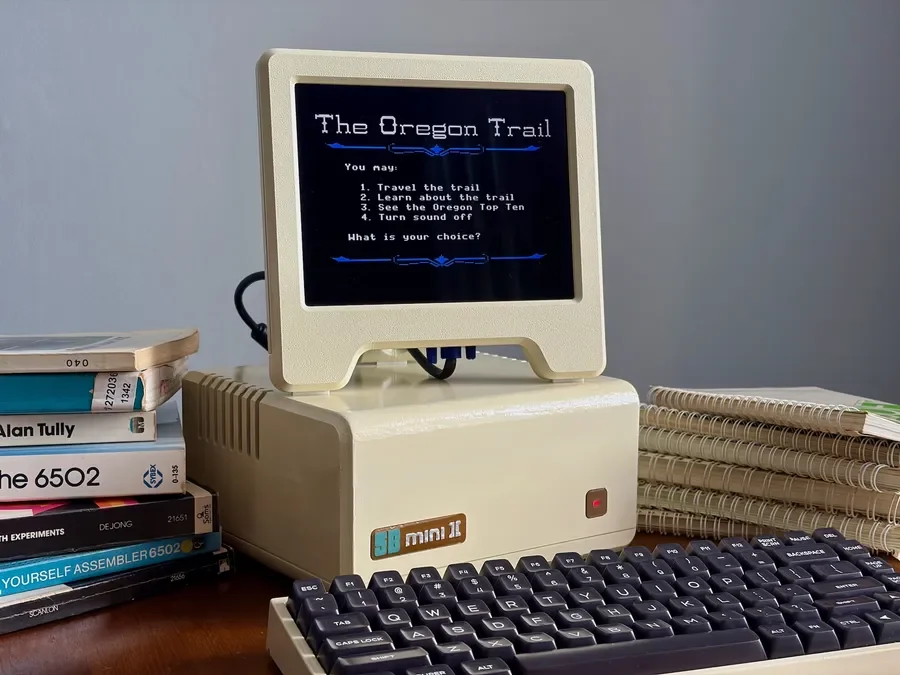
Build a real 65C02 Apple II clone
This week’s pick is SB-mini II, a real 65C02-based Apple II clone with public Gerbers, KiCad source, PDF schematic, BOM, enclosure files, and keyboard firmware.
Difficulty: Intermediate | Estimated cost: $80-130 for the mainboard, plus about $15-25 for the required VGA card | Files: Gerbers, KiCad source, PDF schematic, BOM, enclosure files, and keyboard firmware are public 1 2 3
SB-mini II is Simon Boak's homebrew Apple II clone built around a real 65C02 CPU, 48 kB of SRAM, a 32 kB EEPROM, and 74HC CMOS logic on a four-layer PCB. 1 4 It fits this week's requirement because the project is a real hardware computer rather than an emulator, and the public repository includes fabrication, design, enclosure, and firmware materials instead of only photos and a write-up. 2 5
The caveat is important: SB-mini II has no onboard video hardware. 4 A builder needs an Apple II VGA card, and the obvious companion is markadev's open AppleII-VGA project, which provides a Pico-based VGA card with KiCad files, schematic, BOM, Gerbers, and firmware. 3 That dependency adds one more PCB and one more firmware target, but it is still a manageable dependency because the companion card is also open hardware.
BOM and expected cost
The main SB-mini II board should be budgeted at about $80-130, excluding the VGA card and 3D-printing filament. 1 The separate Apple II VGA card adds roughly $15-25 in parts and PCB cost. 3 The public BOM lists quantities rather than distributor line-item prices, so the dollar figures below are planning estimates mapped to the BOM groups. 6 The biggest cost buckets are the four-layer PCB, the W65C02 CPU, SRAM and EEPROM, 74HC logic, the Pololu 5 V regulator, and eight 50-pin card-edge connectors. 6
Procurement checklist:
- CPU: 65C02, quantity 1, about $8-12 in the sourcing estimate. 6
- Clock: 4 MHz square-can crystal oscillator, quantity 1, included in the mainboard estimate. 6
- RAM: CY62256 32 k x 8 SRAM, quantity 2, about $6-10 for the pair in the sourcing estimate. 6
- ROM: 28C256 32 k x 8 EEPROM, quantity 1, about $3-5 in the sourcing estimate. 6
- Keyboard controller: Raspberry Pi Pico, quantity 1, about $4-5 in the sourcing estimate. 6
- Logic ICs: 74HC74, 74HC08, 74HC138, 74HC259, NE556, 74HC30, 74HCT138, 74HC00, 74HC251, and 74HC244, quantity 16 total, about $8-15 for the group in the sourcing estimate. 6
- Discrete semiconductors: MPSA13, PN2222A, IRF5305, 1N914, 1N5240B, and power LED, quantity 6 total, included in the miscellaneous cost bucket. 6
- Capacitors: 0.1 uF capacitors, 22 nF capacitors, and one 470 uF capacitor, quantities 24 + 4 + 1, included in the $5-10 passive-parts bucket. 6
- Resistors: 3.3 k, 1 k, 2.5 k, 100 ohm, 10 k, 47 k, 27 ohm, 100 k, and 330 ohm values, quantity 20 total, included in the $5-10 passive-parts bucket. 6
- Expansion connectors: 50-pin card-edge connectors, quantity 8, about $10-15 for the connector group in the sourcing estimate. 6
- Power input and regulation: PCB barrel jack, power-switch terminal block, Pololu D24V10F5 5 V 1 A regulator, and Apple II power connector footprint, quantity 1 each; the Pololu regulator is about $8 in the sourcing estimate. 6
- Headers and sockets: DIP-16 Game I/O socket, Pico debug 3-pin header, HI ROM selector 2-pin header, and SHIFT key mod 2-pin header, quantity 1 each, included in the miscellaneous cost bucket. 6
- User I/O: reset tactile switch and 20 mm 0.5 W speaker, quantity 1 each, included in the miscellaneous cost bucket. 6
- Main PCB: Rev 1 four-layer PCB fabricated from the public Gerbers, quantity 1, about $20-30 for a small board-house batch in the sourcing estimate. 5
- Case hardware: 3D-printed enclosure parts, 8 M3 threaded inserts, glue, paint, and hot glue for the light pipe, quantity 1 set; filament and shop consumables are not included in the mainboard estimate. 7
- Required video card: AppleII-VGA card with its own PCB, Pico firmware, BOM, and Gerbers, quantity 1, about $15-25 in the sourcing estimate. 3
The BOM is practical because the board is mostly DIP through-hole parts rather than fine-pitch SMD. 6 The hard part is the part count: eight expansion slots and a large pile of socketed logic mean the build rewards careful orientation checks and continuity testing before power-up.
Schematic and PCB topology
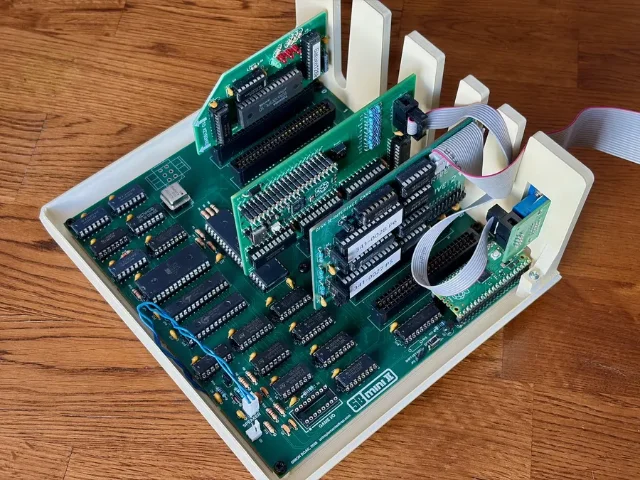
SB-mini II follows the Apple II Plus architecture closely enough to run Apple II software, but it deletes the circuits that make a modern rebuild unnecessarily painful. 1 The CPU is a standard 65C02 clocked near 1.024 MHz by dividing a 4.096 MHz oscillator by four, which puts the machine very close to the original Apple II timing. 4
Memory is simpler than the original design. The board implements 48 kB of RAM with two 32 kB CY62256 SRAM chips, wasting half of one chip but avoiding DRAM refresh circuitry. 1 4 The ROM image lives in a 28C256 32 kB EEPROM, and a jumper selects the high or low half of the chip so the spare space can hold Adrian Black's Deadtest diagnostic ROM. 4
The logic substitution is conservative. Boak uses 74HC CMOS logic instead of the original TTL family, with a 74HCT138 for I/O decoding, and he notes that address decoding follows the original Apple II design based on Jim Sather's Understanding The Apple II. 1 4 The Game I/O circuit replaces the hard-to-find NE558 quad timer with two NE556 dual timers, following a published replacement approach. 4
The project files are complete enough to support a real rebuild. The Rev 1 schematic directory contains a Gerbers folder, a KiCad project folder,
BOM.csv, and a PDF schematic. 5 The enclosure directory contains STEP files for the badge, base, front, left side, lid, light pipe, rear, right side, and tongue pieces, plus assembled and exploded-view images. 7Power enters as 12 V DC and the board uses a Pololu D24V10F5 module to generate 5 V at 1 A. 1 The PCB also includes an Apple II-compatible power connector footprint for builders who need the legacy -5 V and -12 V rails for certain expansion-card scenarios. 1
Firmware and software
The main board itself is mostly hardware, but two Pico firmware paths matter. The SB-mini-II keyboard controller uses a Raspberry Pi Pico as a USB keyboard host and emits the same 7-bit parallel ASCII plus STROBE behavior expected by the Apple II keyboard interface. 8 The same controller can generate reset with Control + Print Screen and performs power-on reset for the system. 4
The video side belongs to the separate AppleII-VGA card. That project listens to the 6502 bus, maintains a video-memory shadow in a Raspberry Pi Pico, and outputs 640 x 480 at 60 Hz VGA. 3 Its repository includes the card's KiCad files, schematic, BOM, Gerbers, and Pico source code, so the video dependency is not a closed black box. 3
You will also need an EEPROM programmer for the 28C256 ROM image. 4 Treat that as a required tool, not an optional convenience, because the machine cannot become an Apple II clone until the ROM contents are programmed correctly.
Difficulty, tools, and risks
Rating: Intermediate. The soldering is mostly forgiving, but the project is too large and too interdependent for a first hardware build. 6 A realistic build time is one to two weekends once the PCB, parts, VGA card, and printed enclosure are already on the bench. 1
Minimum tools are a temperature-controlled soldering iron, flush cutters, multimeter, EEPROM programmer, USB cable for the Pico, and normal 3D-print finishing tools if you build the case. The enclosure assembly needs glue, 8 M3 threaded inserts, a hot-glue light pipe, and a taped-in 20 mm speaker. 4
The first risk is expansion compatibility. SB-mini II has eight 50-pin expansion slots, but the slots omit DMA, USER 1, and the 7M clock signal. 4 The bus is also not buffered, and Boak warns that compatibility with cards using 74LS logic is not guaranteed. 4 Builders who want a general Apple II card testbed should plan around that limitation.
The second risk is the lack of a single polished assembly manual. The public materials are strong, but the builder still has to combine the README, schematic, BOM, Gerbers, enclosure notes, keyboard firmware repository, and VGA-card repository into a build sequence. 2 3 That is common in open hardware, but it means the project suits someone comfortable reading schematics and checking each stage before moving on.
The third risk is video dependency. Without the AppleII-VGA card, SB-mini II has no video output. 4 That is a design simplification rather than a documentation gap, but it affects procurement and debugging because a non-working display path could be either the computer, the VGA card, or the interaction between them.
Bottom line
Build SB-mini II if you want a real 65C02 Apple II-style machine and you are comfortable treating the VGA card as part of the project rather than an accessory. The public file set is the deciding point: the board can be fabricated, the circuit can be inspected, the BOM can be ordered, the enclosure can be printed, and the keyboard path has source code. 2
Wait if your goal is a beginner kit with a step-by-step build guide. SB-mini II is a better project for someone who can turn a complete open repository into a bench plan, then debug power, ROM, keyboard, expansion, and video as separate subsystems.
Cover image: image from Simon Boak - SB mini II: a homebrew Apple II clone
相似内容
- 登录后可发表评论。