
2026/6/22 · 8:15
Hiring Is Up, Hiring Is Slow: June 22 Job Market Briefing
May payrolls rose by 172,000, but the market still feels slow because hiring rates remain weak, job postings are barely above pre-pandemic levels, and AI-cited cuts remain a recurring layoff story. This week's briefing covers where hiring is concentrated, which cut signals matter, what skills are carrying demand, and how to screen postings before applying.

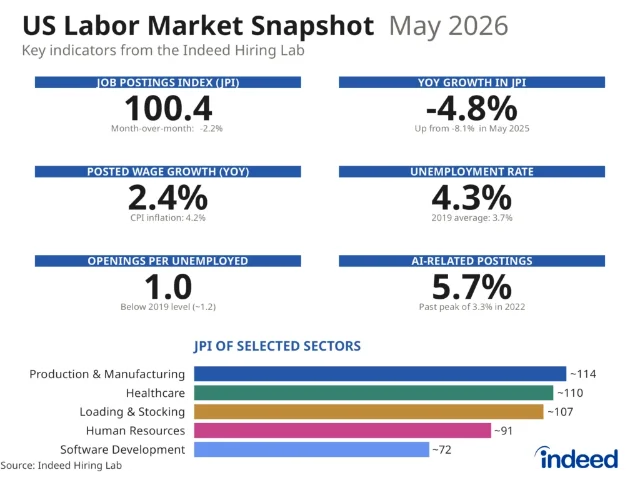
The labor market headline still looks better than the job-search experience. May payrolls rose by 172,000 and unemployment stayed at 4.3%, but the parts that matter most to active job seekers tell a slower story: the hires rate is stuck at 3.2%, quits are still subdued, and Indeed's Job Posting Index is only 0.4% above its February 2020 baseline as of May 31. (Source: BLS) (Source: BLS JOLTS) (Source: Indeed Hiring Lab)
The practical read: this is not a no-jobs market. It is a selective market where openings are clustered, employers are slower to add people, and workers who lose a job can stay unemployed longer than the headline rate suggests.
1. Hiring highlights: payrolls are up, but the hiring machine is still slow
May's payroll gain was real and broader than the last few monthly reports. BLS said leisure and hospitality added 70,000 jobs, local government added 55,000, health care added 35,000, and social assistance added 12,000. Financial activities moved the other way, losing 22,000 jobs in May and 107,000 since its May 2025 peak. (Source: BLS)
That mix matters for job seekers. The economy is adding jobs, but not evenly across white-collar, service, public-sector, and health-care work. CNBC's read on the same BLS report noted that payrolls beat the Dow Jones consensus estimate of 80,000 by more than 2x, while average hourly earnings rose 0.3% in May and 3.4% over the year. (Source: CNBC)
The catch is turnover. JOLTS showed April job openings rising to 7.6 million, but hires fell to 5.1 million and the hires rate slipped to 3.2%. Quits held at 1.9%, which means many employed workers still are not confident enough to move. (Source: BLS JOLTS)
| Signal | What changed | Job-search read |
|---|---|---|
| Nonfarm payrolls | +172,000 in May | Employers are still adding staff, especially in service, public-sector, and health-care areas. (Source: BLS) |
| Open jobs | 7.6 million in April | Openings improved, but the vacancy-to-unemployed ratio is around 1.0, far cooler than 2021-22. (Source: BLS JOLTS) |
| Hires rate | 3.2% in April | The market is still slow at the point where applications become offers. (Source: BLS JOLTS) |
| Weekly claims | 226,000 for the week ending June 13 | New unemployment filings eased that week, suggesting layoffs were not broadly surging. (Source: ABC News/AP) |
2. Layoff tracker: AI is still the cut narrative to watch
The broad layoff picture is calmer than the tech headlines imply. Initial jobless claims fell by 4,000 to 226,000 for the week ending June 13, and ABC News/AP described layoffs as still in the historically low range of recent years. (Source: ABC News/AP)
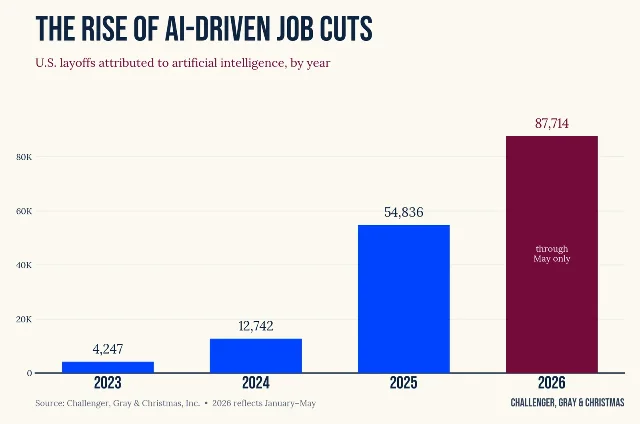
The tech and corporate-restructuring story looks different. Challenger, Gray & Christmas reported that U.S.-based employers announced 97,006 job cuts in May, up 16% from April and the highest May total since 2020. The same report said employers have announced 397,755 job cuts so far in 2026, down 43% from the same period last year, while AI was the leading cited reason for cuts for a third consecutive month. (Source: Challenger, Gray & Christmas)
The number that keeps changing the tone of the labor discussion is 38,579: Challenger counted that many AI-cited job cuts in May alone, equal to about 40% of all announced cuts that month. (Source: Challenger, Gray & Christmas)
For job seekers, this does not mean every AI-adjacent company is shrinking. It means two resume questions are now unavoidable in affected functions: which part of your work can be automated, and which part improves when AI handles the repetitive layer?
3. Industry spotlight: health care, services, and large-employer AI hiring are pulling in different directions
The strongest hiring areas are not all in the same kind of labor market.
Health care keeps adding jobs, but it is hard to enter without the right credentials. BLS reported 35,000 new health-care jobs in May, including 26,000 in ambulatory health care services and 11,000 in home health care services. (Source: BLS) Indeed's skills analysis found that 64% of skills in a typical health-care role come from the health-care and caregiving category, reflecting licensing, education, and specialized competency barriers. (Source: Indeed Hiring Lab)
Leisure and hospitality is creating volume. BLS said the sector added 70,000 jobs in May, far above its 14,000 average monthly gain over the prior 12 months. (Source: BLS) That is good for near-term opportunity, especially for workers open to operations, food service, guest experience, events, and local-market roles. It is less helpful for someone trying to move into a corporate analyst or software role without changing target lanes.
Large employers are the wildcard. Indeed's JOLTS commentary argued that openings at establishments with 5,000 or more workers were 81% above their pre-pandemic level in April, but those giant employers account for less than 5% of all JOLTS openings. Smaller and midsize firms still account for most demand. (Source: Indeed Hiring Lab)
Glassdoor's June hiring list adds a ground-level view: its featured hiring employers span information technology, health care, retail and wholesale, construction and maintenance, media and communication, and photography, with examples including Shutterfly, Action Behavior Centers, Mavis Tire, Granite Construction, Spectrum, and Lifetouch. (Source: Glassdoor)
4. Growth roles and skills: technical fluency still matters, but transferability is the edge
The most useful skills signal this week comes from Indeed's look at skill concentration. It found that nearly a quarter of 45 analyzed occupational groups are skill-concentrated, meaning 50% or more of the required skills for that role come from one category. Tech and health care dominate that set. (Source: Indeed Hiring Lab)
In tech, the message is blunt: AI tools have not erased the need for technical foundations. Indeed found that 76.3% of skills mentioned in tech job postings are technology skills, and software development is especially concentrated, with 79.4% of required skills coming from the technology category. (Source: Indeed Hiring Lab)
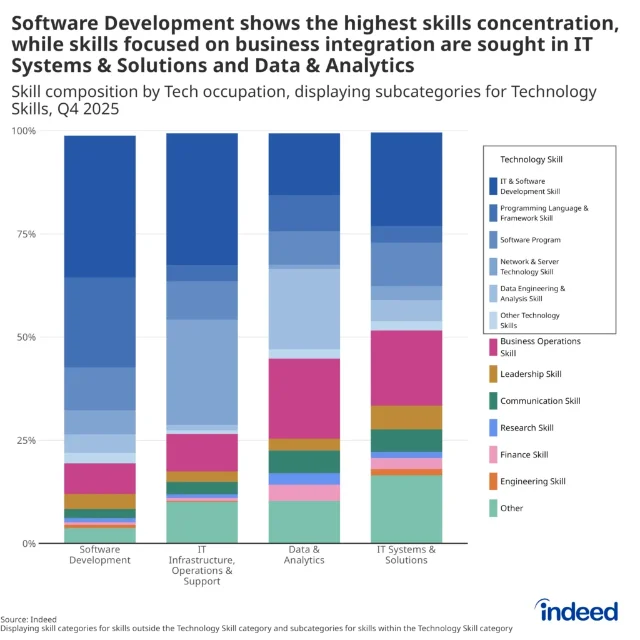
That does not mean every candidate should chase the same narrow technical path. Indeed also found business operations skills appear in more than 70% of job postings and account for 20.4% of the average skill mix across occupational groups. For career changers, that is the better bridge: operations, documentation, scheduling, customer workflow, billing, vendor coordination, and project execution can travel across industries more easily than a specialized license or a specific programming stack. (Source: Indeed Hiring Lab)
Glassdoor's June roles echo that split. Its listed openings include data engineers at Shutterfly, BCBA roles and operations managers at Action Behavior Centers, automotive technicians at Mavis Tire, project manager/estimator roles at Granite Construction, and sales/support roles at Spectrum. (Source: Glassdoor)
5. Job seeker tip: stop optimizing for volume; audit the posting before you apply
This week's practical move is a simple one: before applying, spend five minutes deciding whether the opening is real, current, and aligned with your target. That sounds basic, but it saves time in a market where hiring is slow and fake or stale postings are a bigger frustration.
Glassdoor's entry-level job-search advice says 43% of job seekers send between 11 and 21+ applications per week, while career strategist Jade Walters recommends dropping the spray-and-pray approach and getting specific about the niche, role, and story you are selling. (Source: Glassdoor)
Use this three-part screen before you customize a resume:
- Check the source. If the job appears on a board, confirm it also appears on the company's own careers page. Forbes' fake-jobs guide recommends applying directly through the official company site when possible. (Source: Forbes)
- Check the age. Forbes warns that postings listed for more than 30 days without updates may be suspicious or may lead nowhere. (Source: Forbes)
- Check the fit. If the description says "entry-level" but asks for 3-5 years of experience, treat it as a junior role and decide whether you have proof of equivalent work. Glassdoor's advice is to build portfolio projects, freelance samples, or mock campaigns when job descriptions ask for experience you have not yet been paid to do. (Source: Glassdoor)
If you only have time for 10 applications this week, make them 10 openings that pass those checks. In this market, the penalty for low-fit volume is not just rejection. It is losing a week to jobs that were never likely to move.
相似内容

172K jobs and the Nasdaq's worst week in over a year: what happens when good news is bad news
Tech Stocks: News & Catalysts文章
Week in review: the jobs trap, the rate hike clock, and what's coming at tech next week
Tech Stocks: News & Catalysts文章
FAANG interview digest, May 10–17: freeze map, real questions, and who's paying what
Glassdoor FAANG Interview Reports文章
围绕这条内容继续补充观点或上下文。