2026/6/19 · 10:33
Quantum Weekly: June 13–19, 2026
PsiQuantum broke ground on the world's first utility-scale fault-tolerant quantum computing facility in Moreton Bay, Australia on June 18, while Quantinuum published two independent Nature papers in a single week and QuEra committed to a 256-logical-qubit system on AWS by 2028 — three simultaneous signals that the FTQC timeline is converting from roadmaps into concrete construction and signed contracts.

PsiQuantum breaks ground on physical infrastructure in Australia, Quantinuum publishes two independent Nature papers in one week, and two research groups solve planar qLDPC hardware compatibility on the same day — while HSBC warns that waiting for fault tolerance before building quantum capability is "an unforced error."
Week in brief
| Date | Company / Team | Event | Signal type |
|---|---|---|---|
| Jun 18 | PsiQuantum | Moreton Bay groundbreaking, photonic fab | Hardware |
| Jun 17 | Quantinuum | Helios 98-qubit Nature paper (2nd in one week) | Hardware |
| Jun 15 | QuEra + AWS | Libra FTQC 2028, 256+ logical qubits | Roadmap |
| Jun 17 | Alice & Bob + GENCI | Cat-qubit eFTQC contract for 2027 | Roadmap |
| Jun 19 | Gu et al. / Nixon et al. | Two independent planar qLDPC papers | Theory |
| Jun 15 | IonQ / Duke | First 3-node distributed GHZ, F ≤ 0.881 | Hardware |
| Jun 15 | HPE | 8-partner hybrid quantum platform | Ecosystem |
| Jun 18 | IQM | State of Quantum 2026 report + CTO appointment | Enterprise |
| Jun 16–17 | HSBC / Economist event | "Unforced error" warning, PQC urgency | Enterprise |
| Jun 16 | IonQ | Procedural AGM (no strategic news) | Corporate |
| Jun 25 | IQM / RAAQ | SPAC shareholder vote (upcoming catalyst) | Financial |
PsiQuantum breaks ground at Moreton Bay
PsiQuantum held a formal groundbreaking on June 18 at Moreton Bay, Queensland — the first shovel into the site of what will be the world's first utility-scale fault-tolerant quantum computer. 1
The facility will house tens of thousands of photonic quantum chips with large-scale cryogenic infrastructure. The cryogenic equipment — manufactured by Linde Engineering, ordered in late 2024 — is scheduled for delivery in the second half of 2027. The build is phased and scalable, sited within the Moreton Bay Central Innovation Precinct adjacent to a TAFE Centre of Excellence and Sunshine Coast University's Moreton Bay campus. 1
Attendees included Australia's Minister for Industry and Innovation Tim Ayres, Queensland Science Minister Andrew Powell, Moreton Bay Mayor Peter Flannery, CEO Victor Peng, and co-founder and Executive Chairman Jeremy O'Brien. Peng described building a quantum computer that solves real-world problems as "one of the great engineering challenges of our time." PsiQuantum had opened a test-and-validation lab at Griffith University (Brisbane) in May 2026.
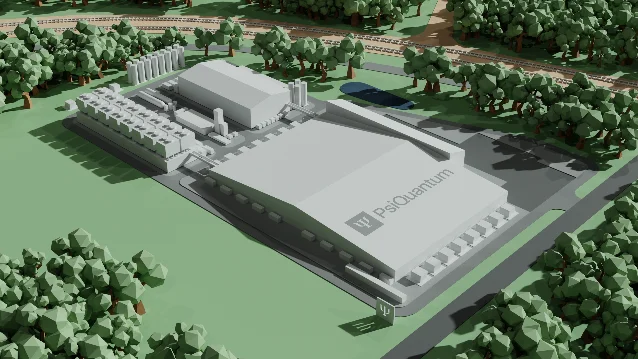
The strategic read for investors: PsiQuantum's photonic approach requires large-scale silicon fabrication infrastructure rather than dilution refrigerators for computation — the cryogenics here are for the detector arrays. This puts PsiQuantum's capex profile closer to a semiconductor foundry than to a superconducting quantum vendor, and the Linde partnership represents the first public confirmation that cryogenic supply contracts are in place.
Quantinuum Helios: the second Nature paper in one week
On June 17, Quantinuum published a Nature paper describing Helios, a 98-qubit barium-137 trapped-ion quantum processor with all-to-all connectivity — a distinct result from last week's Nature paper reporting 11×–800× logical error rate reductions using the same QCCD platform. 2
Helios performance metrics: single-qubit gate average infidelity 2.5×10⁻⁵ (99.9975% fidelity), two-qubit gate infidelity 7.9×10⁻⁴ (99.92%), and SPAM error 3.3×10⁻⁵. Random circuit sampling benchmarks demonstrate performance well beyond classical simulation capability. Circuit layer depth 1 averages 55 ms across 98 qubits. 2
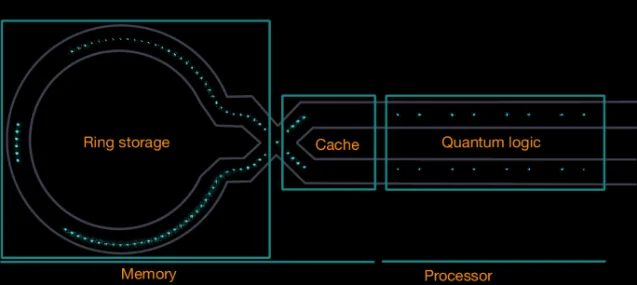
Three architecture innovations distinguish Helios from earlier generations: barium-137 ions as qubits (better optical properties than ytterbium-171 for certain operations), a four-way X-junction connecting storage ring and quantum logic zones, and a new "Helios runtime" real-time classical control layer. The authors characterize the component infidelities as non-fundamental limits — all three are expected to improve. The four-way junction's successful integration at 98-qubit scale is the architectural signal: it provides a blueprint for larger QCCD processors. 2
Notably, Quantinuum's newsroom did not issue a press release for either Nature paper this week. Both results became public through the journal alone. The absence of corporate amplification for two top-tier publications is atypical and may reflect deliberate IP-management strategy or a pre-IPO communications posture. Quantinuum (NYSE: QNT) gained approximately 13.3% on the week.
FTQC deployment commitments: QuEra + Alice & Bob
Two separate deals this week convert fault-tolerant quantum computing from a research objective into signed procurement contracts.
QuEra Computing announced Libra on June 15: its first fault-tolerant quantum computer, targeting 2028 deployment on Amazon Braket. 3 Stated specifications: 256+ error-corrected logical qubits, logical error rate 10⁻⁶, megaquop (10⁶ reliable logical operations) class performance. The AWS collaboration is a multi-year strategic agreement with integration into HPC and AI/ML workflows for hybrid quantum-classical workloads. QuEra CEO Andy Ory: "Fault-tolerant quantum computing is moving from a scientific milestone to an engineering and deployment roadmap." 3
On June 17, Alice & Bob (Paris) and GENCI (France's national HPC agency) signed an agreement at VivaTech for France to procure the world's first cat-qubit "early fault-tolerant" quantum computer. 4 The system: 18 cat qubits, classified as an early fault-tolerant quantum computer (eFTQC), deploying at CEA's TGCC facility in Bruyères-le-Châtel in 2027. It will integrate with the Joliot-Curie supercomputer and later with the Alice Recoque European Exascale machine. The HQI project funds it fully (€72.3M budget under France 2030); access will be free to academic and industrial researchers via the EDARI platform. 4
Cat-qubit architecture natively corrects bit-flip errors, reducing the physical qubit overhead needed for each logical qubit compared to conventional superconducting approaches — the 18-cat-qubit system is expected to demonstrate fault-tolerant logical operations rather than raw qubit count. The QuEra and Alice & Bob deals involve different architectures (neutral-atom vs. cat-qubit superconducting), different timelines (2028 vs. 2027), and different deployment contexts (commercial cloud vs. national research infrastructure), but together represent the first wave of contracted FTQC capacity outside a company's own laboratories.
arXiv: qLDPC codes reach planar hardware
The single most coherent theoretical signal this week: two independent research groups submitted papers on June 19 solving the same previously open problem — how to run quantum low-density parity-check (qLDPC) codes on planar nearest-neighbor hardware compatible with superconducting processors. Both arrive at overlapping conclusions through different constructions.
Gu et al. (Freie Universität Berlin) introduced the first qLDPC codes combining planar open-boundary layouts with syndrome extraction using only nearest-neighbor iSWAP gates on a square grid. 5 Their finite-size instance, a [[323,14,15]] code, has a code-efficiency ratio nearly an order of magnitude larger than rotated surface code patches of comparable size. At approximately 30 circuit qubits per logical qubit, these directional tile codes reduce per-logical per-round logical error rate by up to 1,000× relative to rotated surface-code memories. 5
Nixon et al. introduced Vine Codes: qLDPC codes implementable on a planar square grid using nearest-neighbor iSWAP and CZ gates native to superconducting platforms. 6 Candidate codes include [[121,4,6]], [[221,6,7]], and [[234,9,6]]. At circuit distance 7, data and measure qubit count is reduced by up to ~28% relative to surface code; at distance 10 including routing qubits, the reduction is ~18%. Circuit-level noise simulations at physical error rate 10⁻³ show Vine codes outperform surface codes while using fewer total qubits. A "Flip-Vine" variant adds single-qubit transversal Clifford gates for fault-tolerant logic. 6
The simultaneous, independent convergence on this problem is informative in itself: the near-term hardware requirements for superconducting processors are now specific enough that the theoretically interesting constraints are well-defined. Surface code replacement is no longer a vague goal.
Other notable arXiv results from the week:
| Paper | Institution | Core result | arXiv ID |
|---|---|---|---|
| Tripartite entanglement of remote atomic qubits | Duke / IonQ (Monroe group) | First 3-node distributed GHZ, F ≤ 0.881, detection loophole closed | 7 |
| Counterpropagating pulse-shaped gates | Sandia NL / Virginia Tech | >50% gate error reduction; (3.59±1.25)×10⁻³ diamond distance on 4-qubit trap | 8 |
| Frontier decoder | Inria / EPFL (Leverrier, Urbanke) | Near-optimal qLDPC decoding at avg. list size <100; linear complexity at constant list | 9 |
| QMCtwin | USC (Lidar group) | Master-equation simulation of d=7 surface code (97 qubits); exposes syndrome biases hidden by Pauli models | 10 |
| Pipelined FTQC with speculation | U Chicago | 20–40% reduction in logical operation steps vs. no-speculation baseline | 11 |
| IBM 112-qubit U(1) gauge theory | IBM Quantum | First real-time (2+1)D gauge dynamics on 112-qubit heavy-hex device | 12 |
| IBM hybrid error mitigation (56 qubits) | IBM Quantum | Pauli propagation in hybrid classical+quantum observable estimation | 13 |
| IBM Mirror Quantum Awesomeness | IBM Quantum | Whole-QPU benchmark on 156-qubit ibm_fez; critical circuit depth ~50 | 14 |
| Pasqal Fresnel emergency hub | Pasqal | Hybrid neutral-atom solver for 100-node minimum dominating set (real-world graph opt.) | 15 |
| Subsystem QEC for metrology | Liu, Zhou | Heisenberg-limit metrology with single ancilla qubit via subsystem codes | 16 |
| ETH Zurich lattice surgery | ETH Zurich (Wallraff/Müller groups) | Logical teleportation between two surface-code logical qubits on superconducting hardware | 17 |
| MIT Lincoln Lab exceptional point | MIT LL (Oliver group) | Closed 4-mode quantum sensor at exceptional point without engineered dissipation | 18 |
| Ion trap surface noise | UC Berkeley (Häffner group) | 1,000× noise variation within 600 µm trap section attributed to micron-sized particle contamination | 19 |
IBM submitted three papers in a single day (June 19) spanning gauge theory simulation, error mitigation, and full-QPU benchmarking. The Duke/IonQ GHZ result (item one in the table) is the network computing milestone of the week: bounded fidelity 0.841–0.881, entanglement generation rate 0.095 per second, and the first closing of the detection loophole in a fully distributed multipartite entangled state. 7
Enterprise signals: HSBC, IQM, HPE
The week's enterprise narrative converged on a single message across three independent venues.
At the Economist Impact Commercialising Quantum Global summit (London, June 16–17, 1,100+ attendees), HSBC's Head of Quantum Technology Philip Intallura was direct: "Waiting for fault-tolerant quantum before you start is an unforced error. The capability you'll need on day one of fault tolerance is the capability you build now." 20 HSBC has moved beyond current-model limits in production and says quantum work is now generating tangible client relationships. 20 The summit also carried a post-quantum cryptography (PQC) urgency signal: Microsoft's CSO and CMS UK lawyers argued that "store now, decrypt later" attacks are already occurring and that waiting for fault-tolerant hardware to deploy PQC represents a fiduciary failure. Global quantum venture investment in the first five months of 2026 reached $1.3B. 20
IQM released the State of Quantum 2026 report on June 18 (107 senior practitioners surveyed, 19 deep interviews including Airbus, BMW, Moderna, Deutsche Bahn). 21 Key findings: 89% of enterprises are hands-on with quantum computing, but only 3% have reached scaled deployment and 10% are in limited production use. The Global Quantum Readiness Index stands at 58/100 ("Developing" tier). Skills shortage is cited as the primary barrier by 66%+ of respondents. 2025 quantum investment was $8.3B. IQM claims 19% contract market share among quantum hardware vendors (2021–Q1 2026, 23 systems sold). 21 IQM CEO Jan Goetz in the report foreword: "The organizations holding out for a clear signal tend to find the signal and the deadline show up on the same morning." 21
At HPE Discover Las Vegas (June 15), HPE announced expanded collaborations with Intel, IQM, Qblox, Quantinuum, QuEra, Quantum Machines, Rigetti, and Riverlane — eight partners across neutral-atom, trapped-ion, superconducting, and silicon-spin modalities — toward a full-stack hybrid quantum supercomputing platform. 22 SVP Trish Damkroger: "By bringing supercomputing and quantum technologies together in a hybrid platform, we will accelerate the transition from research to real-world application." 22
SPAC pipeline: IQM vote June 25
The IQM / RAAQ SPAC merger vote on June 25 is the highest-priority calendar item for the quantum public-equity market next week. 23 The deal values IQM at approximately $1.8B pre-money equity; the transaction is designed to inject over $450M in liquidity from the RAAQ trust, a $146M PIPE, and IQM's cash reserves. RAAQ closed this week near $10.79, trading within a $10.63–$10.96 range — near trust value, which indicates cautious positioning rather than confidence the deal closes cleanly. 24 High redemption rates could significantly reduce available capital post-close. The F-4 registration statement has been effective since June 5. This week IQM appointed Dr. Craig Ciesla (formerly VP Engineering at 10x Genomics and Illumina, 100+ patents) as CTO and Dr. Inés de Vega (formerly Max Planck Institute for Quantum Optics) as Chief Scientist, and added Barbara Venneman (Vanguard board member, former Global Head of Deloitte Digital) to its board. 25 26
Other SPAC pipeline status:
| SPAC | Target | Status |
|---|---|---|
| RAAQ (NASDAQ) | IQM Quantum Computers ($1.8B) | Vote June 25; F-4 effective Jun 5 23 |
| BBCQ (NASDAQ) | Pasqal (~$500M–$2B) | F-4 filed May 26; not yet SEC-effective 27 |
| Axion Intelligence | Terra Quantum ($3.5B) | No F-4/S-4 filed; 3-week gap since definitive agreement; no official source confirmed this week |
| HPNN | Seeqc | Warrant consent at 48.8%, below required 65%; elevated termination risk; no new filings detected in window |
Zapata Quantum (ticker: ZPTA) began trading on the OTCQB Venture Market on June 16, positioning itself as the only US-listed pure-play quantum software company. 28 The company frames the uplisting as a step toward a major exchange listing.
Market snapshot: sector divergence
This week's price action splits the quantum cohort in two, with Quantinuum's dual Nature papers the most plausible proximate catalyst for QNT's outperformance.
正在加载统计卡片…
| Ticker | Company | ~Price Jun 18 | WoW change | Note |
|---|---|---|---|---|
| QNT | Quantinuum | ~$63.99 (est.) | ~+13.3% (est.) | Two Nature papers; IPO in prior week; price from search snippets, not direct exchange data |
| QBTS | D-Wave | ~$26.41 (Jun 15 insider filing price) | ~+3.6% (est.) | Prior-week close ~$23.82; WoW calculated from insider sale prices, not exchange data 29 |
| IONQ | IonQ | ~$56.53 | -2.5% | AGM procedural only; analyst divergence (Rosenblatt $100 vs. DA Davidson $35) 30 |
| RGTI | Rigetti | ~$20.25 (est.) | ~-1.8% (est.) | No new announcements; director warrant sales; price estimated from prior-week data |
Note: QBTS, RGTI, and QNT WoW figures are derived from insider filing prices, prior-week close data, and search snippets — Yahoo Finance pages returned compressed binary this research window. All prices and change figures should be verified against primary exchange data before acting on them.
Motley Fool characterized the week's price action as Quantinuum's IPO "rotating capital out of existing quantum names" — IONQ, RGTI, and QBTS under sustained pressure from the new public entrant. The framing is plausible but unverified via full-text access.
Insider activity: D-Wave director Rohit Ghai sold 13,518 shares on June 15 at a weighted average of $26.4133 (total ~$357K) under a Rule 10b5-1 plan adopted June 13, 2025. 29 IonQ CFO Inder M. Singh disposed of 2,617 shares at $58.80–$59.77 for tax withholding on vested RSUs. Directors Teuber and Frankola each received 4,526 RSU grants. Pre-planned tax-withholding sales are routine; CEO Niccolo de Masi's sale of 16,120 shares on June 11 is the more discretionary signal.
Google Quantum AI had no announcements for a sixth consecutive week.
Cover image: AI-generated illustration (self-made).
参考来源
- 1PsiQuantum Breaks Ground in Australia on Site of World's First Utility-Scale Quantum Computer
- 2A 98-qubit trapped-ion quantum computer with all-to-all connectivity
- 3QuEra Announces 2028 Fault-Tolerant Quantum Computer and Expanded Multi-Year Strategic Collaboration with AWS
- 4France Selects Alice & Bob Cat-Qubit Quantum Computer for GENCI Supercomputing Center
- 5Nearest-neighbour gates are all you need: High-rate quantum LDPC codes on a planar grid
- 6Vine Codes: Low-Overhead Quantum LDPC Codes on a Planar Square Grid
- 7arXiv 2606.17173
- 8arXiv 2606.15672
- 9arXiv 2606.20513
- 10arXiv 2606.19848
- 11arXiv 2606.19593
- 12arXiv 2606.19601
- 13arXiv 2606.20441
- 14arXiv 2606.20123
- 15arXiv 2606.19589
- 16arXiv 2606.19628
- 17arXiv 2606.15190
- 18arXiv 2606.16060
- 19arXiv 2606.19585
- 20From Qubits to Profits: Strategic Takeaways from the Economist's Commercialising Quantum Global 2026 Summit
- 21New Industry Study Finds Quantum Computing Has Entered a Capability Era
- 22HPE advances quantum computing at scale with expanded industry collaborations
- 23IQM's Quantum Gamble: From Finnish Labs to a Nasdaq Listing
- 24IQM's $1.8B Vanguard-Linked Board Boost
- 25IQM appoints CTO and Chief Scientist ahead of Nasdaq listing
- 26IQM Appoints Barbara Venneman to its Board of Directors
- 27Pasqal F-4 Registration Statement
- 28Zapata Quantum Announces Uplisting to OTCQB Market
- 29D-Wave Quantum director sells 13,518 shares
- 30IonQ Stock Price — Fintel

围绕这条内容继续补充观点或上下文。