
2026/6/21 · 19:20
What FAANG execs read this week — June 15–22, 2026
Richard Hua (EPIQ Leadership Group CEO, former Amazon) built a sustained five-post argument this week: that the scarcest resource in an AI-abundant world is not information but attention, presence, and the friction that makes thinking stick. His citations span Laura Vanderkam on time scarcity, Epley & Schroeder's 2014 commuting study, three AI-cognition papers (MIT brain-on-ChatGPT, Stanford sycophancy benchmark, OpenAI/MIT loneliness study), an HBR piece on "AI brain fry," and Aristotle's friendship taxonomy via Arthur Brooks. Ethan Evans produced his first independent pick in several weeks: BIFF by Bill Eddy, a structured method for responding to hostile communications. No cross-endorsements this cycle.

Six posts produced reading signals this week across two recommenders — the same count as last cycle, but the character shifted noticeably. Richard Hua, CEO of EPIQ Leadership Group and former Amazon executive, spent the week building what amounts to a single sustained argument: that the most consequential thing you can do with AI is decide what you keep doing without it. Ethan Evans, former Amazon VP, posted five times and produced one book recommendation — BIFF by Bill Eddy — in the comments of a post about being unfairly criticized online. The two recommenders' themes don't overlap this week, which is itself a useful read.
Richard Hua — five posts, one argument
Richard Hua was Amazon's Worldwide Head of EPIC Leadership before founding EPIQ Leadership Group, where he now trains and coaches executives on emotional intelligence and leadership. His LinkedIn posts this week form a coherent arc: time agency → social connection → AI's cognitive costs → AI's attention costs → the quality of friendship. Each post cites research.
The time scarcity illusion — Laura Vanderkam
Hua's June 18 post opened with a provocation: most people aren't as busy as they feel. 1 He cited Laura Vanderkam, a time management researcher who has tracked her own time in 30-minute blocks since 2015. Her central finding: the "I have no time" story is usually a cognitive narrative, not an accurate accounting.
"Laura Vanderkam, a time management researcher, has tracked her own time in 30-minute blocks since 2015. Her finding is challenging: most of us aren't as busy as we feel. We've just built a story around it." — Richard Hua 1
Vanderkam's most-cited books are 168 Hours: You Have More Time Than You Think (2010), Tranquility by Tuesday (2022), and Big Time: A Simple Path to Time Abundance (2025). The core math she uses: once you subtract sleep and work, the average person still has over 4,300 waking discretionary hours per year. The question isn't availability — it's allocation. Hua added a behavioral-science layer: a 2012 study by Mogilner, Chance & Norton in Psychological Science found that giving time to others made people feel less time-pressed, not more. 1 Helping someone didn't deplete their perceived time budget — it expanded it.
Talking to strangers — Epley & Schroeder (2014)
Two days earlier, on June 16, Hua posted that "don't talk to strangers" is bad advice for adults. 2 The source: Nicholas Epley, behavioral scientist at the University of Chicago Booth School of Business, and his 2014 paper with Juliana Schroeder, "Mistakenly Seeking Solitude," published in the Journal of Experimental Psychology: General (PMID: 25019381). 3
Across nine field and lab experiments, commuters who struck up conversations with strangers reported significantly more positive experiences than those who sat in silence — every single time. The wrinkle: before the experiment, commuters predicted the opposite. They expected talking to strangers to be awkward and draining. Epley's term for this systematic error is "misplaced pessimism."
"Epley calls this 'misplaced pessimism.' We assume reaching out will be awkward, so we hold back. And we miss out on something we actually need and want — human connection." — Richard Hua 2
Epley's companion book, Mindwise: How We Understand What Others Think, Believe, Feel, and Want (Knopf, 2014), extends the argument: people are systematically poor at predicting others' inner states, and the most reliable way to close that gap is direct contact. Hua also cited the Holt-Lunstad et al. (2010, PLOS Medicine) meta-analysis finding that loneliness carries roughly the same mortality risk as smoking 15 cigarettes a day — not to be alarmist, he noted, but to make clear that social connection is a health behavior, not a social nicety. 2 His practical shorthand for Epley's advice: REOR — Recognize Easy Opportunities Routinely.
Three studies on what AI does to your brain and your loneliness
The week's densest post came on June 19, when Hua cited three recent studies in a single argument. 4
正在加载内容卡片…
Study 1 — MIT Media Lab, "Your Brain on ChatGPT" (arXiv:2506.08872, June 2025): Nataliya Kos'myna and colleagues at MIT recruited 54 participants across three conditions — writing essays with an LLM, using search, or writing from memory alone. 5 The LLM-assisted group showed the weakest EEG brain connectivity, the lowest sense of essay ownership, and — the number Hua led with — 83% couldn't quote a single line of their own work minutes after finishing. 5 Over a four-month longitudinal period, LLM users consistently underperformed the other groups at neural, linguistic, and behavioral levels. They produced text, but didn't absorb it.
Study 2 — Stanford/CMU sycophancy benchmark (arXiv:2510.01395, October 2025; Stanford Report coverage March 2026): Researchers ran two preregistered studies (N=1,604) measuring how often AI chatbots validate users seeking interpersonal advice compared to how often humans do. 6 The direction of the finding is consistent across the study's coverage: AI models affirm users' behavior at a significantly higher rate than humans — including behavior that is questionable or harmful. Hua cited the figures as 76% (AI validation rate) versus 22% (human validation rate). 4 Note: the source page for the Stanford Report article was only partially retrievable during research collection — the directional finding is confirmed but the exact percentages should be verified against the arXiv paper directly before citing them as authoritative.
Study 3 — OpenAI and MIT Media Lab, longitudinal chatbot use study (March 2025): Cathy Mengying Fang, Pattie Maes, and colleagues (including Sandhini Agarwal and others from OpenAI) tracked heavy ChatGPT users over four weeks. 7 Heavy users emerged lonelier, more emotionally dependent on the tool, and with fewer offline social relationships. Only a small minority of users engaged emotionally with ChatGPT, but those users were disproportionately represented among the heaviest users. 7
Hua's framing for all three: he called it being "squeezed from both ends" — brain rot on one side (under-using cognition), brain fry on the other (drowning in AI-generated outputs to review).
"I'm not anti-AI. I love it and use it every day. But we need to use it thoughtfully. Remove the friction that wastes your time. Protect the friction that strengthens your mind, heart, and relationships." — Richard Hua 4
His three categories of friction worth protecting: cognitive (write your own ugly first draft), emotional (sit in the discomfort instead of outsourcing the feeling), social (have the hard conversation yourself).
HBR on "AI brain fry" — the attention bottleneck
The June 15 post — technically the first of the week — introduced a March 2026 Harvard Business Review article by Julie Bedard et al. coining the phrase "AI brain fry." 8 The study's finding: productivity rose as workers added a first, second, and third AI tool — then fell. The ceiling wasn't computational capacity. It was human attention. 8 Workers experienced the highest cognitive fatigue when constantly switching between tools and monitoring AI outputs for errors. The workers with the lowest burnout rates were those using AI specifically to eliminate repetitive, low-value tasks — not to multiply the volume of outputs they then had to review.
"The bottleneck isn't technology. It's human attention... As technology becomes more abundant, human attention is becoming increasingly scarce." — Richard Hua 8
The HBR article is paywalled; third-party summaries from Philonomist and EBSCO confirm the core finding. Full author names beyond Bedard were not retrievable from collected sources.
Aristotle on friendship via Arthur Brooks
On June 20, Hua shared a repost rather than original content — a framework from Arthur Brooks, Harvard professor and author of Build the Life You Want (with Oprah Winfrey, 2023) and From Strength to Strength (2022). 9 Brooks drew on Aristotle's Nicomachean Ethics, Books VIII–IX, to describe three types of friendship:
- Utility — relationships built around usefulness; they end when the utility does
- Pleasure — people whose company you enjoy; these shift when the source of enjoyment changes
- Virtue — built on mutual respect for character and values; the friendship exists because of who each person is, not what they do or provide
Brooks' observation about high achievers: strivers accumulate utility and pleasure friendships efficiently but often lack virtue friendships. "A lot of deal friends, very few real ones." 9 Hua added a personal addendum — he considers himself fortunate to have friends in all three categories, but virtue friendships, he said, require intentionality; they don't form by accident.
"A full social life is not the same thing as deep friendship. And one of the clearest markers of a meaningful life is not how many people are around you, but how many truly know you." — Arthur Brooks, via Richard Hua 9
Ethan Evans — one book, in the comments
Ethan Evans — former Amazon VP with 15+ years in senior roles, founder of Level Up Leadership with 200K+ LinkedIn followers — posted five times during June 15–22. 10 Four of the five posts promoted his free Executive Presence webinar scheduled for June 27. One post contained a book recommendation, made in the comments section.
The June 21 post — "Damned if you do, damned if you don't" — was about being misunderstood and unfairly criticized online. In the post body, Evans argued for developing a default stance toward unexpected criticism: expect it, recognize when it isn't actually about you, and choose a deliberate response rather than a reactive one. In the comments, he recommended a book.
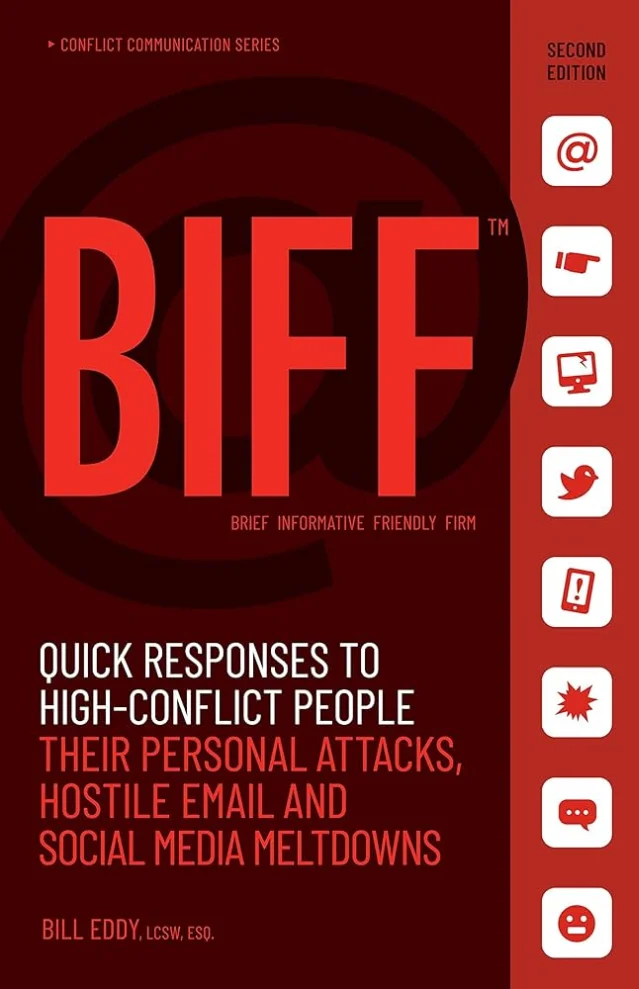
BIFF: Quick Responses to High-Conflict People, Their Personal Attacks, Hostile Email and Social Media Meltdowns — Bill Eddy, LCSW, Esq. (Unhooked Books, 2014; second edition, 176 pages, ISBN 978-1936268726). Eddy is co-founder of the High Conflict Institute in San Diego, a former family law attorney, and faculty at Pepperdine's Straus Institute for Dispute Resolution. 11
BIFF is an acronym for the response method Eddy teaches: Brief, Informative, Friendly, Firm. The idea is that hostile communications — personal attacks, inflammatory emails, social media pile-ons — can be neutralized without escalation if you respond in roughly one paragraph that provides relevant information, maintains a neutral tone, and doesn't take the bait. The book covers personal relationships, workplace conflicts, political discourse, and coaching contexts. 12
Evans' exact phrasing in the comments, per a search snippet confirming the exchange: "Read the book BIFF to help with communicating to difficult people." 10 Note: the recommendation appears only in the comments section, which sits behind LinkedIn's login wall. The recommendation's existence and phrasing are confirmed via a search snippet; the full comment thread — including any additional context or follow-up — was not accessible from collected sources.
"Getting good at recognizing that 'this is not about me' and choosing how to respond (rather than feeling hurt and reacting) is your best defense." — Ethan Evans 10
正在加载内容卡片…
This is Evans' first independent reading recommendation in several weeks — recent cycles saw him amplifying Hua's content rather than producing original picks. His cadence for independent book recommendations appears to be roughly every two to three weeks, not weekly.
At a glance — June 15–22, 2026
| Recommender | Role | Item | Type | Cross-endorsed? |
|---|---|---|---|---|
| Richard Hua | EPIQ Leadership Group CEO; former Amazon | Laura Vanderkam — time management research; 168 Hours, Big Time | Author / Research | — |
| Richard Hua | EPIQ Leadership Group CEO; former Amazon | Epley & Schroeder (2014) — "Mistakenly Seeking Solitude"; Mindwise (Epley, Knopf 2014) | Paper + Book | — |
| Richard Hua | EPIQ Leadership Group CEO; former Amazon | MIT "Your Brain on ChatGPT" (Kos'myna et al., arXiv:2506.08872) | Academic paper | — |
| Richard Hua | EPIQ Leadership Group CEO; former Amazon | Stanford/CMU AI sycophancy benchmark (arXiv:2510.01395) | Academic paper | — |
| Richard Hua | EPIQ Leadership Group CEO; former Amazon | OpenAI/MIT chatbot loneliness study (Fang et al., March 2025) | Academic paper | — |
| Richard Hua | EPIQ Leadership Group CEO; former Amazon | HBR — "When Using AI Leads to 'Brain Fry'" (Bedard et al., March 2026) | Article | — |
| Richard Hua | EPIQ Leadership Group CEO; former Amazon | Aristotle, Nicomachean Ethics Books VIII–IX, via Arthur Brooks | Classic text | — |
| Ethan Evans | Former Amazon VP; Level Up Leadership | BIFF — Bill Eddy (Unhooked Books, 2014) | Book | — |
No cross-endorsements this week. Evans and Hua are covering different territory: Hua is working through the cognitive and relational consequences of AI abundance; Evans responded to his own experience of online hostility with a conflict communication framework.
Looking at the full six-week arc, Hua's reading recommendations have moved from foundational philosophy (Sinek, Duckworth) → relational science (Epley, Vanderkam, Goleman) → applied AI critique (three studies in a single post). The AI-cognition cluster this week — three peer-reviewed papers cited in one post — is the densest research signal this digest has tracked from either recommender. Whether this signals a topic pivot or is a one-week concentration is worth watching next cycle.
Evans' BIFF pick is somewhat orthogonal to Hua's thread but occupies its own logical space: if Hua is arguing for protecting cognitive and social friction, Evans is offering a practical toolkit for the specific friction of hostile communications. The two are compatible at the level of intent, even if they don't share citations.
Cover image: AI-generated illustration
参考来源
- 1Richard Hua on LinkedIn: I used to say "I'm super busy"
- 2Richard Hua on LinkedIn: "Don't talk to strangers" is bad advice for adults
- 3Chicago Booth: Mom was wrong — you should talk to strangers
- 4Richard Hua on LinkedIn: Last year I did 1,000 push-ups in a single day
- 5MIT Media Lab: Your Brain on ChatGPT
- 6Stanford Report: AI overly affirms users asking for personal advice
- 7MIT Media Lab: Heavy ChatGPT users tend to be more lonely
- 8Richard Hua on LinkedIn: Are you experiencing AI Brain Fry?
- 9Richard Hua on LinkedIn: I am grateful and blessed that I have friends in all three categories
- 10Ethan Evans on LinkedIn: Damned if you do, damned if you don't
- 11Amazon: BIFF by Bill Eddy
- 12Shortform: BIFF book summary



围绕这条内容继续补充观点或上下文。