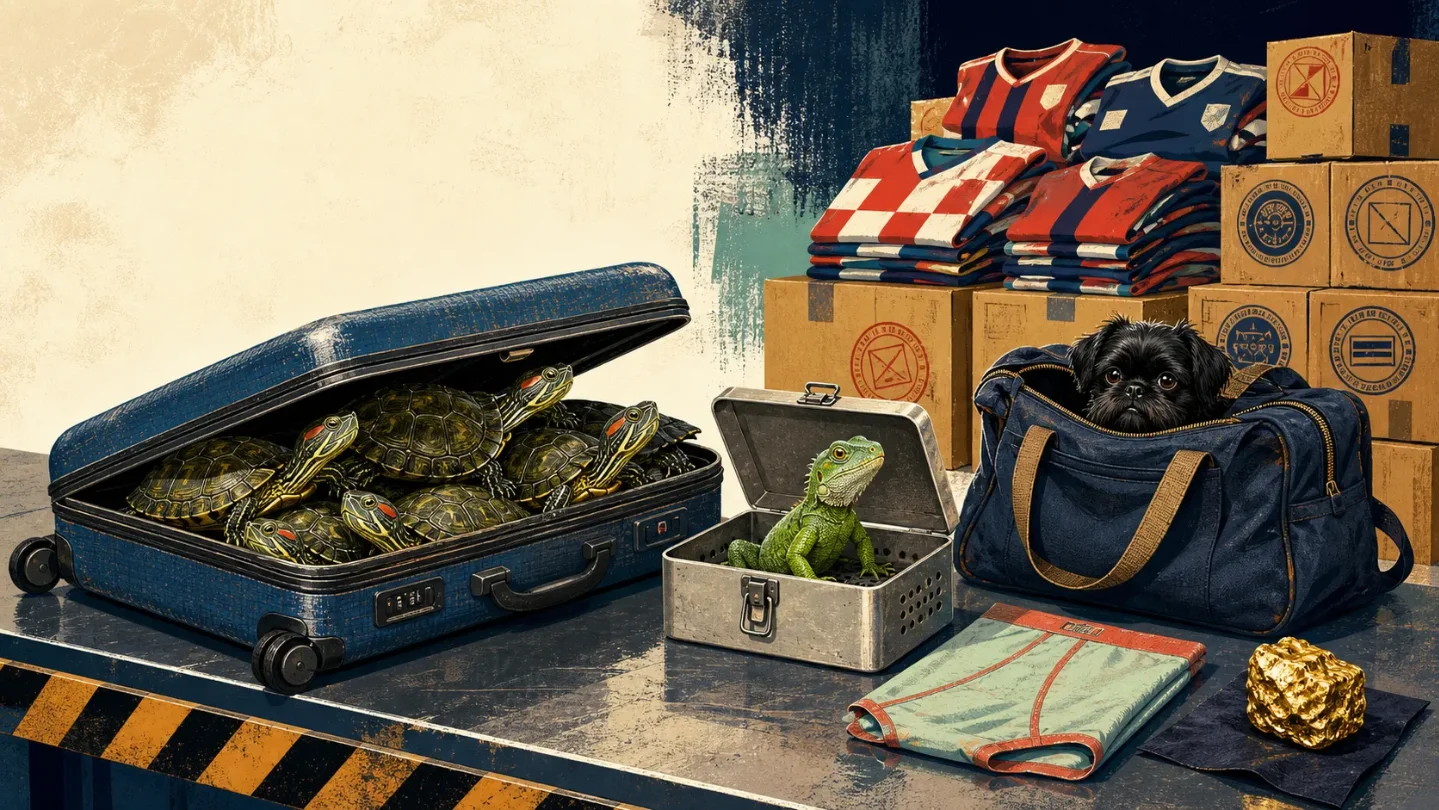
707 turtles, a lizard in a chew-stick parcel, and gold in a brief
A ranked weekly customs-curio roundup led by 707 turtles in checked luggage, lizards hidden among pet products, birds in personal baggage, gold sewn into a brief, and 240,000 suspected counterfeit goods.

The week's top oddities
A checked suitcase from Bangkok held 707 live red-eared slider turtles. A parcel from Australia declared nothing more alarming than pet chew sticks contained 11 lizards in metal boxes. In Kochi, gold was sewn into a brief; in Hong Kong, a counterfeit-goods operation counted its haul in the hundreds of thousands. These are the week's most curious customs releases, ranked by the oddness of the concealment and the scale of the seizure, not by legal severity.
The public releases that could be verified for this window cluster around live animals, gold and counterfeit goods. No qualifying bulletin for antiquities, rare plants or counterfeit currency is included here; older cases and unverified snippets are left out rather than padded into the list.
1. Seven hundred and seven turtles in checked luggage
Kolkata Customs said it seized 707 invasive red-eared slider turtles (Trachemys scripta elegans) on July 22 at Netaji Subhas Chandra Bose International Airport. The animals were in a passenger's checked-in baggage. The customs account says the seizure was made under India's Customs Act, Wildlife Protection Act and CITES rules, with the investigation still open. 1
The passenger had arrived from Bangkok, and reporting on the interception says officers stopped him after he crossed the Green Channel. The turtles were not hidden in an elaborate false compartment; they were simply packed into luggage in a quantity large enough to turn a suitcase into a moving aquarium. No official seizure value was given. 2
The smuggling tactic was volume plus ordinary luggage. Red-eared sliders are familiar pet-trade animals in many countries, but releasing an invasive species can create an ecological problem as well as an animal-welfare one. Seven hundred and seven of them makes the curiosity factor hard to beat.
2. The pet chew sticks were a lizard delivery system
Hong Kong Customs announced on July 19 that officers had seized 11 live lizards at Hong Kong International Airport. The parcel had come from Australia and was declared to contain pet chew sticks. The lizards were mixed with pet products and concealed in multiple metal boxes; customs estimated their market value at about HK$205,000. 3
This is a neat piece of cargo camouflage. The declared contents were already animal-related, so the parcel did not need to pretend to be something entirely unrelated. The metal boxes supplied a second layer of concealment, turning living reptiles into what an X-ray or manual inspection might first read as packaged pet merchandise. The bulletin does not identify the lizards more precisely, so the description stops at the authority's wording: suspected scheduled endangered species.
3. Two pieces of personal baggage, 250 birds
On July 21, Hong Kong Customs reported two suspected illegal-import cases at the Lok Ma Chau Spur Line Control Point. Officers found 250 live birds, worth an estimated HK$50,000, in bird cages inside the personal baggage of two incoming Mainland passengers. Both women were arrested, and the case was handed to the Agriculture, Fisheries and Conservation Department for follow-up. 4
The concealment method was almost disarmingly direct: the birds were in cages, and the cages were in luggage. That makes this less a puzzle of engineering than a bet that ordinary passenger belongings would pass as ordinary passenger belongings. For live animals, the harm is immediate: crowded travel, uncertain care and the risk of moving wildlife outside the legal system that is meant to regulate it.
4. Gold hidden in a specially stitched brief
A passenger arriving at Kochi from Abu Dhabi on July 23 was arrested after customs officers found 1,246.23 grams of 24-carat gold in paste form and two 24-carat chains weighing 100.21 grams. The total seizure was valued at about ₹1.97 crore. The gold paste and chains were concealed in a specially stitched brief worn by the passenger. 5
The clothing was doing the work of a false-bottom suitcase. A stitched compartment stays attached to the traveller, avoids the bulk of a conventional container and is difficult to spot without a targeted examination. The compartment held both processed gold paste and chains, allowing the seizure to travel as clothing rather than as a separate piece of luggage.
This item is based on PTI reporting that quotes customs officials, rather than an accessible customs bulletin. That distinction matters: the seizure details are public, but the source trail is one step removed from the agency's own release.
5. A quarter-million fake World Cup goods in 50 cases
Hong Kong Customs' "Clean Sheet" operation ran from May 26 to July 19 and was announced on July 20. The operation produced 50 related cases and about 240,000 suspected counterfeit items with an estimated total market value of HK$159 million. The release says the activity involved 2026 FIFA World Cup-related goods, cross-boundary transshipments and online sales; 13 local men aged 15 to 59 were arrested. 6
There is no single theatrical hiding place here. The tactic is a distribution network: move goods across borders, split sales across online channels and attach a large counterfeit supply to a global sporting event. That makes the case less like a smuggler's magic trick and more like a small logistics business built around imitation. Counterfeit goods can also bypass the quality and safety checks attached to legitimate products, which is why the legal issue is larger than a fake logo.
6. Three cats, two backpacks
At the same Lok Ma Chau Spur Line Control Point on July 20, customs officers stopped two incoming Mainland passengers in separate cases. A 59-year-old man had two live cats in his backpack; a 58-year-old woman had one live cat in hers. The three cats were valued at about HK$36,000 in total. 7
The backpack is a deceptively efficient animal carrier: it looks like a normal personal item, keeps the contents close to the body and avoids the visual signal of a pet crate. Here, two passengers carried three cats in two separate bags. The bulletin does not say whether the passengers knew each other, so the cases are best treated as separate interceptions.
7. One dog in a shoulder bag
On July 23, Hong Kong Customs intercepted a 27-year-old incoming Mainland passenger at Lok Ma Chau and found one live dog in his shoulder bag. The dog had an estimated market value of about HK$15,000; the announcement was issued on July 24. The passenger was arrested. 8
A shoulder bag is the smallest and most intimate version of the same concealment idea used in the cat cases: turn an animal into carry-on luggage. It also shows why curiosity rankings are not simple counts. One dog is a much smaller seizure than 707 turtles, but a live animal hidden beside a traveller's shoulder is an unusually blunt attempt to make a border crossing look routine.
The week's cases divide into three practical tricks. Some cargo was made to look boring: pet products, metal boxes and checked luggage. Some animals were carried as if they were personal effects. Gold was built into clothing, while counterfeit goods used the infrastructure of legitimate trade and online retail. The strangest detail is often not the object itself, but the ordinary container chosen to make it disappear.
参考来源
- 1Kolkata Customs post on 707 Red-eared Slider turtles
- 2Chennai man from Bangkok and 707 hidden exotic turtles
- 3Hong Kong Customs seizes live lizards of suspected scheduled endangered species
- 4Hong Kong Customs seizes suspected illegally imported live birds
- 5Gold worth about Rs 2 cr seized at Kochi airport, one held
- 6Hong Kong Customs seizes suspected counterfeit goods worth about $159 million in "Clean Sheet" operation
- 7Hong Kong Customs detects suspected cases of illegal importing of animals
- 8Hong Kong Customs detects suspected case of illegal importing of animal
相似内容
- 登录后可发表评论。