2026/6/30 · 7:25
June 30: four overnight resets
A June 30 practitioner briefing on four one-day market resets: Roosevelt’s 1906 food and meat laws, the first Corvette, IBM’s System/370, and German monetary union.

Today's June 30 briefing is about one-day resets. President Theodore Roosevelt signed the Pure Food and Drug Act and the Federal Meat Inspection Act on June 30, 1906. 1 2 Chevrolet's first production Corvette rolled off a Flint, Michigan, assembly line on June 30, 1953. 3 IBM announced System/370 on June 30, 1970. 4 At midnight on June 30, 1990, East Germany's mark gave way to the Deutsche Mark as monetary, economic, and social union began. 5
The common thread is control. A market can reset when a rule changes the standard of trust, when a product forces a company to choose between image and capability, when a platform owner protects customers from a break in compatibility, or when a state converts money faster than firms can convert productivity.
1906: regulation becomes a market operating system
On June 30, 1906, Roosevelt signed the Pure Food and Drug Act, also known as the Wiley Act, and the Federal Meat Inspection Act. 1 2 The Pure Food and Drug Act prohibited interstate commerce in adulterated or misbranded food and drugs, and the Meat Inspection Act required federal inspection before slaughter, postmortem inspection of carcasses, sanitary standards for slaughterhouses, and continuing federal monitoring. 6 2
The business issue was trust at scale. Congress had seen about 160 food and drug bills introduced since 1879 before the 1906 law finally passed, and public pressure intensified after Upton Sinclair's The Jungle and Harvey W. Wiley's food-additive investigations made invisible risks legible to customers. 6 Sinclair later said, "I aimed at the public's heart and by accident I hit it in the stomach," because his labor critique became a food-safety catalyst. 6
The acts did not create modern regulation in its final form. The Bureau of Chemistry in the U.S. Department of Agriculture enforced the 1906 drug and food law, and that bureau was renamed the Food and Drug Administration in 1930. 6 The 1906 framework was later replaced by the more comprehensive Food, Drug, and Cosmetic Act of 1938 after the Elixir Sulfanilamide disaster killed more than 100 people. 1
Decision mirror. Compliance can start as a cost center and become the market's trust layer. The meatpacker, drugmaker, or food brand that treats inspection only as a legal hurdle misses the larger operating shift: customers and retailers eventually prefer products whose safety does not require private investigation.
1953: a halo product survives its first bad fit
On June 30, 1953, the first production Chevrolet Corvette, chassis No. 001, came off a makeshift assembly line in Flint, Michigan. 3 The 1953 run was tiny by General Motors standards: 300 Corvettes were hand-built that year, all in Polo White with red interiors and black canvas soft tops. 3 The car had a fiberglass body, a 235-cubic-inch "Blue Flame" inline-six engine rated at 150 horsepower, and a two-speed Powerglide automatic transmission. 3
The Corvette's first problem was that the story outran the machine. Harley Earl, General Motors' head of styling, had pushed the idea of an American sports car after watching European MG, Jaguar, and Ferrari models attract attention, and the project debuted as the EX-122 concept at GM's Motorama in New York on January 17, 1953. 3 The production version looked like a sports car, but its first drivetrain did not fully deliver the performance promise.
Sales exposed the gap. Production moved to St. Louis for 1954, but Chevrolet produced 3,640 Corvettes that year and nearly one-third remained unsold at year-end. 3 General Motors considered killing the model in 1954 and 1955, but three forces changed the decision: Chevrolet added a 265-cubic-inch V8 and a three-speed manual option in 1955; Ford launched the two-seat Thunderbird; and Zora Arkus-Duntov pushed the car toward credible performance. 3 Arkus-Duntov later became Chevrolet's director of high performance vehicles in 1957 and is widely known as the "father of the Corvette." 7
Decision mirror. A halo product can survive a weak first version if the company can close the gap between symbolism and performance before the market stops caring. The launch bought GM attention; the V8, manual transmission, and internal champion gave the product a reason to keep existing.
1970: compatibility becomes platform strategy
On June 30, 1970, IBM introduced System/370 as the successor to System/360. 4 IBM's first two announced models were the Model 155, scheduled for first customer shipment in January 1971, and the Model 165, scheduled for April 1971. 4 The company added the Model 145 on September 23, 1970, and IBM describes that model as its first computer with all main memory on monolithic silicon chips. 4
The strategic choice was backward compatibility. Thomas J. Watson Jr., IBM's chief executive, had lived through the pain of System/360, a sweeping product-line replacement that forced customers through difficult transitions. Before System/370 launched, Watson told IBM employees: "Despite the unprecedented success of 360, we should not forget the tremendous problems we encountered in making such a sweeping change in our entire product line, and we should not forget the difficulties that we created for our customers. We don't want to make the same mistakes twice." 4
Buck Rogers, president of IBM's Data Processing Division, made the customer promise explicit at launch: "System/360 users will be able to run most of their existing programs on the new system without change." 4 That promise mattered because System/360 customers had already built software, processes, and operating knowledge around IBM architecture. State Street Bank and Trust Company of Boston ordered four System/370 machines on announcement day, and the bank planned to consolidate nine computers running 2,000 programs into one mainframe system. 4
IBM still missed an important feature. Initial System/370 models did not include virtual memory, and IBM added virtual storage in its August 2, 1972, System/370 Advanced Function announcement with DOS/VS, OS/VS1, OS/VS2, and VM/370 operating systems. 4 System/370 remained IBM's primary mainframe line through the 1970s and 1980s before System/390 replaced it on September 5, 1990. 4
Decision mirror. Incumbents do not always win by forcing a clean break. When customers have already invested in applications, training, and workflows, compatibility can be the product. The tradeoff is real: the same architecture that protects customers can invite plug-compatible competitors and constrain future moves.
1990: currency converts faster than capacity
At midnight on June 30, 1990, German monetary, economic, and social union took effect: the East German mark was replaced by the Deutsche Mark, trade barriers were lifted, legal, tax, and social insurance systems were harmonized, and barriers to capital and labor movement were removed. 5 The treaty had been signed on May 18, 1990, by West German finance minister Theo Waigel and East German finance minister Walter Romberg, and it entered into force on July 1, 1990. 8
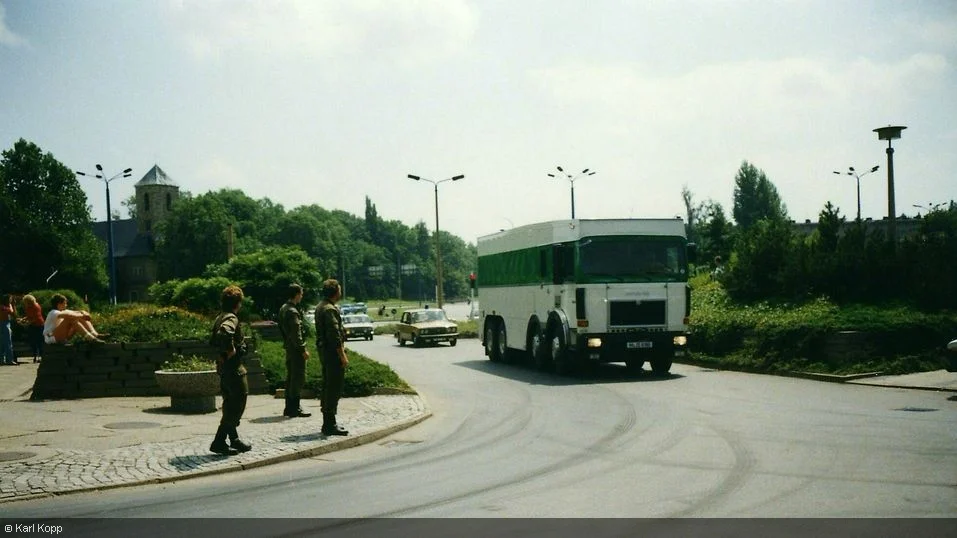
The operating work was enormous. The Bundesbank says roughly 24.7 million accounts held by East Germany's population of about 16 million were switched to Deutsche Mark. 8 The central bank shipped about 440 million banknotes and 102 million coins into East Germany before July 1, opened 15 new branches and a provisional administrative office in East Berlin, and used town halls and schools as auxiliary payment points. 8
The conversion formula carried the political bet. Wages, salaries, rents, and savings up to 4,000 East German marks converted at 1:1, while larger savings and corporate debt converted at 2:1; the black-market rate was about 7:1. 5 Bundesbank president Karl Otto Pöhl opposed the 1:1 rate, but Chancellor Helmut Kohl prioritized the political momentum of rapid unification. 8
The aftermath showed the cost of making nominal equality arrive before operating equality. A Brookings paper by George Akerlof, Andrew Rose, Janet Yellen, and Helga Hessenius calculated that firms employing only 8% of the East German labor force were viable after currency union in the sense of covering short-run variable costs. 5 Later accounts put East German productivity at about 30% of West German levels at the time of union, and the Treuhandanstalt privatized, liquidated, or restructured nearly 12,000 state-owned enterprises within five years. 9 The same retrospective says 70% of East German industrial jobs disappeared, cumulative fiscal transfers from West to East reached about €2 trillion over 30 years, and East German GDP per capita was 66% of the West German level in 2023. 9
Decision mirror. Integration is not finished when the labels match. A single currency, shared systems, or unified org chart can remove visible barriers overnight, but productivity, ownership, and management capacity adjust on a different clock. Leaders who collapse the visible layer first need a plan for the operating layer they just exposed.
June 30's pattern is direct enough for a pre-work read. Roosevelt's laws show trust becoming enforceable infrastructure. The Corvette shows a brand promise needing engineering proof. System/370 shows an incumbent turning compatibility into a customer-retention strategy. German monetary union shows the risk of converting symbols faster than capabilities. In each case, the visible reset took a day; the business consequences took years to price.
Cover image: Deutsche Mark transport before German monetary union, photographed by Karl Kopp, via Deutsche Bundesbank.
参考来源
- 1U.S. FDA: The 1906 Food and Drugs Act and Its Enforcement
- 2Wikipedia: Federal Meat Inspection Act
- 3History.com: First Chevy Corvette rolls off the assembly line
- 4IBM: The IBM System/370
- 5Brookings Papers: East Germany in from the Cold
- 6Wikipedia: Pure Food and Drug Act
- 7Wikipedia: Zora Arkus-Duntov
- 8Deutsche Bundesbank: German monetary union historical background
- 9Economics Observatory: Germany's reunification lessons for policy-makers today
围绕这条内容继续补充观点或上下文。