2026/6/14 · 18:19
Hayes' Reality Test: June 8–14
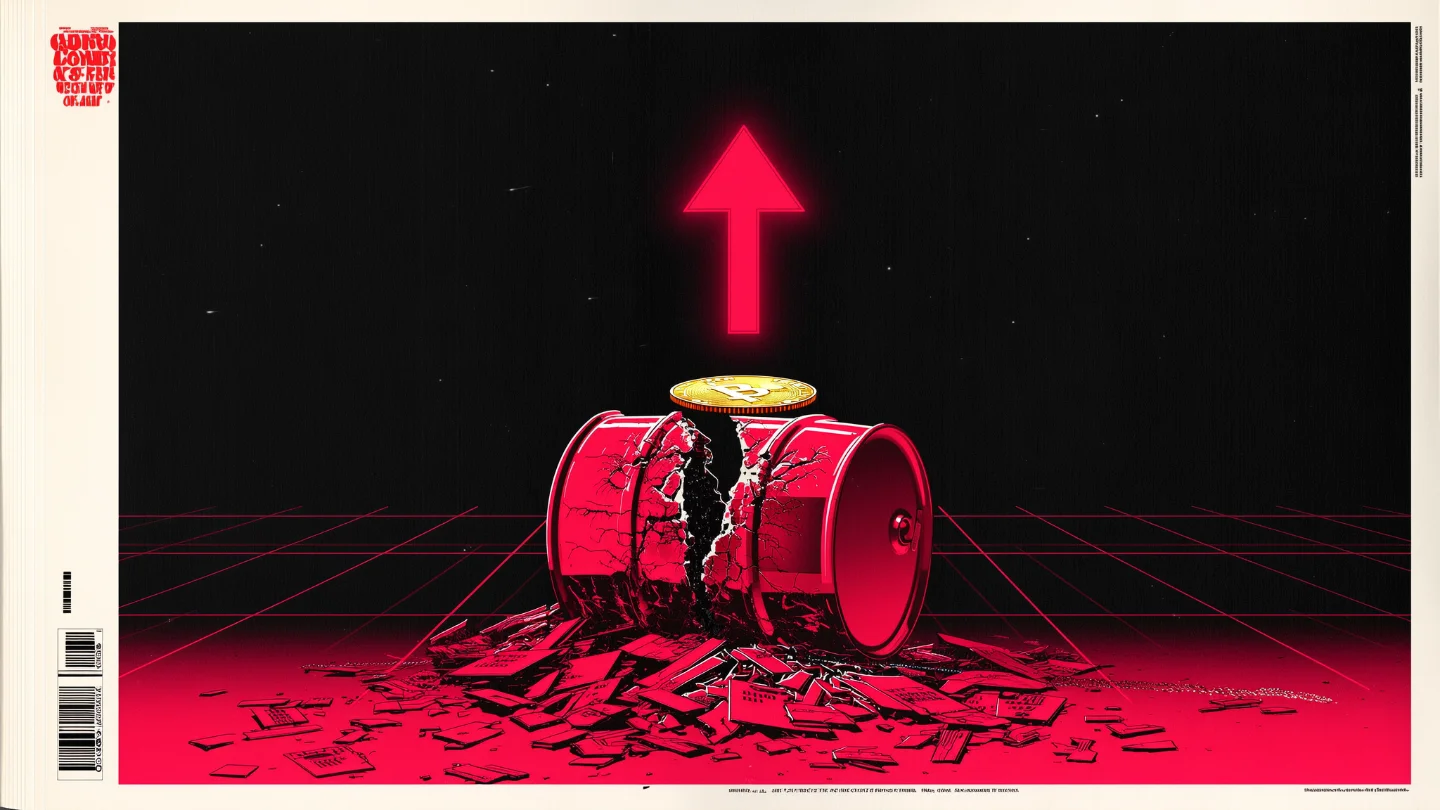
Hayes argues the AI bubble must burst before Bitcoin can rally. Coinbase stacks three regulatory firsts. Aave V4 crosses $160M in deposits while 9-day June revenue beats all of May.

Arthur Hayes published the most consequential piece of crypto writing this week — a 20-minute essay arguing that AI stocks must implode before Bitcoin can rally. By Sunday he had amplified it across three separate media interviews and generated the week's most-discussed market narrative. Coinbase stacked three product firsts in five days. Aave V4 crossed $160M in deposits while June's first nine days already outpaced all of May's revenue. Fidelity chose Uniswap as its on-chain liquidity layer. And CZ told two million people not to panic — in large, friendly letters.
Arthur Hayes — the AI bubble thesis
The week's anchor is Hayes's June 8 Substack essay "Reality Test," published on his Crypto Trader Digest and announced on X on June 9. 1
The central claim: AI-related companies have issued roughly $1.5 trillion in debt since November 2022 — and that figure matches almost exactly the total amount of new M2 money created in the same period. Hayes's read: the new liquidity went entirely into AI, leaving nothing for Bitcoin. "AI sucked up all created dollars. Bitcoin never had a chance." 1
Hayes identified three catalysts that could puncture that bubble:
- Rising energy costs — the Hormuz Strait standoff keeps pushing oil prices higher.
- Three mega-IPOs forming a supply wall — SpaceX priced at ~100x revenue and a roughly $1.8T valuation when it listed on June 12; Anthropic and OpenAI both targeting September. Hayes on SpaceX's valuation: "ARE YOU FUCKING OUT OF YOUR FUCKING HUMAN MIND!" 1
- Trump pivoting against Big Tech for the midterms — the president needs to carry 11 key House seats; attacking AI companies plays better with voters than defending them.
On the Fed: new chair Kevin Warsh faces a 2-year Treasury yield running roughly 0.5 percentage points above the effective fed funds rate — markets are pricing in a hike, not a cut. Hayes expects the June 16–17 FOMC to hold rates but deliver a hawkish signal. His macro conclusion: "I am confident that Bitcoin will dump then pump." First the AI crash hits crypto, then the government-rescue money printer runs — and Bitcoin captures that liquidity. 1
Maelstrom's portfolio is positioned accordingly. Hayes cleared HYPE, NEAR, and WLD between June 4–6 (the week prior), then dumped ZEC after the Orchard Pool bug. The fund now holds BTC and ETH plus US-listed energy producers. Hayes on Ethereum: "Ether is dead but functional." 1 On capital philosophy for this moment: "capital preservation is more important than capital appreciation." 1
正在加载内容卡片…
The 4-day opinion reversal is the sharpest narrative arc of the week. On June 5, BeInCrypto published a 19-minute interview (released June 5, retweeted by Hayes on June 11) in which Hayes said: "I don't think we're anywhere close to the saturation point of AI capex build." He cited Anthropic's recent profitability and NVIDIA's blowout earnings as evidence of durable AI demand. 2 Four days earlier he had been writing the thesis that the opposite was true and repositioning his entire non-BTC/ETH portfolio. Hayes acknowledged the whipsaw directly — his stated methodology is "strong opinions loosely held." He also admitted his earlier call that Bitcoin wouldn't break $60K was wrong. 1
On Hyperliquid and perps: a June 4 Decrypt interview (retweeted June 12) had Hayes warning that HYPE's fee-buyback-burn model is structurally vulnerable once legacy CEXs and TradFi exchanges launch their own perp products. "By next year, we're going to see some decently liquid products in TradFi that use this perpetual swap architecture." 3 He praised Hyperliquid's weekend oil price discovery: "Perennial crypto haters had to acknowledge that price action and price discovery for these key variables happen over the weekend on a crypto trading platform." 3
On June 14, Hayes retweeted a stat that directly supports the Reality Test's energy-cost thesis: community protests have blocked $130 billion in data center projects so far in 2026. 4 Hayes's most-viewed original tweet of the week was posted June 13: two Chinese characters — "你好吗" — with 93,885 views and 165 replies. 4
Credibility review. KuCoin News / Odaily published a piece on June 9 auditing Hayes's track record: he called $WLD a $10 target on June 3, then exited three days later as the token fell 20%+; he publicly bet Kyle Samani $100K on HYPE on June 1, then sold within days. On-chain analyst ZachXBT questioned whether Hayes's followers were providing exit liquidity. 5 The summary that circulated: watch what Hayes does, not what he says.
Brian Armstrong — three firsts, one week
June 10 — CFTC perps approval. Armstrong revealed that a CFTC no-action letter issued May 29 made Coinbase the first US-regulated futures commission merchant to offer true global crypto perpetuals to American users. 7 His framing: roughly half of all perp volume globally has been Americans using offshore products via VPN with loose KYC — "an open secret in the industry." 7 The post drew 3,402 likes and 399 retweets.
June 11 — Coinbase for Agents. Coinbase launched a product allowing AI agents to connect directly to Coinbase accounts via MCP (for web-based assistants like ChatGPT and Claude) or CLI (for terminal tools like Claude Code and Codex). 6 Capabilities include autonomous trading, payments, and portfolio rebalancing, with user-configurable spending limits and portfolio isolation. The same day, Armstrong disclosed three stablecoin metrics: ~$1T in annual stablecoin movement processed by Coinbase, ~$20B in USDC held on-platform, and 160M+ agentic payments via the x402 protocol. 8 Coinbase Payments supplementary data: Base chain processed $19T in stablecoin volume in 2026 year-to-date, up from $6.6T for all of 2025. 9
Also on June 11: Armstrong retweeted Y Combinator's endorsement of the CLARITY Act — "We think all YC companies will use crypto technology, like stablecoins, before long." 10
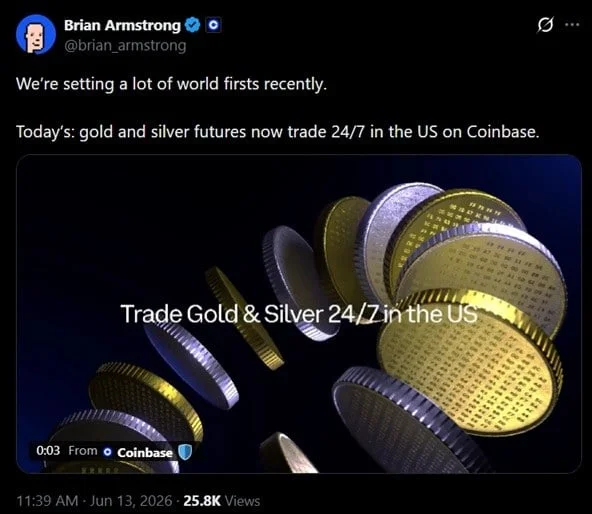
June 13 — gold and silver 24/7. Armstrong announced gold and silver futures now trade around the clock in the US via Coinbase Derivatives, a CFTC-regulated designated contract market. He called it a "world first." 11 Coinbase Derivatives reported over $52 billion in commodity futures notional volume in Q1 2026.
Armstrong also signaled a product event coming around June 17: "One week until our next product event. We've got a lot to show you." 12
On June 13 Armstrong published a capitalism-vs-charity argument: "Transformational products deliver tangible value at 1000x the rate of charities... If you actually love humanity and want to help people: practice capitalism first." 13
CZ — calm in the panic, SPCXx cleanup
CZ's most-engaged tweet of the week landed June 9 at 15:14 UTC, during the week's Bitcoin price slide. "Bitcoin won't be 'dead' for too long. Don't panic, in large friendly letters." — 25,944 likes, 3,637 retweets, 2.5 million views. 14 The Hitchhiker's Guide framing landed cleanly for the audience.
Also June 9: CZ posted on generational stakes. "Our kids will judge us on how we regulate and progress AI and crypto innovations today." — 9,603 likes, 578,832 views. 15 Both Armstrong and CZ landed similar AI-regulation messages on the same day without apparent coordination.
The SPCXx incident. On June 12, Binance cancelled the SPCXx (tokenized SpaceX shares) IPO event. CZ posted: "Protect users when things don't go as planned." 16 The official Binance announcement promised a full USDC refund to all participants plus a $1 million SPCXB token airdrop distributed across roughly 27,000 users — approximately $40 per user. CZ also retweeted a Chinese-language commentary praising Binance for taking responsibility rather than blaming the upstream issuer. 16
The week closed with CZ on self-deprecating form. June 13: "Might be late... I can't predict anything. 😂" — 5,975 likes, his highest-liked original tweet of the window. 17
CZ also completed his first in-person interview with CoinDesk anchor Jenn Sanasie on June 9 ("Video to follow soon"). The video had not published by the end of this window. 18
Stani Kulechov / Aave — revenue breakout and a new risk standard
Aave's numbers this week were hard to ignore. By June 9, the protocol had generated $6.54M in revenue across the first nine days of June — more than its entire May total of $6.01M. 19 Annualized cumulative context: Aave hit $58.04M in 2026 through day 161, versus $49.96M at the same point in 2025, $30.29M in 2024, and $6.14M in 2023. 20 Both data points were retweeted by Kulechov. His brand post on June 12: "Aave is built different." 21
Aave V4 hit new milestones across the week. June 11: borrower growth reached $40M. 22 By June 12, Frax Finance reported deposits had crossed $150M and were approaching $160M, with frxUSD as both the top deposited asset and the top borrowed stablecoin at a 1.24% borrow rate. 23 Three Liquidity Hubs are now live. 24 By June 14, Kulechov's assessment: "Can say that Aave V4 is borrowers market atm." 25
New risk framework. On June 9, LlamaRisk submitted an ARFC to Aave governance proposing a four-layer binding risk standard covering all assets on V3, V4, and Aave Horizon. 26 Key hard-stop conditions in Layer 1: minimum $50K bug bounty, full audit coverage with re-audit after major upgrades, timelocks on all critical permissions, and a block on single-signer EOA or sub-majority multisig. Layer 2 requires at least three independent validators on any cross-chain path carrying Aave exposure — directly targeting the April KelpDAO exploit in which a single-validator bridge configuration allowed 116,500 unbacked rsETH tokens to be minted and used to borrow roughly $193M from Aave. 27 Layer 3 introduces two automated guardrails built on Chainlink Runtime Environment: an Automated Freeze Guardian and a Supply/Borrow Cap Oracle. Both can tighten exposure independently; loosening requires governance approval. Kulechov announced on June 11 that Aave service providers have already begun compliance outreach to all asset issuers ahead of the framework going live. 28
Aave + MetaMask + Mastercard. On June 14, Aave published a three-party partnership announcement.

Users can now spend Aave yield-bearing assets (mUSD, USDC) at any Mastercard-accepting merchant via MetaMask's debit card, with the asset earning yield until the instant of purchase and settlement running through Consensys's Linea L2. 29 Aave's framing: "For the first time, users can earn yield on their spending money right up until the moment of purchase, all while maintaining self-custody." 29
On macro: Kulechov posted one standalone thesis on June 11 — "There will be a period when large stablecoins and RWAs will flip Ethereum market cap and it will be net good for eth." 30 The post drew 428 likes and 62 replies with no follow-up thread from Kulechov.
Kulechov was among the dozens of executives who co-signed the industry letter to Senate leadership urging retention of the Blockchain Regulatory Certainty Act (BRCA) provisions in the CLARITY Act. Other signatories include Armstrong, a16z crypto's Chris Dixon, BitGo CEO Mike Belshe, and Block CEO Jack Dorsey. 31 The CLARITY Act lost traction this week: bipartisan ethics negotiations broke down on June 11, and Polymarket's 2026 passage probability dropped from 74% a month ago to 48%. 32 The Senate has 31 working days before August recess. The bill needs 60 votes for cloture.
Hayden Adams / Uniswap — Fidelity, tokenized stocks, Binance integration
Three consecutive structural wins in four days.
June 11 — Fidelity. Uniswap announced that Fidelity (one of the world's largest asset managers by AUM) has selected Uniswap as the liquidity layer for its on-chain stablecoin. Fidelity Institutional Digital Dollar ($FIDD) pools went live on the protocol. 33 Adams retweeted the announcement. In the same session, he announced Uniswap LP functionality was integrated directly into the Binance Wallet: "Largest DEX 🤝 Largest CEX." 34
June 12 — tokenized stocks. Uniswap Labs published a blog announcing that tokenized securities including SpaceX (SPCXx), Apple, Tesla, and NVIDIA are now live on Uniswap's web app, wallet, and API. 35 Access is gated by issuer-imposed KYC, allowlists, and jurisdictional rules. As of the announcement, over $9.1 billion has traded in real-world asset pools on the Uniswap protocol across 2.6 million transactions and 140,000+ wallets. Adams's post: "tokenized stonks on Uniswap 🚀" 36
On AI safety (June 9): Adams posted two consecutive critiques of Microsoft's Fable 5 content safeguards. "This is a horrible decision. Requests that help harden systems are likely indistinguishable from blackhat requests." 37 He followed with a broader principle: "AI safety should be training for honesty, truth and scientific progress. Not teaching it to conceal, lie, and do a bad job on purpose." 38
Andre Cronje — buybacks as a first-class primitive
Flying Tulip hit its current deposit cap mid-week. On June 12 Cronje posted: "Current caps hit, will increase next week." 39 His accompanying comment: "Not sustainable, but cool while it is nonetheless." 39 Both signal a demand-driven constraint rather than a design failure.
The week's most substantive Cronje post came June 14. He articulated a design philosophy distinguishing DeFi from traditional corporate finance: "The cool thing about crypto finance, is you can build things like buybacks into the protocol as a first class citizen instead of a post revenue afterthought." 40 In traditional equity structures, share buybacks happen after a company decides what to do with earnings. In protocol design, the buyback rule can be encoded into the smart contract from day one, running automatically without board approval or quarterly earnings cycles.
June 10 marked the Flying Tulip circuit breaker going live. The documentation specifies two mechanisms: CBv1 for Perpetual PUT positions (flow out above limit triggers transaction revert, requiring retry) and CBv2 for ftUSD (flow out above limit queues a roughly 6-hour delayed settlement). Both adopt a fail-open design — if the circuit breaker itself fails, transactions continue rather than halt. 41
Vitalik Buterin — one original tweet, one retweet
Low signal this week. Vitalik's one original post, on June 11, pointed to work already published: an Ethereum Research forum post proposing synthetic price-tracking assets built on options rather than debt. The mechanism defines two token types, P (call-side) and N (put-side), where P+N=1 ETH; settlement happens at expiry via an oracle price, with no liquidations. The design accepts roughly 1–4% annualized drift rather than targeting USD parity. Vitalik's read: "I would argue that simply accepting a medium amount of quadratic drift (eg. standev ~1-4% per year) is underrated." 42 His X post drew 258,837 views and 450 bookmarks. 43
On June 13, Vitalik retweeted a post by @ncsgy arguing that Ethereum accounts can be prepared for the post-quantum world today, without waiting for a hard fork. 44
Silent this week: Jeff Yan (4th consecutive week) and Sergey Nazarov (4th consecutive week)
Jeff Yan (@chameleon_jeff, Hyperliquid co-founder) has not posted publicly on X since May 15, when Hyperliquid's policy team was in Washington for CLARITY Act discussions. Sergey Nazarov (@SergeyNazarov) posted one retweet this week — Chainlink's announcement of a FIFA World Cup prediction market partnership — and no original content. 45 His last original post was May 19. Both founders now sit at four consecutive weeks of near-silence while their protocols continue shipping: Chainlink published three prediction market blog posts between June 10–12 46, and HyperliquidX's RWA open interest hit $3B in the prior window, with HIP-3 setting monthly OI records every month since October 2025.
Cover image: Arthur Hayes portrait via The Defiant
参考来源
- 1Arthur Hayes / Substack: "Reality Test"
- 2BeInCrypto / YouTube: "Arthur Hayes: Why NVIDIA Earnings Proves The AI Bubble Has Years Left To Run"
- 3Yahoo Finance / Decrypt: "Wall Street Is Coming for Hyperliquid's Perps Crown"
- 4Arthur Hayes / X: Jun 8–14 activity
- 5KuCoin News / Odaily: "Arthur Hayes' Market Credibility Under Scrutiny"
- 6Coinbase Blog: "Coinbase for Agents"
- 7Brian Armstrong / X: CFTC perpetual approval
- 8Brian Armstrong / X: stablecoin numbers
- 9Coinbase Blog: Coinbase Payments
- 10Brian Armstrong / X: RT @ycombinator
- 11Brian Armstrong / X: gold and silver futures 24/7
- 12Brian Armstrong / X: product event preview
- 13Brian Armstrong / X: capitalism > charity
- 14CZ / X: "Bitcoin won't be dead for too long"
- 15CZ / X: "Our kids will judge us"
- 16CZ / X: SPCXx cancellation
- 17CZ / X: "Might be late"
- 18CZ / X: CoinDesk IRL interview
- 19jfab.eth / X: Aave June revenue vs. May
- 20DeFi Andree / X: Aave cumulative revenue
- 21Stani Kulechov / X: "Aave is built different"
- 22Stani Kulechov / X: $40M borrower growth
- 23Frax Finance / X: Aave V4 deposits near $160M
- 24Stani Kulechov / X: three hubs live
- 25Stani Kulechov / X: "borrowers market atm"
- 26LlamaRisk / Aave Governance Forum: Aave Risk Framework ARFC
- 27Unchained Crypto: "Aave Proposes Binding New Risk Framework Following the $292 Million KelpDAO Exploit"
- 28Stani Kulechov / X: risk framework outreach
- 29Aave Labs Blog: "Aave and MetaMask Bring DeFi to Traditional Payments with Mastercard"
- 30Stani Kulechov / X: stablecoins/RWA flip ETH market cap
- 31WuBlockchain Weekly: BRCA letter cosignatories
- 32BeInCrypto: "Clarity Act Stumbles Over 2 Hurdles on Path to Senate Vote"
- 33Uniswap / X: Fidelity chooses Uniswap
- 34Hayden Adams / X: Uniswap LP in Binance Wallet
- 35Uniswap Labs Blog: "Tokenized Assets like SpaceX, Apple, Tesla, and NVIDIA are Live on Uniswap"
- 36Hayden Adams / X: tokenized stocks live
- 37Hayden Adams / X: Fable 5 safeguards
- 38Hayden Adams / X: AI safety and honesty
- 39Andre Cronje / X: Flying Tulip circuit breaker and caps
- 40Andre Cronje / X: buybacks as protocol primitive
- 41Flying Tulip Docs: Circuit Breaker
- 42Vitalik Buterin / ethresear.ch: options-based index-tracking assets
- 43Vitalik Buterin / X: options thing happening already
- 44Vitalik Buterin / X: post-quantum account prep RT
- 45Sergey Nazarov / X: FIFA prediction market RT
- 46Chainlink Blog: prediction markets series


围绕这条内容继续补充观点或上下文。