The painting that puts the king behind your eyes
Wikipedia's July 25, 2026 Featured Article follows how Velázquez's Las Meninas turns a royal studio scene into a puzzle about mirrors, power, and the viewer's place in the picture.

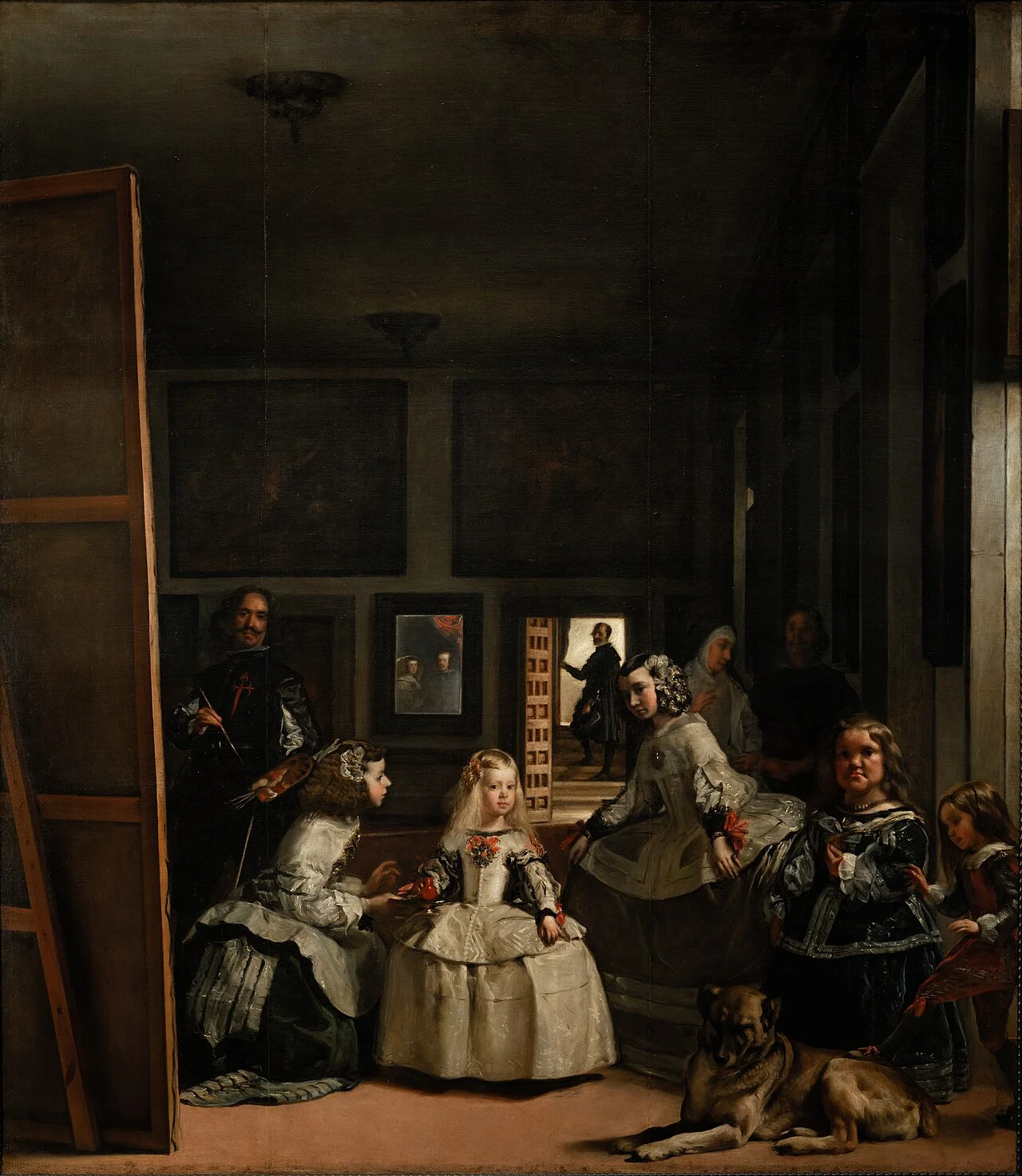
In 1656, Diego Velázquez painted a scene in the Madrid palace that appears to show a five-year-old princess, her attendants, a dog, and the painter himself at work. Then he placed a mirror on the back wall. In it, King Philip IV and Queen Mariana appear to be standing where the viewer stands. The result is a court picture that turns the act of looking into its subject. 1
The painting is Las Meninas, Spanish for "The Ladies-in-waiting." Its surface is crowded below and strangely open above, its figures look in several directions at once, and its most important image may be the one the viewer cannot see: the front of the large canvas Velázquez is painting. That arrangement has kept art historians arguing over who is inside the picture, who is outside it, and whether the mirror reflects the royal couple or the portrait on the hidden canvas. 2
| The work in brief | |
|---|---|
| Artist | Diego Velázquez |
| Date | 1656 |
| Medium | Oil on canvas |
| Dimensions | 318 × 276 cm |
| Current home | Museo del Prado, Madrid |
A court painter finally puts himself in the room
In 17th-century Spain, painting was generally treated as a craft rather than an art on the level of poetry or music. Velázquez had spent 33 years in the royal household by the time he painted Las Meninas, and he had climbed far beyond the usual status of a court artisan. In 1651, Philip IV appointed him palace chamberlain, a position that brought money and standing but also consumed much of his time. In the last eight years of his life, he produced only a few works, most of them royal portraits. 2
The setting was probably Velázquez's studio in the Royal Alcázar of Madrid. Philip had given him the main room of the late Balthasar Charles's quarters for that purpose, and the king often sat there watching him work. The relationship mattered: the king allowed himself to appear in Las Meninas even in old age, when he was reluctant to sit for portraits. 2
The child at the center was Margaret Theresa, Philip's daughter by Mariana of Austria. She was the couple's only surviving child at the time of the painting and would later marry the Holy Roman Emperor Leopold I. Placing her at the center makes the scene look like a portrait of a princess. Placing Velázquez beside a canvas, with the royal couple appearing only as a reflection, gives the painter's own work an equal claim on the viewer's attention. 2
Read the room from front to back
Margaret Theresa stands in the bright foreground. On either side of her are the two meninas: Isabel de Velasco, poised to curtsy, and María Agustina Sarmiento de Sotomayor, kneeling as she offers the princess a drink on a golden tray. To the right are Mari Bárbola, an Austrian dwarf, and Nicolás Pertusato, an Italian dwarf who nudges a sleepy Spanish mastiff with his foot. Behind them stand the princess's chaperone, Marcela de Ulloa, and the bodyguard Diego Ruiz Azcona. 2
At the far back, José Nieto Velázquez pauses in a doorway. He may be coming or going. His bent knee and the steps beneath him make the uncertainty visible rather than resolving it. The doorway is also the painting's vanishing point: extend the lines of the room and they converge around the opening. Light from that space pulls the eye deeper into the palace, while the figures in front of it pull the eye back toward the scene being watched. 2
On the left, Velázquez looks out from behind the rear of a large canvas. The viewer cannot see what he is painting. His red cross of the Order of Santiago is visible on his chest, although he did not receive that honor until 1659, three years after the picture was completed. According to the account recorded by Antonio Palomino, the cross was added later, possibly at Philip's order. The keys hanging from the painter's belt refer to his court offices. 2
The arrangement is more controlled than the momentary scene suggests. Nine figures occupy the lower half of the canvas, or eleven if the reflected king and queen are counted. The high ceiling and dark upper wall leave an unusual amount of empty space above them. Velázquez has made the room feel both measurable and unstable: it can be plotted with perspective, yet the most important action takes place beyond the frame.
The mirror makes the viewer unstable
The mirror on the back wall reflects the heads and upper bodies of Philip IV and Mariana. The most common reading is straightforward: the royal couple is standing in front of the painting, posing for Velázquez, while the child and her entourage occupy the studio. The viewer therefore sees the scene from the couple's position. Several figures, including Margaret Theresa, Velázquez, and Mari Bárbola, seem to look directly toward that position. 2
But the hidden canvas offers another possibility. H. W. Janson and Joel Snyder argued that the mirror could be reflecting the portrait Velázquez is painting rather than the actual people in front of him. The large canvas is roughly comparable in size to Las Meninas, and its front is concealed from us. Under that reading, the mirror is not a window onto the room outside the picture. It is evidence of an image inside the picture, an image that the viewer is denied. No single explanation has won universal agreement. 2
This is why the mirror does more than add the king and queen to the cast. It makes the viewer's position part of the evidence. If the couple is physically outside the painting, the viewer shares their place. If the mirror shows the hidden portrait, the viewer is looking at a representation of a representation. In either case, the picture refuses to give us a neutral seat in the room.
The doorway creates a second uncertainty. José Nieto is visible only to the royal couple and the viewer, not to the foreground figures. His presence could mean that the king and queen are about to leave. It could also simply be a pause in palace traffic. The painting records a moment, but it does not tell us which moment it is.
Light is part of the argument
The right-hand window sends light across the foreground, while the open doorway supplies a narrower path into the distance. Velázquez uses those sources to organize attention. Margaret Theresa's face and pale dress catch the strongest illumination. The maid kneeling beside her is bright in profile, while the other maid answers her across the princess with a less defined, shadowed form. Their opposing positions frame the child without enclosing her. 2
The painter's face is lit indirectly, but his dark hair and the light on his hand and brush make him easy to find. The mirror is a pale rectangle set inside a dark wall, so it behaves like a small light source of its own even though the reflected faces are not sharply drawn. The composition keeps asking the eye to move: from the princess to the maid, from the maid to the painter, from the painter to the mirror, then through the doorway and back out toward the viewer.
That movement is why the picture cannot be absorbed in one glance. The figures face different directions, the light divides the room into planes, and the hidden canvas blocks the explanation that would normally anchor a painter-at-work scene. Velázquez gives the viewer a sequence of clues rather than a single answer.
The painter is making a case for painting
The social argument sits inside the optical one. Velázquez shows himself in the company of royalty, not as a servant carrying materials but as the person who controls the image everyone else is gathered around. Art historian Svetlana Alpers read the arrangement as a claim that painting was a liberal art, not a mechanical trade. The distinction mattered because membership in the Order of Santiago excluded people whose occupations were considered mechanical. 2
That reading does not turn the painting into a simple self-promotion poster. Velázquez's position remains dependent on the court. The keys on his belt announce his offices, and the cross on his chest was added only after the king had granted him a higher honor. The picture presents artistic ambition through the machinery of royal service.
Michel Foucault made the painting the opening subject of The Order of Things, using it to examine the structure of classical representation. His interest was less in identifying each courtier than in the chain of looks connecting painter, subject, and viewer. Earlier, the Italian Baroque painter Luca Giordano called Las Meninas "the theology of painting." In 1827, the Royal Academy president Thomas Lawrence called it "the true philosophy of the art." Those phrases sound grand, but they point to a concrete feature: the painting makes its own conditions of visibility impossible to ignore. 1
A damaged object with a moving name
The painting was first recorded under titles including La Familia, or "The Family." An inventory from 1666 described it, and Antonio Palomino published a fuller account in 1724 that helped identify several of its figures. Its physical history is less tidy than its place in the canon. The canvas was cut down on both sides and damaged in the 1734 fire that destroyed the Alcázar. Court painter Juan García de Miranda restored it, repainting most of the Infanta's left cheek where pigment had been lost. 2
The work entered the Museo del Prado's collection when the museum was founded in 1819. The Prado catalogue first used the title Las Meninas in 1843. In 1984, British conservator John Brealey supervised a cleaning that removed a yellow veil of accumulated dust from the previous restoration. The result provoked angry protests because the painting looked different, although the Velázquez specialist José López-Rey judged the restoration impeccable. Because of its size, importance, and value, the painting is not lent for exhibitions. 2
The surface also preserves traces of changing decisions. Infrared examination found minor pentimenti, or earlier passages that Velázquez altered while working. His head, for example, was initially inclined to the other side. The visible picture is therefore layered in two ways: it contains a court scene that may be changing as we watch, and a physical painting that records the artist changing his mind.
The picture keeps producing new viewers
The first major afterlife of Las Meninas was not a single doctrine but a repeated act of looking again. Luca Giordano made A Homage to Velázquez. Francisco Goya used the painting as a model for his 1778 print and later echoed its studio arrangement in Charles IV of Spain and His Family. John Singer Sargent painted a small copy in 1879 and drew on Velázquez's example for The Daughters of Edward Darley Boit. In 1957, Pablo Picasso made 58 interpretations of Las Meninas and related figures. Each response changes what counts as the subject: royal family, artist, room, mirror, or viewer. 2
That may be the painting's most useful challenge. It does not merely ask what the figures are doing. It asks what a picture has to leave outside itself in order to look complete. The king and queen may be in the room, in the mirror, on the concealed canvas, or in the place occupied by whoever stands before the Prado original. The painting never settles the matter, and its power comes from making that lack of settlement visible.
Wikipedia's editor-curated selection for July 25, 2026 gives the full subject its due: read the Featured Article page and the complete Las Meninas article for the article's references, technical history, and competing interpretations.
Sources
相似内容
- 登录后可发表评论。