July 10: control meets trust
A July 10 business-history briefing on four control decisions: Jackson’s Second Bank veto, AT&T’s Telstar launch, the Rainbow Warrior bombing, and the final edition of News of the World. The throughline is that technical or institutional control can work in the moment, but legitimacy, governance, and conduct decide whether the system keeps permission to operate.

July 10 has a useful warning for anyone running a system other people must trust. The institution may control the charter, the launch pad, the operation, or the front page. That does not mean it controls permission to keep operating.
The four events below are not the same kind of story. A president fought a bank, a phone company launched a satellite, a government attacked a protest ship, and a media empire killed a newspaper. The business mirror is the same: technical control is fragile when legitimacy, governance, or conduct breaks underneath it.
For a manager, the practical test comes before the public announcement or the irreversible action. Ask whether the move can be executed, then ask who must still regard the system as fair, lawful, and safe after it works. July 10 is full of decisions that cleared the first test and then met the second one under pressure.
1832: Jackson vetoes the bank and turns infrastructure into politics
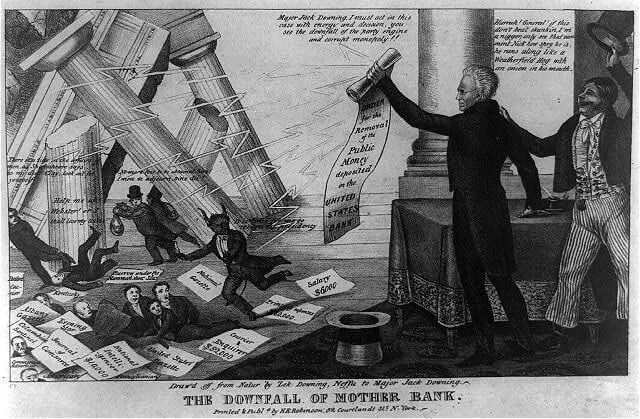
Andrew Jackson, the seventh president of the United States, vetoed the bill to recharter the Second Bank of the United States on July 10, 1832; Congress had presented the bill to him on July 4. 1 2 The Second Bank had been chartered in 1816, was headquartered in Philadelphia, and functioned as an important fiscal institution for the federal government. 3
The bank was infrastructure, but Jackson treated it as a political concentration of power. His veto message objected on constitutional, economic, and populist grounds, arguing that the bank concentrated privileges in a way he believed was inconsistent with the public interest. 2 The veto then became a campaign issue in the 1832 presidential election, which made the bank's operating model inseparable from democratic consent. 4
The aftermath was not clean. Federal deposits were removed in 1833, and the Second Bank became a private Pennsylvania-chartered company in 1836. 3 The broader period included the Panic of 1837 and left the United States without a central bank until the Federal Reserve System was created in 1913. 3
Decision mirror: Shared financial infrastructure needs more than operational competence. If users, voters, or counterparties see the system as captured, the governance fight can become bigger than the service the institution provides.
1962: Telstar proves the market before the rules settle
AT&T launched Telstar 1 from Cape Canaveral, Florida, at 4:35 a.m. ET on July 10, 1962, using a Thor-Delta rocket. 5 Bell Labs built the satellite for AT&T, and the Smithsonian identifies Telstar as the world's first active communications satellite. 6
The phrase "active communications satellite" mattered. Telstar could receive, amplify, and retransmit microwave signals rather than simply reflect them. 6 The satellite enabled the first transatlantic television transmission on July 11, 1962, and a public transatlantic broadcast followed on July 23. 7
Telstar also exposed how hard it is for a private company to own the whole governance layer of a new infrastructure. The satellite failed on February 21, 1963, after radiation damage connected to the Starfish Prime high-altitude nuclear test. 5 In the same year as Telstar's launch, the Communications Satellite Act of 1962 created COMSAT, a government-private hybrid that redirected satellite communications into a regulated structure beyond AT&T alone. 7
The business lesson is not that first movers lose. Telstar gave AT&T and Bell Labs a spectacular proof point. The lesson is narrower: the first working platform in a strategic infrastructure market may prove demand, standards, and feasibility, while the final control model moves to a broader coalition.
Decision mirror: When a product becomes infrastructure, its governance becomes part of the product. A company can win the technical race and still have to share the operating system with governments, regulators, and partners.
1985: Rainbow Warrior shows the cost of coercive control
French intelligence divers attacked Greenpeace's ship Rainbow Warrior at Marsden Wharf in Auckland, New Zealand, late on July 10, 1985; the first explosion came at 7:38 a.m. ET and the second at 7:45 a.m. ET, which was late evening local time in Auckland. 8 Greenpeace photographer Fernando Pereira, 35, drowned after returning to his cabin. 8
The immediate objective was to stop a protest ship. The strategic outcome was much larger. French agents Dominique Prieur and Alain Mafart were captured and later pleaded guilty to manslaughter on November 22, 1985. 8 France publicly admitted responsibility on September 22, 1985, and later paid compensation through UN-mediated settlements. 8 The original Rainbow Warrior was later scuttled as an artificial reef on December 12, 1987. 8
For business readers, the point is not limited to governments. Organizations under pressure often face a version of the same temptation: treat an opponent, critic, leak, union drive, activist campaign, or regulator as an obstacle to neutralize. Coercive control can work on the immediate asset and still expand the conflict by changing the moral frame.
Decision mirror: The more secretive the tactic, the more expensive the disclosure. If the action would be indefensible once public, the risk model is already broken.
2011: News of the World closes when distribution cannot cover conduct
News of the World published its final edition on July 10, 2011, after 168 years in print. 9 James Murdoch announced the closure on July 7, 2011, as the phone-hacking scandal widened. 9 The paper had been founded on October 1, 1843. 10
The decision followed revelations tied to the hacking of murder victim Milly Dowler's voicemail, which shifted the scandal from tabloid misconduct to a reputational crisis for News International. 11 The final front page carried the headline "THANK YOU & GOODBYE," and about 200 staff lost their jobs. 9 The final edition sold an extra 1.5 million copies, according to The Guardian's report the next day. 12
That last sales spike is the uncomfortable part. Audience demand had not vanished. The asset still had attention, brand recognition, and distribution. What it lost was permission to remain the vessel for the parent company's media business under that name.
Decision mirror: A brand can survive weak growth longer than it can survive conduct that makes ownership politically and commercially toxic. When the operating method becomes the scandal, scale becomes evidence against the institution rather than protection for it.
July 10's pattern is blunt. Jackson's veto, Telstar, Rainbow Warrior, and News of the World all turn on control over a system other people depended on or watched closely. The actor with control could trigger the decision. The actor could not unilaterally decide whether the public, the state, the market, or the audience would keep granting trust.
That is the operating mirror. Before pushing a high-control move, ask who else has to keep believing the system is legitimate after the move succeeds.
Cover image: 1833 political cartoon showing Andrew Jackson destroying the Second Bank, via Library of Congress.
参考来源
- 1Library of Congress: Renewal of the Second Bank of the United States Vetoed
- 2Yale Avalon Project: President Jackson's Veto Message Regarding the Bank of the United States; July 10, 1832
- 3Federal Reserve History: The Second Bank of the United States
- 4Federal Reserve Bank of Richmond: The Bank War
- 5Wikipedia: Telstar 1
- 6Smithsonian National Air and Space Museum: Telstar
- 7Smithsonian National Air and Space Museum: Telstar and the World of 1962
- 8Greenpeace Aotearoa: Rainbow Warrior bombing educational resource
- 9BBC News: News of the World to close amid hacking scandal
- 10Wikipedia: News of the World
- 11Wikipedia: News International phone hacking scandal
- 12The Guardian: The final edition of the News of the World sells extra 1.5m copies
相似内容
- 登录后可发表评论。