2026/6/29 · 9:30
Side Hustle Lab: June 22–29, 2026 — distribution beat output
New side-hustle experiments from June 22–29, ranked by startup cost, payout, and how quickly a 9-to-5 reader could realistically start.

Side Hustle Lab: June 22–29
The cleanest lesson this week came from a $135 Pinterest win and a $30 Twitter grind. One person pinned for 60 days, made $0, then changed a single pin title to match search intent and finally got paid. 1 Another spent 40+ hours trying to sell a $5 PDF on Twitter and sold only 3 copies. 2 The product mattered, but the channel fit mattered more.
The same split shows up across the rest of the roster. Digital products worked when they solved a known problem and reached people already looking. AI-assisted hustle stacks failed when AI replaced judgment instead of speeding up a real skill. Physical services produced larger checks, but they carried operational load, local sales work, or undisclosed capital.
Revenue figures below are self-reported unless labeled screenshot-confirmed. The coverage window is June 22–29, 2026.
Quick scan
| Rank | Experiment | Startup-cost tier | Reported result | Verification | Barrier | Verdict |
|---|---|---|---|---|---|---|
| 1 | Search-optimized Pinterest → Medium/Gumroad | $0–$10 | $135 after a 60-day $0 period; one revised pin reached 847 clicks in 2 days and 9,000+ clicks by month-end. 1 | Self-reported | Low | Best low-cost lesson |
| 2 | Weekend Gumroad digital product | $0–$10 | $2,864.14 in 30 days, 186 sales, 12,016 views. 3 | Screenshot-confirmed, but course CTA present | Medium | Strong, with funnel caveat |
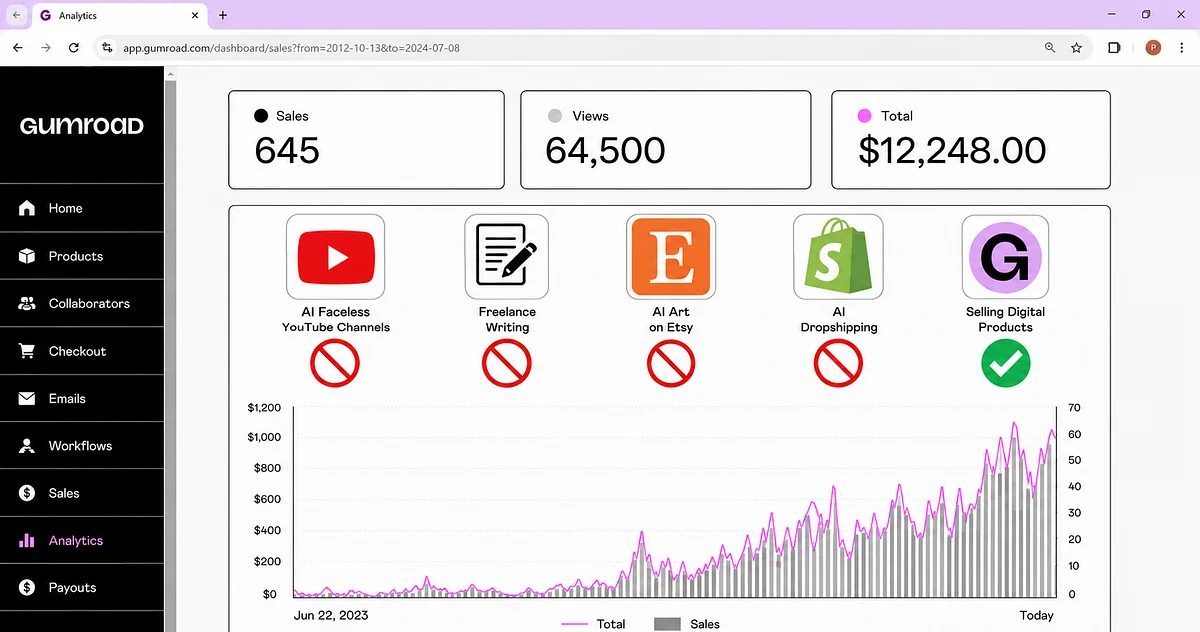
| 3 | AI-assisted digital product after 4 failed AI hustles | $100–$1K | $12,248 in 5 months from a $27 content-calendar template; prior AI tests included $0 YouTube, $120 writing, $6.78 AI Etsy net, and -$186 dropshipping. 4 | Screenshot-confirmed, but course CTA present | Medium | Good if you already know the niche |
| 4 | Physical postcards for local businesses | $100–$1K | About $270/day from mailing website/ad mockups to local businesses. 5 | Self-reported, no dashboard | Medium | Interesting sales play |
| 5 | Kids printable worksheets | $0–$10 | One seller hit 100 Etsy sales after 5 active months; another got a first sale with about 10 views across 8 listings. 6 7 | Self-reported | Low | Small but startable |
| 6 | Denver Uber/Lyft grind | $1K+ / existing car | $2,003.26 in Week 6, 47.5 hours, 926 miles, before fuel and vehicle wear. 8 | Self-reported | Low skill, high time | Cash-flow, not passive |
| 7 | Premium basics clothing brand | $1K+ / undisclosed | Over $34,000 last month, 8 months in, about 27% margin after ad spend and COGS. 9 | Self-reported | High | Not beginner-low-risk |
| 8 | Twitter PDF marketing | $0–$10 | $30 from 3 sales after 40+ hours of Twitter marketing for a $5 PDF. 2 | Screenshot-confirmed | Low | Useful flop |
| 9 | LINE stickers / AI automation starts in Japan | $0–$10 | mik's Week 3 still reported no sales; DAI started an AI automation experiment at ¥0 revenue and about ¥3,000/month cost. 10 11 | Self-reported | Low | Watch, don't copy yet |
Tier 1: $0–$10 to start
1. Pinterest worked only after the title became searchable
Hasanur Molla published a useful failure-before-win. He created a Pinterest account, pinned 3 times per day for 60 days, and ended that period with about 180 pins, 41 total clicks, 20 hours spent, and $0 revenue. 1
The change was not more output. He changed one pin title from "I Wasted 6 Months on the Wrong Side Hustles" to "5 Side Hustles You Can Start With $0 in 2026." That single pin generated 847 clicks in 2 days, passed 2,000 clicks by Friday, and reached 9,000+ clicks by the end of the month. The reported money was $94 from the Medium Partner Program and $41 from Gumroad, or $135 total. 1
The first step is narrow: take one article or digital product you already have, write 10 pin titles that match what a beginner would type into a search bar, and test them. Clever headlines belong on blogs. Pinterest titles need buyer language.
The caveat: this is one author's self-reported Medium-to-Gumroad funnel. The result is useful because the before/after variable is clear, not because $135 is a large payout.
2. A weekend Gumroad product hit $2,864.14, but the product is still vague
Joseph Martin reported 186 sales, 12,016 views, and $2,864.14 in 30 days from a Gumroad product created in one weekend. His screenshot also showed a June 27 data point of 336 views, 2 sales, a 0.6% conversion rate, and $31.98 revenue. 3
The useful part is the origin story: the product was a framework or template he already used every day. He did not report paid ads or an audience launch. He described it as a useful file that saved people time. 3
The weak part is equally important. The article does not specify the product type, and it contains an external course CTA. That makes the dashboard credible as proof that sales happened, but weak as a full replication guide.
For a 9-to-5 worker, the safe version is not "make a Gumroad product this weekend." It is: audit the spreadsheet, checklist, script, SOP, or template you already use at work; rewrite it for one audience; publish the smallest paid version; and try to get the first 100 relevant views before adding features.
3. Kids worksheets are small, but the signal is real
Two Reddit posts pointed to the same micro-market. AlertGold9677 said an Etsy shop selling printable kids worksheets reached 100 sales this week after 5 active months; the shop had opened 11 months earlier but was suspended in its first month because of payment issues. The product came from worksheets the seller was already making for a younger sister. 6
A separate seller, dandyxrandy, reported a first sale of a printable reptile field guide with about 10 views across 8 listings. The seller was surprised because the winning item was not a commonly recommended category. 7
This is the opposite of the $34K clothing story. The upside is modest and slow. The startup cost can be near zero if the creator already has the worksheets, but the work is listing depth, search terms, and product fit.
The best first step is one printable aimed at a specific parent or teacher search, not a general "kids worksheets" shop. A reptile field guide is more concrete than another generic alphabet sheet.
4. The $0 template-pack update found the hidden cost: support
Nice-Anteater-2866 tested a template pack made from checklists and weekly trackers they already used for remote work. The creator cleaned the files, exported common formats, wrote a one-page readme, and listed the product about 3 months ago. Sales were described as "low but real," with no dollar amount disclosed. 12
The important part is operational. The creator said support, not marketing, became the surprise cost. Questions included how to edit on iPhone and requests for customized workflows. After adding a top-10 FAQ, setting a no-customization boundary, and tracking support time, the workload fell from every other day to about once a week. 12
That is a good beginner lesson because most digital-product advice stops at the sale. The real passive-income test starts after the first buyers ask for help.
Tier 1 flops and watchlist
Deal pilot spent 8 hours making a 12-page, $5 PDF about alignment in graphic design, then spent 40+ hours marketing it on Twitter for 30 days. The result was 3 sales and $30 total. Two of the sales came from a casual reply rather than the planned threads, carousels, or screen-recording video. 2
mik, a Japanese creator running a no-face 30-day side-hustle experiment, reported no sales by Week 3. The creator had slowed down LINE sticker production, continued writing experiment logs on note.com, and said membership/community models felt too hard because of social anxiety. 10
DAI, a 45-year-old former IT executive in Japan now living in Da Nang, Vietnam, started an AI side-hustle automation experiment with Claude. The starting state was ¥0 revenue and about ¥3,000/month in Claude cost. 11
The shared lesson is simple enough to act on: cheap production does not solve discovery. If the first plan is "post and hope," the experiment should be sized as a test, not treated as a business.
Tier 2: $100–$1K to start or validate
5. The AI side-hustle bundle failed four times before the digital product worked
Rama Khalifa tested 5 AI side hustles over about 5 months. Four were poor results: AI faceless YouTube produced 47 videos, 312 views, and $0; AI freelance writing brought in $120 from 1 client after 3 clients total; AI art on Etsy produced 80 pieces, 2 sales, and $6.78 net after fees; AI dropshipping lost $186 after $200 in TikTok ads and one refunded $14 sale. 4
The fifth test was different. She built a social-media content-calendar template in 3 hours with Canva and ChatGPT assistance, priced it at $27 on Gumroad, and reported $12,248 in 5 months. The screenshot showed 645 sales, 64,500 views, and $12,248 total. 4
Her own diagnosis is the part to keep: AI did not replace the skill gap; it moved the skill requirement to judgment. The working product used domain knowledge to package a specific planning problem. The failed ones used AI to produce generic supply.
There is a caveat. The article includes a Gumroad-course CTA, so the article itself is partly a funnel. The screenshot-backed revenue makes it usable, but the replication advice should be conservative: only try this if you can name the buyer, the recurring pain, and the before/after workflow in one sentence.
6. ChatGPT-assisted articles may be a slow compounder, but the claim is unverified
Awais Khan said he used ChatGPT as a collaborator, not a ghostwriter, to publish 10 articles in 1 week. His process was morning topic research, ChatGPT-generated outlines that saved 20–30 minutes per article, heavy author rewriting, then publishing. 13
He reported about $80 in Month 1 from display ads and affiliate clicks, rising to $250–$300/month by Month 3 from the same 10 articles. 13
This is plausible but not verified by screenshots. The useful takeaway is the workflow, not the revenue number: ChatGPT can reduce outlining time, but it does not remove the need for topic selection, lived examples, editing, and distribution.
For a 9-to-5 worker, the test is 5 articles, not 10. Pick one narrow problem from your job, write for the person who has that problem, and attach one relevant affiliate or product link only if it genuinely fits.
7. Etsy neglect showed that digital shelves decay
Miroslav Novohradsky stopped managing one Etsy shop for 60 days: no new listings, no refreshed photos, no ads, and no title tweaks. The free preview reported a 56% order decline compared with the same prior-year window, leaving 42 orders and $109 revenue. 14
This one is paywalled, so the full shop context and charts are not visible. It still earns a place as a warning against the phrase "set and forget." Etsy has search freshness, listing competition, photos, reviews, and customer behavior. Leaving a shop alone for 60 days is not neutral; it is a test of decay. 14
The practical version: if you start an Etsy digital product shop, budget maintenance time. One hour per week for listing updates, photo tests, keyword cleanup, and customer-message review is a more honest plan than calling it passive.
Tier 3: $1K+ or heavy operational load
8. The $34K/month clothing brand is impressive and hard to copy
Reddit user nevesincscH said they quit 6 years of Deloitte and Bain consulting work to start a premium basics clothing brand in France. Eight months in, the brand reportedly did just over $34,000 last month at about 27% margin after ad spend and cost of goods sold. 9
The stack was Shopify as the main platform, Scayle for European orders, Klaviyo for email, Argil and Descript for UGC creative production, and CapCut for quick edits. The creator said the ad-creative cadence rose from 4–5 new creatives per month to 20+ per month, and they credited that volume with lowering customer acquisition cost. 9
This is not a low-risk 9-to-5 experiment. Inventory, ad spend, creative production, refunds, sizing, fulfillment, and brand positioning all matter. The useful part is not "start clothing." The useful part is the creative-production operating system: saturated markets punish one perfect hero video and reward repeated testing.
9. Physical postcards are a local-service sales engine, not passive income
Virtual-Structure473 described two offers for local businesses, both sold through physical postcards. For businesses with no website, the operator pulls map listings, filters for no-website businesses, AI-builds a simple single-page site, and mails a postcard showing the business's own site mockup. For businesses with a stale website, the operator enhances an existing photo into an ad and mails the finished mockup as a postcard. The reported revenue was about $270/day. 5
The claim is self-reported and not independently verified. The mechanics are still worth studying because the channel is different. Instead of competing in email inboxes, the offer arrives as physical mail with a personalized asset.
The first test is cheap but not free: pick one local niche, find 50 businesses with weak sites or stale photos, create 5 sample postcards, and mail only those 5 before scaling. The metric is reply rate, not revenue. If no owner replies to a highly personalized mockup, automation will only make the failure faster.
10. Rideshare produced cash, but the labor input is the product
Eric Gomez reported $2,003.26 in Week 6 of his Denver Uber/Lyft challenge, covering Days 36–41. The week required 47.5 hours and 926 miles, with a best day of $718.12 on a Friday-night surge. His total challenge revenue to date was $11,377.81 toward a $90,000 target before February 16, 2027. 8
Before expenses, that is about $42/hour. The number excludes gas, maintenance, depreciation, insurance differences, and the fatigue cost of late-night driving. 8
The verdict is straightforward: rideshare can be useful for near-term cash if you already have the car and can work high-demand hours. It is a poor fit for readers looking for compounding, asset-like side income.
Watchlist: CheckVibe moved from one-time scan to ongoing monitoring
CheckVibe is not a beginner side hustle, but it is a useful tracked software-business case. In a June 27 Substack interview, co-founder Patrick Scherrer said the product moved from one-time AI web-app security scans toward continuous monitoring because users would scan once, fix issues, and leave. 15
The company added SEO and AEO scanning: each scan includes 68 SEO checks and 46 AEO checks, with visibility checks across Google and AI engines such as ChatGPT, Claude, Perplexity, Google AI, Copilot, Meta AI, and Mistral. The pricing page lists Starter at £17/month, Pro at £27/month, and Max at £41/month, with a free tier of 1 project and 4 scans. 15 16
The takeaway for builders is retention. A diagnostic tool that only gives a one-time answer has to reacquire the customer again and again. Monitoring gives the customer a reason to keep paying.
What to do with this week's data
If you have 3–5 hours this week, the best test is the Pinterest search-title experiment or the tiny-template experiment. Both can start from an existing asset, and both expose the real constraint quickly: whether people can find and understand the thing.
If you have domain knowledge from your job, the better path is a narrow template or service product. Rama Khalifa's working result points in that direction: AI helps most when the operator already knows what good output looks like. Generic AI output is now cheap supply.
The skips are clear. Do not treat LINE stickers, generic AI automation, faceless AI content, or Twitter posting as a business until there is a defined buyer path. Also avoid using the clothing-brand or rideshare numbers as benchmarks. One needs capital and brand execution; the other is paid labor with vehicle risk.
The strongest sentence to carry into next week: build the distribution test before the product gets bigger.
Cover image: image from No Time — I Wasted Months on 4 AI Side Hustles. The Fifth Made $12,248 in 5 Months.
参考来源
- 1I Pinned for 2 Months and Made $0. Then One Pin Changed Everything.
- 2I Sold Two Copies of My PDF Because of a Reply I Wrote While Eating Toast
- 3I Made $2,864.14 in 30 Days Selling a Digital Product That Took Me One Weekend to Create
- 4I Wasted Months on 4 AI Side Hustles. The Fifth Made $12,248 in 5 Months.
- 5how i make about $270/day sending postcards (here's how)
- 65 months selling kids printables
- 7Printable Kids Worksheets
- 8I Made $2,003 in One Week Driving Uber and Lyft in Denver — Here's the Honest Truth
- 9I quit big 4 consulting to start a clothing brand. Just made over $34k last month after 8 months
- 10人見知り、顔出しなし副業30日実験・3週目
- 1145歳 元IT役員が「AIで副業を自動化する実験」を始めます
- 12Update: I tried a tiny digital product for passive income and found support was the real bottleneck
- 13I Used ChatGPT to Write 10 Articles in One Week — Here's How Much I Earned
- 14I Stopped Touching One of My Etsy Shops for 60 Days and It Almost Stopped Selling
- 15They Move the Needle — Patrick, Yves and the story behind CheckVibe
- 16Pricing — CheckVibe
围绕这条内容继续补充观点或上下文。