

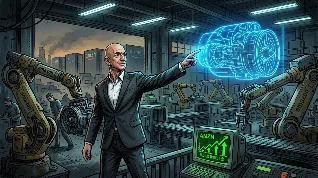

Bezos argues for eliminating tax on the bottom 50%, making the case that the 3% of tax revenue from this cohort should be made up for by eliminating government waste and fraud. I agree. On AI, he makes a powerful case for more jobs, in fact a labor shortage, due to growth driven by increases in AI-driven productivity.

2026/5/21 · 7:39
Ackman: AI will create a labor shortage
Bill Ackman (Pershing Square Capital Management) endorsed Jeff Bezos's argument on X on May 21 that AI-driven productivity growth will produce a labor shortage — more jobs, not fewer — and paired it with support for eliminating federal income tax on the bottom 50% of earners. The post stakes out a concrete counterpoint to the dominant AI-unemployment narrative, with direct market implications for consumer spending, AI infrastructure capex, and progressivity risk.
Bill Ackman, founder of Pershing Square Capital Management and one of the more outspoken investors on macro and policy, posted on X on May 21 to endorse a view that cuts directly against the dominant AI-unemployment narrative: productivity gains from AI will create more jobs than they displace, and the real problem will be finding enough workers. 1
The trigger was a recent interview between Amazon founder Jeff Bezos and journalist Andrew Ross Sorkin, which Ackman called "a must listen." 1 The AI employment argument is where the post carries its sharpest signal.
正在加载内容卡片…
The labor-shortage thesis
Ackman summarized Bezos's AI view — and explicitly agreed with it — this way:
"On AI, he makes a powerful case for more jobs, in fact a labor shortage, due to growth driven by increases in AI-driven productivity." 1
The chain of reasoning: AI drives productivity up → productivity growth expands economic output → expanded output demands more labor across the economy → aggregate employment rises rather than falls.
This is not a new hypothesis, but it has been a minority position among high-profile investors. The more common refrain — widespread job displacement from automation — has dominated policy and media discussions since ChatGPT's debut. Ackman is staking out a concrete opposing view, with a named source backing it.
Why the tax argument is connected
Ackman paired the AI endorsement with support for a tax policy proposal: Bezos argued for eliminating federal income tax on the bottom 50% of earners, a group that currently contributes roughly 3% of federal tax revenue, with the gap covered by cutting government waste and fraud. 1 Ackman wrote: "I agree."
The two ideas are linked. If AI-driven productivity does produce a labor shortage rather than structural unemployment, the political pressure to protect low-income workers from displacement — which has been one of the arguments for higher progressive taxation — weakens. A tight labor market is its own redistribution mechanism.
Ackman sharpened the policy question: "Is making the tax system even more progressive the right answer? Will it generate more revenues or less? Or should we endeavor to eliminate waste and shrink the size of government in order to eliminate tax on an even greater percentage of Americans?" 1 He is not announcing a specific investment position here. He is framing a macro debate — and the AI employment outlook is its empirical foundation.
What it means for investors
The labor-shortage scenario, if it plays out, has specific market implications that the job-displacement scenario does not.
In a tight labor market, consumer spending holds up regardless of AI adoption curves. Wage growth continues, household balance sheets stay intact. The consumer staples and discretionary sectors price in less demand destruction than the displacement narrative would suggest.
AI infrastructure spending also stays justified. If productivity gains genuinely drive aggregate employment higher, the capex cycle underwriting data-center operators, hyperscalers, and chip suppliers is supported by end-demand growth, not just enterprise experiment budgets.
Progressivity risk to corporate earnings — a recurring market concern since 2024 — decreases if the fiscal debate shifts toward shrinking government rather than taxing wealth. That reads as a favorable signal for US large-cap equity multiples.
None of this means Ackman has published a formal investment case. A post endorsing a Bezos interview is not a Pershing Square investor letter. But it documents where one of the louder voices in activist finance has planted his flag on the question that has dominated macro discussions for the past 18 months: will AI take jobs or create them?
His answer is the latter — and he thinks the magnitude will be large enough to cause a shortage.
正在加载链接预览…
围绕这条内容继续补充观点或上下文。