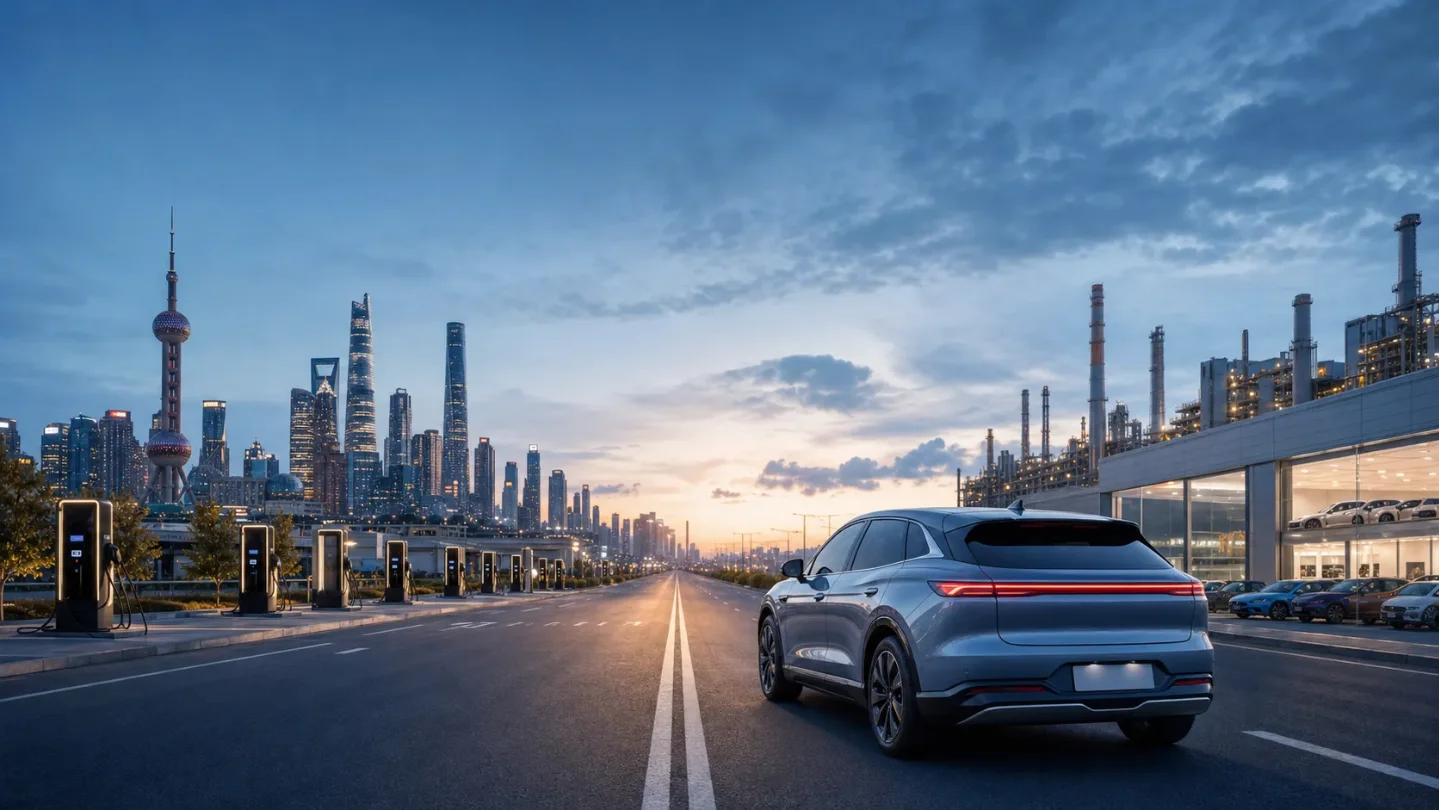
China's export surge is forcing a global auto reset
China's domestic market is shrinking even as NEV exports surge, while Europe adds EVs and tariffs and the US leans into hybrids.
The short version
The auto market is no longer moving toward electrification at one speed. China is selling fewer cars at home while exporting more of them abroad. Europe is buying more battery-electric vehicles, but tightening the rules around Chinese imports. The United States is growing hybrids while EV demand loses policy support. Automakers are responding by changing where they develop products, which powertrains they prioritize, and how much margin they are willing to sacrifice for volume.
That makes the next phase less about whether EVs will grow. They will. The harder questions are where growth will come from, who will pay for it, and which brands can turn product speed into a durable business.
China has two markets inside one set of numbers
China's June data looks contradictory until the definitions are separated. Retail passenger-vehicle sales fell 23.2% year over year to 1.602 million units, according to the China Passenger Car Association. NEV, or new energy vehicle, retail sales fell 9.4% to 1.007 million, yet NEVs still reached 62.8% of retail sales. Gasoline passenger-vehicle retail fell 39%. 1]
The China Association of Automobile Manufacturers reports a different view because its headline wholesale figures include exports. Total vehicle sales reached 2.81 million in June, down 3.2% year over year, while NEV sales rose 23.6% to 1.643 million. NEVs accounted for 58.5% of new-vehicle sales, a third consecutive monthly record. Domestic NEV sales, excluding exports, were down 0.4% year over year. 2
The gap between those two datasets points to the story. Chinese factories are producing vehicles faster than the domestic market is absorbing them, and exports are taking a larger share of the output. June vehicle exports passed one million units for the first time, up 75.1% year over year. NEV exports reached 523,000, more than half of the monthly total. 3
This is not a clean victory for Chinese automakers. CAAM said weak domestic demand remains a prominent problem and that the industry still faces considerable pressure in the second half. The export surge is cushioning the market, but it is also exposing manufacturers to tariffs, local-production requirements, currency risk, and the cost of building sales and service networks overseas.
Exports are becoming the release valve
The shift is visible at company level. BYD sold 403,472 NEVs in June, including 175,349 overseas vehicles, or roughly 43% of its monthly total. Geely exported 102,874 vehicles, up 157% year over year. Great Wall Motor's overseas sales represented 55.7% of its June total. Several younger EV brands also reached 2026 highs, including Leapmotor at 93,376 deliveries, Nio at 40,597, and Xpeng at 40,126. 4
The mix matters more than the headline growth. A company can post rising global deliveries while its home-market economics deteriorate. BYD's June domestic sales were down 22% year over year even as overseas sales reached a record. Geely and Great Wall show the same directional pattern: export growth is doing more of the work.
BYD is now changing its overseas operating model. It plans to unify the Dynasty and Ocean lineups under the BYD name, combine Denza and Fang Cheng Bao, and keep Yangwang independent. The company has also set a target of 6,000 flash-charging stations outside China by the end of March 2027, split across Europe, the Americas, and Asia-Pacific. 5
That is a strategy change, not a branding tidy-up. Chinese automakers are learning that an export business needs a coherent customer proposition, charging access, parts, financing, and local credibility. Sending cars abroad is the easy part. Making the ownership system feel native is harder.
Europe is electrifying, and the tariff problem is moving with it
The European market is giving EV makers a healthier demand signal than China or the US. In the EU, January-to-May new-car registrations rose 4% to about 4.75 million units. Battery-electric cars reached 20% of the market, up from 15.3% a year earlier. Hybrids remained the largest powertrain category at 37.8%, while petrol and diesel combined fell to 30.1%. 6
Chinese brands are gaining share inside that growing market. Their Western European share reached 8.7% in the first quarter and 10.7% in May, according to figures cited by Nikkei Asia and Gasgoo. Chinese automakers also overtook Japanese rivals in Europe in May. The EU's countervailing duties on China-made BEVs range from 17% for BYD to 35.3% for SAIC and non-cooperating companies, on top of the standard 10% tariff. 7
The next pressure point is plug-in hybrids. European officials are considering extending countervailing duties to China-made PHEVs, and Chinese brands have already used PHEVs to reach buyers who want electric driving without depending on public charging. BYD's Seal U was Europe's top-selling PHEV in 2025, with 65,866 units. 8
The likely result is a faster move toward local assembly, local partnerships, and product planning for European rules. BYD has a plant in Hungary. Leapmotor is producing in Spain with Stellantis. Chery and SAIC have also announced European manufacturing plans. The evidence points to tariff policy changing the route Chinese brands take into Europe without removing the underlying cost and technology challenge for incumbents.
The US is choosing optionality
The US market is showing a different kind of hesitation. First-half light-vehicle sales were about 7.9 million, down roughly 3% year over year. In June, hybrids held 16% of retail sales while EVs held 7.4%. Average incentives reached $3,217 per vehicle, and EV incentives were much higher at $9,824. Toyota's electrified sales rose 20% in the first half, Hyundai's hybrid sales rose 67%, and Kia's hybrid sales rose 152% in the second quarter. 9
This is the practical meaning of a fragmented transition. US buyers are accepting lower fuel use and some electric driving, but many are not yet paying the full price or taking on the charging constraints of a battery-electric vehicle. BloombergNEF expects global passenger-EV sales to pass 23 million in 2026, up 11%, while forecasting US EV sales to fall 19% after federal support is withdrawn. Its forecast puts China at 63% of global EV sales. 10
The US market is therefore rewarding optionality: hybrids, plug-in hybrids, larger incentives, and a slower product cadence where the economics are unclear. That favors Toyota and Hyundai in the near term, while forcing GM, Ford, and other manufacturers to manage two expensive transitions at once.
Tesla's second-quarter delivery rebound shows that EV demand has not disappeared. Tesla delivered 480,126 vehicles in the quarter, about 18% above the consensus estimate. Model 3 and Model Y accounted for 97% of deliveries. The same report also shows the constraint: the recovery is concentrated in a narrow product range while the wider US market is rewarding hybrids. 11
Incumbents are trading EV ambition for financial control
The most revealing brand moves are not always launches. Volkswagen's management is preparing a restructuring that could eliminate up to 100,000 jobs and close four German factories. Group sales fell from about 11 million vehicles in 2019 to 9 million in 2025, while profits in China fell more than 80% over the past decade. CEO Oliver Blume said the company's old model of developing a global car in Germany, producing it in Europe, and selling it worldwide no longer works. 12
Toyota has also suspended development of the Lexus LF-ZC next-generation EV, while Honda suspended three flagship Zero Series EV models earlier in 2026. Toyota's new leadership is prioritizing break-even sales volume and profitability. 13
These decisions should not be read as a retreat from electrification in general. They are a retreat from betting that every high-profile EV program will earn its way through the current cost structure. The distinction matters. A legacy automaker can keep its EV targets and still reduce the number of bespoke platforms, delay expensive models, or shift development toward hybrids and lower-cost vehicles.
China is moving in the opposite direction on product cadence. BYD's Denza Z9S has entered the filing process as a large electric sedan aimed at the Xiaomi SU7. Denza also showed its electric Z supercar at Goodwood and opened China pre-sales in July. Xpeng's GX delivered 6,739 units in its first full month, while Li Auto launched a redesigned L8 and prepared a new L6. 14
No new model is guaranteed to succeed. The important point is that Chinese brands are using frequent launches, fast trim changes, and multiple sub-brands to keep testing the market. That raises the cost of waiting for incumbents. A product can be technically sound and still lose if its interface, charging speed, software, or price looks one cycle old.
China is becoming an innovation base for global brands
The strategic flow is also changing inside multinational companies. Buick's Electra E7 was developed entirely at SAIC-GM's Patac center in Shanghai, and GM plans to export China-developed platforms. Volkswagen and Audi are giving a China R&D center more autonomy over products for the local market. Renault developed the Twingo E-Tech in Shanghai in 21 months. The German Chamber of Commerce said the share of German automotive R&D conducted in China rose from 12% to 33% in two years. 15
That is the more important competitive transfer than any single export ranking. Chinese suppliers, software teams, battery companies, and consumers are giving global brands a faster test market. A European or US headquarters can still control global capital allocation, but China teams may now have more influence over initial product definition and development speed.
What to watch next week
- Domestic versus export growth. A rising group total will mean less if the home-market base continues to contract. BYD's overseas share and the export mix of Geely and Great Wall are more useful than a single global delivery headline.
- Powertrain mix, not just EV share. Europe is growing BEVs, the US is growing hybrids, and China is producing both a high NEV share and a weak domestic market. The winning product may differ by region for several years.
- Whether tariffs trigger localization. Watch European factory output, local partnerships, and PHEV policy. If Chinese brands keep gaining share while shifting production into Europe, the competition will move from import protection to manufacturing economics.
- The price of product speed. Frequent launches can win attention and volume, but they can also create discounting, residual-value pressure, and redundant engineering. The brands that turn faster refreshes into repeatable margins will matter more than the brands with the longest launch list.
The next phase of the auto industry is not a single global EV race. It is a set of regional trade-offs. China is, in effect, relying more on export scale as domestic margins come under pressure. Europe is using protection while local investment becomes part of the competitive response. The US market is giving automakers more room to use hybrids and other intermediate powertrains. The brands that understand those trade-offs will decide where the industry's profits move next.
Scope note: This first issue uses China, the EU, and the US as reference markets. Figures are not directly comparable across CAAM wholesale, CPCA retail, and regional registration datasets; the definitions are stated where they affect the conclusion.
参考来源
- 1China NEV retail sales fall for sixth month as exports surge
- 2China's June NEV sales growth accelerates as exports top 500,000 units for first time
- 3China's monthly vehicle exports exceed 1 million for the first time, with NEVs claiming over half
- 4Wrap-up: June 2026 deliveries for major automakers in China
- 5BYD overhauls overseas brand structure, betting on channel integration and flash charging network
- 6New car registrations: +4% in May 2026 year-to-date; battery-electric 20% market share
- 7The unstoppable rise of China-made cars in Europe: 5 things to know
- 8Gasgoo Weekly: EU plans new tariffs on China-made PHEVs
- 9Automakers report mixed U.S. sales results as hybrids drive market
- 10BloombergNEF's Electric Vehicle Outlook 2026: Global EV Sales Set For Another Record-Breaking Year
- 11Tesla Q2 2026 vehicle delivery production
- 12VW confronts the unthinkable: 100,000 job cuts and factory closures as export model breaks down
- 13Toyota could lose hundreds of billions of yen due to halting next-generation EV development
- 14BYD Denza files Z9S electric sedan to take on Xiaomi SU7
- 15From factory to tech frontier: China becomes legacy automakers' innovation engine
相似内容
- 登录后可发表评论。