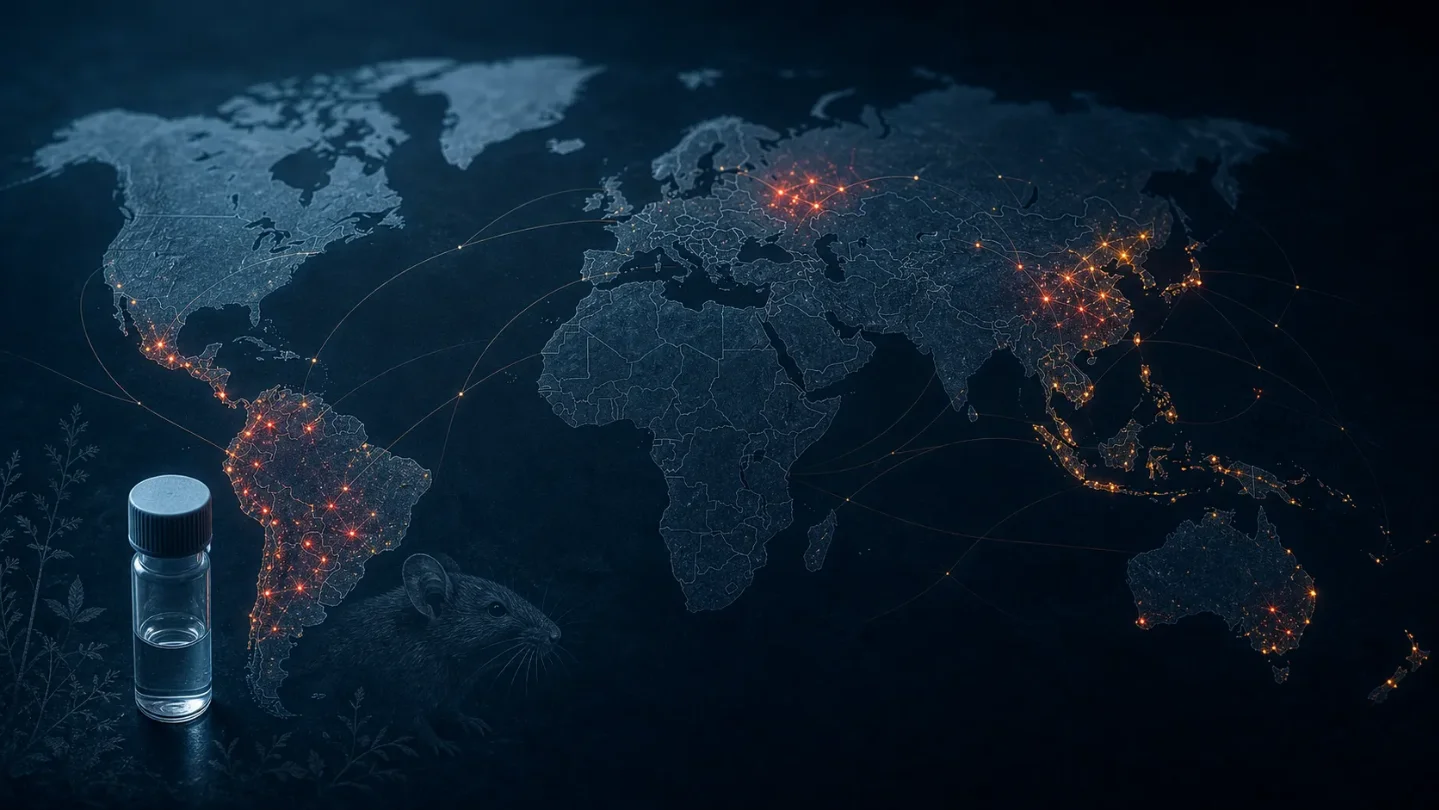
Hantavirus Global Situational Briefing — July 26, 2026
A laboratory-confirmed HFRS case in Ukraine adds a new European surveillance signal, but the exposure site remains unknown and the wider global picture has not shifted to a linked outbreak.

Executive read
A new European case signal is now verified: Ukraine's Lviv Regional Center for Disease Control and Prevention reported a laboratory-confirmed hantavirus infection in a 53-year-old man from Stryi. The clinical presentation was haemorrhagic fever with renal syndrome (HFRS), and hantavirus RNA was detected by PCR in serum. The investigation has not established where transmission occurred. 1
This is a confirmed individual case, not evidence of a Ukrainian outbreak, an Andes-virus infection, or person-to-person transmission. The patient reported travel in Croatia and western Ukraine, but the public-health investigation has not linked the infection to any one site or exposure.
The wider picture is mixed but not escalating as a single global event. ECDC's week 30 bulletin, covering 18–24 July, contains no hantavirus item. Argentina's latest disease-specific national table still shows 51 accumulated 2026 hantavirosis events against a 2022–2025 median of 34, while its latest-four-week comparison is below expected. Venezuela's last public update still consists of three confirmed deaths in Anzoátegui, with two Barinas deaths under investigation and no public case denominator. The M/V Hondius Andes-virus event remains closed at 13 cases and three deaths, with no additional secondary cases reported by WHO. 2 3 4
Signal table
| Signal | Latest verified reading | Interpretation at 08:00 on 26 July |
|---|---|---|
| Ukraine | One PCR-confirmed HFRS case in a 53-year-old Stryi resident; exact exposure site remains unknown. 1 | A new national case signal requiring follow-up, but not enough information to infer local transmission or a regional trend. |
| Europe | ECDC week 30 lists Ebola, West Nile virus infections, Crimean-Congo haemorrhagic fever, malaria, dengue, expert deployment, World Pride and respiratory-virus epidemiology, but no hantavirus topic. 2 | No new ECDC escalation. The Ukrainian case also shows why a threat bulletin cannot substitute for national case surveillance. |
| Argentina | BEN 817 records 51 accumulated 2026 hantavirosis events versus a 2022–2025 median of 34; year-to-date is above expected, while the latest four weeks are below expected. 3 | Cumulative activity remains elevated without a new short-term acceleration in this table. |
| Venezuela | Three confirmed deaths in Anzoátegui; two deaths of health professionals in Barinas remain under investigation. 5 | Serious but too incomplete for a case-fatality estimate, strain attribution or cluster-size estimate. |
| M/V Hondius | WHO's final event notice records 13 cases, 12 laboratory-confirmed and one probable, with three deaths and no additional secondary cases after contact follow-up. 4 | Closed transmission event. Any future source investigation would add ecological attribution, not reopen the event without new cases. |
Ukraine: a confirmed HFRS case with an unresolved exposure site
The Lviv regional health authority said the patient's illness began on 12 July with a temperature of 38.6°C, chills, headache, nausea, loss of appetite and calf-muscle pain. He was admitted to the Lviv Regional Infectious Clinical Hospital on 15 July with an initial diagnosis of an unspecified bacterial infection. Testing found no Leptospira interrogans antibodies in serum and no Leptospira DNA in urine; PCR detected hantavirus RNA in serum. 1
The epidemiological history includes a stay on Croatia's Makarska Riviera from 1–7 July and travel through mountainous areas of Ivano-Frankivsk region on 11 July. The patient denied contact with mouse-like rodents, nests or excreta, time in basements, and consumption of food or water that might have been contaminated. The authority specifically cautioned that swimming in the Adriatic and washing hands in the Kamyanka River are recorded history, not confirmed infection routes. Local anti-epidemic and preventive measures are under way, and the investigation continues. 6
Several limits matter for interpretation. The public report does not identify the hantavirus species or genotype, does not establish whether infection occurred in Croatia or Ukraine, and does not report additional linked cases. HFRS is the clinical syndrome; it is not a strain name. The case therefore adds a verified European surveillance signal, but not evidence of Andes virus, a Croatia-linked cluster, or human-to-human spread.
Europe: the weekly threat bulletin and the national case report are different views
ECDC's week 30 report was published on 24 July and covers 18–24 July. Its listed topics do not include hantavirus, Andes virus or the Hondius event. That supports a narrow conclusion: the latest ECDC threat bulletin contains no new hantavirus escalation. It does not show that every European country had zero cases, and it does not conflict with a national report from Ukraine, which is outside the EU/EEA. 2
A recent Europe-focused commentary in Clinical Microbiology and Infection places the case in a broader preparedness problem. It notes that Puumala and Dobrava viruses account for most recognised European disease, while Seoul virus matters in port and urban settings. It describes the 2026 Hondius Andes-virus cluster, involving passengers from 23 countries, as a stress test for preparedness for both endemic and imported disease. The article is a professional commentary, not a new case series, so its value here is operational: national diagnostic capacity and exposure investigations remain important even when a regional threat bulletin is quiet. 7
The Americas: three separate signals still need separate denominators
Venezuela's 21 July health-ministry statement, reported by Reuters, confirms three hantavirus deaths in Anzoátegui. It separately describes two deaths of health professionals in Barinas as under investigation and says there is no scientific evidence of person-to-person transmission in the country. The report gives no confirmed or suspected patient denominator, onset dates, municipalities, strain, diagnostic method or rodent findings. A fatality rate cannot be calculated from three deaths alone. 5
Argentina's BEN 817 remains the cleaner quantitative signal. Its quick surveillance table gives 51 accumulated 2026 hantavirosis events against a 2022–2025 median of 34. The year-to-date comparison is above expected, but the most recent four-week comparison is below expected. The table does not supply the provincial distribution, strain, exposure setting, deaths or laboratory method behind the 51 events, so it cannot support a claim about a particular rodent host or transmission chain. 3
These figures should not be pooled. The Argentine number is a surveillance-event count, the Venezuelan signal is a partial death report, and the Hondius figure is a closed international event with its own case definition. Chile is not assigned a current count here because the latest indexed Ministry of Health hantavirus bulletin was not available as a readable primary document.
Asia-Pacific and the closed international event
Health New Zealand's page, updated 22 July, continues to say that no human or animal hantavirus case has been identified in Aotearoa New Zealand, that it is not aware of anyone in the country who was exposed, and that the local risk is low. This is a monitoring and risk-communication update, not a new local case report. 8
WHO's final notice for the Hondius event records 13 total cases, including 12 laboratory-confirmed Andes-virus infections and one probable case, with three deaths. All identified contacts completed the 42-day follow-up period without additional secondary cases, and WHO says the outbreak no longer poses a public-health risk. CDC separately reported that all monitored U.S. contacts completed follow-up without developing disease, while rodent and environmental work in Argentina had not established the likely source. 4 9
The operational distinction is now clear. The international transmission event is closed, but the ecological source question remains open. That unresolved work should not be used to connect the ship event to Ukraine or Venezuela without new laboratory, epidemiological or environmental evidence.
Watchpoints for the next briefing
- Ukraine: the patient's clinical outcome, virus species or genotype, the precise exposure investigation, and whether any linked cases or contacts are identified.
- Venezuela: a confirmed and suspected case denominator, diagnostic method, strain information, illness-onset dates, municipality-level geography and rodent findings. The two Barinas deaths should remain outside the hantavirus count until confirmation.
- Argentina: a newer disease-specific bulletin or provincial breakdown that explains the 51-event national total.
- Europe and Asia-Pacific: national notifications that add cases or change the current low-risk and post-response posture.
- M/V Hondius: ecological or sequencing results that identify a source. Such findings would refine attribution, not change the closed transmission status by themselves.
As of 08:00 on 26 July 2026, the new information is a verified HFRS case in Ukraine with an unknown exposure site. It raises the value of national surveillance and diagnostic follow-up, but it does not yet change the global risk assessment: no linked cluster is documented, the Venezuelan signal remains under-quantified, Argentina is cumulatively above its historical reference without a recent four-week excess, and the Hondius outbreak remains contained.
参考来源
- 1Lviv Regional Center for Disease Control and Prevention: confirmed hantavirus infection
- 2ECDC Communicable Disease Threats Report, week 30
- 3Argentina BEN 817, epidemiological week 27
- 4WHO Disease Outbreak News: Hantavirus outbreak linked to cruise ship travel
- 5Venezuela says three people with confirmed hantavirus have died
- 6Ukraine: Lviv man contracts hantavirus after vacationing in Croatia
- 7Hantavirus risk and preparedness in Europe in an era of climate change and global mobility
- 8Health New Zealand: Hantavirus
- 9CDC transcript: Update on CDC's Hantavirus Response
相似内容
- 登录后可发表评论。