



The $6,000 shower curtain and the $36 billion empire: Tyco's governance collapse and reconstruction
2026/6/19 · 8:27

The $6,000 shower curtain and the $36 billion empire: Tyco's governance collapse and reconstruction

Dennis Kozlowski built Tyco International into a $36 billion conglomerate through 1,000+ acquisitions — then used it as a personal ATM, extracting $274 million through a hijacked employee loan program, billing a $2.1 million Sardinia birthday party to the company, and forging bonus approvals the Compensation Committee never gave. A sales-tax evasion probe on a Monet painting unraveled everything. This case traces the decade-long governance capture, the two criminal trials (mistrial 2004, conviction 2005), the $3.2 billion shareholder settlement, and Ed Breen's clean-slate board replacement that became the post-SOX governance template — concluding with the 2007 three-way breakup that dismantled the conglomerate structure that had made the looting possible.

In June 2002, Manhattan District Attorney Robert Morgenthau's investigators were pursuing a routine sales-tax evasion case against an art dealer when they noticed something odd on an invoice for a Monet painting. The work had been shipped — at least on paper — to New Hampshire to avoid New York City sales tax. The actual painting had traveled roughly one city block, from the dealer's gallery at 930 Fifth Avenue to the buyer's apartment at 950 Fifth Avenue. The buyer was L. Dennis Kozlowski, the chief executive of Tyco International, one of America's largest conglomerates, with a market capitalization that had recently topped $100 billion.
That invoice led to a sales-tax indictment. The indictment opened a broader investigation. The broader investigation uncovered a decade of systematic looting that would result in a $1 billion accounting fraud settlement with the SEC, a $3.2 billion shareholder class-action settlement, and criminal sentences of 8⅓ to 25 years for Kozlowski and his CFO. By the time the legal reckoning was complete, Tyco no longer existed as a single company — it had been split into three publicly traded entities in one of the most consequential governance-driven restructurings of the post-Enron era.
This case study traces that arc: how a board lost control of a CEO it had made extraordinarily wealthy, how the institutional machinery of corporate governance failed at every level, and how one incoming executive rebuilt the company into a laboratory for Sarbanes-Oxley compliance before concluding that the conglomerate structure itself had to be dismantled.

The four parties and what they actually wanted

PartyStated objectiveReal leverageBATNAHidden preference
Kozlowski / SwartzRun Tyco as a high-growth conglomerate; maximize stock performanceTotal operational control; compliant board; KELP loan structure as personal liquidity toolCriminal exposure (none perceived)Unlimited personal enrichment without disclosure; preserve appearance of authorized compensation
Tyco board (pre-2002)Oversee a high-performing CEO; retain executive talent; avoid disruptionBoard composition authority; Compensation Committee approval powerCEO departure to a competitorMinimal friction; continued stock appreciation; avoid reputational damage
Manhattan DA / SECProsecute corporate theft and securities fraud; deter future misconductCriminal indictment power; civil enforcement authority; full document discoveryPublic censure without convictionFull conviction; disgorgement; officer/director bars
Ed Breen (post-2002)Stabilize Tyco; avoid bankruptcy; rebuild market confidenceMandate from panicked board; SOX compliance as external authority anchorCompany collapse (liquidation value)Full governance reset; clean separation from Kozlowski-era liabilities; strategic breakup when conditions allowed

The acquisition machine, 1992–2001

Dennis Kozlowski became Tyco International's chairman and CEO in 1992, succeeding John Fort. The company at the time was a diversified manufacturer — fire protection systems, electrical components, healthcare products — with annual revenue of roughly $3 billion and a market capitalization of approximately $1.5 billion. 1
Over the following decade, Kozlowski completed more than 1,000 acquisitions, pushing revenue to approximately $36 billion and peak market capitalization to $106 billion in 2001. 2 The signature deals included ADT Security Services (acquired 1997 for $5.6 billion), which more than doubled Tyco's size and shifted the nominal corporate headquarters to Bermuda for tax purposes, and CIT Group (2001, $9 billion), a commercial lending business that extended Tyco's reach into financial services. 1
Wall Street rewarded the strategy generously. Tyco's stock rose from around $32 at Kozlowski's appointment to nearly $62 at its 2001 peak. His own compensation tracked the ascent: $950,000 in 1992, $26 million in 1997, $70 million in 1998, and a reported IRS income of $137,491,353.39 in 2000 — a figure that combined authorized compensation with funds that prosecutors would later characterize as outright theft. 3
An anonymous Tyco director, quoted in The New Yorker, captured the board's posture at the time: "One thing we found out after he was CEO is that he really had a big pair of balls. By God, he was not afraid of risk. He took risks and he made it work." 1 That admiration was, in retrospect, the opening of the governance gap.

The governance failure: board structure and the KELP mechanism

The compensation committee's blind spot

Tyco's board under Kozlowski had eleven members — a mix of long-tenured insiders, allied business partners, and directors with financial relationships to the company that created layered conflicts. 4 Director Richard Bodman had invested $5 million with Kozlowski in a private fund. Director Stephen Foss received $751,000 for aircraft services routed through a company in which he held an interest. Director Lord Michael Ashcroft, who joined Tyco through the ADT acquisition, used $2.5 million in company funds toward a personal property purchase. 1
The Compensation Committee — chaired at different periods by Foss and later by Frank Walsh — never approved a series of payments that Kozlowski and CFO Mark Swartz quietly processed for themselves. Foss testified at trial that the committee had not authorized the $25 million / $12.5 million special bonuses of August 1999, the TyCom IPO loan-forgiveness payments (roughly $33 million for Kozlowski, $16.6 million for Swartz), or the ADT Automotive sale bonuses ($16 million / $8 million). 5 As Foss later testified, the board became concerned about executive loan balances only in 2001 — after learning at a Christmas party in New Hampshire that one division president was financing a very expensive home in the state through the company. 5
The Harvard Business Review later summarized the structural cause: "In the heat of the new economy… it became unfashionable for [finance] to exercise checks and balances on [operations]." 6

The KELP: a loan program as personal ATM

The Key Employee Loan Program (KELP) had been established in 1983 with a legitimate purpose: to advance funds so that executives could pay federal income tax on vesting restricted stock without having to sell the underlying shares. 3 Between 1997 and June 2002, Kozlowski borrowed more than $274 million from the program through over 200 separate transactions. Of that total, approximately $29 million — barely 10% — went to actual tax payments. The remaining $245 million funded yachts, art purchases, jewelry, luxury apartments, and vacation homes. 7
Swartz borrowed approximately $85 million from KELP, with a similar disproportion between stated purpose and actual use. Mark Belnick, Tyco's executive vice president and chief corporate counsel, took $14 million in "relocation loans" — $4 million for a Manhattan apartment (despite never having worked at Tyco's New Hampshire headquarters, which is the standard condition for such loans) and $10 million for a ski house in Park City, Utah, in a state where Tyco had no operations. 4
What made the mechanism particularly opaque was a secondary layer: Kozlowski arranged to forgive loan balances without board authorization. In August 1999, he credited $25 million to his own KELP account as forgiven and $12.5 million to Swartz's — a transaction the board later confirmed it had never approved. In September 2000, another round of forgiveness followed: $33 million for Kozlowski and $16.6 million for Swartz, booked under TyCom IPO-related entries. These forgiven amounts were recorded in Tyco's financial statements under fictitious categories — "TyCom offering expenses" and "direct selling costs" — and were not disclosed to shareholders. 3
Stephen Cutler, the SEC's Director of Enforcement, later described the pattern in terms that applied to the entire Kozlowski era: "Kozlowski, Swartz and Belnick treated Tyco as their private bank, taking out hundreds of millions of dollars of loans and compensation without ever telling investors. Those shareholders deserved better than to be betrayed by the management of the company they owned." 7

The $20 million finder's fee and the director who voted to pay himself

While Kozlowski and Swartz were operating the KELP mechanism, Lead Director Frank Walsh was running a simpler self-dealing arrangement. In late 2000, Walsh recommended that Tyco acquire CIT Group. As the transaction moved toward closing, Kozlowski — without disclosing to the full board — agreed to pay Walsh a "finder's fee" of $20 million ($10 million in cash and $10 million as a charitable contribution to a foundation of Walsh's choosing). Walsh voted in favor of the CIT acquisition at the board meeting without disclosing that he would receive a payment contingent on that vote. 8
The payment came to light only in January 2002, when Tyco's lawyers preparing the annual proxy statement stumbled across it in the company's books. Walsh refused to return the money, saying he had earned it. He resigned from the board in February 2002. 5 Director Joshua Berman called it "a blatant conflict of interest, unheard of for a director." 1
The personal spending Kozlowski ran through Tyco was no secret to anyone who saw the receipts — it simply was never escalated. Tyco purchased a $16.8 million apartment at 950 Fifth Avenue for Kozlowski and spent an additional $3 million renovating it, including a hand-painted interior by two German craftsmen. Among the items billed to the company: a $15,000 dog umbrella stand, a $2,200 gilded wastebasket, and a $6,000 upholstered partition that became one of the most recognizable symbols of the scandal — despite being, technically, a window covering rather than a shower curtain. 9
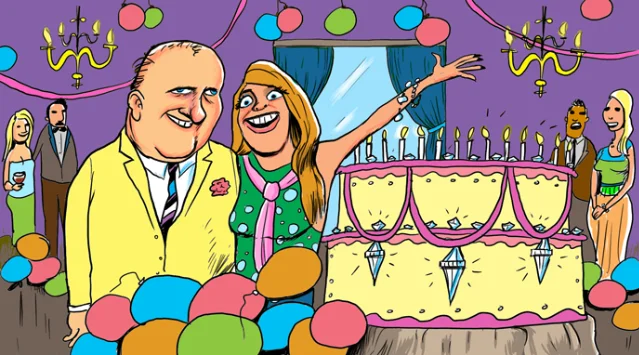
Cartoon illustration of Kozlowski and Karen Mayo at their Sardinia birthday celebration, with a large cake, balloons, and party decorations
The $2.1 million Sardinia birthday party — held June 10-11, 2001 on the island's Costa Smeralda — featured a Roman-theme, Jimmy Buffett performing ($250,000 fee), and a David ice sculpture serving Stoli vodka. Tyco reimbursed more than $1 million. 10

The June 2002 crisis

The sales-tax trigger

The Sardinia party, the apartments, the art collection, and the KELP loans might never have come to public attention if not for a detail on an invoice. In early 2002, Morgenthau's office, while investigating art dealer Alexander Apsis on an unrelated matter, found that Kozlowski had purchased a $3.95 million Monet through Apsis with a bill of sale noting "sales tax is not applicable as the painting is being sent to New Hampshire." In fact, the painting had moved one city block. A contemporaneous memo written by art consultant Christine Berry contained a hand-scrawled "wink, wink" next to the shipping notation. 1
On Friday, May 31, 2002, Kozlowski's personal attorney informed him that a criminal indictment for evading more than $1 million in New York sales taxes was imminent. Over the weekend, Kozlowski called each director. By Saturday evening, the board had reached unanimous agreement: he had to go. 11 At 1:30 AM on Monday, June 3, a telephone board meeting accepted Kozlowski's resignation. John Fort, the former CEO he had replaced a decade earlier, returned as interim CEO. On June 4, Kozlowski was arraigned on 12 counts of sales-tax evasion and released on $3 million bail. 12
The stock, which had already been falling on accounting concerns throughout 2002, continued its descent. What had begun as a tax case quickly expanded as Boies, Schiller & Flexner, the law firm retained to conduct an internal investigation, began pulling on the threads of the KELP program, the unauthorized bonuses, and the acquisition accounting.

The September indictment

On September 12, 2002, Morgenthau's office announced sweeping new indictments. Kozlowski and Swartz each faced 38 criminal charges — enterprise corruption, conspiracy, grand larceny (the theft of approximately $170 million directly from the company), and securities fraud (a further $430 million extracted through fraudulent stock sales). 13 Belnick faced charges of falsifying business records. Kozlowski was released on $100 million bail — among the highest personal bail amounts in U.S. history — and approximately $600 million in combined assets were frozen. 2
The same day, the SEC filed civil fraud charges against all three, and Tyco simultaneously brought a civil suit against Kozlowski seeking to recover $244 million in compensation since 1997 plus all severance benefits. 7
The company-level accounting problems were distinct from the individual criminal charges, and the distinction matters for how practitioners read this case. The SEC's 2006 settled civil action against Tyco as a corporate entity found that the company had inflated reported operating income by at least $1 billion between 1996 and 2002: approximately $500 million through improper acquisition accounting (understating acquired assets, overstating acquired liabilities to create "cookie jar" reserves) and $567 million through bogus "connection fees" at ADT Security Services — a revenue recognition scheme where ADT charged dealers a connection fee while simultaneously paying it back through inflated contract prices. 14 The New Yorker, writing in 2003, made the architectural distinction explicit: "Unlike Enron, Global Crossing, WorldCom, and Adelphia, Tyco has not turned out, so far, to be another massive corporate-accounting fraud." The core problem at Tyco was executive self-dealing and theft, not a fictitious business. 1

The first trial: six months, a hung jury, and a "wink"

The first criminal trial of Kozlowski and Swartz opened in September 2003 before Justice Michael Obus in Manhattan Supreme Court. The prosecution presented 32 counts and roughly six months of testimony. On April 2, 2004, at 12:20 PM, Obus declared a mistrial. The triggering event was a report in The Wall Street Journal identifying Juror No. 4 — Ruth Jordan, a 79-year-old retired teacher — as apparently having made an "OK" hand gesture toward the defense table during deliberations. Jordan, who maintained she was the lone holdout for acquittal, subsequently received threatening phone calls and letters. Obus noted formally: "No finding has been made that this juror has done anything remotely wrong." 15
Morgenthau acknowledged the outcome tersely: "It is unfortunate that, after a six-month trial, the proceedings ended in a mistrial." He promised a retrial "at the earliest opportunity." 15
While awaiting the retrial, Mark Belnick was tried separately. On July 15, 2004, a Manhattan jury acquitted him on all charges after five days of deliberation — the highest-profile corporate acquittal since the post-Enron prosecutions began. Belnick later settled SEC civil charges for a $50,000 fine and a five-year officer ban. 16

The second trial: conviction on 22 of 23 counts

The retrial opened in January 2005. Prosecutors slimmed their case after criticism that the first trial had been too diffuse — they removed some of the more colorful expense details and tightened the legal theory around the unauthorized bonus payments. Kozlowski testified in his own defense, describing his compensation arrangements as "confusing" and "almost embarrassingly big" but arguing none of it was criminal. 2
On June 17, 2005, after 11 days of deliberation, the jury convicted Kozlowski on 22 of 23 counts — grand larceny, securities fraud, conspiracy, and falsifying business records. Swartz was convicted on parallel charges. 17 On September 19, 2005, Justice Obus sentenced both men to indeterminate terms of 8 years and 4 months to 25 years in New York state prison. Kozlowski was fined $70 million; Swartz $35 million. Combined restitution ordered to Tyco: $134 million. 18
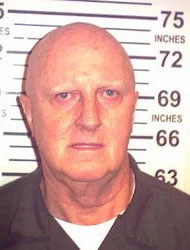
Dennis Kozlowski's New York State Department of Corrections booking photograph
Kozlowski's New York State DOC booking photograph. He served more than six and a half years before being released on parole on January 17, 2014. 19
Walsh — who had pleaded guilty in December 2002 to violating New York's Martin Act — paid $20 million in restitution and a $2.5 million criminal fine in exchange for avoiding prison, and was permanently barred from serving as a director or officer of a public company. 8
The SEC filed its settled civil injunctive action against Tyco International as a corporate entity on April 17, 2006 (Case No. 06 CV 2942, S.D.N.Y.), requiring the company to pay a $50 million civil penalty and $1 in nominal disgorgement, and to accept a permanent injunction against future securities law violations. 20 The company-level enforcement action was separate from, and settled independently of, the shareholder class action, which resolved in May 2007: Tyco paid $2.975 billion to defrauded shareholders, and PricewaterhouseCoopers — Tyco's auditor throughout the Kozlowski era — paid an additional $225 million, in what ranked among the largest auditor settlements on record. 21 22
In December 2010, a separate civil ruling under New York's "faithless servant" doctrine required Kozlowski to forfeit all compensation earned during his period of disloyalty — a period Tyco argued ran from 1997 through 2002, covering approximately $500 million in salary, bonuses, and stock gains. Combined with criminal fines and restitution, Kozlowski ultimately paid approximately $167 million, effectively wiping out his personal wealth. 2
At his 2013 parole hearing, Kozlowski offered a different explanation than he had during trial: "It was greed, pure and simple. I feel horrible. I can't say how sorry I am and how deeply I regret my actions." 19

Ed Breen's board rescue

Edward Breen joined Tyco as chairman and CEO in July 2002 — arriving from Motorola, where he had served as president and COO for less than seven months — on the same day CNBC reported that Tyco might file for bankruptcy. The stock fell 18% that day. 23 The company had $28 billion in debt, of which $11 billion was due within 12 months.
Breen's approach to the governance problem was categorical rather than surgical. He fired 290 of the top 300 executives and then fired the board that had hired him, replacing it entirely with independent directors who had no prior relationship with Tyco. The new board was led by John Krol — former chairman and CEO of DuPont — as lead director, and included Jerome York, the former Chrysler CFO who had also served on Apple's board during its turnaround. 23
On September 11, 2002 — one year exactly after the World Trade Center attacks — Breen appointed Eric Pillmore as Tyco's first-ever Senior Vice President of Corporate Governance. Pillmore's task was to build the compliance architecture from scratch: a 32-page Guide to Ethical Conduct distributed in multiple languages to all 250,000+ employees, a confidential ethics hotline (the "ConcernLINE"), an ombudsman function, and a mandatory annual ethics certification for every employee. 6
Breen also imposed a three-year moratorium on acquisitions — a direct structural repudiation of the Kozlowski model. "I wanted the company to be operationally fixed," he told Wharton. "Then when we add acquisitions on top of it, we have the right systems in place." 23 He closed 980 facilities totaling 25 million square feet of real estate, including Tyco's Manhattan offices, and moved the operating headquarters to West Windsor, New Jersey. At the 2003 annual meeting, shareholders voted to require independent approval of any future executive severance arrangements and to mandate a non-executive chairman.
The financial recovery was rapid by any measure. Revenue, which had fallen from $34.8 billion to the low $30s in the immediate post-scandal period, recovered to $40.2 billion by 2004. Net income swung from a $9.2 billion loss in 2002 — driven by write-downs — to a $2.9 billion profit in 2004. 23
Pillmore described the institutional position Tyco occupied with notable precision: "Among all the companies that were touched by scandal in 2002, Tyco was uniquely positioned to serve as a laboratory for governance reform. It had solid manufacturing businesses and, unlike Enron or WorldCom, it was not the victim of massive, systemic accounting fraud." 6
Tyco's reconstruction coincided with the passage and implementation of the Sarbanes-Oxley Act, signed by President George W. Bush on July 30, 2002 — three weeks after Breen's appointment. SOX passed the Senate 99-0 and the House 423-3. Senator Chuck Schumer, in floor debate on the conference report, named Tyco explicitly among the corporate scandals that had made the legislation necessary: "Enron, Arthur Andersen, Adelphia, CMS Energy, Reliant Resources, Dynergy, Tyco International, and now Xerox and WorldCom." 24 Because Breen was building governance infrastructure at the exact moment SOX was creating the regulatory baseline, Tyco's compliance program was constructed to meet — and in many respects exceed — the new statutory requirements, making it one of the first demonstrable examples of what post-SOX governance could look like in practice. 25
正在加载链接预览…

The breakup: announced January 2006, executed July 2007

By early 2006, the legal and financial stabilization was far enough along that Breen could address the question he had been deliberately deferring: what was the Tyco conglomerate actually worth as a single entity? He had already asked the question internally. "That's the age-old conglomerate question," he told Wharton. "What is the corporate shell adding in value? Otherwise the divisions should be on their own." 23
On January 13, 2006, the Tyco board approved the separation into three independent publicly traded companies, to be distributed as tax-free stock dividends to existing shareholders: 26
  • Tyco Healthcare (later renamed Covidien after the separation), containing medical devices, pharmaceuticals, and imaging products
  • Tyco Electronics (later renamed TE Connectivity), containing passive electronic components for automotive, telecommunications, and industrial applications
  • Tyco International, containing the original fire protection and security businesses, including ADT Worldwide
Breen announced: "Our balance sheet and cash flows are strong and many legacy financial and legal issues have been resolved. After a thorough review of strategic options with our board of directors, we have determined that separating into three independent companies is the best approach to enable these businesses to achieve their full potential." 26
The distribution was executed on June 29, 2007. Each Tyco shareholder received one share of Covidien (NYSE: COV) and one share of Tyco Electronics (NYSE: TEL) for every Tyco share held, followed immediately by a 1-for-4 reverse stock split on the residual Tyco entity. Regular-way trading on all three companies began July 2, 2007. 27 Tyco Electronics had 2006 sales of $12.8 billion and an initial market capitalization of approximately $19.87 billion, with shares opening at $39.97. Covidien had 2006 sales of $9.6 billion. Total breakup costs reached approximately $1.6 billion, the majority attributable to debt refinancing and tax-structuring fees. 28
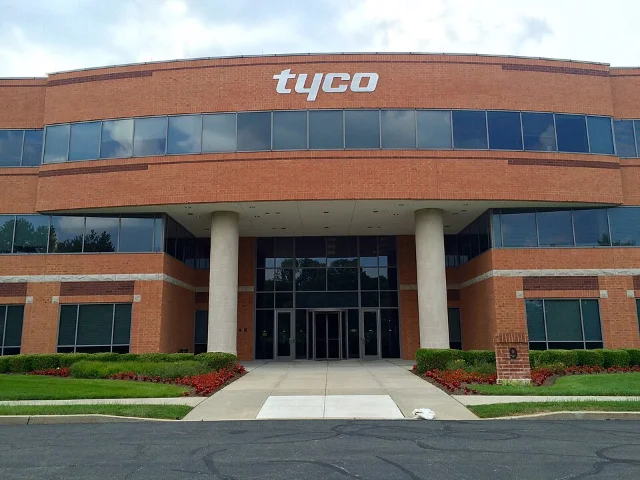
Tyco International headquarters in West Windsor, New Jersey — the brick building with white Tyco lettering that Ed Breen moved operations to from Manhattan in 2002
Tyco's West Windsor, NJ headquarters — where Breen relocated the company from its Manhattan offices as part of the governance reset. 29
The three successor companies went on to separate trajectories. Covidien was acquired by Medtronic for $42.9 billion in 2015, with the combined entity redomiciling to Ireland in a transaction that itself attracted controversy as a corporate tax inversion. 30 Tyco Electronics, renamed TE Connectivity in 2011, grew its market capitalization from approximately $19.87 billion at the 2007 IPO to roughly $61.94 billion by the mid-2020s. 31 Post-breakup Tyco International underwent a second breakup in 2012 — spinning off ADT as a separate public company and merging its flow-control business with Pentair — before the residual fire-and-security entity merged with Johnson Controls in September 2016 to form Johnson Controls International. 29
The Harvard Business School published a 29-page teaching case, "Tyco International: Corporate Governance" (Case 408-059), in November 2007, examining how the board recovered from scandal without filing for bankruptcy — a success story that was, at the time of the case's publication, still uncommon enough to warrant detailed study. 32

Frameworks you can use

Governance capture: when the board becomes a ratification machine

Kozlowski's board did not fail because its members were incompetent. It failed because its composition, financial relationships, and behavioral norms had converged over a decade into a structure that treated CEO decisions as requiring approval in form but not in substance. Multiple directors had direct financial ties to Kozlowski or Tyco. Long tenure — most members had served for more than ten years — created familiarity that eroded adversarial scrutiny. The Compensation Committee approved broad annual compensation frameworks but was never informed of the side payments, loan forgiveness rounds, and fee arrangements that ran in parallel.
The Stanford Law Review's empirical study of outside director liability (1980–2005) identified only four cases where directors paid meaningful personal sums — and placed the Tyco/Walsh case in a distinct category from monitoring failures: Walsh's liability arose from self-dealing (breach of the duty of loyalty), not from oversight failure. 33 That distinction matters for practitioners: the legal risk profile for directors who fail to catch fraud is very different from the risk profile for directors who participate in undisclosed self-dealing. Boards that want to avoid governance capture should focus less on compliance checklists and more on whether any director's financial interests are correlated with specific CEO decisions — and whether the CEO controls the board's information flow.

The loan-forgiveness compensation evasion pattern

Tyco's KELP fraud had a structure worth isolating. The mechanism operated in three steps: (1) establish a nominally legitimate loan program with board approval; (2) extract funds from the program in excess of its stated purpose without alerting the authorizing committee; (3) forgive the excess balance through a series of small, variously characterized ledger entries that never surface as a single reportable line item.
The pattern is not unique to Tyco. Executive loan forgiveness was a documented phenomenon at WorldCom (Bernard Ebbers borrowed $408 million and had $408 million forgiven 34) and at Adelphia (the Rigas family used company funds as personal financing). SOX Section 402 — enacted in direct response to these cases — prohibits public companies from making or arranging personal loans to executive officers or directors. The practical lesson for compensation committee members: any loan program accessible to senior executives requires independent review of actual disbursement purposes, not just the program's stated eligibility criteria. Aggregate loan balances are far less informative than transaction-level purpose codes.

The acquirer's governance discount

Kozlowski's acquisition strategy created a governance blind spot that was structural, not incidental. A company growing through more than a thousand acquisitions over a decade cannot build the organizational infrastructure — consistent accounting systems, unified HR policies, centralized financial controls — fast enough to keep pace with the integration workload. Tyco's operating divisions reported directly to Kozlowski with minimal corporate oversight, which the UNM case study described as a "decentralized organizational structure" where "few people, including board members, accurately understood the company's activities and financial condition." 4
This creates what might be called an acquirer's governance discount: each incremental acquisition adds revenue and complexity, but the governance infrastructure — audit controls, financial reporting, compliance oversight — scales more slowly than the enterprise. At some threshold, the CEO is the only person who holds the full organizational picture, which is precisely when the CEO's personal incentives become the single most important governance variable. Boards of serial acquirers should treat rapid inorganic growth as a governance risk factor rather than purely a financial one, and should demand evidence of integration maturity — not just revenue addition — before approving successive large transactions.

The clean-slate board replacement playbook

Breen's response to the governance failure established a template that subsequent practitioners and HBS teaching cases have cited as a model. The components:
Replace comprehensively, not selectively. Breen replaced 290 of the top 300 executives and the entire board. Selective replacement — keeping some legacy figures while adding new ones — preserves informal networks of loyalty and information asymmetry that undermine the authority of incoming leadership. "Comprehensive" signals a genuine break; "selective" signals ambiguity about whether the old norms still apply.
Create governance infrastructure before enforcement. Pillmore's appointment on September 11, 2002, predated the formal organizational cleanup by months. Ethics programs, hotlines, and compliance checklists matter less for their immediate detection capability than for their signal value — they communicate to the organization that a behavior-reporting norm is now legitimate, which changes the threshold at which employees escalate concerns.
Use external authority as an anchor. Breen could have resisted aspects of SOX as compliance burdens. Instead, he positioned Tyco as the standard-bearer — building governance infrastructure that exceeded SOX requirements and citing the external mandate as a legitimizing frame for internal change. When transformational change has an external authority source (regulatory requirement, court order, new ownership), leaders can make institutional demands that would otherwise look like personal power plays.
Explicitly address the conglomerate question. The breakup was the final act of the governance reset, not an add-on. By separating into three focused entities — each with its own independent board and management team — Breen eliminated the structural condition that had enabled Kozlowski: a single CEO who was the sole integrator of information across a dozen unrelated business lines.

What to remember

  • The KELP mechanism was a precision instrument, not a smash-and-grab. Kozlowski borrowed $274 million through over 200 individual transactions in a program that had existed since 1983. The mechanism's longevity and apparent legitimacy was what made it invisible to the Compensation Committee. Simple theft is easy to detect; incremental extraction through existing authorized channels is not.
  • Governance capture is slow and self-reinforcing. The board members who approved Kozlowski's escalating compensation packages in the late 1990s were not acting corruptly — they were responding to genuine stock performance and an admired CEO. But each approval made the next approval easier, each withheld challenge made the next challenge harder, and by 2001 the board's deliberative function had effectively ceased. The Christmas party anecdote — a director discovering loan abuses informally, at a social event — is not a fluke; it is the endpoint of a process where formal oversight channels have been progressively bypassed.
  • Ed Breen's recovery was faster than the scandal warranted because the underlying businesses were real. Pillmore's characterization of Tyco as a "laboratory for governance reform" depended on a condition that did not apply at Enron or WorldCom: the company's actual operations — fire protection, electronic components, medical devices — were profitable and could be governed properly once the self-dealing was removed. Governance failure at a company with a genuine business is recoverable; governance failure at a company whose revenues are partly fabricated is not.
  • The SOX legislative moment amplified the governance rebuild. Had Breen arrived in 2002 without the external pressure of a sweeping new regulatory framework, the governance changes he implemented would have been internally optional. SOX converted optional reforms into compliance requirements, giving Breen institutional cover for changes that a board's natural risk-aversion might otherwise have delayed or diluted.

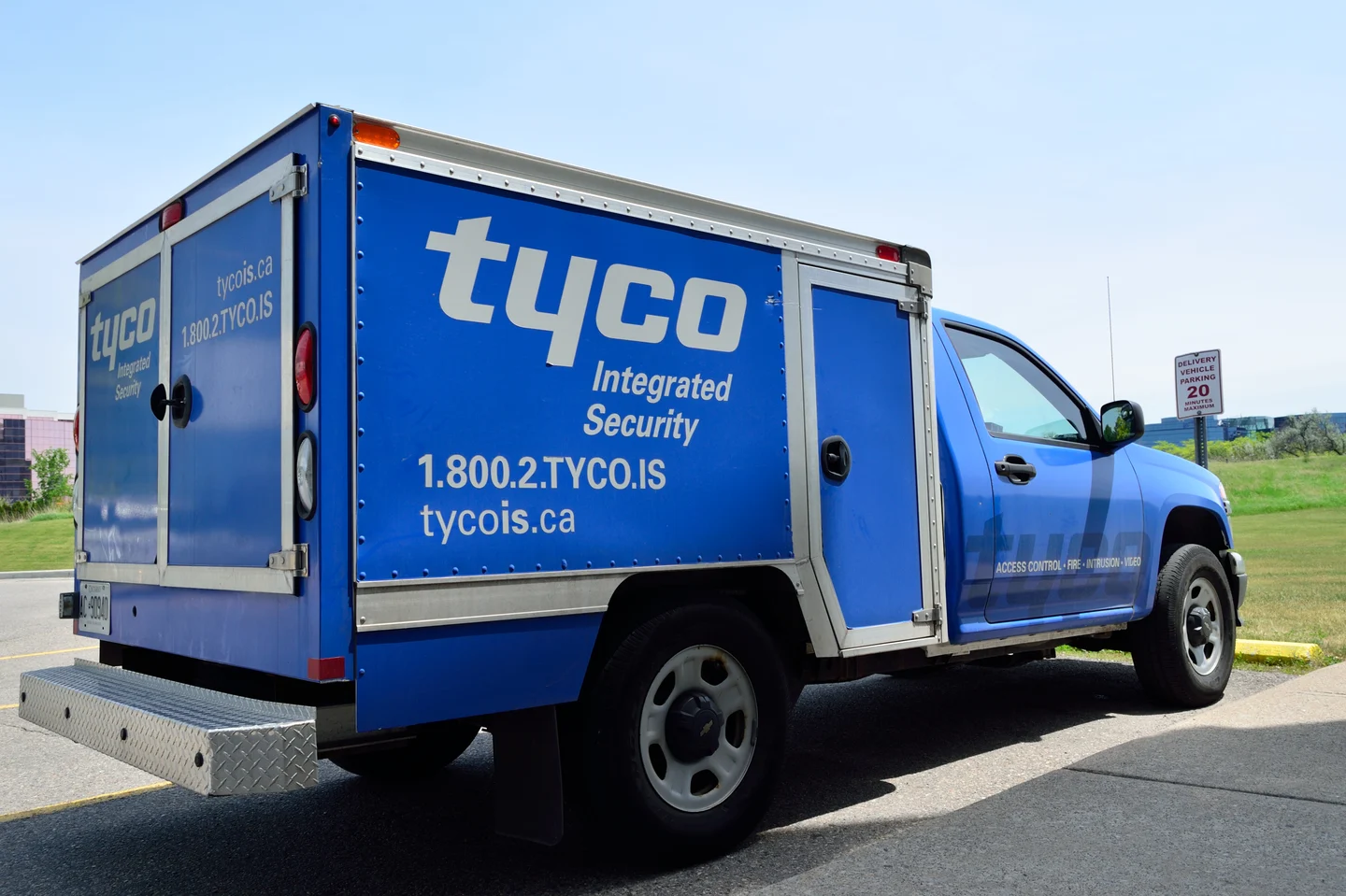
Cover image: Tyco Integrated Security service vehicle. Via Wikimedia Commons, CC0 public domain.

参考来源

  1. 1The New Yorker: Spend! Spend! Spend!
  2. 2Wikipedia: Dennis Kozlowski
  3. 3Light Reading: Tyco Sues Kozlowski
  4. 4University of New Mexico: Tyco International — Leadership Crisis
  5. 5New Haven Register: Ex-Tyco exec claims board was in dark
  6. 6HBR: How We're Fixing Up Tyco
  7. 7SEC: Litigation Release No. 17722
  8. 8SEC: Litigation Release No. 17896 (December 2002)
  9. 9Reuters: Kozlowski's $6,000 shower curtain to find new home
  10. 10CBS News: Tyco Jurors View $2M Party Video
  11. 11Washington Post: Tyco CEO Resigns Amid Criticism
  12. 12Los Angeles Times: Kozlowski Charged With Tax Evasion
  13. 13CNN/Money: Three Tyco execs indicted for fraud
  14. 14SEC: Press Release 2006-58
  15. 15Forbes: Judge Declares Kozlowski Mistrial
  16. 16Washington Post: Former Tyco Executive Acquitted
  17. 17Forbes: Kozlowski Guilty On 22 Counts
  18. 18SEC: Litigation Release No. 21129 (July 2009)
  19. 19NYT DealBook: Kozlowski Is Granted Parole
  20. 20SEC: Litigation Release No. 19657 (April 2006)
  21. 21Washington Post: PwC Settles Tyco Investors' Suit Over Fraud
  22. 22CourtListener: In Re: Tyco Securities Litigation
  23. 23Knowledge at Wharton: Tyco's Edward Breen — When Leadership Means Firing Top Management and the Entire Board
  24. 24Congressional Record, Vol. 148, No. 103: Sarbanes-Oxley Conference Report
  25. 25Harvard Corp Gov: The Important Legacy of the Sarbanes-Oxley Act
  26. 26NBC News / AP: Tyco International to split into three companies
  27. 27Reuters: Tyco OKs spin-off of healthcare, electronics units
  28. 28TE Connectivity: Tyco Electronics Separates from Tyco International
  29. 29Wikipedia: Tyco International
  30. 30Wikipedia: Covidien
  31. 31Wikipedia: TE Connectivity
  32. 32HBS Faculty: Tyco International: Corporate Governance (Case 408-059)
  33. 33Stanford Law Review: Outside Director Liability
  34. 34Wikipedia: WorldCom

相似内容

围绕这条内容继续补充观点或上下文。

  • 登录后可发表评论。