




The $35 billion fiction: how Sprint-Nextel's "merger of equals" erased $30 billion in value
2026/6/20 · 8:22

The $35 billion fiction: how Sprint-Nextel's "merger of equals" erased $30 billion in value

In December 2004, Sprint and Nextel announced a $35 billion "merger of equals" — the largest U.S. wireless deal in history at the time. Three years later, Sprint Nextel booked a $29.7 billion goodwill write-down and the stock had collapsed 93%. This case traces how a deal structured to preserve parity between two unequal companies, priced on synergies that were technically impossible, and governed by a board split exactly 6-6 became one of the most instructive failures in M&A history.

On December 14, 2004, Gary Forsee stood at a podium and announced that Sprint and Nextel had agreed to merge. He called the combined company — to be named Sprint Nextel Corporation — a "premier telecommunications company" that would "win in the market." 1 The deal was valued at $35 billion. The combined entity would carry 44 million wireless subscribers, rank as America's third-largest carrier, and generate roughly $40 billion in annual revenue. 2
Three and a half years later, Sprint Nextel booked a $29.7 billion goodwill impairment — writing off roughly 85% of the deal's original value. 3 The stock had collapsed from $25 at announcement to $1.91 by year-end 2008, a 93% decline. 4 Both architects of the deal were gone within two years of closing: Tim Donahue (Nextel CEO, Executive Chairman) stepped down in October 2006; Forsee was ousted in October 2007 with a $40 million severance package. 5
This is a case study in how a "merger of equals" — a narrative that sounds like balance and fairness — becomes a mechanism for avoiding every hard decision that makes integration succeed.

The four parties and what they actually wanted

PartyPrimary objectiveLeverageBATNAHidden preference
Sprint (Gary Forsee)Scale against Verizon/Cingular duopoly; add business-wireless segmentLarger company (2× revenue); CDMA/data superiority; Nextel needs Sprint's 3GRemain independent at ~19% market share — slowly losing ground50/50 governance to close deal; no plan to operationalize the combined entity
Nextel (Tim Donahue)Access to Sprint's 3G data network and spectrum; consumer-market reachHigh ARPU (~$70/mo vs. industry $52); strong business-wireless churn lock-in; iDEN push-to-talk loyaltyIndependent operation; Nextel stock had risen 120% in two years — Donahue held leverageEqual governance seat; Executive Chairman role to preserve Nextel culture against absorption
Sprint shareholdersPremium on Sprint shares; synergy realization50.1% ownership in merged entityHold or sell Sprint stockEffective integration within 18 months; one network, one culture, one leadership team
DOJ / FCC regulatorsNo substantial lessening of competition in wireless; spectrum deploymentClayton Act §7 enforcement power; FCC public-interest mandate; license transfer approvalReject or condition the mergerClean pass — four national carriers post-merger plus regional players sufficient

The strategic logic, such as it was

In late 2004, the U.S. wireless market had just undergone its first major consolidation: Cingular acquired AT&T Wireless, giving Cingular and Verizon combined 49% market share. 6 Sprint and Nextel each held roughly 10% share independently. Both feared the same scenario: Verizon would acquire the other, leaving the survivor at a fatal scale disadvantage.
That fear, more than any coherent synergy thesis, drove the deal. Russell McGuire, Sprint's Director of Strategic Planning from 2003 to 2005, later described the merger's only real strategy as "get bigger" — "There wasn't a long-term vision for the combined company. There wasn't a clear direction forward. Near-term objectives were entirely focused on achieving financial synergies." 6
The complementarity story had surface appeal. Sprint owned a nationwide 3G CDMA network — data speeds around 1 Mbps — and was the leading carrier for wireless data services. Nextel owned a proprietary iDEN (Integrated Digital Enhanced Network) — a Motorola technology — that powered its signature "Direct Connect" push-to-talk feature, the product that gave Nextel its unusually loyal construction, logistics, and field-services customer base. Nextel's average revenue per user (ARPU) was nearly $70 per month against an industry average of $52. 6
What the complementarity story obscured: CDMA and iDEN were technically incompatible at every level. They could not share network infrastructure. Dual-mode handsets were attempted and customers rejected them. Combining them would not produce a single unified network — it would produce two parallel networks running side by side indefinitely. That single fact invalidated the entire synergy model, and it was knowable before the deal was signed.

Deal mechanics: how a 2× company bought a 1× company at 1:1

Sprint's total business at the end of 2004 was more than twice Nextel's size: ~15 million consumer wireless subscribers against Nextel's ~10.5 million business subscribers, plus a local telecom operation with 7.5 million access lines in 18 states and a long-distance business — neither of which Nextel possessed. 6 Yet the deal was structured as a true merger of equals.
Exchange ratio: Each Nextel share converted into 1.26750218 Sprint Nextel shares plus $0.84629198 in cash, calibrated to a 1.3-share-equivalent value. Each Sprint share converted 1:1. The result: Sprint shareholders held ~50.1% of the combined entity, Nextel shareholders ~49.9%. 7
Enterprise value: $46.5 billion including assumed debt. Combined equity value at announcement: approximately $70 billion. 8
Fairness opinions: Five separate financial advisors weighed in — Lehman Brothers and Citigroup for Sprint; Goldman Sachs, J.P. Morgan, and Lazard for Nextel — all rendering standard fairness opinions. 9 No advisor publicly noted the CDMA/iDEN incompatibility as a synergy-invalidating constraint.
Governance structure: A 12-member board with exactly 6 representatives from each company. Forsee became President & CEO. Donahue became Executive Chairman, protected from removal for three years except by a two-thirds board vote. 7 The governance structure did not designate which organization's operating model, systems, or culture would govern the combined entity. It preserved both.
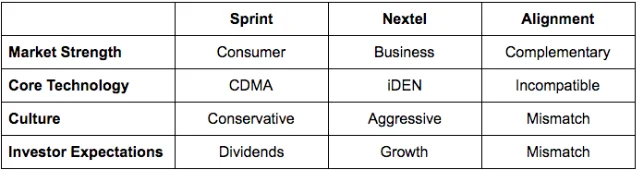
Sprint vs. Nextel pre-merger profile comparison
Pre-merger profile: Sprint's consumer-market strength and Nextel's business-wireless loyalty sat alongside a core incompatibility that would determine the outcome. 6
Regulatory clearance: The FCC voted 4:0 on August 3, 2005, approving the merger in Memorandum Opinion and Order FCC-05-148 after finding no local market required a divestiture. 10 The DOJ Antitrust Division closed its investigation the same day without enforcement action, concluding that "it is unlikely that the merged company could unilaterally exercise market power to harm competition." 11 The merger closed on August 12, 2005. Sprint Nextel common stock began trading on the NYSE under the symbol "S" on August 15.

The first 90 days: a cultural autopsy in real time

The cultural gap surfaced before the ink was dry on the merger agreement. At a Nextel managers meeting held in December 2004, just days after the announcement, Nextel CEO Tim Donahue — in a sweater vest and khakis — pumped up the crowd with a pep-rally chant: "Let's go stick it to Verizon!" 12 He then introduced "a special guest" from Kansas City. Gary Forsee walked on stage in a suit and gave a PowerPoint presentation. The room went silent.
That scene became the shorthand for what was playing out organizationally. Sprint was a century-old Midwestern telecom utility: centralized, hierarchical, process-governed. Nextel was a Virginia-based field-sales operation built on aggressive deal-making and fast execution. Neither culture had a reason to subordinate itself; the governance structure gave neither side authority to force the other.
The board retained both headquarters — Overland Park, Kansas for operations; Reston, Virginia for executives. The corporate jet ran between them at least once a day. Sprint's campus in Overland Park, with its manicured grounds and extensive landscaping, drew a nickname from Nextel employees: "Overhead Park." 13 Two years after the merger, Nextel veterans gathered at the American Tap Room in Reston Town Center; Sprint employees drank around the corner at Clyde's. One employee summarized the dynamic plainly: "I think we all have a tendency to stick to our own kind." 13
In post-merger integration meetings, the dynamic was consistent: Nextel employees proposed acting quickly; Sprint counterparts said they needed to consult their superiors first. "Many such meetings ended with Nextel employees storming out, leaving the Sprint side baffled," the Washington Post reported. 13 Sprint people thought Nextel "made reckless decisions and spent money impulsively"; Nextel people felt "stifled by Sprint's process-oriented pace."
All overlapping positions — affecting 80,000 employees — were put up for competition in a process "that dragged on for months and created animosity." 14 As Nextel technical staff — who had the institutional knowledge to maintain and repair the iDEN network — took lucrative exit packages, the expertise needed to run the acquired asset walked out the door.
HSBC Securities analyst Richard Dineen stated the structural problem simply: "In the spirit of a merger, that was a big mistake. Having your management and operations half a country apart doesn't foster a spirit of camaraderie." 13

The network incompatibility: eight years, parallel CapEx, zero convergence

Sprint's CDMA (Code Division Multiple Access) and Nextel's iDEN (Integrated Digital Enhanced Network) had zero technical overlap. They could not interoperate. They could not share cell sites, spectrum, or switching infrastructure. Every attempt to merge them at the device level — dual-mode CDMA/iDEN handsets — produced products with poor call quality and high failure rates that customers returned or refused to buy. 15
The consequence was structural: Sprint Nextel ran two entirely separate nationwide wireless networks from August 2005 through June 2013 — eight years of parallel capital expenditure. In 2006, the company added approximately 1,800 iDEN cell sites and approximately 2,200 CDMA cell sites, maintaining two separate build programs and two separate operating organizations. 6 The projected $12 billion in synergies never materialized. The redundant CapEx drained the cash that Verizon and AT&T invested in next-generation LTE infrastructure.
Customer service degraded immediately. Leigh Elliott, a Nextel subscriber in New Hampshire, noticed the change within months of the merger closing: "On my 20-minute drive to and from work every day, I'd lose a call up to five times. This never happened before the Sprint-Nextel merger." She canceled and switched to Verizon in September 2006. 16 In Q4 2006, approximately 300,000 subscribers dropped service, most citing iDEN network quality. 16
American Technology Research analyst Albert Lin, watching subscriber trends in 2007, put it directly: "The company totally lacks focus. Trying to create grandiose visionary initiatives, like a 4G network or a converged cable and wireless service, sounds good, but it's difficult to implement." 16 Sprint had simultaneously bet $5 billion on WiMax (via the Clearwire partnership) as its 4G strategy — while Verizon and AT&T moved to LTE, which became the industry standard. WiMax was abandoned commercially.
A telecommunications tower equipped with satellite dishes against a cloudy sky
Sprint Nextel maintained two separate, incompatible nationwide networks for eight years — CDMA and iDEN — draining the capital that competitors deployed into next-generation LTE infrastructure. 15
The iDEN network was officially shut down on June 30, 2013 — the core asset of the $35 billion acquisition declared operationally worthless after eight years. The 800 MHz spectrum iDEN had occupied was eventually repurposed for CDMA and LTE, salvaging some residual value from the radio spectrum. The brand, the network, and the infrastructure were gone.

The collapse: two CEO departures and a $29.7 billion write-down

The deterioration moved in predictable quarterly increments. The integration plan, Sprint executives later admitted, "was assembled in the months after close rather than before." 17 The two billing systems were never unified. Marketing strategies clashed. Subscriber losses began accumulating.
October 2006: Tim Donahue announced he would leave as Executive Chairman at year-end — more than a year ahead of schedule. His departure followed COO Len Lauer's forced exit in August 2006 after weak Q2 earnings. Nextel founding board chairman William Conway Jr. (Carlyle Group co-founder) had already announced in March 2006 that he would not seek re-election. 18 The entire Nextel side of the leadership structure had been stripped within 14 months of closing.
October 8, 2007: The board removed Forsee as Chairman and CEO. Q3 2007 had produced a net loss of approximately 337,000 post-paid subscribers and guidance below all forecasts. Board member Irvine Hockaday stated: "It is the right time to put in place new leadership to move the company forward in improving its performance and realizing corporate objectives." 5 Forsee had been named one of BusinessWeek's "Best Managers of 2004" for engineering the merger. He departed with a $1.5 million annual salary through 2009, $5 million in bonuses, stock options and restricted shares worth $23 million, and an $84,000/month pension for life — over $40 million total. 19
December 18, 2007: Dan Hesse — who had led the spinoff of Sprint's local telecom business as Embarq — was named CEO after a 71-day leadership search, ending speculation about whether anyone would take the job. 20 Stifel Nicolaus analyst Christopher King offered a blunt assessment: "Sprint Nextel's problems are bigger than any one person, a CEO, can change in the near term." 20
February 28, 2008: Hesse's first earnings call. Sprint Nextel reported a Q4 2007 net loss of $29.5 billion ($10.36 per diluted share), driven by the $29.7 billion non-cash goodwill impairment against the Nextel unit. 3 The charge reduced Nextel's book value by approximately 80% — a formal accounting acknowledgment that the $35 billion acquisition had destroyed nearly all its value in under 30 months. The company's credit-default swap spread jumped 206 basis points to 580 basis points, the highest on record at that time per CMA Datavision. 21
Hesse's assessment of what he had inherited: "The issues we face are more difficult than I expected to find." 21
The subscriber hemorrhage continued through 2008: the total direct subscriber base declined by 5.1 million that year, of which approximately 4.1 million were post-paid. Average monthly post-paid churn reached 2.18% — substantially higher than AT&T and Verizon, whose churn rates were well below Sprint's. 22
The legal aftermath was extensive. Shareholders filed Bennett v. Sprint Nextel (No. 09-cv-2122) in U.S. District Court for the District of Kansas on March 10, 2009, alleging that Forsee, CFO Paul Saleh, and Controller William Arendt had made false statements about $14.5 billion in projected merger synergies, integration progress, and goodwill impairment. 23 After six years of litigation and review of more than 8.7 million pages of documents, the case settled in March 2015 for $131 million — approximately 12% of plaintiffs' estimated $1.079 billion in damages, a recovery ratio more than six times the typical median for comparable cases. 24
Sprint's final chapter: the company was acquired by T-Mobile in April 2020 after a $26 billion deal that required a DOJ consent decree mandating DISH Network absorb Sprint's prepaid brands and spectrum to create a fourth national competitor — the regulatory concession that the 2005 Sprint-Nextel merger had never required.

Frameworks you can use

正在加载链接预览…

The merger-of-equals governance trap

A "merger of equals" is a negotiating fiction, not an operating plan. Sprint and Nextel retained dual headquarters, split a 12-member board evenly, and assigned Forsee as CEO while Donahue served as Executive Chairman with three-year removal protection. None of these arrangements resolved the only question that matters for integration: which organization's operating model, systems, and culture governs the combined entity?
The governance structure preserved both. Every integration decision that required a clear owner — whose billing system to use, whose network architecture to prioritize, whose management approval cadence to follow — hit a deadlock or compromise. Sprint's bureaucratic approval chains and Nextel's entrepreneurial speed could not coexist in the same decision-making structure, and neither side had the authority to subordinate the other.
The parallel case is DaimlerChrysler (1998): Schrempp pitched "merger of equals," Daimler treated it as a German acquisition, Chrysler fought the subordination for five years, and the conflict destroyed $29 billion in value before Cerberus bought Chrysler for $7.4 billion in 2007. 15 As M&A Science's distilled rule states: "The deal was framed as a merger of equals, which delayed the integration work that should have started on day one." 15
Practitioner test: Before signing any merger-of-equals agreement, answer in writing: Which entity's CEO is operationally responsible for Day 1 integration? Which entity's systems survive? Which culture is the operating default? If the answers require negotiation, that negotiation should happen before close — not after.

Technology compatibility as a binary diligence gate

In technology-intensive M&A, core infrastructure incompatibility is not an "integration challenge" to be solved post-close. It is a deal-premise failure that invalidates the synergy model regardless of price.
Sprint's CDMA and Nextel's iDEN had zero technical overlap. That fact was verifiable by any engineer with network architecture access before the merger agreement was signed in December 2004. Yet the $12 billion synergy model depended on network convergence that was technically impossible. The deal was priced on synergies that could never be realized, and the incompatibility was "discovered" during integration rather than treated as a go/no-go gate during diligence.
M&A Science's formulation is precise: "In a transaction where network integration is central to the value thesis, technical architecture review is not a secondary workstream. It belongs at the center, scoped and costed before the deal is priced." 15 Finexus stated the corollary explicitly: "When a transaction requires the long-term maintenance of parallel incompatible infrastructure, the expected synergies are almost certainly overstated." 25
Practitioner test: For any deal where synergy is premised on infrastructure consolidation, require the technical architecture teams to produce a written convergence plan with a timeline and cost estimate before the LOI is signed. If they cannot produce one within the diligence window, the synergy model requires a formal reduction.

Culture as a quantitative diligence workstream

Sprint and Nextel had fundamentally incompatible organizational cultures — centralized bureaucracy versus decentralized entrepreneurialism — and this incompatibility was visible in their histories, organizational structures, and geographic separation before the merger was announced. It was never subjected to structured pre-close assessment.
The outcome was a talent exit that compounded the technology problem. Nextel technical staff — who alone held the institutional knowledge to maintain the iDEN network — left in the exodus triggered by the cultural friction and job-competition process. Their departure removed the expertise needed to run the acquired asset's core product. Culture clash did not merely create friction; it removed the operational capacity to manage what had been acquired.
.png) Sprint/Nextel ($35B, 2005) ranks among the largest failed mergers on record. M&A Science's buyer lesson: "Tech stack compatibility is a diligence question, not an integration one." 15
PwC's M&A Integration Survey found that deals where cultural assessment was completed before signing had a 28% higher synergy-realization rate than deals where culture was assessed only post-close. Mercer's survey found 67% of integration leaders ranked cultural misalignment as the single largest barrier to synergy capture. 17 The Washington Post's 2007 investigation, "No Cultural Merger At Sprint Nextel," documented the clash in terms consistent with those survey results: "Two sharply different corporate cultures have resulted in clashes in everything from advertising strategy to cellphone technologies, preventing Sprint Nextel from becoming the merger of equals envisioned." 26
Practitioner test: Before signing, map the two organizations' decision-making authorities, approval chains, and operating cadences. Identify which decisions require consensus across the merged entity and which require a single owner. If that mapping reveals structural incompatibility — as it would have for Sprint and Nextel — the integration design must resolve the incompatibility before close, not after.

The deferred integration plan catastrophe

Sprint executives later admitted the integration plan "was assembled in the months after close rather than before." 17 The two billing systems were never fully integrated. Customer churn ran at 2.18% monthly against competitors holding well below that level. 22 The dual-HQ governance structure meant no single executive had the authority to designate integration decision-makers.
Every day post-close without a written integration plan is a day in which the acquired company's people, processes, and customer relationships degrade on their existing trajectory — while the synergy clock runs backward. EY's 2025 M&A research found that acquirers with an Integration Management Office (IMO) staffed at signing achieved 1.8× the synergy capture of acquirers who stood up the IMO post-close. Yet only 44% of mid-market acquirers had an IMO in place at signing. 17
Practitioner test: The integration plan — with named owners, a Day 1 operating model, and a 90-day milestone schedule — should be a deliverable of the diligence process, not a post-close project. A deal that closes without a signed integration plan is a deal that has already started losing value.

What to remember

  • The synergy model was invalidated before the deal closed. Sprint's CDMA and Nextel's iDEN could not be combined onto a single network — a fact verifiable by any network engineer with access to the architecture. The projected $12 billion in synergies rested on network convergence that was physically impossible. The five investment banks that rendered fairness opinions in December 2004 apparently treated this as an integration problem rather than a deal-premise problem. It was the latter.
  • "Merger of equals" is a governance vacuum. The 50/50 board split, the dual-CEO structure, and the dual-headquarters decision preserved both organizations intact — which meant neither organization had the authority to force the integration decisions that every merger requires. Sprint and Nextel both kept their approval chains, their budgets, their cultures, and their headquarters. The predictable result was that integration decisions were deferred until the window to make them effectively had closed.
  • The talent exodus was a direct consequence of the cultural friction, not a coincidence. Nextel's iDEN technical staff were the only people who knew how to maintain the acquired network. When those employees took exit packages rather than adapt to Sprint's approval culture, Sprint Nextel lost the operational capability it had paid $35 billion to acquire. Culture clash didn't create friction — it destroyed an asset.
  • The write-down was an accounting lagging indicator, not the event. The subscriber losses, the dual-network CapEx drain, the churn rate divergence, and the management departures were all measurable in real time from 2005 onward. The $29.7 billion goodwill impairment in February 2008 acknowledged what the operating metrics had been signaling for two and a half years. In any deal with a technology integration thesis, the CEO should be tracking platform convergence metrics monthly from Day 1 — treating subscriber retention on the acquired network as the primary early-warning indicator, not a lagging financial result. 25

Cover image: Communication tower against a cloudy sky. Photo by Barnabas Davoti via Pexels.

参考来源

  1. 1Forbes: Forsee Named CEO Of Sprint Nextel In Wireless Merger
  2. 2SEC: Sprint Nextel Completes Merger (Exhibit 99.1)
  3. 3CFO.com: Dropped Call — Sprint Has $29.5B Q4 Loss
  4. 4Çeliktaş et al. (2016): Analysis of a Failed Merger — Sprint-Nextel Case
  5. 5NBC News/AP: Sprint Nextel CEO ousted as bad results loom
  6. 6ClearPurpose / Russell McGuire: Sprinting to Nextel
  7. 7SEC EDGAR: Form 8-K (Sprint Nextel, August 18, 2005)
  8. 8Jones Day: Nextel and Sprint combine in $46.5B merger of equals
  9. 9SEC EDGAR: Form S-4 Registration Statement (March 15, 2005)
  10. 10FCC: FCC 05-148 Memorandum Opinion and Order
  11. 11Tech Law Journal: FCC and DOJ Approve the Merger of Sprint and Nextel
  12. 12Washington Post: No Cultural Merger At Sprint Nextel (Kim Hart)
  13. 13Washington Post: No Cultural Merger At Sprint Nextel — Page 2
  14. 14Washington Post: Sprint, Nextel Employees Compete to Keep Their Jobs
  15. 15M&A Science: Top 11 Failed Mergers and Acquisitions of All Time
  16. 16CNET: Broken connection for Sprint Nextel (Marguerite Reardon)
  17. 17CT Acquisitions: Why Mergers and Acquisitions Fail
  18. 18GoUpstate/Herald-Journal: Sprint chairman leaving company
  19. 19BetaNews: Sprint CEO Forsee Resigns, Company's Outlook Downgraded
  20. 20CNBC: Sprint Names Former Embarq CEO as New Leader
  21. 21Business Insider: Sprint Nextel Q4 a Disaster
  22. 22SEC EDGAR: Sprint Nextel Form 10-K (FY 2008)
  23. 23Robbins Geller: Bennett v. Sprint Nextel Corp. Case Summary
  24. 24Motley Rice: Sprint Settles for $131M in Shareholder Class Action
  25. 25Finexus: The Architecture of Value Destruction
  26. 26Washington Post: No Cultural Merger At Sprint Nextel (archived)

相似内容

围绕这条内容继续补充观点或上下文。

  • 登录后可发表评论。