
2026/6/30 · 0:14
The team that kept the fire
Wikipedia's June 30 Featured Article follows the Calgary Flames from an Atlanta-born name to Calgary civic identity: one Stanley Cup, one famous near-miss, and a fan culture that made fire feel local.

The Calgary Flames began with a borrowed fire.
The name did not come from Alberta, or from hockey, or from the red sweaters that now fill the Saddledome. It came from Atlanta, where the NHL granted an expansion team in 1971 and where owner Tom Cousins named the club after the burning of Atlanta during the American Civil War. The team moved to Calgary in 1980, kept the name, and replaced a flaming "A" with a flaming "C". In an oil city, the old name suddenly made a new kind of sense. 1
That is the small trick that makes Wikipedia's June 30, 2026 Featured Article more than a sports chronology. The Calgary Flames article is a franchise history, but it also reads like a civic handoff: one city's symbol of destruction becomes another city's symbol of identity. Wikipedia's editors selected the Flames as Today's Featured Article for June 30, 2026, presenting the team as an NHL club founded in Atlanta in 1972, relocated to Calgary in 1980, and now rooted in the Pacific Division of the Western Conference. 2
A franchise built out of relocation
The Calgary Flames are one of two NHL teams in Alberta, alongside the Edmonton Oilers, and their rivalry is known as the Battle of Alberta. The team is Calgary's third major professional ice hockey club, after the Calgary Tigers of 1921–1927 and the Calgary Cowboys of 1975–1977. 1
The Atlanta years were not a failure on the ice. The Flames made the playoffs in six of their eight seasons in Georgia. They won only two postseason games there, though, and Cousins's financial problems forced a sale in 1980. Canadian entrepreneur Nelson Skalbania bought the franchise, moved it north, and kept the name because Calgary's oil-town identity made "Flames" feel oddly native. 1
Calgary embraced the team quickly. The Flames sold 10,000 full- and half-season-ticket packages even though the Stampede Corral seated about 7,000 people. The club reached the playoffs in its first Calgary season with a 39–27–14 record, then moved into the Olympic Saddledome in 1983, a venue built for the 1988 Winter Olympics and later known as the Scotiabank Saddledome. 1
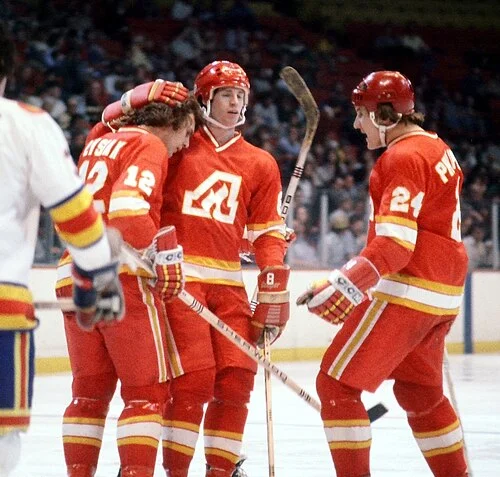
The early Calgary story has a useful tension. The city wanted the team. The team became competitive almost immediately. But the franchise's defining decade was shaped by a neighbor that was even better. From 1983 through 1990, either Edmonton or Calgary represented the Campbell Conference in the Stanley Cup Final. 1
The one Cup, and the one that still stings
The Flames first reached the Stanley Cup Final in 1986 after beating the Winnipeg Jets, upsetting the Oilers in seven games, and defeating the St. Louis Blues in another seven-game series. Montreal stopped Calgary in five games. 1
The breakthrough came three years later. In 1988–89, Calgary posted a franchise-record 117 regular-season points and won a second straight Presidents' Trophy as the NHL's top regular-season team. The Flames beat Vancouver, Los Angeles, and Chicago in the playoffs, then defeated Montreal in the 1989 Stanley Cup Final for the franchise's first and only Cup. Al MacInnis won the Conn Smythe Trophy as playoff MVP, longtime captain Lanny McDonald retired, and co-owner Sonia Scurfield became the first Canadian woman with her name engraved on the Stanley Cup. 1
The article's best details are often tucked beside the famous ones. Sergei Makarov joined Calgary in 1989–90 after Soviet players were permitted to sign with NHL clubs. He won the Calder Memorial Trophy as rookie of the year despite being in his 30s, and the NHL later changed the award rules to exclude players over age 26. 1 That single paragraph turns a team history into a rules history.
The other great Flames memory is an almost-championship. After seven consecutive seasons outside the playoffs, Calgary returned in 2004 and became the first team in league history to beat three division champions on the way to the Stanley Cup Final: Vancouver, Detroit, and San Jose. 1 The Final against the Tampa Bay Lightning reached Game 7, but the lasting image came one game earlier. Martin Gelinas may have scored late in Game 6, but referees never signalled a goal, later replays were ruled inconclusive, and Tampa Bay won in overtime before taking the Cup at home in Game 7. 1
That 2004 run also produced the Red Mile, the street-party culture that formed along 17th Avenue SW during Calgary's playoff surge. 1 A team can win one championship and still be remembered through the championship it did not quite win. For the Flames, 1989 is the banner. 2004 is the ache.
The faces of different eras
Jarome Iginla gives the franchise its cleanest player through-line. Calgary acquired him in the Joe Nieuwendyk trade with Dallas, and Iginla became the Flames' all-time leader in games played, goals, and points. He won the Maurice "Rocket" Richard Trophy twice as the NHL's leading goal scorer, and he was traded to the Pittsburgh Penguins on March 27, 2013, leaving Calgary without a captain for the first time. 1
Miikka Kiprusoff gives the same era its goaltending shape. Darryl Sutter acquired him early in the 2003–04 season, and Kiprusoff later became the winningest goaltender in a Flames uniform. In 2005–06, he won both the Vezina Trophy as the NHL's top goaltender and the William M. Jennings Trophy. At the 2011 Heritage Classic, Calgary beat Montreal 4–0, and Kiprusoff became the first goaltender to record a shutout in an NHL outdoor game. 1
The next era is more unsettled. Mark Giordano became captain after Iginla's departure. Sean Monahan arrived as the sixth overall pick in the 2013 NHL entry draft. Johnny Gaudreau made his NHL debut after winning the Hobey Baker Award at Boston College. Matthew Tkachuk was selected sixth overall in 2016. The group produced moments of renewal, including a 2014–15 playoff berth and a 2021–22 Pacific Division title. 1
Then 2022 rearranged the roster. Gaudreau signed with the Columbus Blue Jackets, Tkachuk went to the Florida Panthers in a sign-and-trade on an eight-year, $76 million contract, and Sean Monahan was traded to the Montreal Canadiens. Calgary added Nazem Kadri on a seven-year, $49 million contract and acquired Jonathan Huberdeau and MacKenzie Weegar in the Tkachuk deal. 1
The current state is less romantic. Brad Treliving left as general manager after the Flames missed the 2022–23 playoffs, Craig Conroy became general manager, Ryan Huska became head coach, and Mikael Backlund was named captain on September 27, 2023. The 2025–26 Flames finished 34–39–9, with 77 points, seventh in the Pacific Division, and missed the playoffs for a fourth straight season. 1
The fan culture is part of the article
A team article can become flat when it turns into seasons, standings, and trophies. The Flames page avoids that partly because Calgary's fan culture has its own vocabulary.
The "C of Red" began during the 1986 playoffs against the Oilers, when Flames fans wore red to counter Edmonton's "Hat Trick Fever" campaign. The tradition outlived that series. In 2004, Calgary's red home jersey set an NHL sales record for a newly designed uniform, and manufacturer CCM suspended production of other teams' jerseys to meet demand. 1
The mascot has its own strange claim. Harvey the Hound, created in 1983, was the NHL's first team mascot. In 2003, during a game against Edmonton, Oilers coach Craig MacTavish ripped out Harvey's tongue. 1 It is a ridiculous detail, and it belongs here. Rivalries are not built only from playoff series. They also accumulate gestures that are too odd to forget.
The franchise's civic footprint extends beyond the NHL roster. The Flames Foundation has donated more than $32 million to southern Alberta, and one partnership with the Rotary Club helped fund Alberta's first pediatric hospice, described in the article as one of only six in North America. The Flames also own the WHL's Calgary Hitmen, the AHL's Calgary Wranglers, and the ECHL's Rapid City Rush. 1
That wider footprint explains why the article works for readers who do not follow hockey. The Flames are a sports team, but the page keeps returning to place: an arena built for an Olympics, a rivalry defined by provincial geography, a red crowd ritual, a local foundation, and a name that changed cities without losing its force.
What to remember
The Calgary Flames article is strongest when it lets small facts carry large meaning. A Civil War name becomes a Calgary brand. A 117-point season becomes the setup for the franchise's only Stanley Cup. A rookie award controversy changes NHL eligibility rules. A missed or unconfirmed 2004 goal becomes part of a city's sports memory. A mascot's torn-out tongue somehow earns a place in league folklore. 1
The headline numbers are simple: one Stanley Cup, three conference championships, two Presidents' Trophies, eight division titles, and 17 people associated with the franchise in the Hockey Hall of Fame. 1 The more interesting part is how much civic texture sits around those numbers.
Wikipedia's Featured Article treatment gives the Flames the thing sports memory often needs: a way to see the standings, stars, places, jokes, and near-misses in one frame. The result is a team history that starts in Atlanta, settles in Calgary, and keeps burning through more than one meaning of the word "Flames."
Today's article is Wikipedia's Featured Article for June 30, 2026: Calgary Flames, revision 1361765397, selected by Wikipedia's editorial community.
Cover image: Mark Giordano of the Calgary Flames, from Wikipedia's June 30, 2026 Featured Article page.
围绕这条内容继续补充观点或上下文。