ALV: The Airbag Maker Trading at a Five-Year Valuation Low

Autoliv (NYSE: ALV) — world's largest passive auto safety supplier, 44% market share. Passes all 3 hard filters: 3-yr ROE avg 21.8%, positive TTM FCF, forward P/E 11.55 (~24% below sector median). Trading near a five-year valuation low.
Autoliv, Inc. (NYSE: ALV) passes all three hard screening filters — trailing 3-year return on equity (ROE) above 15% in each year, positive free cash flow on a trailing twelve-month basis, and a valuation that sits below the sector median on a forward earnings basis. Today's price: $114.85 (NYSE close, May 15, 2026).1

What the company does

Autoliv, founded in Sweden in 1953, is the world's largest supplier of passive automotive safety systems. Its products — frontal and side airbags, curtain airbags, knee airbags, seatbelts with pretensioners, and steering wheels — go into virtually every light vehicle built globally.2 Revenue in FY2025 was $10.815 billion, generated through long-term OEM supply contracts with Toyota, Volkswagen Group, Stellantis, General Motors, Ford, Hyundai-Kia, BMW, Mercedes-Benz, and most other major automakers.3
The company operates 60+ manufacturing facilities across 25 countries, with 13 technology centers and 20 crash-test tracks, and employs roughly 64,000 people.2 Revenue is roughly evenly split among Europe / Middle East / Africa (EMEA), Asia (China ~18%, India ~6%, rest of Asia), and the Americas.
In Q1 2026, Autoliv reported record first-quarter net sales of $2.753 billion (+6.8% year-over-year), beating expectations even as global light vehicle production fell 3.4% in the period.4 CEO Mikael Bratt described the results as evidence that Autoliv can "adapt and grow in challenging market conditions," pointing specifically to China OEM outperformance.

Three filters: all passed

正在加载统计卡片…
ROE — Filter 1. Autoliv's return on equity has exceeded 15% in each of the past three fiscal years: 19.04% in FY2023, 27.68% in FY2024, and 29.45% in FY2025.5 The TTM figure through March 31, 2026 stands at 27.67%, confirming the trend holds into the current fiscal year.
Free cash flow — Filter 2. Operating cash flow on a trailing twelve-month basis was approximately $1 billion through Q1 2026.1 On an annual basis, FCF (operating cash flow minus capital expenditures) rose from $413 million in FY2023 to $497 million in FY2024,6 and Autoliv reported a record $734 million in free operating cash flow for FY2025.3
Valuation — Filter 3. At $114.85, ALV trades at a trailing P/E of 13.09 versus a sector median of 13.97 (Eqvista, December 2025),7 and a forward P/E of 11.55 versus the sector median of 15.13 (NYU Stern/Damodaran, January 2026).8 The EV/EBITDA of 7.45 sits near its own five-year low.9
Revenue growth has been modest in absolute terms — from $10.475 billion in FY2023 to $10.815 billion in FY2025, a cumulative gain of about 3.2%.10 What's notable is how much more income that revenue is generating.
正在加载图表…
Operating margin expanded from 6.58% in FY2023 to 10.05% in FY2025 — the company roughly doubled its operating margin over two years on essentially flat revenue.11 Diluted EPS followed: $5.72 in FY2023, $8.04 in FY2024 (+40.6%), and $9.55 in FY2025 (+18.8%).12 Gross margin also expanded steadily, from 17.38% to 19.17%, a gain of roughly 90 basis points per year.13

Competitive moat

Autoliv holds approximately 44% of the global passive safety market as of 2025, unchanged from 2024 — a lead that took decades to build and would be extremely difficult for a new entrant to close.3 The nearest competitor, Joyson Safety Systems (which acquired the distressed Takata business), operates at a fraction of Autoliv's scale.
The structural moat rests on switching costs and qualification cycles. When an OEM awards a safety platform contract to a supplier, that supplier's components go through a two-to-four year co-development and certification process before production starts. Switching mid-cycle carries recall liability — a risk the entire industry has been acutely aware of since the Takata airbag crisis. The top five customers represent about 44% of Autoliv's revenue, but the largest single contract is only about 2% of total sales, keeping concentration risk manageable.3
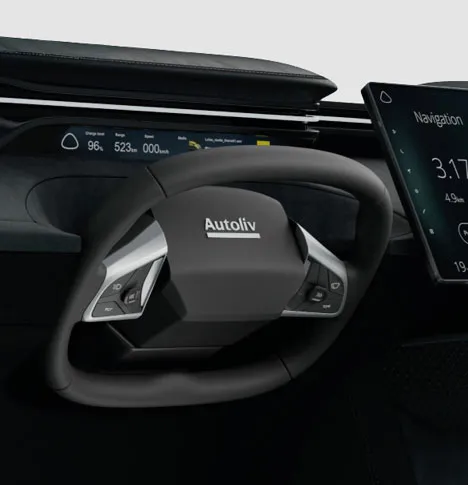
R&D spending was $413 million in FY2025 (3.82% of net sales), directed at products ranging from foldable steering wheels for autonomous driving scenarios to motorcycle airbags — categories where the company is the technological incumbent.14
Autoliv foldable steering wheel, designed for autonomous driving scenarios
Regulatory tailwinds add a structural demand floor. Updated NCAP and UN-ECE standards — adding far-side impact tests, enhanced pedestrian protection requirements, and new crash configurations — require more airbag modules per vehicle. Autoliv estimates safety content per light vehicle is on track to grow at roughly 3–5% per year through 2028.15 India, now about 6% of Autoliv's sales and nearly triple its share from three years ago, is one of the faster-growing contributors as local safety regulations tighten.
On EV exposure: Fitch Ratings noted in December 2025 that Autoliv's products are "agnostic" to the electric vehicle transition — the airbag and seatbelt content per vehicle is essentially the same regardless of powertrain.15 EV platforms may actually require more passive safety content given heavier battery floors and different structural geometry.

Price context

At $114.85, ALV sits in the lower half of its 52-week range of $98.45 – $130.14.1 The stock is up +12.6% over the past year, versus +24.2% for the S&P 500 over the same period — trailing the index by roughly 12 percentage points. The May 15 session saw a -4.80% single-day decline, bringing the price below the 200-day moving average ($118.69) and within 3% of the 50-day moving average ($111.08).

Valuation: a case for reasonable pricing

CompanyDescriptionTrailing P/EForward P/EEV/EBITDA
ALVAutoliv — passive safety global leader13.0911.557.45
APTVAptiv PLC — auto software & hardware34.499.308.61
BWABorgWarner — powertrain tech35.6515.1710.20
MGAMagna International — full-spectrum auto parts26.639.226.59
LEALear Corporation — seating & electrical systems13.979.586.27
Sector medianAuto Parts & Equipment13.9715.136.43
Data: Yahoo Finance (trailing P/E), Roic.ai (P/FCF cross-check), NYU Stern/Damodaran (forward P/E sector median, Jan 2026), Eqvista (trailing P/E sector median, Dec 2025).1168
ALV's forward P/E of 11.55 is approximately 24% below the sector median of 15.13. The EV/EBITDA of 7.45 is above the sector median of 6.43, which partly reflects Autoliv's higher debt load relative to some peers (total debt/equity of 85%), but it is nonetheless near the company's own five-year low of 7.30 reached in 2025.9
On its own 5-year trailing P/E history (2021: 17.80 → 2022: 17.52 → 2023: 22.81 → 2024: 12.24 → 2025: 12.30), the current 13.09 is roughly 14% below the five-year median of about 15.26.9
Wall Street consensus: 12 analysts cover the stock, with 2 Strong Buy, 5 Buy, and 5 Hold ratings and 0 Sell.17 The median 12-month price target is $138, implying about +20% upside from the current price; the average target is $134. The target range runs from $113 to $150.17 TD Cowen analyst Itay Michaeli reiterated a Strong Buy on April 20, 2026 and raised his target from $147 to $150 following Q1 results. Jefferies analyst Michael Aspinall downgraded to Hold in April, cutting his target from $150 to $120, citing limited near-term upside. Analyst price targets carry well-documented optimistic bias — these figures are directional, not a guarantee.

Key risks

Automotive production cyclicality. Nearly all of Autoliv's revenue is tied to light vehicle production volumes. In Q2 2020, when the COVID-19 pandemic shuttered automotive plants globally, Autoliv's net sales fell 51% year-over-year, with April 2020 organic sales down 65%.18 The company suspended its dividend and cut 3,700 jobs that quarter. The business recovered in subsequent quarters, but the volatility benchmark is real. In Q1 2026, Autoliv managed +0.8% organic growth against a -3.4% LVP backdrop — encouraging, but a deeper or more prolonged production downturn would still press margins meaningfully.
Raw material costs. Direct materials represent approximately 49% of Autoliv's sales.1 In the Q1 2026 earnings call, CEO Mikael Bratt disclosed that the company's full-year 2026 assessment for gross raw material cost impact had been raised to ~$90 million, up from ~$30 million estimated just one quarter earlier, driven by higher prices for textiles, nylon, resin, and aluminum.4 Customer contracts include price pass-through provisions tied to commodity indices — these are expected to offset a meaningful portion of the cost increase, though typically with a one-to-two quarter lag. Management incorporated this estimate into its full-year guidance of 10.5–11% adjusted operating margin.
China pricing pressure and the Turkey restructuring charge. Chinese OEM customers (18% of Autoliv's sales) are price-sensitive, and local suppliers such as Joyson Safety Systems have home-field cost advantages in that market. In Q1 2026, Autoliv outperformed Chinese LVP by more than 40 percentage points — a strong result — but margin on China OEM business is generally below the company average.4 Additionally, Autoliv announced on May 8, 2026 that it will wind down its Turkish manufacturing operations — affecting approximately 2,200 employees — with a $142 million pre-tax restructuring charge ($129 million cash, $13 million non-cash) expected mostly in Q2 2026. Production will be transferred to other EMEA facilities before completion in the first half of 2028.19 At roughly 13% of annual operating income, this is a one-time but material hit to reported earnings in the current quarter.

The thesis in brief

Autoliv checks the three filters cleanly. The stock trades at a discount to its own five-year valuation history and below the sector median on a forward-earnings basis, even as margins have expanded substantially and free cash flow hit a record in 2025. The 3.01% forward dividend yield ($3.46 per share annually) adds some floor to the return profile for investors willing to hold through automotive cycle noise.1
The open questions worth tracking: whether global automotive production holds up through the rest of 2026 given tariff-related demand uncertainty, and whether the raw material cost escalation stabilizes or continues to widen. The Q2 2026 print — which will absorb most of the Turkey restructuring charge — will be a cleaner read on underlying profitability once the one-time item is stripped out. The next scheduled earnings date is July 2026.
Cover image credit: Autoliv Annual Report 2025

围绕这条内容继续补充观点或上下文。

  • 登录后可发表评论。