Quantum Weekly: May 10–17, 2026
Eight new papers, $800M+ in ecosystem funding, and three company milestones define the week — from the first Z₃ superconducting time crystal to a 59.7× FTQC compiler speedup.
The week delivered across every layer of the stack — hardware physics, fault-tolerant compilation, cloud security, and a funding sprint that pushed the sector's visible capital haul past $800 million in a seven-day window.
Papers
Z₃ discrete time crystal stabilized on 15 superconducting qutrits
| Field | Detail |
|---|---|
| arXiv ID | 2605.14293 |
| Submitted | May 14, 2026 |
| Institutions | UC Berkeley, Lawrence Berkeley National Lab, Harvard, Google Quantum AI |
| Review status | Preprint |
| Code / data | Not disclosed |
Core problem. Discrete time crystals (DTCs) observed to date have been Z₂-symmetric — order that doubles the driving period. Extending to Z₃ (period tripling) requires a higher-dimensional system and a stabilizing mechanism that Z₂ Ising physics does not provide.
Method. The team used a 20-qubit processor of flux-tunable transmon qutrits (three-level units, not two-level qubits) arranged in a square grid with tunable couplers. They engineered a Floquet chiral clock model (CCM) in which a chiral angle θⱼ, displaced from integer multiples of π/3, creates an energy barrier that stabilizes the Z₃ phase. Circuits ran to 40 Floquet periods using 600 two-qutrit gates — deep enough to probe the phase boundary. 1
Results. Period tripling held robustly across a range of driving strengths, independent of initial state — the signature of a genuine DTC phase rather than transient oscillation. Edwards-Anderson order-parameter crossings at system sizes N = 6, 9, 12 put the critical drive strength at gc ≈ 0.82–0.89. Entanglement entropy grew logarithmically in the DTC phase (slow) versus linearly in the thermal phase (fast). 2 The team also demonstrated a continuous Z₂→Z₃ interpolation by restricting dynamics to a subspace.
vs. prior work. All prior experimental DTCs were Z₂. The chiral angle is an intrinsic feature of the CCM with no Z₂ Ising analogue, so the stabilization mechanism is genuinely new — not a direct extension of earlier surface-code or Ising-based DTC experiments.
"Our results establish native qudit hardware as a powerful platform to access a broader landscape of non-equilibrium phases."— Noah Goss et al. 2
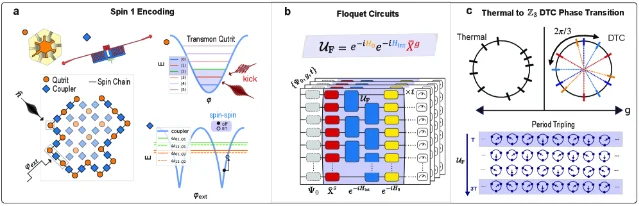
Figure from A Qutrit Time Crystal Stabilized with Native Chiral Interactions (CC BY 4.0)
Qomet: C-Phase-aware compiler achieves up to 59.7× FTQC speedup
| Field | Detail |
|---|---|
| arXiv ID | 2605.14042 |
| Submitted | May 13, 2026 |
| Institutions | University of Michigan, University of Chicago |
| Review status | Preprint |
| Code / data | Not disclosed |
Core problem. Fault-tolerant quantum compilation (FTQC) relies on lattice surgery, in which logical gate sequences are serialized into time slices. Existing compilers treat these slices rigidly, ignoring commutation relations among C-Phase gates — a property common to QFT and QAOA circuits. The result is artificially sequential execution and underutilized physical resources. 3
Method. Qomet inserts a co-design engine between the algorithm optimizer and the physical scheduler. The key insight: C-Phase gate commutativity lets adjacent gate sequences be converted into concurrent multi-target lattice surgery interactions rather than forced into series. An event-driven, cycle-accurate scheduler then models spatial layout and routing contention at the physical level. The pipeline runs in three stages: multi-target CNOT sweep → rotation layer → final CNOT sweep. Two magic-state regimes are supported — EFT (continuous-angle injection) and FFT (magic state distillation/cultivation). 4
Results. On QAOA and QFT benchmarks across four layout configurations (Compact, ½ Filling, ⅔ Filling, Square Sparse) and two magic-state density regimes (MS-Abundant, MS-Starved), Qomet achieved up to 59.7× reduction in execution time compared to standard baselines. 3
"This approach substantially reduces idle resources and achieves up to a 59.7× reduction in execution time compared to standard baselines."— Dhanvi Bharadwaj et al. 4
vs. prior work. Standard FTQC compilers (including those used as baselines in this paper) decouple program optimization from physical layout. Qomet's co-design engine is the first to treat C-Phase commutativity and lattice surgery geometry as jointly optimizable — the speedup range reflects how aggressively the existing tools underutilize parallelism.
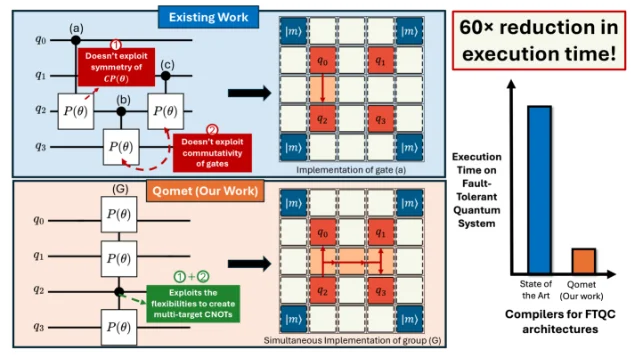
Figure from C-Phase-Aware Compilation for Efficient Fault-Tolerant Quantum Execution (arXiv non-exclusive license)
Blind quantum computation on a modular superconducting processor
| Field | Detail |
|---|---|
| arXiv ID | 2605.14656 |
| Submitted | May 14, 2026 |
| Institutions | ETH Zurich (Wallraff group) |
| Review status | Preprint |
| Code / data | Not disclosed |
Core problem. Cloud quantum processors today give the service provider full visibility into submitted circuits — the algorithm and the data are exposed. Blind quantum computation (BQC) offers information-theoretic privacy: the server executes a computation without learning what it is. Prior demonstrations required either entangled photons between parties or impractical resource states; implementing BQC in a superconducting architecture at any meaningful scale had not been shown. 5
Method. The Zurich team used a flip-chip bonded dual-module superconducting processor. Module A (server) generates a 2D cluster state and forwards it to Module B (client); Module B performs only adaptive single-qubit rotations and measurements to realize a universal gate set — no entangling operations needed at the client side. Information flow is strictly one-way, consistent with the blindness guarantee.
Results. Three-qubit Deutsch-Jozsa algorithm executed successfully. Analysis confirmed that measurement statistics from the server module leaks negligible information about the client's computation, consistent with the blindness criterion.
"This proof-of-principle demonstration establishes key elements of blind quantum computation in superconducting-circuit architectures, indicating that intermediate-scale implementations of blind protocols may become feasible with realistic near-term improvements in gate fidelities."— Yongxin Song et al. 5
vs. prior work. Blind QC had been demonstrated with photons and in specialized entanglement-distribution setups. This is the first proof-of-principle on a scalable solid-state (superconducting) modular platform.
Fraxonium: fractional fluxon states for qudit encoding
| Field | Detail |
|---|---|
| arXiv ID | 2605.14586 |
| Submitted | May 14, 2026 |
| Review status | Preprint |
| Code / data | Not disclosed |
Core problem. Standard superconducting circuits (transmon, fluxonium) encode a single qubit in two low-energy states. Extending to d-level qudits with native leakage protection requires engineering a potential with exactly d well-separated minima — a non-trivial circuit design challenge. 6
Method. Fraxonium generalizes the fluxonium circuit by Fourier-engineering the Josephson potential to contain d minima. The low-energy eigenstates — termed fraxons — are localized in each minimum, giving natural leakage protection: transitions to higher levels require tunneling across substantial energy barriers. The paper analyzes d = 4 and d = 5 qudit spectra in detail, with particular focus on the qutrit case, and proposes non-Abelian STIRAP (Stimulated Raman Adiabatic Passage) gate protocols tailored to this system.
Results. Energy-level analysis confirms good separation between qudit subspace and higher levels. STIRAP protocol design is validated analytically. No experimental realization is reported in this preprint.
vs. prior work. The qudit hardware landscape includes fluxonium-based qutrits and spin-based qudits. Fraxonium's distinguishing feature is the Fourier-engineered multi-minimum potential rather than multi-level exploitation of a single potential well — a structurally different encoding that the authors claim opens new perspectives for circuit engineering beyond the qubit paradigm.
Energy efficiency of quantum computers: first cross-platform benchmark
| Field | Detail |
|---|---|
| arXiv ID | 2605.15090 |
| Submitted | May 14, 2026 |
| Authors | Miquel Carrasco-Codina et al. |
| Review status | Preprint, 66 pages |
| Code / data | Not disclosed |
Core problem. As quantum computing hardware scales, energy consumption becomes operationally and strategically relevant — yet no systematic cross-platform efficiency framework existed. "How energy-efficient is a quantum computer?" had no quantitative answer. 7
Method. The paper covers five hardware platforms — superconducting qubits, silicon spin qubits, trapped ions, neutral atoms, and photonic qubits — and defines energy efficiency as the number of algorithms executable per unit time per unit energy consumed. Platform-specific expert insights and algorithm-compilation overhead are incorporated. Concrete energy consumption numbers for current systems are provided (figures unavailable in public HTML; full data in the 66-page PDF).
Results. Platform-specific energy consumption values are established. A benchmarking framework for future quantum architectures is proposed. The relative efficiency order across platforms is architecture- and algorithm-dependent.
vs. prior work. Individual platform energy analyses exist for superconducting and trapped-ion systems; no prior work attempted a unified five-platform comparison with a shared efficiency metric.
Adaptive window decoding cuts average buffer size by ~40%
| Field | Detail |
|---|---|
| arXiv ID | 2605.14637 |
| Submitted | May 14, 2026 |
| Institutions | Osaka University (Keisuke Fujii group) |
| Review status | Preprint |
| Code / data | Not disclosed |
Core problem. Real-time decoding is a hard constraint in fault-tolerant quantum computing: the decoder must keep pace with the quantum processor's syndrome extraction rate. Existing window decoders use a fixed buffer size — large enough to maintain accuracy but slow for most shots, since most measurement records are clean. 8
Method. The Osaka team introduces a spatiotemporal complementary gap as a soft-information confidence measure. After decoding with a small buffer, the decoder checks its confidence in the correction; low-confidence shots trigger a second decode with a larger buffer. Because only a minority of shots fall below the confidence threshold, the average buffer size — and average decoding latency — drops substantially.
Results. Numerical simulations show approximately 40% reduction in average buffer size while maintaining the logical error rate unchanged. 8
vs. prior work. Prior soft-information approaches to window decoding were not directly applicable to the small-buffer regime. The spatiotemporal complementary gap provides a form of soft confidence that works natively in that regime.
TZAP: linear-time T-gate optimizer handles million-gate circuits in seconds
| Field | Detail |
|---|---|
| arXiv ID | 2605.13929 |
| Submitted | May 13, 2026 (cross-listed cs.PL) |
| Author | Aws Albarghouthi (single author; no institutional affiliation listed in abstract) |
| Review status | Preprint. Single author, no institutional affiliation disclosed — peer-review status unknown |
| Code / data | Not disclosed |
Core problem. T-gate count is the dominant cost metric in fault-tolerant quantum computation because T gates require expensive magic-state distillation. Existing T-count optimization tools (PyZX, VOQC, Feynman) scale poorly — they cannot handle the circuit sizes needed to demonstrate quantum advantage. 9
Method. TZAP applies phase folding — a standard T-count reduction technique — using a linear-time randomized algorithm. Instead of tracking symbolic expressions (which grow combinatorially), TZAP propagates fixed-width bit strings to approximate the set of reachable quantum states with arbitrarily high probability. The approximation trades exactness for speed without, the author claims, materially degrading T-count reduction quality.
Results. On standard benchmarks, TZAP matches the T-count reductions of PyZX, VOQC, and Feynman while running multiple orders of magnitude faster — optimizing circuits with millions of gates in seconds on a laptop.
"Our implementation, TZAP, is multiple orders of magnitude faster than state-of-the-art tools — such as PyZX, VOQC, and Feynman — closely matches their T-count reductions on standard benchmarks, and within seconds on a laptop computer can optimize circuits with millions of gates."— Aws Albarghouthi 9
vs. prior work. PyZX uses ZX-calculus graph rewrites; VOQC and Feynman use path-integral / verification-based methods. All three are superlinear in circuit size. TZAP's use of random bit-string propagation is a distinct approach — closer in spirit to static analysis than symbolic manipulation. The single-author, no-affiliation nature of this preprint warrants independent verification before deployment in production compilers.
Covert quantum computing: long-range crosstalk undermines multi-tenant cloud privacy
| Field | Detail |
|---|---|
| arXiv ID | 2605.14325 |
| Submitted | May 14, 2026 |
| Authors | Evan J. D. Anderson et al. |
| Platforms tested | IQM 54-qubit Emerald; IBM 156-qubit ibm_fez (Heron 2) |
| Review status | Preprint |
| Code / data | Not disclosed |
Core problem. Multi-tenant cloud quantum processors partition physical qubits among concurrent users. A natural security question: can a co-tenant detect that another computation is happening on a portion of the device they were not allocated? This work formalizes that question and finds the answer is more nuanced — and more concerning — than expected. 10
Method. The paper introduces a quantum-strategy framework for analyzing covertness and derives a discrete isoperimetric inequality: in an n-qubit circuit, only O(√n) border qubits leak detectable information to an adversary in the adjacent partition. Ramsey experiments on both the IQM Emerald and IBM ibm_fez processors map the actual crosstalk profile.
Results. Short-range crosstalk follows the O(√n) bound. But experiments also reveal long-range coupling effects beyond the border qubits — attributed to drive/control-line leakage rather than qubit-qubit coupling — which constitutes a side channel the adversary can exploit regardless of spatial isolation.
"We also observe long-range coupling effects beyond the border qubits, revealing a side channel that the adversary can exploit."— Evan J. D. Anderson et al. 10
vs. prior work. Prior work on quantum crosstalk characterization (Ramsey spectroscopy, simultaneous randomized benchmarking — RB) focused on performance degradation, not adversarial exploitation. This paper reframes crosstalk as a privacy problem — a framing with direct implications for cloud providers and multi-tenant scheduling policies.
Anchor papers (submitted before May 10 — context for ongoing work)
Three papers submitted earlier in the spring remain relevant context for the week's discussions on fault-tolerant architecture:
- Walking Cat FTQC architecture (arXiv:2604.19481, submitted April 21, 2026) — IonQ / Quantinuum joint blueprint for trapped-ion FTQC using LDPC codes. Dense configuration: 110 logical qubits from 2,514 physical qubits, ~1 million T gates per day. Estimates 10,000 physical qubits sufficient to simulate a 100-site Heisenberg model to chemical accuracy within one month. 11
- Dynamic compass code on heavy-hex superconducting array (arXiv:2604.14296, submitted April 15, 2026) — University of Sydney. Distance-5 implementation with noise-aware decoding via ACES (averaged circuit eigenvalue sampling) achieves up to 38.3% improvement in logical error rate. 12
- Mirror codes: high-threshold qLDPC beyond CSS (arXiv:2603.05496, submitted March 5, 2026) — MIT (Khesin & Lu). New non-CSS qLDPC code family parameterized by a group G and two subsets; includes [[60,4,10]], [[36,6,6]], and other codes with kd > n. End-to-end pseudothreshold ≈ 0.2%, matching the [[144,12,12]] bivariate bicycle (BB) code under the same noise model. 13
Company news
Google REPLIQA: $10M for quantum biology research at five universities
Google Quantum AI and Google.org announced the Research Program at the Intersection of the Life Sciences and Quantum AI (REPLIQA) on May 11, committing $10 million across five academic institutions: Harvard University, MIT, UC San Diego, UC Santa Barbara, and the University of Arizona. 14
The research agenda targets molecular processes — drug metabolism (the P450 enzyme is the cited example), protein folding, and quantum spin effects in cellular biology — where classical simulation struggles with combinatorial state space. Google frames REPLIQA as long-term foundational work rather than a product pipeline.
"Biological processes, like how a protein folds or how a cell reacts to a new drug, involve incredibly complex interactions at the atomic level. Classical computers often struggle to accurately simulate these interactions."
"REPLIQA is a foundational research effort. We will not see results overnight."— Hartmut Neven, Founder and Lead of Google Quantum AI 14
For investors tracking Google's quantum roadmap: REPLIQA does not represent a hardware or algorithm milestone — it is a domain-expansion bet, positioning Google at the quantum × AI × drug-discovery intersection. The explicit "we will not see results overnight" framing is unusual for a corporate announcement and reflects Neven's characteristic long-horizon positioning.
IonQ opens 22,000 sq ft R&D lab in Boulder, Colorado
IonQ (NYSE: IONQ) opened a new quantum computing R&D and semiconductor chip testing lab in Boulder on May 12. The 22,000-square-foot facility occupies two floors at Boulder 38, a Class A research campus at 1685 38th Street. 15
The lab is focused on designing, testing, and iterating semiconductor ion trap chips — the hardware substrate for IonQ's electronics-based (rather than laser-based) trapped-ion approach. The first quantum computer is expected to be fully installed at the facility later in 2026. The lab operates under David Allcock, IonQ's VP of Science.
IonQ CEO Niccolo de Masi emphasized that electronics-based ion trapping enables production through the standard semiconductor supply chain — the primary manufacturing scalability argument IonQ makes against laser-based competitors.
"IonQ is delivering, today, on the promise of using our advanced quantum technologies to solve the world's most complex problems." 15
President of Quantum Computing Chris Ballance described the approach as achieving "world record quantum performance at a fraction of the cost and complexity of competing approaches" — a claim that benchmarks in the IonQ roadmap context rather than in peer-reviewed performance tables. 15
IBM and MIT rename joint lab, extend scope to quantum computing
IBM and MIT signed a new 10-year agreement on May 11, expanding the scope of the MIT-IBM Watson AI Lab — operational since 2017 — to include quantum computing alongside its existing AI portfolio. The lab is now called the MIT-IBM Computing Research Lab. 16
Research portfolio allocation: roughly 50% AI, 50% quantum-related, with overlap in areas like AI-assisted circuit design and quantum-classical hybrid algorithms. Quantum focus areas named in the announcement: error correction, quantum-centric supercomputing for scientific discovery, and AI tools for quantum computation. Hanhee Paik leads the quantum algorithm center work. 17
IBM also announced an expanded 10-year algorithm-focused partnership with ETH Zurich and a 5-year agreement with the University of Illinois Urbana-Champaign covering quantum computer science center (QCSC) architecture and AI-native systems. The Cambridge-based lab's cumulative output: 200,000+ citations, 550+ joint publications, H-index 199.
"Quantum is on an arc to become very powerful in the next few years and I'm optimistic about the potential crossovers with AI." 16— David Cox, IBM Director of the lab
Ecosystem
Funding: seven deals, eight-figure to billion-dollar range
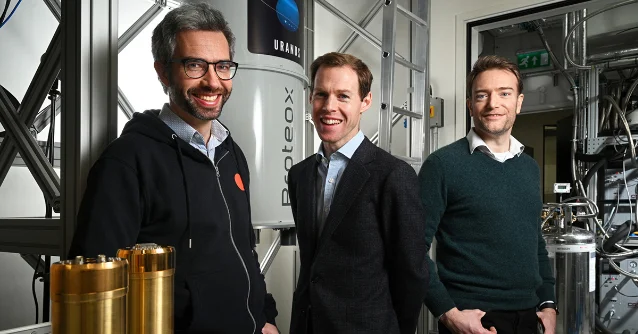
Image from Quantum Motion Series C announcement
| Company | Announced | Amount | Lead investor(s) | Technology | Notes |
|---|---|---|---|---|---|
| Photonic Inc. | May 12 | CAD $275M (~$200M USD), $2.7B CAD post-money valuation | Planet First Partners | Silicon spin qubits + native photonic links | Cumulative: >CAD $350M; Microsoft, RBC, TELUS continue. DARPA Quantum Benchmarking Phase B participant. 18 |
| Quantum Motion | May 7 | $160M Series C (UK record VC round for QC) | DCVC + Kembara | Silicon CMOS qubits | 100× cost reduction, 1,000× energy reduction claimed vs. non-CMOS routes; deployed at NQCC (UK National Quantum Computing Centre). 19 |
| Sygaldry Technologies | May 16 | $139M total (Series A $105M + seed $34M) | BEV (A), Initialized Capital (seed) | Quantum-for-AI servers | Founded by Chad Rigetti (formerly Rigetti Computing). Goal: reduce AI training/inference energy cost. 20 |
| Nord Quantique | May 15 | Undisclosed (details page not retrieved); $1.4B valuation | Fidelity-backed | Superconducting | Valuation sourced from TQI headline; deal specifics not independently confirmed. 21 |
| eleQtron | May 5 | €57M Series A | Schwarz Digits (Schwarz Group) | MAGIC (Magnetic Gradient Induced Coupling) microwave trapped-ion | €54.2M order backlog at close; EIC Fund (European Innovation Council Fund) participating. 22 |
Public market earnings — May 16:
D-Wave (NYSE: QBTS) Q1 2026: bookings $33.4M (+~2,000% YoY), revenue $2.9M (−81% YoY — the prior-year quarter included a $12.6M one-time system recognition), net loss $18.4M. Remaining performance obligations $42.4M (+563% YoY); ~54% expected to convert within 12 months. D-Wave also closed the acquisition of Quantum Circuits Inc. (superconducting dual-rail qubit designer), establishing a gate-model roadmap: 175 physical-qubit dual-rail system by 2028, 1,000 physical qubits by 2030, 100 logical qubits by 2032. 23
Xanadu (Nasdaq/TSX: XNDU) Q1 2026 (first post-IPO quarter): revenue $2.8M (+4× YoY vs. $700K), net loss $20.6M, cash $272.5M. PennyLane (Xanadu's open-source quantum ML framework) reports 35,000+ active users and ~200,000 monthly downloads. Xanadu demonstrated a 25× speedup on a 20-qubit computational fluid dynamics simulation involving 35 million quantum gates — run in collaboration with AMD. Canadian government negotiations ongoing for approximately CAD $390M (~$285M USD) in support for Project OPTIMISM. A $300M at-the-market (ATM) facility planned. 24
Policy and geopolitics
France–Germany quantum cooperation declaration (May 12). More than 100 representatives — from CEA, Fraunhofer, CNRS, Inria, Quandela, QUTAC, and the European Champions Alliance, among others — gathered in Paris for a quantum reception hosted by the German Ambassador Stefan Steinlein. The session produced a cooperation declaration with four pillars: developing industrial use cases, researching quantum adoption pathways, improving public-private coordination, and demonstrating commercial quantum deployments. The declaration is a framework statement of intent, not a funded program or formal joint venture. France committed approximately €1.8 billion to its national quantum strategy in 2021; Germany has committed comparable sums through federal and state programs. 25
Origin Quantum Wukong-180 (May 15). China-based Origin Quantum launched the fourth-generation Wukong-180, a superconducting quantum computer with a proprietary 180-qubit chip. The full stack — chip, control electronics, cryogenic environment, and operating system — is domestically developed. The previous-generation system logged over 90 million quantum computing tasks across 160+ countries. Origin Quantum has built China's first quantum chip production line. 26
U.S. NQIA Reauthorization. The House Science, Space, and Technology Committee passed H.R.8462 (NQIA Reauthorization Act) on April 29 — outside this issue's primary window but relevant background. The bill adds NASA as a formal quantum research partner and emphasizes commercialization, supply chain resilience, and allied coordination. Senate companion bill S.3597 passed the Commerce Committee unanimously on World Quantum Day. FY2026 funding levels remain unresolved. 27
Post-quantum cryptography: Q-Day timeline tightens
On May 17, CNN published a feature on "Q-Day" — the point at which a quantum computer can break widely deployed public-key encryption — positioning it as a cybersecurity crisis potentially more disruptive than Y2K. 28
Several concrete data points from the piece:
- Google and Cloudflare have projected a cryptographically-relevant quantum computer as early as 2029, significantly earlier than prior consensus estimates.
- The 7th edition of the Global Quantum Threat Timeline Report (based on 26 experts) rates a full-scale cryptography-breaking machine as "likely" within the next 10 years.
- A paper published approximately late April 2026 — cited in Prof. Roee Ozeri's Wix Engineering Conference keynote on May 13 29 — claims 10,000 physical qubits would suffice to break RSA-2048. Current hardware stands at hundreds to low thousands of physical qubits, placing the gap at roughly one order of magnitude.
- NIST finalized its post-quantum cryptography (PQC) algorithm standards in 2024. The White House has advised entities to complete PQC migration by 2035.
- McKinsey data: more than 90% of enterprises have no quantum-safe migration roadmap.
- Hudson Institute estimate: a quantum attack on the Federal Reserve's interbank payment system could trigger a six-month economic recession.
"There's going to be a very stark security transition — one day all your data is safe, and the next, it's not."— Michele Mosca, Institute for Quantum Computing, University of Waterloo 28
The 10,000-qubit RSA-2048 claim is a significant downward revision from earlier estimates (which typically cited 4–20 million noisy physical qubits). The underlying paper has not been independently verified in this issue; treat as a preliminary result pending peer review.
MIT researchers separately published a study in Nature Physics on May 12 identifying that series inductance in circuit wiring — not the Josephson junction itself — is the actual source of second-harmonic corrections in superconducting circuits 30. This finding directly affects qubit design: the harmonic correction causes two Cooper pairs to tunnel simultaneously rather than sequentially, introducing computational errors that the standard circuit model does not capture.
Cover image: Z₃ time crystal experimental setup from A Qutrit Time Crystal Stabilized with Native Chiral Interactions (CC BY 4.0)
参考来源
- 1arXiv:2605.14293
- 2arXiv:2605.14293v1 full text
- 3arXiv:2605.14042
- 4arXiv:2605.14042v1 full text
- 5arXiv:2605.14656
- 6arXiv:2605.14586
- 7arXiv:2605.15090
- 8arXiv:2605.14637
- 9arXiv:2605.13929
- 10arXiv:2605.14325
- 11arXiv:2604.19481
- 12arXiv:2604.14296
- 13arXiv:2603.05496
- 14Google Blog: REPLIQA
- 15IonQ press release
- 16IBM Research Blog
- 17IBM Research Blog: broader partnerships
- 18BC Technology
- 19Quantum Motion
- 20The Quantum Insider
- 21The Quantum Insider
- 22The Quantum Insider
- 23The Quantum Insider: D-Wave
- 24The Quantum Insider: Xanadu
- 25The Quantum Insider: France-Germany
- 26The Quantum Insider: Wukong-180
- 27The Quantum Insider: NQIA
- 28CNN: Q-Day
- 29Wix Engineering: Ozeri keynote
- 30MIT News
围绕这条内容继续补充观点或上下文。