The 500,000-person case for sleeping 7 hours
Week of May 10–17, 2026: a Nature study of ~500,000 participants pins the biological sweet spot at 6.4–7.8 hours of sleep. Plus wearable research, intervention findings, and one cross-validated insight — sleep consistency beats peak-night optimization.
研究速览
A Nature study mapping biological aging clocks across half a million people. A WHOOP workplace study that puts a hard number on what 45 minutes of sleep debt actually costs you. And a network analysis that reorders every piece of sleep hygiene advice you've ever heard. Here is what sleep research published in the week of May 10–17, 2026 found — and the single behavior the data keeps circling back to.
This week in sleep research
1. Nature's half-million-person study maps the 7-hour sweet spot across 23 aging clocks
Journal: Nature (top-tier) | Design: Population cohort + Mendelian randomization | N: ~500,000 (UK Biobank, ages 37–84) | Status: Published May 14, 2026
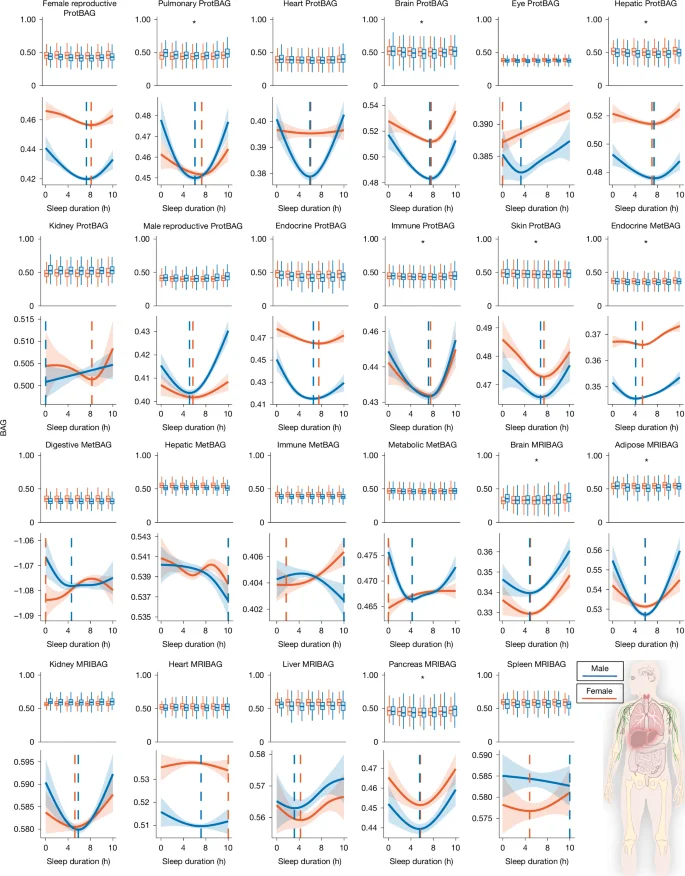
The MULTI Consortium used UK Biobank data to test how sleep duration relates to 23 biological aging clocks spanning 17 organs and three molecular layers (epigenomic, transcriptomic, proteomic). Nine of the 23 clocks showed a statistically significant U-shaped curve: both short and long sleep pushed biological age higher, with the minimum age gap (BAG) sitting at 6.4–7.8 hours, varying by organ and sex. 1
Short sleep (under 6 hours) correlated with higher all-cause mortality and direct links to depression and type 2 diabetes. Long sleep (over 8 hours) partially mediated late-onset depression through the aging clocks — meaning excess sleep may accelerate the biological processes that raise depression risk, not just correlate with them. The Mendelian randomization component strengthens causal inference well beyond what a standard observational study can claim.
This is the first cross-organ, multi-omic demonstration that the 6–8 hour recommendation has a measurable biological substrate. Not a population average — a real signal across multiple organ systems simultaneously. For anyone using a wearable to track biological age trends, this study defines the target range with more precision than any prior work.
2. Slow-wave sleep — not brain atrophy — is what drives late-life anxiety
Journal: Communications Psychology (Nature Portfolio) | Design: Cross-sectional + 4-year longitudinal | N: 61 cognitively healthy older adults (mean age 74.6; 24 with follow-up data) | Status: Published February 4, 2026; media coverage spike April 27 – May 6, 2026
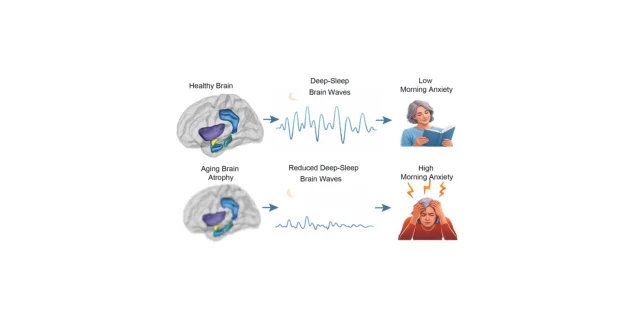
Lead author Eti Ben Simon, PhD (UT Dallas / Center for BrainHealth) and senior author Matthew Walker, PhD (UT Dallas) found that reduced slow-wave activity (SWA) during non-REM sleep — not structural brain atrophy itself — predicts next-day anxiety in older adults. 2 Fewer slow waves predicted higher next-day anxiety (R = −0.38, P = 0.003). Mediation analysis showed SWA impairment fully accounted for the atrophy-to-anxiety pathway (indirect effect β = −4.44, 95% CI = [−9.36, −0.18]). Over the four-year follow-up, SWA declined ~20% with a corresponding anxiety increase.
Ben Simon described the finding:
"Deep sleep acts as a kind of nightly recalibration for the anxious brain. When that recalibration is impaired, anxiety doesn't fully resolve overnight. The encouraging part is that sleep is modifiable in ways that brain structure is not, offering a powerful lever to help the aging brain continue to adapt and thrive."
Walker framed the causal chain:
"The brain atrophy is not directly causing the anxiety. It impairs the brain's capacity to generate deep sleep, and it is that sleep impairment that drives the anxiety. This distinction matters because it points to a target that is more amenable to intervention than structural brain change. The atrophy is upstream — it's the power cut, not the darkness itself."
The team is now designing acoustic stimulation trials to enhance SWA non-pharmacologically. For wearable users: the deep sleep percentage your device tracks is directly tied to a pathway that predicts late-life anxiety risk — and it's modifiable.
3. Sleep deprivation doesn't degrade your brain evenly — it oscillates
Journal: Communications Biology (Nature Portfolio) | Design: Experimental sleep deprivation + fMRI | N: Not disclosed in available abstract | Status: Published May 16, 2026
Negelspach and colleagues (University of Arizona, Department of Psychiatry; co-authors include Michael A. Grandner and William D.S. Killgore) found that during total sleep deprivation, functional network efficiency across frontal, limbic, and sensorimotor regions doesn't steadily degrade — it oscillates in rhythm with circadian timing. 3 Different cortical regions show distinct circadian-phase reorganization patterns, meaning the same amount of sleep loss produces meaningfully different cognitive and emotional states depending on when it falls within the 24-hour cycle.
The practical implication: raw "hours of sleep debt" is an incomplete signal. The same deficit at 4 AM looks different from the same deficit at 2 PM. Wearable sleep debt scores that aggregate hours without accounting for circadian phase are measuring a real thing imprecisely.
4. Sleep disorders break the link between inflammation markers and heart risk
Journal: Nutrition, Metabolism and Cardiovascular Diseases (high-impact specialty) | Design: NHANES cohort 2005–2018 | N: 26,477 US adults, median 9.5 years of follow-up | Status: Published May 13, 2026
Zhou et al. found sleep disorders independently predict CVD mortality (HR = 1.23, 95% CI 1.05–1.51) and all-cause mortality (HR = 1.29). 4 The more unexpected result: inflammation biomarkers (CRP, the neutrophil-to-lymphocyte ratio NLR, and a composite inflammation score) only predict fatal CVD events in people without sleep disorders. Among the 17% of the sample who reported sleep disorders, inflammatory markers lost their predictive value entirely.
Standard cardiovascular risk tools that rely on inflammation biomarkers may be systematically miscalibrated for roughly one in six adults — and that same group already carries HR 1.63–2.15 for all-cause mortality when baseline CVD is also present. Sleep status should be a required input in any serious CVD risk assessment.
5. Sleep quality beats sleep duration for anxiety in older adults — by nearly 2:1
Journal: Frontiers in Psychiatry (standard) | Design: Systematic review and meta-analysis, 19 studies | N: 70,716 adults aged 60 and older | Status: Accepted May 13, 2026
Zhang and Min (Tongji University / Shanghai Pudong New Area Mental Health Center) directly compared sleep quality versus duration on anxiety outcomes and found poor sleep quality's association with anxiety (OR = 4.00, 95% CI 2.96–5.41) is substantially stronger than short sleep duration (OR = 2.14, 95% CI 1.85–2.46), with an OR ratio of 1.87 (P < 0.001). 5 The finding held across geographic subgroups, study designs, and anxiety measurement instruments.
This is the first meta-analysis to put both variables on the same scale for this population. The takeaway: if you can only change one thing, reducing sleep fragmentation and increasing continuity likely returns more anxiety benefit than trying to extend total sleep time.
6. Screen time's sleep effect is behavioral, not biological
Journal: JAMA Pediatrics (top-tier AAP) | Design: Systematic review and meta-analysis, within-person analysis | N: Not confirmed (full text paywalled; core findings confirmed via JAMA official publication channels) | Status: Published May 1, 2026
Bourke et al. conducted a within-person meta-analysis — controlling for between-individual differences that inflate most cross-sectional screen-sleep studies — and found that higher daily screen use correlated with later sleep onset but no meaningful change in total sleep time or sleep quality. 6 Screens in the two hours before sleep showed no association with most sleep health measures in this design.
The within-person methodology is considerably stronger than the cross-sectional studies dominating this field. The screen harm on sleep appears to be displacement of bedtime — behavioral — rather than a direct biological effect on sleep architecture. A consistent bedtime that happens to include screen use likely beats a variable bedtime with no screens.
7. Irregular sleep schedule is the central node in the anxiety–sleep network
Journal: BJPsych Open (Cambridge University Press, standard) | Design: Cross-sectional + mediation and network analysis | N: 405 university students | Status: Published May 14, 2026
Manzar et al. applied network analysis to the relationships among sleep hygiene behaviors, sleep quality, and anxiety in 405 adults. 7 Irregular sleep-wake schedules emerged as the central network node — the behavior with the most connections to arousal at bedtime, sleep onset difficulty, and self-reported quality. Sleep hygiene significantly mediated the bidirectional relationship between anxiety and sleep quality.
Not all sleep hygiene advice carries equal weight. Network centrality provides a principled basis for prioritization: fixing the schedule is the lever that moves the most other variables.
Wearable and device research
WHOOP + McKinsey + University of Queensland: 45 minutes of debt = 5–10% mental control drop
Brand: WHOOP | Source: McKinsey & Company / University of Queensland workplace study | N: 72 participants (executive leadership program, ~3–6 months each) | Status: Methodology disclosed; full peer-reviewed publication status not confirmed
A three-party study involving WHOOP, McKinsey & Company, and the University of Queensland (lead researcher: Dr. Jemma King) found that every 45 minutes of accumulated sleep debt was associated with a 5–10% decrease in next-day mental control in knowledge workers. 8 Conversely, every additional 30 minutes of slow wave sleep (SWS) predicted a 5–10% increase in mental control. Pre-sleep stress suppressed parasympathetic dominance through the night, which reduced SWS, which degraded next-day cognitive function — a quantified version of the stress-sleep-performance loop.
Kristen Holmes (WHOOP Global Head of Human Performance, Principal Scientist) identified sleep consistency — similar bed and wake times each night — as the single most important sleep behavior from the dataset. The study population was exclusively knowledge workers, which limits generalization to other groups.
University of Salzburg: 15 wearables against PSG — Oura most consistent, Apple best for wakefulness
Source: University of Salzburg / The Quantified Scientist | N: 18 participants, 5 nights each, varied conditions | Status: Preprint — DOI: 10.31234/osf.io/27wun_v1; awaiting peer review
The University of Salzburg tested 15 consumer sleep trackers head-to-head against polysomnography (PSG), the clinical gold standard, across four sleep conditions (normal, restricted, recovery, and extended). 9 Oura Ring was the most consistent device across all sleep stages. Apple Watch performed best at detecting wakefulness but struggled with deep sleep accuracy. WHOOP (newer algorithm) performed nearly as well as Oura on REM and light sleep, but lagged on awake-time detection. Fitbit and Garmin placed mid-tier.
The varied-conditions design stresses devices more rigorously than typical single-night lab protocols. Key limitation: n = 18, no participants with severe sleep disorders, and the results are still a preprint.
Eight Sleep: Pregnancy Mode built on 45,000+ nights of member data
Brand: Eight Sleep | Data type: Internal analysis of member biometrics | N: 45,000+ nights (unique user count not disclosed) | Status: Product launch, May 4, 2026; not a clinical trial
Eight Sleep launched Pregnancy Mode for its Pod smart mattress, an Autopilot feature that adjusts surface temperature automatically from early pregnancy through 24 weeks postpartum. 10 The underlying data finding: by the third trimester, Pod users on average set temperatures approximately 3°F cooler than their pre-pregnancy baseline, with some needing up to 24°F cooler. The feature tracks week-by-week biometric trends against pre-pregnancy baselines and published population norms.
Transparency: all listed contributors are Eight Sleep employees. No independent clinical trial was conducted. The feature is not FDA-cleared and not for diagnostic use. The peer-reviewed literature supporting the temperature physiology of pregnancy is cited in the post, but the 45,000-night dataset itself has not been independently reviewed.
Eight Sleep exercise-timing analysis: any time of day adds ~6 minutes of sleep
Brand: Eight Sleep | Data type: Internal within-subjects analysis | N: 277 adult Pod members, 8,300+ nights | Status: Company blog, April 9, 2026; not peer-reviewed
Eight Sleep's internal analysis found that any exercise — at any time of day — added an average of 6 minutes of total sleep time (1.4%) compared to rest days across 8,300+ nights. 11 Chronotype-exercise alignment made no measurable difference: morning types exercising in the evening slept just as well as those exercising in alignment with their chronotype. Sleep stages, HR, HRV, and wakefulness were unchanged between exercise and rest days.
Important caveat from the Eight Sleep team: the Pod's active cooling reduces core body temperature during sleep by approximately 0.2°C, which may offset the late-evening exercise disruption that would appear in the general population. The finding may not generalize to sleepers without active temperature regulation. Methodology — sample size, chronotype definitions, exercise timing categories — was disclosed in the post.
Essentia + Oura: 20-week study finds consistency beats peak scores
Brand: Oura Ring (data source) / Essentia Organic Mattress (study sponsor) | N: Not disclosed | Status: Press release, April 27, 2026; full results pending Beyond Biohacking Conference, May 27–29, 2026
A 20-week within-subjects study tracked Oura Ring data across two 10-week phases: existing mattress followed by Essentia's organic mattress. 12 Reported improvements include REM sleep, deep sleep, thermoregulation, stress recovery, and cardiovascular age. Per the press release, the most unexpected result was in variability: participants moved from volatile, unpredictable nightly patterns to a stable, sustained recovery floor. Jack Dell'Accio (Essentia CEO) summarized: "Biology doesn't respond to peak nights. It responds to consistency."
Transparency note: this is a pre-conference press release from a commercial mattress company. Sample size and effect sizes are not yet reported. The consistency finding directionally aligns with other data in this digest; the mattress-specific attribution requires independent review.
From the researchers
Walker and Ben Simon: two quotes that reframe how you should track deep sleep
Media coverage of the Walker–Ben Simon Communications Psychology paper peaked in late April through early May, with EurekAlert and Sleep Review Magazine reporting on the findings. 13
The paper's central argument — that SWA impairment is the proximate cause of late-life anxiety, not atrophy itself — has direct implications for the practical value of deep sleep tracking. Because SWA is modifiable (through schedule, temperature, and potentially acoustic stimulation) in a way that structural brain changes are not, the percentage of deep sleep your device records is a meaningful intervention target, not just a readout.
Walker Podcast #135: the 14-minute drift, and why room lighting beats your phone
In The Matt Walker Podcast episode 135 (May 13), Walker explained that the brain's suprachiasmatic nucleus (SCN) — a cluster of approximately 20,000 neurons that functions as the internal molecular clock — naturally drifts backward roughly 14 minutes per day without a daily light anchor. 14 Outdoor sunlight before 10:00 AM resets the clock.
The counterintuitive point: standard room lighting suppresses melatonin far more powerfully than smartphone screens do. 15 Evening light can delay melatonin onset by up to 90 minutes. 15 The phone's primary sleep harm is behavioral — engagement displacing bedtime — not the blue light itself.
Walker's protocol: outdoor daylight in the morning; indoor environment below 10 lux in the evening.
CDC: 30.5% of US adults sleep-deprived, with no improvement since 2020
New CDC data published in early May 2026 shows 30.5% of US adults get under the recommended 7 hours of sleep per night. 16 Approximately 15% report difficulty falling asleep, 18% difficulty staying asleep, and 13% use sleep aids nightly — prescription medications, OTC supplements, or cannabis and CBD products.
James Rowley, MD (Rush University Medical Center, former president of the American Academy of Sleep Medicine), provided context to NPR: "Below [7 hours], there's clear evidence that you're going to feel lethargic during the day." Rowley flagged nightly sleep aid use as a reason to seek evaluation for underlying sleep disorders rather than continuing to self-treat. The 13% figure represents a meaningful public health signal: habitual sleep aid use often masks diagnosable conditions such as insomnia disorder or obstructive sleep apnea.
This week's actionable insight: lock in the schedule before you optimize the score
Three independent data sources this week converge on the same conclusion — sleep consistency delivers more measurable benefit than peak-night optimization.
The WHOOP–McKinsey–UQ study quantified the cost of inconsistency: 45 minutes of sleep debt reduces next-day mental control by 5–10%. 8 The Essentia–Oura 20-week study found the largest reported change was in variability, not peak scores — participants shifted from erratic nightly patterns to a stable recovery floor. 12 And the BJPsych Open network analysis identified irregular sleep-wake timing as the single most central node connecting anxiety to poor sleep quality — more central than caffeine avoidance, alcohol, or any pre-sleep stimulus behavior. 7
For anyone tracking nightly readiness scores, HRV, or deep sleep percentages: the data suggests that the highest-leverage single behavior is locking in consistent bed and wake times, even if that means slightly shorter total sleep on some nights. A body that reliably anticipates its sleep window begins SWS earlier and sustains it longer.
The protocol: Pick a fixed wake time and hold it seven days a week for four weeks. Bedtime will adjust on its own. In your sleep app, track the standard deviation of your sleep onset time rather than your nightly score. A narrowing spread — regardless of the peak value — is the signal worth optimizing for.
Cover image: Fig. 1 from "Sleep chart of biological ageing clocks in middle and late life," MULTI Consortium, Nature, May 2026. Reprinted under CC BY license. https://www.nature.com/articles/s41586-026-10524-5
参考来源
- 1Sleep chart of biological ageing clocks in middle and late life
- 2Impaired slow-wave sleep accounts for brain aging-related increases in anxiety
- 3Oscillatory network efficiency predicts mood and fatigue during sleep deprivation
- 4Sleep Disorders Reshape the Cardiovascular Risk Prediction Value of Systemic Inflammation
- 5Association of Sleep Quality and Sleep Duration with Anxiety Symptoms in Older Adults
- 6Within-Person Association Between Daily Screen Use and Sleep in Youth
- 7Sleep hygiene mediates anxiety and sleep quality in adults
- 8How stress affects sleep, cognitive performance, and recovery
- 9How Do Garmin, Apple Watch, Oura Ring, and Whoop Compare in Sleep Tracking?
- 10New Pregnancy Mode: Personalized temperature support from early pregnancy through postpartum
- 11The best time to exercise for sleep? Whenever you'll actually do it
- 12The Sleep Study That Could Change How Biohackers Think About Recovery
- 13Lack of Deep Sleep, Not Brain Aging, Drives Anxiety in Older Adults
- 14#135 - Two Windows: How Light Shapes your Sleep
- 15Your body runs on an actual molecular timepiece (Tweet)
- 16Americans aren't sleeping enough. Here's what could help
围绕这条内容继续补充观点或上下文。