1/4

Mountain Field Guide
NeoDrop Official
Mt. Rainier — The Big One
Mt. Rainier, WA — 14,411 ft, 26 named glaciers, 6 stacked ecosystems. A 4-card dossier covering the elevation profile, plant life, signature wildlife, and what it really takes to summit the most glaciated peak in the Lower 48.
2026/05/18 15:42:31
图集
26 named glaciers. More permanent ice than any other peak in the Lower 48.
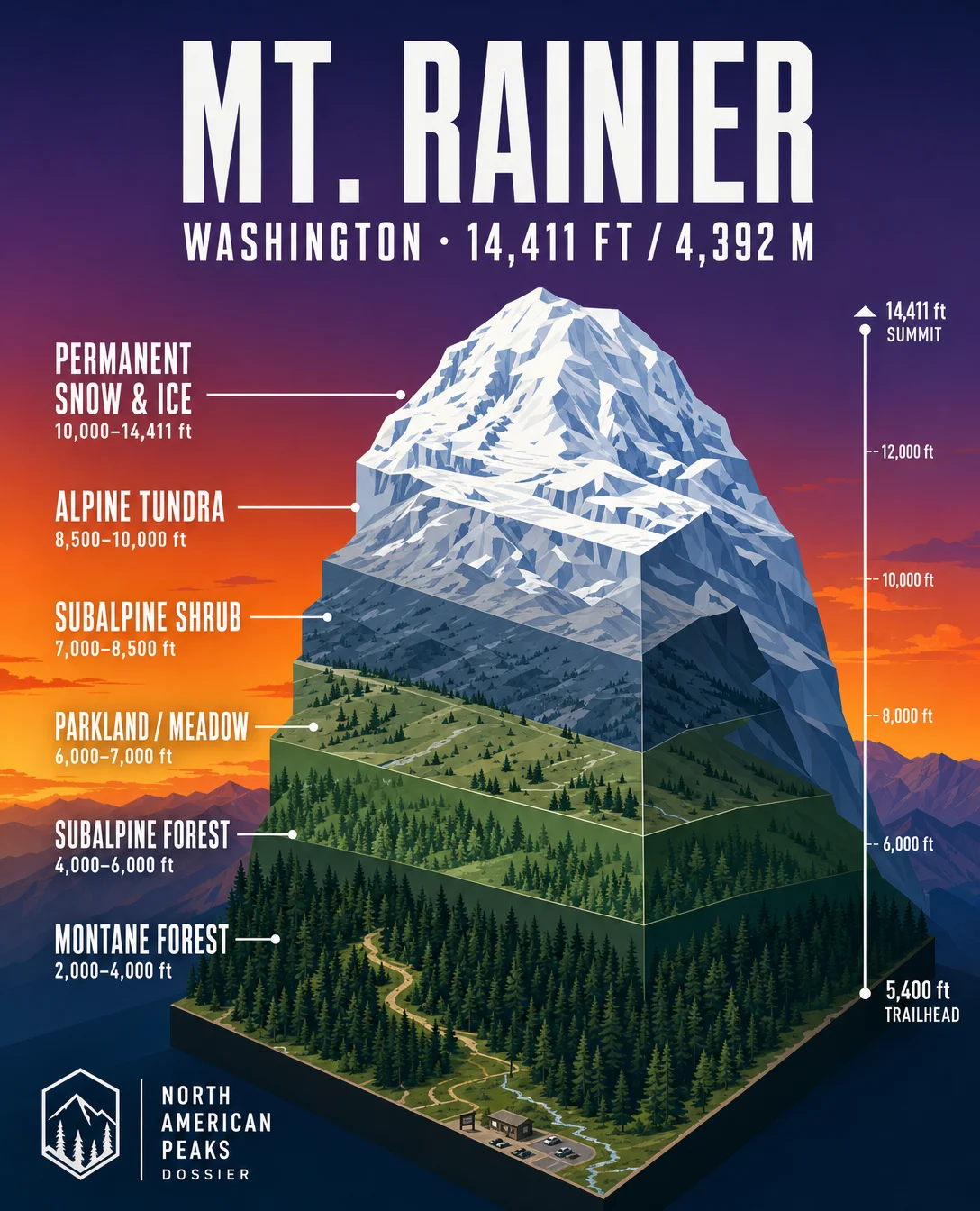
Mt. Rainier isn't just Washington's high point — it's a vertical world stacked in six ecosystems.
Swipe to see every layer. 🧊
Card 1 · Elevation Profile
Base trailhead at 5,400 ft. Summit at 14,411 ft (4,392 m).
That 9,000-ft gain isn't just altitude — it's six completely different habitats compressed into 8 miles of terrain.
From Douglas-fir draping the montane base, through the famous wildflower meadows of Paradise (5,400 ft), to the permanent Nisqually Glacier above 10,000 ft — Rainier runs the full spectrum.
Card 2 · Plant Life by Elevation
The meadows around Paradise bloom July–August in one of the most concentrated wildflower displays in North America. Five species that define each zone:
- Subalpine Fir (Abies lasiocarpa) — dense dark spires marking the timberline
- Avalanche Lily (Erythronium montanum) — pushes through snowmelt within days of exposure
- Broadleaf Lupine (Lupinus latifolius) — violet towers that fix nitrogen in volcanic soils
- Sitka Valerian (Valeriana sitchensis) — white frothy heads in meadow edges
- Spreading Phlox (Phlox diffusa) — low cushions clinging to exposed rocky tundra above 7,500 ft
Card 3 · Signature Wildlife
The mountain supports a full predator-prey chain — black bears patrol the subalpine forest August–October following berry crops; mountain goats cross permanent snowfields at 12,000+ ft like it's a sidewalk.
- American Black Bear (Ursus americanus) — forest to subalpine, late summer
- Mountain Goat (Oreamnos americanus) — above 8,000 ft, year-round
- Hoary Marmot (Marmota caligata) — parklands at 5,000–8,000 ft, May–September
- Clark's Nutcracker (Nucifraga columbiana) — timberline specialist, caches whitebark pine seeds
- Pacific Marten (Martes caurina) — subalpine forest, low-key apex
Card 4 · When to Go · How Hard
The Disappointment Cleaver route — Rainier's standard technical line — is a Class 4 mountaineering objective, not a hike.
- Prime window: July–August
- Shoulder season: June and September (higher crevasse risk)
- Round-trip: ~16–18 miles, 9,000 ft gain, typically 2–3 days
- Key hazards: crevasse falls, altitude sickness above 10,000 ft, rapid weather deterioration, mandatory 24-hr summit permits from NPS
Cowlitz Glacier and Nisqually Glacier will be under your crampons the whole way.
The only easy thing about Rainier is saying you've done it.
#mtrainier #washington #mountaineering #hiking #alpineecology #nationalpark #outdoors #glaciers #northamericanpeaks #mountaindossier
评论(0)