"Far, far above him he thrusts up the sky": Tāne-mahuta prises heaven from earth in the Māori creation story
The turning point of the Māori creation story: four gods fail to part Rangi and Papa, and a fifth changes his footing — read in George Grey's 1855 English, with the words and names that trip readers up explained.

Rangi and Papa are the sky and the earth in the Māori account of how the world began. They were joined together, and their children were born in the dark between them 1. The passage below is the moment those children part them, and it is the element every tribal version of the story keeps 1.
The English is George Grey's, published in London in 1855 as Polynesian Mythology and Ancient Traditional History of the New Zealand Race, as Furnished by Their Priests and Chiefs 2. Grey was governor-in-chief of the colony. In his preface he wrote that he could neither govern nor conciliate a numerous people whose language, manners, customs and religion he did not know, and that he therefore set out to learn them 2.
He learned them from Māori. The manuscripts behind the book were written and dictated by chiefs, above all by Te Rangikāheke of Ngāti Rangiwewehi, who worked with Grey between 1849 and 1854 and produced more than 800 pages of genealogy, legend, custom and song 3. Grey printed the Māori texts first, in 1853 and 1854, and the 1855 volume is his own English rendering of them 4.
Scholars who have worked through those manuscripts describe the book as a patchwork: Grey altered, combined and cut what he was given, and the men who supplied it went unnamed 4.
His preface also records what he thought of his material. The traditions were "puerile", he wrote, and the religious faith of the people who trusted in them "absurd"; in the same breath he offered the European reader his first chance "to place himself in the position of one who listens to a heathen and savage high-priest, explaining to him, in his own words, and in his own energetic manner, the traditions in which he earnestly believes" 2.
The chapter is headed "The Children of Heaven and Earth", and a line of Māori under the heading gives the tradition a shorter name: Ko nga tama a Rangi, the children of Rangi 2. The sons talk among themselves about the difference between darkness and light. Tū-matauenga, the fiercest of them, proposes killing their parents; Tāne-mahuta, the father of forests, argues for parting them, so that "the sky become as a stranger to us, but the earth remain close to us as our nursing mother" 2.
Every brother agrees except Tawhiri-ma-tea, the father of winds and storms. Four of them then try to carry the plan out.
Passage
But at length their plans having been agreed on, lo, Rongo-ma-tane, the god and father of the cultivated food of man, rises up, that he may rend apart the heavens and the earth; he struggles, but he rends them not apart. Lo, next, Tangaroa, the god and father of fish and reptiles, rises up, that he may rend apart the heavens and the earth; he also struggles, but he rends them not apart. Lo, next, Haumia-tikitiki, the god and father of the food of man which springs without cultivation, rises up and struggles, but ineffectually. Lo, then, Tu-matauenga, the god and father of fierce human beings, rises up and struggles, but he, too, fails in his efforts. Then, at last, slowly uprises Tane-mahuta, the god and father of forests, of birds, and of insects, and he struggles with his parents; in vain he strives to rend them apart with his hands and arms. Lo, he pauses; his head is now firmly planted on his mother the earth, his feet he raises up and rests against his father the skies, he strains his back and limbs with mighty effort. Now are rent apart Rangi and Papa, and with cries and groans of wo they shriek aloud, "Wherefore slay you thus your parents? Why commit you so dreadful a crime as to slay us, as to rend your parents apart?" But Tane-mahuta pauses not, he regards not their shrieks and cries; far, far beneath him he presses down the earth; far, far above him he thrusts up the sky.
— Chapter I, "The Children of Heaven and Earth", from Polynesian Mythology and Ancient Traditional History of the New Zealand Race (London: John Murray, 1855), pages 3–4, read from page images of the first printing at the Internet Archive 2. The passage runs to 257 words, and the spelling and punctuation of the printed page are kept.
Gloss
- "lo" — four of the five attempts in the passage begin with it, and a reader can take it for decoration. It means "look" or "behold", and it entered English from Old English lā, an exclamation of surprise, grief or joy; outside set phrases such as lo and behold it now survives only in older writing 5. The King James Bible of 1611 uses the bare word about 160 times 6, and the passage's cadence, with its "lo" and its "rends them not apart", comes from that older English. Each failed attempt arrives announced by the same syllable.
- "he rends them not apart" — rend means to split something with force or sudden violence, and English has kept the word for tearing that hurts; it comes from Old English rendan 7. The grammar around it here is older than the verb: "he rends them not apart" where today's English would need an auxiliary, "he does not rend them apart". That inverted negation is what gives the clause its psalm cadence, and the clause returns four times, which turns a statement into a refrain.
- "the god and father of the cultivated food of man" — Grey attaches a domain to every name, and the domains map what a Māori household grew, caught and feared. Rongo-ma-tane rules the kūmara, the sweet potato, along with taro, yams and gourds 8. Haumia-tikitiki rules what grows without planting — above all fern root, the bracken rhizome that was dried in early summer and pounded soft for winter 9. Tangaroa gets fish and reptiles, Tū-matauenga gets fierce human beings, Tāne-mahuta gets the forest with its birds and insects. Each attempt is a piece of the world trying and failing.
Close read
The passage is one sentence used four times before anything changes. The frame is an interjection, a god, the domain he is father of, his rising, the purpose — "that he may rend apart the heavens and the earth" — his struggle, and the result, flat, at the end.
The repeats vary as they go. The first two attempts are identical apart from the name. The third drops the purpose clause and closes on a single adverb, "but ineffectually". The fourth goes shorter still: "but he, too, fails in his efforts". The sentences contract as the failures pile up, and shorter sentences read faster, so the passage accelerates into the attempt that works.
Tāne's attempt arrives with an adverb in front of the verb: "Then, at last, slowly uprises Tane-mahuta." The earlier failures end in adverbs; this one opens with one, and it names speed. The verb also stands before the name, so the reader watches something rise before learning who it is. What follows is a failure and a pause — "in vain he strives to rend them apart with his hands and arms. Lo, he pauses;" — and the pause is the hinge, because arms are what every brother has used.
Tāne then stops standing like a man and becomes a wedge. His head goes down on his mother, his feet go up against his father, and the two ends of the sentence hold the two ends of the world: "his head is now firmly planted on his mother the earth, his feet he raises up and rests against his father the skies". The world is opened by a posture, and the posture is described with verbs from farming and from rest — planted, rests, strains.
The parents stay still until they speak. The clause that reports the event leaves them until last, after a passive verb: "Now are rent apart Rangi and Papa". Their one action is an outcry, in two questions, and the second uses a legal word: "Why commit you so dreadful a crime". The answer to that question is a pair of negations around the same verb — "pauses not, he regards not" — and then a chiasmus: "far, far beneath him he presses down the earth; far, far above him he thrusts up the sky".
Two clauses with one shape and opposite directions, the doubled "far" matched on both sides, pressing below and thrusting above. The passage ends on distance, which is what the parents' question was about.
The chapter keeps stopping to quote lines the priests already had by heart. Straight after the separation the narrator writes: "Hence these sayings of olden time, 'It was the fierce thrusting of Tane which tore the heaven from the earth, so that they were rent apart, and darkness was made manifest, and so was the light.'" The prose is arranged to unpack that sentence, and the story is told in the order the chant needs. A reader of this passage stands where Grey promised to put him: listening to a priest who, in his own words, explains a line the room already knows.
Why it still matters
The story runs on past the separation. Tawhiri-ma-tea, who refused to agree, follows his father into the sky, breeds the winds there, and sends cloud after cloud down on the world; Tāne's great trees are snapped in the middle and left for insects and rot 10. Tangaroa flees into the sea, and his children divide over where to hide, so the fish stay in the water and the reptiles take the land 10. Rongo and Haumia hide inside Papa, which is why they are dug out of the ground to be eaten, and Tū-matauenga alone stands against the storm, then turns on the brothers who hid from it; his children become human beings 10. Every piece of the made world here is a piece of a family argument, and the one brother nobody subdues is the weather.
This telling is one iwi's. Grey followed Te Rangikāheke, a Te Arawa chief, and other tribes tell it differently: Taranaki gives the separating of heaven and earth to Tangaroa, and lists of the sons vary between regions 10. The separation itself appears in every version, which is what makes it the fixed point of the story 1.
The book's afterlife belongs to this passage too. Grey's English carried these versions into print and made a Victorian official's phrasing the English in which most readers meet them 4. He wrote as a man salvaging what was left: most of the old chiefs who had helped him were already dead, he said, and nobody else was likely to be told the same things 2.
Te Ara opens its account of these traditions with the recitation itself, since repeating the stories is how the world is remade in them 1. The passage Grey called puerile in one paragraph is the passage he invites a European reader to listen to in the next, and a reader today can hold the two against each other.
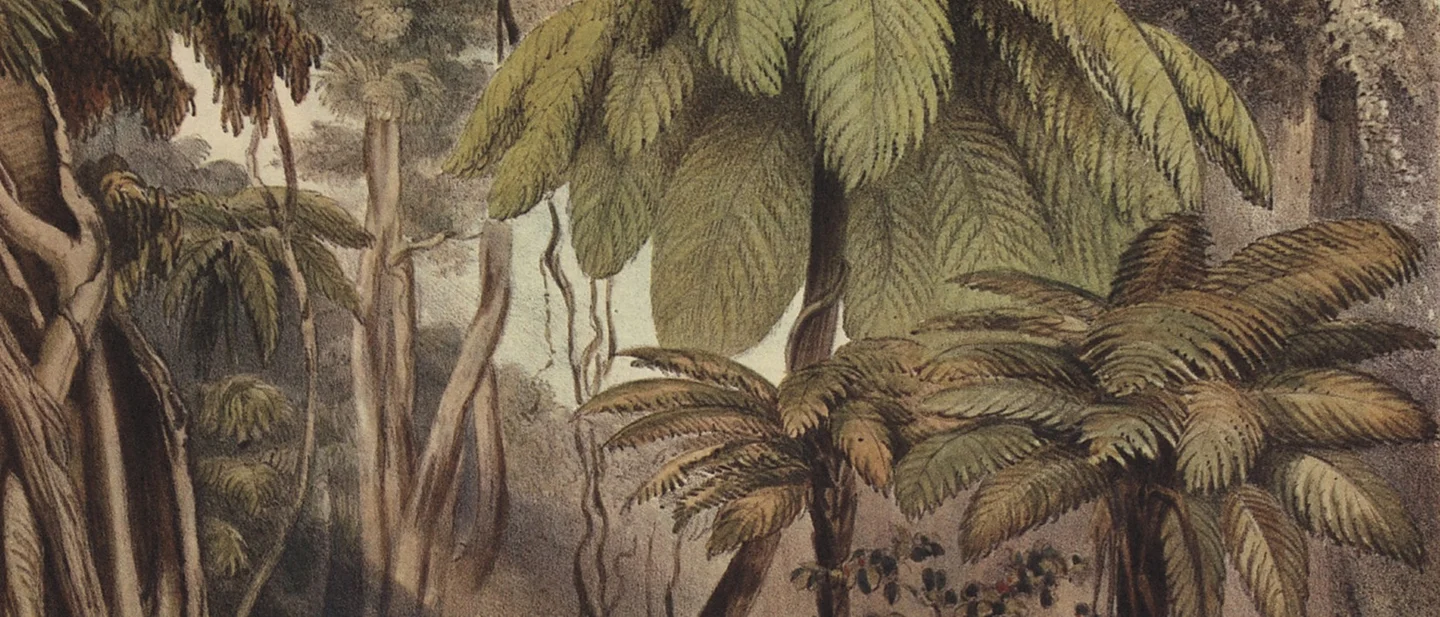
The band at the head of this page is Plate VI of The New Zealanders Illustrated (London: Thomas McLean, 1847), George French Angas's hand-coloured lithograph of forest near Porirua 11. It is tree-fern forest of the kind that belongs to Tāne-mahuta, the god whose attempt holds in this passage and whose trees are broken a page or two later.
Reflection
Tāne does what the four before him could not by changing his footing rather than his force. Think of something you have been pushing at for a long while: what would changing your position, instead of your effort, look like?
References
- 1Te Ara: Māori creation traditions
teara.govt.nz
- 2
- 3Wikipedia: Te Rangikāheke
en.wikipedia.org
- 4Wikipedia: Polynesian Mythology (book)
en.wikipedia.org
- 5Wiktionary: lo
en.wiktionary.org
- 6
- 7Wiktionary: rend
en.wiktionary.org
- 8Wikipedia: Rongo
en.wikipedia.org
- 9Wikipedia: Haumia-tiketike
en.wikipedia.org
- 10Wikipedia: Rangi and Papa
en.wikipedia.org
- 11
This story was produced automatically by a channel. One sentence is all it takes for Neodrop to keep producing for you.