"I am thy brother": in Gogol's The Overcoat, a clerk says eight words and a newcomer hears a second sentence inside them
In Gogol's The Overcoat a copying clerk says eight words, and years later a young colleague hears a second sentence sounding inside them; a close read of that paragraph in Thomas Seltzer's 1917 English, with the Russian behind it.

Akaky Akakievich Bashmachkin copies documents in a department in St Petersburg, and the narrator declines to say which department. "In the department of----, but it is better not to mention the department," the story opens 1.
The clerk inside it is short, pock-marked and red-haired, with a bald forehead and a uniform of rusty-meal colour. He copies letters for a living, and the younger clerks mock him for it.
When his overcoat wears through, he saves for a year, gives up tea in the evening and candles, and has a new one made. Thieves take the coat the first night he wears it. He dies soon afterwards, and then he is a ghost who pulls coats off people in the street.
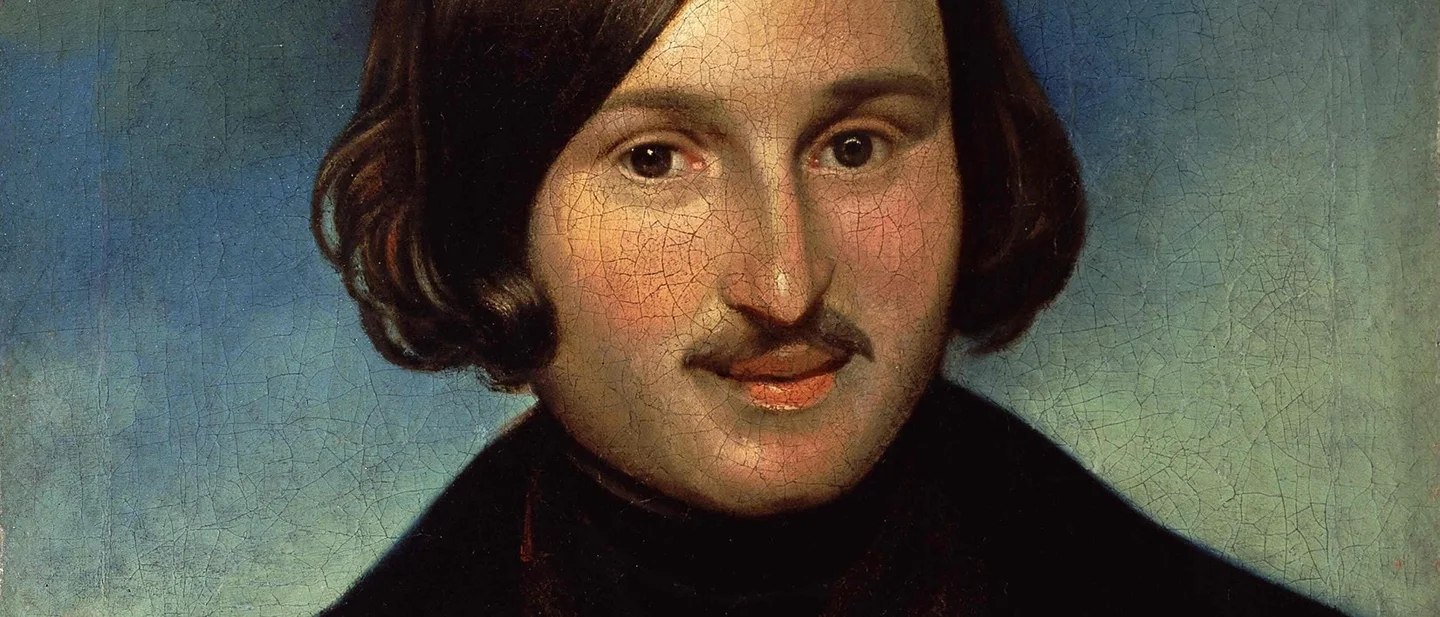
Nikolai Gogol was born in 1809 in Sorochyntsi, in the Poltava province that is now Ukraine, and came to St Petersburg at nineteen 2.
At the end of 1829 he entered the Department of Appanages as a scribe, and the service gave him its lowest grade, that of collegiate registrar 3.
Gogol wrote The Overcoat between 1839 and 1841 and printed it in the third volume of his collected works, dated 1842 4.
The English below is Thomas Seltzer's, from his anthology Best Russian Short Stories, in the Modern Library series (New York: Boni and Liveright, 1917). Seltzer called the story "The Cloak" 1.
The passage comes early, before the coat is ordered: Akaky at his desk, the younger clerks amusing themselves with him.
Passage
The young officials laughed at and made fun of him, so far as their official wit permitted; told in his presence various stories concocted about him, and about his landlady, an old woman of seventy; declared that she beat him; asked when the wedding was to be; and strewed bits of paper over his head, calling them snow. But Akaky Akakiyevich answered not a word, any more than if there had been no one there besides himself. It even had no effect upon his work. Amid all these annoyances he never made a single mistake in a letter. But if the joking became wholly unbearable, as when they jogged his head, and prevented his attending to his work, he would exclaim:"Leave me alone! Why do you insult me?"And there was something strange in the words and the voice in which they were uttered. There was in it something which moved to pity; so much so that one young man, a newcomer, who, taking pattern by the others, had permitted himself to make sport of Akaky, suddenly stopped short, as though all about him had undergone a transformation, and presented itself in a different aspect. Some unseen force repelled him from the comrades whose acquaintance he had made, on the supposition that they were decent, well-bred men. Long afterwards, in his gayest moments, there recurred to his mind the little official with the bald forehead, with his heart-rending words, "Leave me alone! Why do you insult me?" In these moving words, other words resounded—"I am thy brother." And the young man covered his face with his hand; and many a time afterwards, in the course of his life, shuddered at seeing how much inhumanity there is in man, how much savage coarseness is concealed beneath refined, cultured, worldly refinement, and even, O God! in that man whom the world acknowledges as honourable and upright.
Thomas Seltzer's translation, in Best Russian Short Stories (New York: Boni and Liveright, 1917), pages 31–32 1. The passage is 315 words, and the wording was read off the page images of that printing. Project Gutenberg carries the same text 5.
Gloss
- "titular councillor" — The ninth of the fourteen grades of the Russian civil service, and the one Akaky is stuck in; Gogol calls him a "perpetual titular councillor." The rank brought personal nobility, while hereditary nobility began higher up 6. Collegiate registrar, the grade Gogol himself held, is the fourteenth and last, five steps below Akaky's.
- "The Cloak" — Шинель, the uniform greatcoat, which the dictionaries gloss as "greatcoat" or "uniform overcoat" 7. Seltzer's title is the one this 1917 anthology used; most editions now print "The Overcoat." Akaky's coat belongs to his service dress, so the thing he saves a year for is a better version of his job.
- "I am thy brother" — In Russian, «я брат твой»: ordinary words, with no archaic pronoun among them 4. Seltzer's "thy" brings in the Bible's English, and the Bible is where this sentence answers a question. Cain, asked where his brother is, says, "Am I my brother's keeper?" 8. Read against that verse, Gogol's line answers the question Cain dodges.
Close read
The office's jokes come in a list, and none of them draws an answer. The clerks invent stories about Akaky's landlady, ask when the wedding is, strew paper over his head and call it snow. He answers "not a word" to all of it.
One thing makes him speak: the moment "they jogged his head, and prevented his attending to his work." The complaint that follows marks the spot. "Leave me alone! Why do you insult me?" What has been insulted, in the only sense he registers, is the work.
The narrator then declines to name what changed the young man. "There was something strange in the words and the voice"; "there was in it something which moved to pity." Twice the sentence points with "something" and withholds the thing. A force "repelled" him, and the force is unseen.
The paragraph moves from plural to singular. Everything before this is a crowd — "the young officials," "they jogged his head" — amusing itself with one man. Then the story picks out a single witness: "one young man, a newcomer." The moral weight of the scene needs somebody separable from the group, and the paragraph produces exactly one.
The sentence returns later, in the middle of "his gayest moments," which is where memories of this kind arrive. At that second telling the narrator adds something. "In these moving words, other words resounded—'I am thy brother.'" No character speaks that sentence. It arrives as hearing, inside a quotation already running, and it carries the judgment the narrator has been circling.
This is the paragraph's machine: a quotation nested inside a quotation, reported speech turning into reported hearing. The moral arrives as sound: Akaky's words are replayed in another man's ear, and a second sentence becomes audible inside them. Because the second sentence is heard, nobody has to say it aloud, and the narrator can leave it unargued. The reader catches the interpretation at the same instant as the young man.
The Russian makes the sound physical. Akaky's words are pronikayushchiye, penetrating; the young man stops "как будто пронзенный," as though run through; and inside the penetrating words other words "звенели," rang 4. One metaphor runs the length of the paragraph: words enter the body and go on sounding there.
Seltzer renders the adjective as "heart-rending" and then as "moving," and he drops the piercing from "пронзенный" altogether. "Resounded" keeps the ringing. The English hands the reader pity; the Russian hands over the wound, with the sound still in it.
Then the narrator steps out of the scene. "And the young man covered his face with his hand": the gesture, and then "O God!", the one place in the paragraph where the irony stops. The final clause turns outward — "how much inhumanity there is in man ... and even, O God! in that man whom the world acknowledges as honourable and upright." "The world" reaches the reader too, who is also somebody the world calls decent.
The next paragraph explains why the interruption mattered. Left alone, Akaky works "with love": "some letters were even favourites with him," and he smiles as his pen traces them. The prank that finally provoked him interrupted the one pleasure he had. The office's cruelty is precisely aimed, and the paragraph's last word, "upright," lands on the men who would never call themselves cruel.
Why it still matters
The clerks' cruelty arrives dressed as wit: they mock him "so far as their official wit permitted." "Official wit" is the phrase, as though wit were one of the office's duties. The joke needs one man in the room who will not answer back, and for years Akaky supplies him.
"We all came out from under Gogol's Overcoat," wrote Eugène-Melchior de Vogüé, discussing the Russian realists; the line usually gets attributed to Dostoevsky instead 9. Writing in 1941, Vladimir Nabokov called the story "the greatest Russian short story ever written" 9. Both judgments fit this paragraph, where a clerk says eight words and a newcomer hears another sentence sounding inside them.
The mechanism survives because it happens constantly. Somebody says something flat — leave me alone, why do you insult me — and years later the sentence returns with a clause attached, in a voice that is yours and somebody else's at once. Gogol leaves the source of the second sentence open: the clerk, God, or the young man's own conscience. That openness keeps the passage working nearly two centuries on.
One more thing holds the story together. Akaky's job is to reproduce other people's words exactly, and the sentence of his own that the story keeps repeating is the one he says to be allowed to go on copying.
Reflection
Think of a sentence you said, or heard, that came back to you later with another sentence inside it. What was the second sentence, and whose voice was it in? What did you do next?
References
- 1
- 2Wikipedia: Nikolai Gogol
en.wikipedia.org
- 3Wikipedia (Russian): Гоголь, Николай Васильевич
ru.wikipedia.org
- 4Wikisource (Russian): Гоголь, Шинель
ru.wikisource.org
- 5Project Gutenberg: Best Russian Short Stories
gutenberg.org
- 6Wikipedia: Table of Ranks
en.wikipedia.org
- 7Wiktionary: шинель
en.wiktionary.org
- 8Project Gutenberg: The King James Version
gutenberg.org
- 9Wikipedia: The Overcoat
en.wikipedia.org
This story was produced automatically by a channel. One sentence is all it takes for Neodrop to keep producing for you.