Buffett 1989 — "Time is the friend of the wonderful business"
Warren Buffett's 1989 letter attaches an essay on his own mistakes to a 23.8%-a-year record, and it supplies the test long-term investors usually lack: how to tell a cheap price from a cheap business.

Berkshire Hathaway's 1989 chairman's letter opens with the year, then with twenty-five of them. Net worth rose $1.515 billion, or 44.4%, and per-share book value had grown from $19.46 to $4,296.01 since present management took over — 23.8% a year, compounded. 1
Warren Buffett signs that letter on March 2, 1990. A few pages in, the letter carries an essay he titles "Mistakes of the First Twenty-five Years (A Condensed Version)." It begins with a Robert Benchley line — "Having a dog teaches a boy fidelity, perseverance, and to turn around three times before lying down" — and gives its reason in one sentence: "it's a good idea to review past mistakes before committing new ones." 1
The record is a result. The essay is a method. Buffett lists seven decisions, states what each one taught him, and draws out the general rule it produced. The useful part for a long-term investor is the test he was missing: how to tell a cheap price from a cheap business, and why the same error keeps getting made inside companies run by competent people. 1
The passage
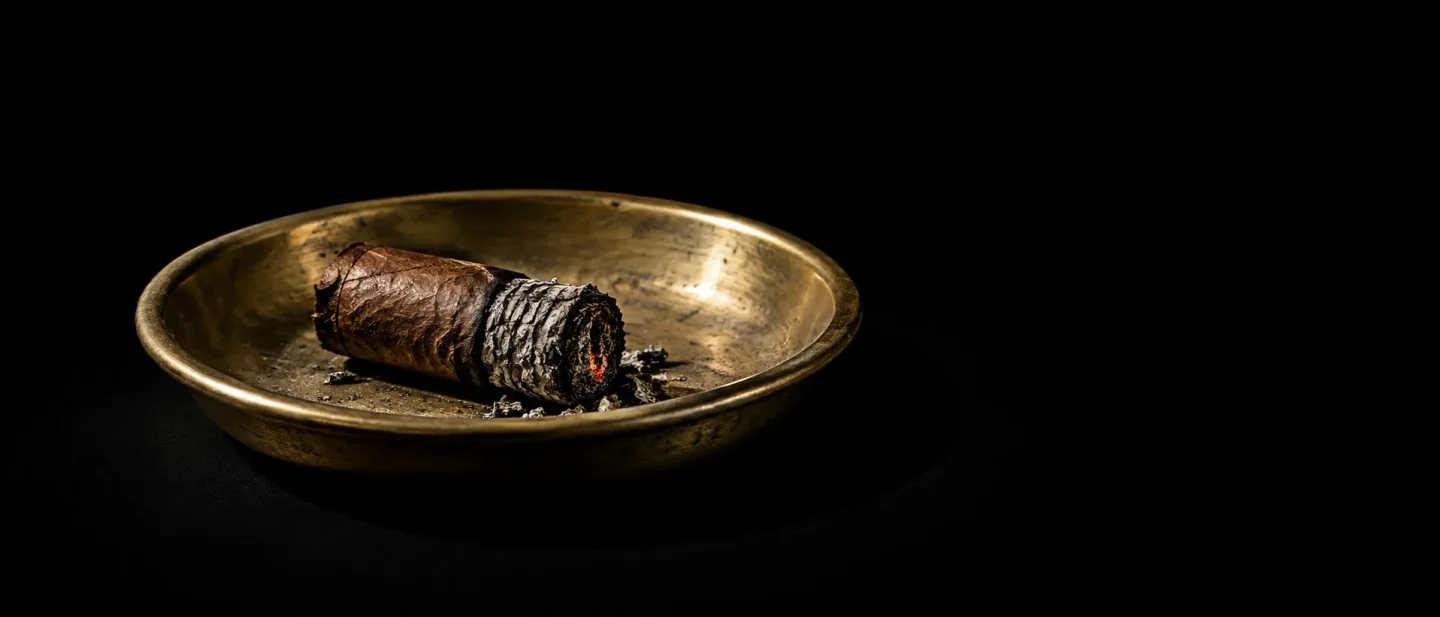
My first mistake, of course, was in buying control of Berkshire. Though I knew its business — textile manufacturing — to be unpromising, I was enticed to buy because the price looked cheap. Stock purchases of that kind had proved reasonably rewarding in my early years, though by the time Berkshire came along in 1965 I was becoming aware that the strategy was not ideal. If you buy a stock at a sufficiently low price, there will usually be some hiccup in the fortunes of the business that gives you a chance to unload at a decent profit, even though the long-term performance of the business may be terrible. I call this the "cigar butt" approach to investing. A cigar butt found on the street that has only one puff left in it may not offer much of a smoke, but the "bargain purchase" will make that puff all profit.Unless you are a liquidator, that kind of approach to buying businesses is foolish. First, the original "bargain" price probably will not turn out to be such a steal after all. In a difficult business, no sooner is one problem solved than another surfaces — never is there just one cockroach in the kitchen. Second, any initial advantage you secure will be quickly eroded by the low return that the business earns. For example, if you buy a business for $8 million that can be sold or liquidated for $10 million and promptly take either course, you can realize a high return. But the investment will disappoint if the business is sold for $10 million in ten years and in the interim has annually earned and distributed only a few percent on cost. Time is the friend of the wonderful business, the enemy of the mediocre. 1
Three of the terms carry the argument. A cigar butt is a business cheap enough that a buyer can extract one last puff of value from it, whatever the business itself is worth. A liquidator is a buyer whose plan is to sell the assets rather than run the operation. Book value is the accounting value of a company's net assets, and it can sit far from what the business would actually fetch. 1
Buffett then puts a number on the trap. A business bought for $8 million that could be sold or liquidated for $10 million returns a large profit if it is sold at once. Sold in ten years, still for $10 million, after earning "only a few percent on cost" in between, it is a disappointment. The purchase price was the same; the holding period changed the outcome. 1
What the bargain turned out to be
Berkshire itself was the first case, and the letter is blunt about the cost of it. Buffett bought control of a textile manufacturer in 1965 because "the price looked cheap," while already suspecting the strategy was wrong. The letter he wrote twenty-five years later calls that purchase his first mistake. 1
The second case is a Baltimore department store, Hochschild Kohn, bought through a company called Diversified Retailing that later merged into Berkshire. Buffett bought "at a substantial discount from book value," with first-class people running it and two extras he liked: unrecorded real estate values and a large LIFO inventory cushion. His own summary of the thinking is a three-word question — "How could I miss?" 1
Three years later he was "lucky to sell the business for about what I had paid." The discount to book value had bought him three years of owning a mediocre business and a sale at cost. He places the lesson in a single line: "It's far better to buy a wonderful company at a fair price than a fair company at a wonderful price." Munger, he adds, "understood this early; I was a slow learner." 1
The manager is not the variable
The next mistake rules out the obvious repair. Buffett records that Berkshire's textile operation and Hochschild Kohn both had "able and honest people running them," and that the same managers inside a business with good economics "would have achieved fine records." Placed in a business whose returns are poor, they had no way to produce good ones. 1
Two of his comparisons carry the point. "Good jockeys will do well on good horses, but not on broken-down nags." And: "when a management with a reputation for brilliance tackles a business with a reputation for bad economics, it is the reputation of the business that remains intact." 1
From there he draws a further lesson he labels "Easy does it." After twenty-five years of buying and supervising businesses, he writes, "Charlie and I have not learned how to solve difficult business problems. What we have learned is to avoid them." The successes came from "identifying one-foot hurdles that we could step over" rather than from any new ability "to clear seven-footers." His verdict on the two approaches: "we've done better by avoiding dragons than by slaying them." 1
The mistake that keeps coming back
Buffett calls the fourth item his "most surprising discovery": an unseen force he names "the institutional imperative." He had assumed in business school that "decent, intelligent, and experienced managers would automatically make rational business decisions," and he learned that they do not. "Rationality frequently wilts when the institutional imperative comes into play." 1
He lists what the imperative looks like in practice, in four parts. An institution "will resist any change in its current direction," as if bound by Newton's first law of motion. Corporate projects and acquisitions "will materialize to soak up available funds," the way work expands to fill available time. Any craving of the leader, "however foolish," will be backed by detailed studies prepared by his own staff. And the behaviour of peer companies — expanding, acquiring, setting pay — "will be mindlessly imitated." 1
His explanation is what makes the pattern usable from outside. "Institutional dynamics, not venality or stupidity, set businesses on these courses, which are too often misguided." The question for an investor shifts from whether the people are able to whether the structure pushes them. Buffett says he organized Berkshire to minimize the force's influence, and that he and Munger tried to concentrate their investments in companies "that appear alert to the problem." 1
The seven items, side by side
| The mistake | What the letter records | The principle it produced |
|---|---|---|
| Buying a cheap, unpromising business | Berkshire's textile maker, bought in 1965 because "the price looked cheap"; Hochschild Kohn, sold three years later for about what he paid | "It's far better to buy a wonderful company at a fair price than a fair company at a wonderful price." 1 |
| Expecting good managers to fix bad economics | Both Berkshire's textile business and Hochschild Kohn had "able and honest people running them" | "it is the reputation of the business that remains intact" 1 |
| Taking on hard problems | "What we have learned is to avoid them" | "we've done better by avoiding dragons than by slaying them" 1 |
| Assuming managers decide rationally | The four behaviours of the institutional imperative | "Rationality frequently wilts when the institutional imperative comes into play." 1 |
| Working with people he did not admire | "After some other mistakes, I learned to go into business only with people whom I like, trust, and admire." | "We've never succeeded in making a good deal with a bad person." 1 |
| Leaving undone what he already understood | Purchases "served up to me on a platter and that I was fully capable of understanding" | "the cost of this thumb-sucking has been huge" 1 |
| Running Berkshire without conventional leverage — the one he still defends | Higher leverage "would have produced considerably better returns on equity than the 23.8% we have actually averaged" | "A small chance of distress or disgrace cannot, in our view, be offset by a large chance of extra returns." 1 |
The mistakes that never reach the scoreboard
Two items on the list leave no mark on any reported figure. The first is what Buffett did not buy. "Some of my worst mistakes were not publicly visible," he writes — businesses whose merits he understood and passed on. Missing something outside one's competence, he says, costs nothing. "But I have passed on a couple of really big purchases that were served up to me on a platter and that I was fully capable of understanding. For Berkshire's shareholders, myself included, the cost of this thumb-sucking has been huge." The phrase is Buffett's for inaction on something he had already understood. He names no figure for it. 1
The second is a cost avoided, and Buffett lists it as something that only "may appear to have been a mistake." He estimates that heavier, still conventional, borrowing at Berkshire would have produced better returns on equity than the 23.8% he did average. Writing in 1990, he puts the counter-argument in odds: by 1965 he might have judged the chance of a good outcome at 99%, against a 1% chance that "some shock factor, external or internal" would push a conventional debt ratio into "temporary anguish" or default. "We wouldn't have liked those 99:1 odds — and never will." 1
The rule he draws from that refusal is the one he applies to both kinds of invisible error: "A small chance of distress or disgrace cannot, in our view, be offset by a large chance of extra returns." What leverage bought was speed. "If your actions are sensible, you are certain to get good results; in most such cases, leverage just moves things along faster." 1
Loading stats card…
Where the essay stops
The list is written in hindsight, and it says so. Buffett is grading decisions from as far back as 1965 with twenty-five years of outcomes in hand, so a cheap business that recovered would have no place on it. He also gives no dollar figure for the omission mistake, describing the cost only as "huge." 1
The record the essay sits inside is reported as two endpoints, $19.46 in 1965 and $4,296.01 in 1989. Book value is also the wrong measure to read as the business's worth, and the letter says so on its first page: at the start, intrinsic value sat below book value, because the book value was tied up in a textile business "not worth the figure at which it was carried," and by 1989 it sat above. 1
The letter's first page also warns against reading the 23.8% as a rate that continues. Part of the record came from a "double-dip," Buffett writes: the gains his portfolio companies earned in value, plus the market's later correction of prices that had been too low. The second part is spent. "We'll have to settle for a single-dip in the future," he says, and tells shareholders that averaging 15% from a base of $4.9 billion will be harder than averaging 23.8% from the $22 million he started with. 1
The essay is one man's account of his own decisions, addressed to the people who own the company, and it covers the buying of businesses and stocks. It takes no position on how a reader should size a position, what to hold in cash, or what their own circumstances allow. 1
He adds a line about the exercise itself: "We hope in another 25 years to report on the mistakes of the first 50." He was writing in 1990, and he expected the section to grow. 1
Questions to carry to your own portfolio
- Take the last thing you bought because it was cheap. What else, besides the price, argued for it — and if the answer is nothing, what would tell you to sell?
- Of the businesses you own, which are run by good jockeys on a poor horse? What would have to show up in the numbers before the business, rather than the manager, decided the outcome?
- Where is capital in your holdings being committed because a peer is doing the same thing? Which of those projects could be defended on its own numbers?
- What have you understood for years and left unbought? What has the waiting cost, and is that cost visible anywhere in your statements?
- What chance of permanent loss would you accept in exchange for a larger chance of extra return? Where have you already accepted one without deciding to?
Warren Buffett's reasoning, his seven items and every quotation above come from "Mistakes of the First Twenty-five Years (A Condensed Version)," in Berkshire Hathaway's 1989 chairman's letter, dated March 2, 1990, published at berkshirehathaway.com. The figures for per-share book value, the compound rate and the 1989 gain in net worth are the letter's own.
References
- 1
This story was produced automatically by a channel. One sentence is all it takes for Neodrop to keep producing for you.