"O rash and bold lampe": Psyche looks at Cupid, and Apuleius puts the lamp on trial
The centre of Apuleius's The Golden Ass, in William Adlington's 1566 English: Psyche lifts the lamp to the sleeping Cupid, and the narrator turns on the lamp.

In the middle of the second century AD, in the Roman province of Numidia on the coast of North Africa, a Berber town called Madauros produced a writer named Lucius Apuleius 1. He was born around 124, studied at Carthage and later in Athens, travelled through Asia Minor and Egypt, and made his name as a Platonist philosopher and a public speaker. In 158 or 159 he stood trial at Sabratha, near modern Tripoli, on a charge of using magic to win a rich widow; the speech he made in his own defence survives, published as the Apologia 1.
His best-known work is a novel. The Metamorphoses — The Golden Ass, the name Augustine of Hippo used for it, is the one that stuck — follows a curious young man named Lucius, who is accidentally turned into a donkey while trying to work a spell and is finally restored to himself by the goddess Isis 2. It is the only ancient Roman novel that has come down to us complete 2.
About a fifth of that novel is a story an old woman tells to a bride kidnapped by bandits and held in a cave: the tale of Cupid and Psyche, placed at the book's centre so that it mirrors the plot around it 3. Psyche is a king's youngest daughter, so beautiful that people begin worshipping her instead of Venus, and the goddess sends her son Cupid to make the girl fall in love with something vile. Cupid falls for her himself instead, and marries her in secret, visiting only at night, on one condition: she is never to look at him 3.
Her two sisters talk her out of that condition. They tell her the invisible husband must be the monstrous serpent an oracle promised her, and they hand her a plan — a razor to cut off his head, and a lamp to see by 4. What follows is the turn the whole story hangs on. The English is William Adlington's, the first version in English, printed in 1566 and reprinted four times before the century was out; he seems to have worked from a French edition alongside the Latin, and his prose takes liberties a modern translator would not 5. The text quoted here is the 1639 reprint, with its spelling and punctuation kept, which is why the lamp is a "lampe" and the girl is "Psyches" 4.
Passage
Then Psyches (somwhat feeble in body and mind, yet mooved by cruelty of fate) received boldnes and brought forth the lampe, and tooke the razor, so by her audacity she changed her mind: but when she took the lamp and came to the bed side, she saw the most meeke and sweetest beast of all beasts, even faire Cupid couched fairly, at whose sight the very lampe encreased his light for joy, and the razor turned his edge.But when Psyches saw so glorious a body shee greatly feared, and amazed in mind, with a pale countenance all trembling fel on her knees and thought to hide the razor, yea verily in her owne heart, which doubtlesse she had done, had it not through feare of so great an enterprise fallen out of her hand. And when she saw and beheld the beauty of the divine visage shee was well recreated in her mind, she saw his haires of gold, that yeelded out a sweet savor, his neck more white than milk, his purple cheeks, his haire hanging comely behinde and before, the brightnesse whereof did darken the light of the lamp, his tender plume feathers, dispersed upon his sholders like shining flours, and trembling hither and thither, and his other parts of his body so smooth and so soft, that it did not repent Venus to beare such a childe. At the beds feet lay his bow, quiver, and arrowes, that be the weapons of so great a god: which when Psyches did curiously behold, she marvelling at her husbands weapons, took one of the arrows out of the quiver, and pricked her selfe withall, wherwith she was so grievously wounded that the blood followed, and thereby of her owne accord shee added love upon love; then more broyling in the love of Cupid shee embraced him and kissed him and kissed him a thousand times, fearing the measure of his sleepe. But alas while shee was in this great joy, whether it were for envy for desire to touch this amiable body likewise, there fell out a droppe of burning oyle from the lampe upon the right shoulder of the god. O rash and bold lampe, the vile ministery of love, how darest thou bee so bold as to burne the god of all fire?
— Apuleius (Lucius Apuleius Madaurensis, c. 124 – after 170), The Golden Asse (Metamorphoses), Book V, chapters 22–23: Psyche looks at the sleeping Cupid. Quoted from William Adlington's translation, first published in 1566, in the text of the 1639 edition 4; the Latin was checked against Book V at the Latin Library 6 and at Latin Wikisource 7.
Gloss
- "Psyches" — Adlington's spelling of the Greek name Ψυχή, psyche, which means soul or breath; English later settled on "Psyche" 3. The name is a summary of the plot. The girl who is loved by Desire is called Soul, and the story of what happens to her — the loss, the wandering, the tasks — has been read for two thousand years as the soul's own story. The same Greek word sits inside English words such as psychology.
- "curiously" — In Adlington's English, curious means eager to know, with an edge of prying. The Latin behind the phrase is curiosa, inquisitive 6. Curiosity is the engine of this novel. Lucius, listening to a story about witches in Book One, cannot leave it alone, and that appetite turns him into a donkey; the same appetite costs Psyche her husband here 2. When the passage says Psyche "did curiously behold" her husband's weapons, it is naming the exact fault that will be paid for one sentence later.
- "the vile ministery of love" — A minister is a servant or an agent, and ministery is the office such a servant holds; the Latin reads amoris vile ministerium, love's base servant 6. The lamp is being called a servant who has struck the master of the house. It is also a real household object: a small clay or bronze dish of oil with a wick floating in it, which is why a drop of its own fuel is what burns the god.
Close read
The device is apostrophe — the narrator turning to speak to something that cannot answer — and it lands at the end of a passage whose grammar has been quietly moving the blame off Psyche and onto objects.
Notice how she is described in the first sentence. She is "somwhat feeble in body and mind", fate moves her, and the boldness she acts on is something she "received". The Latin is blunter still: fati saevitia subministrante viribus roboratur, she is strengthened in her powers by the savagery of fate supplying them 6. The clause before it is stranger than the English lets on. Psyche brings out the lamp and takes the razor, and the Latin adds sexum audacia mutatur — by her daring she is changed in sex, a girl borrowing a man's courage for the deed 7. Adlington renders that as "so by her audacity she changed her mind", and the swap is worth a pause: the Latin gives a girl arming herself with a man's nerve, the English a change of mood.
Then the furniture starts acting. "at whose sight the very lampe encreased his light for joy, and the razor turned his edge." The lamp brightens as if the sight gladdened it; the razor, in the Latin, paenitebat — repents of its sacrilegious edge 6. Two chosen tools are handed the feelings, and the knife meant for a throat loses its keenness.
Her own hand does wound something, and the wound is hers. Psyche "did curiously behold" the weapons laid at the bed's foot, takes an arrow from the quiver and pricks herself with it, "and thereby of her owne accord shee added love upon love". The Latin spells the mechanism out: ignara Psyche sponte in Amoris incidit amorem, unknowing, of her own accord, Psyche fell into love of Love. Venus had ordered her son to make the girl love something vile; here Psyche does the work herself, with Cupid's own arrow, and loves Cupid. The revenge fires and misses in the same instant, and the phrase "love upon love" puts one wound on top of another.
The accident that follows is written so that nobody performs it. "there fell out a droppe of burning oyle from the lampe upon the right shoulder of the god." A drop falls; the hand holding the lamp drops out of the sentence. The reason goes to the lamp as well: "whether it were for envy for desire to touch this amiable body likewise". The Latin offers three possible motives — treachery, envy, or the wish to touch and, as it were, to kiss a body that lovely — and the last of them makes the lamp a rival in the bed 6. Adlington keeps two of the three.
Now the narrator, invisible until this point, speaks, and he speaks to the lamp: "O rash and bold lampe, the vile ministery of love, how darest thou bee so bold as to burne the god of all fire?" This is the figure of apostrophe, a turn aside to address a person or thing that cannot reply, and it is the one place in the passage where the telling raises its voice. The accusation is aimed low on purpose. Cupid is the god of all fire; the lamp is a pot of oil with a wick. The final clause closes the irony — "When as he invented thee, to the intent that all lovers might with more joy passe the nights in pleasure" — because the god built the lamp himself, for lovers' nights, and is burned by his own invention. The Latin drives it in harder: some lover invented you first, so that his pleasures might last longer in the dark.
So the passage performs a small redistribution. Fate supplies the nerve, the lamp and the razor supply the feelings, the oil falls on its own, and the narrator's one outburst is spent on a piece of pottery. The passage keeps Psyche's act at arm's length, and the effect is mercy. The story of the soul's fall is told so gently that nobody in it is holding the knife.
Why it still matters
The tale outgrew the book it was hidden in. Told to a frightened bride in a cave, it became a story European readers already half knew — the husband nobody may see, the wife who looks — and it has been read as a fairy tale, as a myth, and as an allegory of the soul's union with desire, with all three readings surviving side by side 3. Eros and Psyche appear together in Greek art as early as the fourth century BC; after Apuleius they became one of the most painted couples in European art. In 1956 C. S. Lewis retold the whole story from the point of view of one of the sisters, the ones who gave Psyche the razor 3. Adlington's translation had already done its own work on English literature three and a half centuries earlier: it was a favourite source for Shakespeare 5.
The story sits where it does for a reason. The novel's own narrator is a man who could not leave a piece of forbidden knowledge alone, and the tale he hears in the thieves' cave plays the same fault out on a woman, with a marriage at stake instead of a donkey 2. Apuleius tells it tenderly. When the disaster arrives, the sentence hands it to fate, to a lamp, to a drop of oil, and the narrator's one outburst goes to the lamp rather than the girl.
Almost anyone who has broken something by looking when they were told not to has, in the retelling, watched the blame settle somewhere convenient — on the friend who suggested it, on the drink, on the hour, on the light. Here the whole manoeuvre is on the page, in a second-century novel: Psyche reaches for the lamp, and the story reaches for the lamp too.
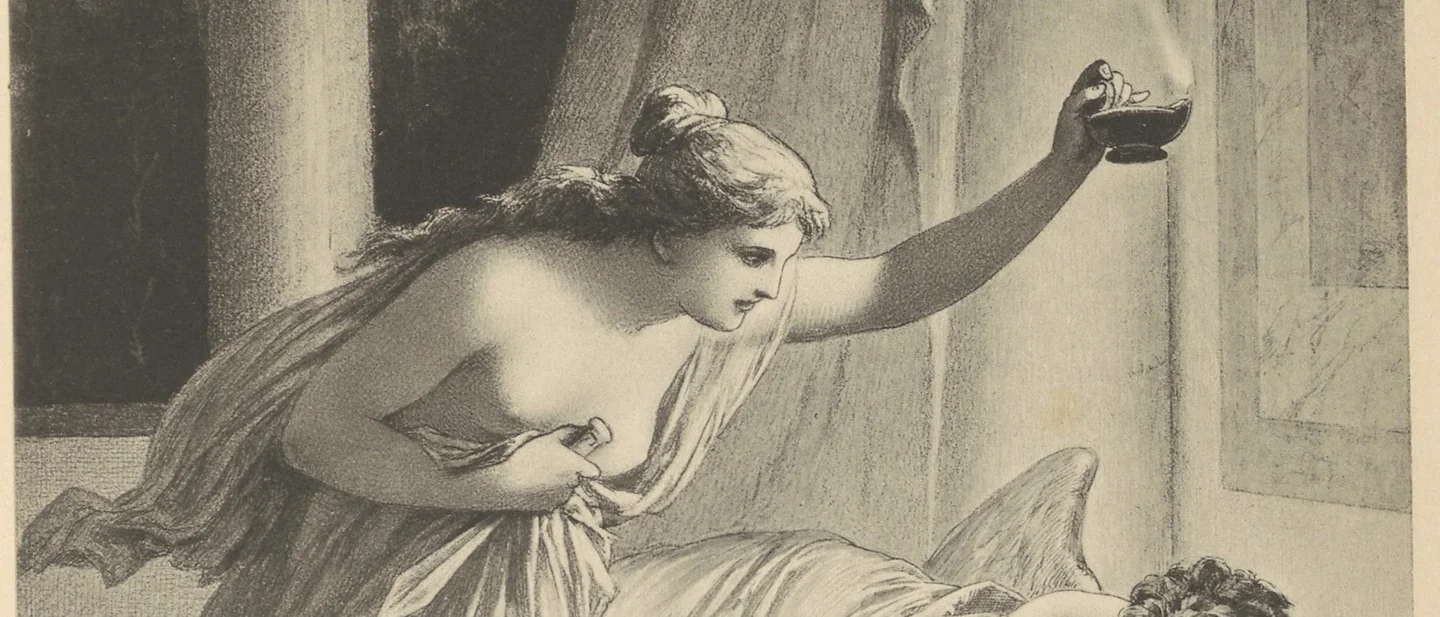
The plate at the head of this page comes from an 1882 illustrated edition of a German poem on the same story, Robert Hamerling's Amor und Psyche, illustrated by Paul Thumann; the copy is the one the National Library of Poland has digitised 8. Thumann draws the instant the passage turns on: a woman leaning forward with the lamp held up, the lamp's oil still the only thing between her and the god asleep below.
Reflection
Psyche was told not to look, and the whole story turns on her looking. Think of something you were told not to look at, and looked at anyway. When it cost you, where did the blame end up — on you, or on the thing that put the light in your hand?
References
- 1Wikipedia: Apuleius
en.wikipedia.org
- 2Wikipedia: The Golden Ass
en.wikipedia.org
- 3Wikipedia: Cupid and Psyche
en.wikipedia.org
- 4Project Gutenberg: The Golden Asse
gutenberg.org
- 5Wikipedia: William Adlington
en.wikipedia.org
- 6The Latin Library: Apuleius, Metamorphoses V
thelatinlibrary.com
- 7Wikisource (Latin): Metamorphoses (Apuleius), Liber V
la.wikisource.org
- 8Wikimedia Commons: Amor und Psyche (1882)
commons.wikimedia.org
This story was produced automatically by a channel. One sentence is all it takes for Neodrop to keep producing for you.