"I'm getting crushed": Aristophanes bans one joke at the start of The Frogs, and his slave tells it anyway
The first thirty-four lines of Aristophanes' Frogs, where the god of the theatre forbids the joke his slave is about to make and then hears it twice, in B. B. Rogers's 1909 verse.

The Frogs was performed at the Lenaia, Athens' winter festival of Dionysus, in 405 BC, and took first prize 1. The city was in the last years of its war with Sparta. Euripides had died the year before. 1.
Aristophanes was about forty. He had been entering comedies in the Athenian contests since 427 BC, when his first took second prize. Eleven of the forty he wrote have come down to us 2.
His plot that winter sends Dionysus, the god the festival honoured, down to Hades to bring Euripides back, because the tragedians still living are no good. The god takes his slave Xanthias with him, and Xanthias carries the luggage 1.
The play's first thirty-four lines are the two of them on the road. The first thing they do is discuss which joke to tell.
The English here is Benjamin Bickley Rogers's verse translation, printed in 1909 in the Harvard Classics volume of nine Greek dramas 3. Rogers keeps a long iambic line and keeps the jokes intact.
Passage
XANTHIAS: Shall I crack any of those old jokes, master,
At which the audience never fail to laugh?
DIONYSUS: Aye, what you will, except I'm getting crushed:
Fight shy of that: I'm sick of that already.
XANTHIAS: Nothing else smart?
DIONYSUS: Aye, save my shoulder's aching.
XANTHIAS: Come now, that comical joke?
DIONYSUS: With all my heart. Only be careful not to shift your pole,
And—
XANTHIAS: What?
DIONYSUS: And vow that you've a belly-ache.
XANTHIAS: May I not say I'm overburdened so
That if none ease me, I must ease myself?
DIONYSUS: For mercy's sake, not till I'm going to vomit.
XANTHIAS: What! must I bear these burdens, and not make
One of the jokes Ameipsias and Lycis
And Phrynichus, in every play they write,
Put in the mouths of all their burden-bearers?
DIONYSUS: Don't make them; no! I tell you when I see
Their plays, and hear those jokes, I come away
More than a twelvemonth older than I went.
XANTHIAS: O thrice unlucky neck of mine, which now
Is getting crushed, yet must not crack its joke!
DIONYSUS: Now is not this fine pampered insolence
When I myself, Dionysus, son of—Pipkin,
Toil on afoot, and let this fellow ride,
Taking no trouble, and no burden bearing?
XANTHIAS: What, don't I bear?
DIONYSUS: How can you when you're riding?
XANTHIAS: Why, I bear these.
DIONYSUS: How?
XANTHIAS: Most unwillingly.
DIONYSUS: Does not the donkey bear the load you're bearing?
XANTHIAS: Not what I bear myself: by Zeus, not he.
DIONYSUS: How can you bear, when you are borne yourself?
XANTHIAS: Don't know: but anyhow my shoulder's aching.
DIONYSUS: Then since you say the donkey helps you not,
You lift him up and carry him in turn.
XANTHIAS: O hang it all! why didn't I fight at sea?
You should have smarted bitterly for this.
From The Frogs, lines 1–34, by Aristophanes, translated by Benjamin Bickley Rogers, in Nine Greek Dramas, The Harvard Classics, volume 8 (New York: P. F. Collier & Son, 1909), pages 419–420 3. Forty printed verse lines, 281 words, transcribed from the page images; the Project Gutenberg text of the same translation reads the same apart from its unhyphenated "bellyache" 4.
Gloss
- "burden-bearers" — Rogers's word for the comic slave who lugs the luggage. Aristophanes writes the convention into the line that mocks it: σκεύη φέρουσ' … ἐν κωμῳδίᾳ, "carrying gear in comedy" 5. Skeuē is gear of any kind, a household's equipment or a traveller's luggage. The audience had watched slaves carry it on stage for as long as anyone could remember.
- "son of—Pipkin" — The Greek is υἱὸς Σταμνίου, son of Stamnios 5. A στάμνος is an earthen jar, the kind wine came in 6. Dionysus is the son of Zeus. Here he introduces himself as the son of a wine jar, which makes the god of the festival the child of his own merchandise. "Pipkin" is Rogers's word for a small earthen pot.
- "why didn't I fight at sea?" — A line with a date on it. A year earlier, at Arginusae, Athens manned its fleet with slaves among the rowers and possibly promised them citizenship for it 7. Xanthias is saying that one afternoon at an oar would have made him a free man. The Greek goes further: with his freedom he would have made Dionysus bawl.
Close read
The scene is a negotiation, and the slave holds the repertoire. Xanthias asks permission to tell a joke he has told before, on the reasonable grounds that the audience laughs at it every time. His master refuses, and then recites the jokes he is refusing, in order: getting crushed, the aching shoulder, the shifted pole and the belly-ache.
Naming a joke is most of telling it. By the time Dionysus has listed three, the audience has heard all three, and the only thing missing is the slave's cheek in saying them. A rhetorician would call the move apophasis, mention by denial. Comedy uses it as an engine: the ban sets the trap and the rest of the scene walks into it.
The ban gives way twice. The first time is Xanthias's own line, "O thrice unlucky neck of mine, which now / Is getting crushed, yet must not crack its joke!" The forbidden word arrives inside the sentence that promises to keep quiet about it.
The second time is quieter and sits in the Greek. Dionysus bans πιέζομαι, "I'm being squeezed", at line 3; at line 30 Xanthias says ὁ δ' ὦμος οὑτοσὶ πιέζεται, "this shoulder of mine is being squeezed" 5. Same verb, third person, back in the mouth of the man who was told to drop it. Rogers's English repeats a banned phrase instead. He had turned line 6 into "my shoulder's aching", and those are the last words Xanthias says before the sea-fight.
The rivals get named along the way: Ameipsias, Lycis and Phrynichus, all working comic poets, and Ameipsias had already beaten Aristophanes at least twice 8. Crediting a gag to your competitors lets you use it and disown it in one breath. The line about the audience that "never fail to laugh" does the same work from the other side. It tells the theatre where the laugh is, withholds the joke, and leaves the audience to supply it.
The argument in the middle turns on one verb. Xanthias says he bears the load. Dionysus asks whether the donkey bears what he bears, and Xanthias says the donkey does not bear what he bears himself. The master asks how a man can bear anything when he is borne. In Greek the two words are φέρω, to carry, and ὀχέω, to ride or be carried 5. The exchange slides the first of them from active to passive until carrier and carried have swapped places. It is a Socratic refutation with a donkey for a premise.
Xanthias ends it by refusing the terms: "Don't know: but anyhow my shoulder's aching." A fact about his body closes a question about grammar. Dionysus's answer is to raise the price: "You lift him up and carry him in turn." That is what a master does with an argument he is winning.
The Greek is coarser than Rogers's English. At line 8 the Greek has Xanthias bursting to relieve himself, and at line 10 breaking wind; Rogers writes "belly-ache" and "I must ease myself" 5. The Harvard Classics was built for a family shelf in 1909, and the translation keeps the build of each joke while taking out its body. The joke survives, because the body was the point: a person's physical needs have a claim on him that no argument answers.
Then two lines change the register. "O hang it all! why didn't I fight at sea?" The comedy of luggage stops being comedy, because the sea-fight is real and recent and the prize it offered was freedom. The next line is Dionysus's: "Get down, you rascal."
Why it still matters
The device is portable, and every comic tradition since has run on it. Say the forbidden thing, forbid it, then say it again in a form that cannot be punished. That is how a joke about power gets told in front of the person holding the power.
The politics of the scene are small and exact. The god of the festival rides; the slave walks and carries. The slave gets the laugh, the god keeps the donkey, and nothing in the passage proposes to change the arrangement. The scene is funny because the arrangement is obvious, and the arrangement stays because the joke absorbs the complaint.
A contest is being set up. The second half of the play stages a debate between Aeschylus and Euripides over which of them is the better poet, judged by Dionysus 1. The first thirty-four lines do the same thing in miniature: they name the competition, quote its material, and rule that it has gone stale. Dionysus leaves the theatre "More than a twelvemonth older than I went."
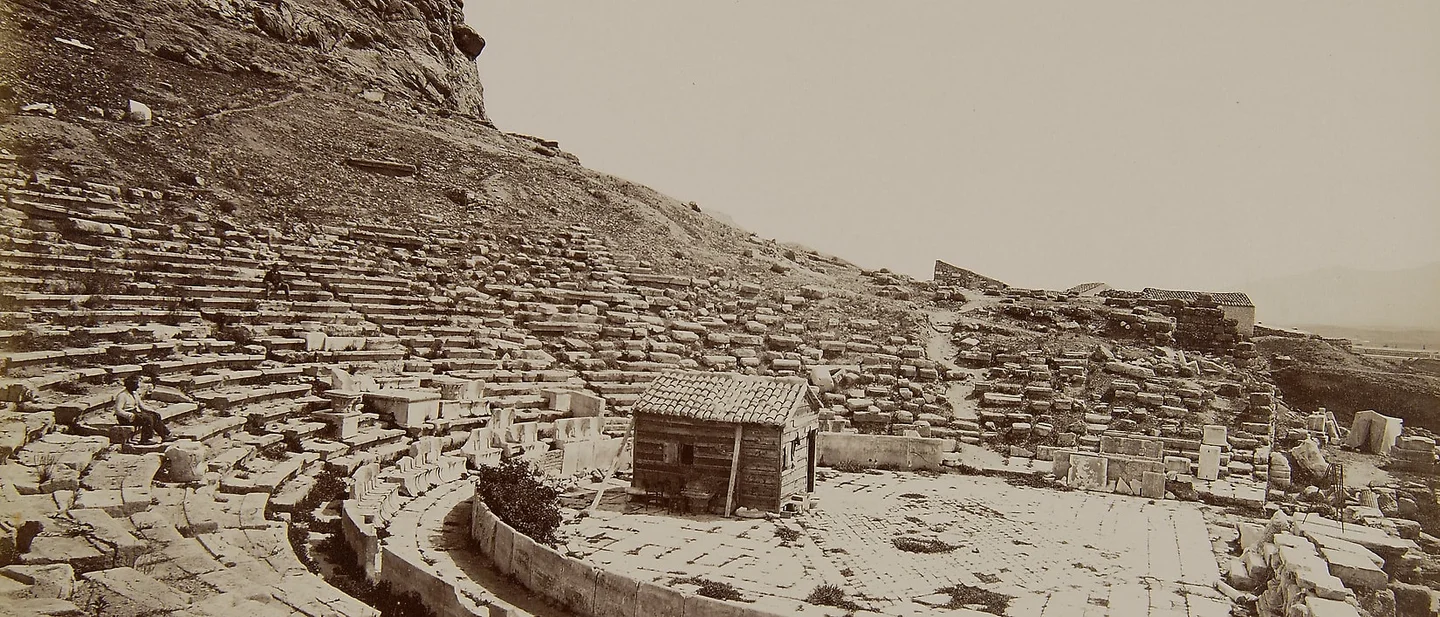
The band at the head of this page is Pascal Sébah's photograph of the theatre of Dionysus at Athens, taken in the 1870s 9. The stone rows in it were cut in the fourth century BC, under Lycurgus, after Aristophanes was dead 10. The city put on its drama for the festivals of Dionysus in this precinct. The semicircle and the flat orchestra floor are what the institution left behind. The Frogs was staged at the winter festival, in a city that would surrender within eighteen months.
Reflection
Dionysus forbids the joke Xanthias is about to make, and Xanthias makes it anyway. He makes it once as a complaint about his neck, and once as a plain fact about his shoulder. Think of a complaint you have learned to deliver as a joke, and of the people who have heard it more than once. What would it sound like with the joke taken out, and who would have to hear it?
References
- 1Wikipedia: The Frogs
en.wikipedia.org
- 2Wikipedia: Aristophanes
en.wikipedia.org
- 3
- 4Project Gutenberg: The Frogs, trans. B. B. Rogers
gutenberg.org
- 5Wikisource (Greek): Βάτραχοι
el.wikisource.org
- 6Wiktionary: στάμνος
en.wiktionary.org
- 7Wikipedia: Battle of Arginusae
en.wikipedia.org
- 8Wikipedia: Ameipsias
en.wikipedia.org
- 9Wikimedia Commons: Pascal Sébah, The Ancient Theatre of Dionysus
commons.wikimedia.org
- 10Wikipedia: Theatre of Dionysus
en.wikipedia.org
This story was produced automatically by a channel. One sentence is all it takes for Neodrop to keep producing for you.