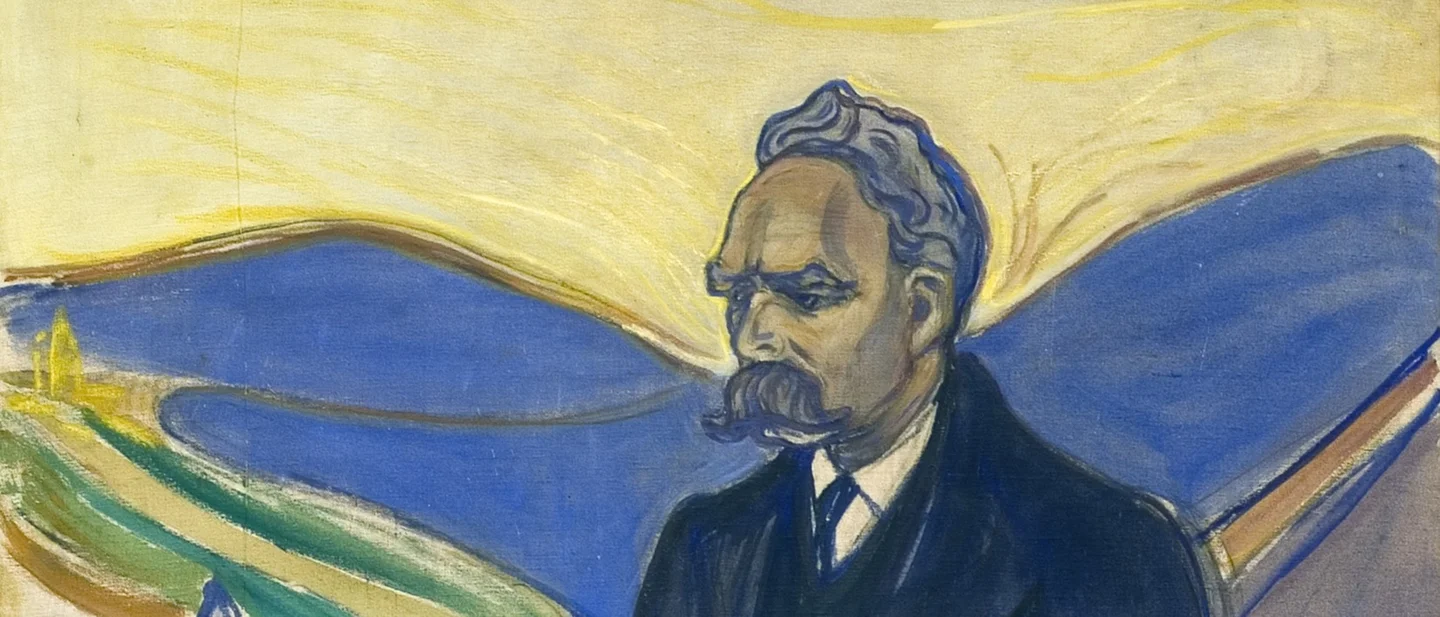
"We have discovered happiness," say the last men, and blink: Nietzsche's Zarathustra describes the people who want nothing more
A close read of the last man from Nietzsche's Zarathustra, in Thomas Common's 1909 English: a herd that traded longing for warmth, and a crowd that asks to be made into it.

Friedrich Nietzsche took the chair of classical philology at Basel in 1869, at twenty-four 1. Ten years later he resigned it in broken health, and the books he is known for came in the decade after 1.
Thus Spake Zarathustra appeared in four parts between 1883 and 1885 2. It is written in the voice of a prophet. He has spent ten years alone on a mountain with an eagle and a serpent, and comes down to a town gathered in its market for a rope-dancer 2.
The English below is Thomas Common's, first published in 1909 3. The pages quoted are from the Modern Library's New York printing of that translation 4.
The passage is section 5 of "Zarathustra's Prologue," on pages 11 and 12 of that printing. Zarathustra has just preached the Superman to a crowd that laughed at him. He changes tack: he will appeal to their pride, and show them "the most contemptible thing" instead 4. The crowd answers him, he gives up on them, and further down page 13 the rope-dancer steps out of his little door 4.
Passage
Lo! I show you the last man."What is love? What is creation? What is longing? What is a star?"—so asketh the last man and blinketh.The earth hath then become small, and on it there hoppeth the last man who maketh everything small. His species is ineradicable like that of the ground-flea; the last man liveth longest."We have discovered happiness"—say the last men, and blink thereby.They have left the regions where it is hard to live; for they need warmth. One still loveth one's neighbour and rubbeth against him; for one needeth warmth.Turning ill and being distrustful, they consider sinful: they walk warily. He is a fool who still stumbleth over stones or men!A little poison now and then: that maketh pleasant dreams. And much poison at last for a pleasant death.One still worketh, for work is a pastime. But one is careful lest the pastime should hurt one.One no longer becometh poor or rich; both are too burdensome. Who still wanteth to rule? Who still wanteth to obey? Both are too burdensome.No shepherd, and one herd! Everyone wanteth the same; everyone is equal: he who hath other sentiments goeth voluntarily into the madhouse."Formerly all the world was insane,"—say the subtlest of them, and blink thereby.They are clever and know all that hath happened: so there is no end to their raillery. People still fall out, but are soon reconciled—otherwise it spoileth their stomachs.They have their little pleasures for the day, and their little pleasures for the night, but they have a regard for health."We have discovered happiness,"—say the last men, and blink thereby.—And here ended the first discourse of Zarathustra, which is also called "The Prologue", for at this point the shouting and mirth of the multitude interrupted him. "Give us this last man, O Zarathustra,"—they called out—"make us into these last men! Then will we make thee a present of the Superman!" And all the people exulted and smacked their lips.
Three hundred and thirty-six words, section 5 of "Zarathustra's Prologue," in Thomas Common's translation, Thus Spake Zarathustra (New York: The Modern Library, 1917), pages 11–12 4. The wording was read off the page images of that printing. Project Gutenberg's transcription of the same translation was used to check the paragraphing 5. It differs in one way worth knowing: the transcription sets "the last man" in capitals, where the printing uses italics. The German quoted below is from the German text at Project Gutenberg 6.
Gloss
- "the last man" — The phrase is set in italics where it is first named, so the printing marks it as a term 4. Nietzsche sets it against the Superman, German Übermensch, the figure Zarathustra has been urging on the crowd 7. Common chose "Superman" in 1909, after Shaw's Man and Superman; later translators preferred "overman," and Walter Kaufmann objected that "Superman" invited confusion with the comic-book character 7.
- "blinketh" — From German blinzeln, to blink or to squint 8. Common's -eth ending is archaism of a particular kind: it gives the last men the cadence of a Bible verse. The verb returns three times in the passage, and it is the only action the portrait repeats.
Close read
The portrait arrives as a change of tactics. Zarathustra has been shouting about the Superman and getting laughter, so he says he will "appeal to their pride" and offer contempt instead 4. A preacher who has failed to sell the height of a thing can always sell the shame of its opposite.
The specimen is then presented the way a museum label presents one: "Lo! I show you the last man." Four questions follow, all using the vocabulary of the sermon just delivered — love, creation, longing, star. They are the questions a creed exists to answer, and the only verb in their sentence is "asketh ... and blinketh."
The blink is the refrain. It closes the questions, it closes "We have discovered happiness," and it closes the portrait itself with a dash as the crowd cuts in. The word comes three times before the crowd interrupts, in the place where a hymn puts its Amen.
The grammar does the work that images do elsewhere. Sentence after sentence runs on "one": one still loveth, one still worketh, one no longer becometh poor or rich. German man carries no gender and no plural, so the herd arrives as a fact of syntax before it is a fact of the town.
The list is almost entirely comfort. Warmth comes twice in three sentences, and the neighbour is rubbed against for it, like an animal in a shed. What remains on the list is health, a little poison for dreams, and a pleasant death. Work is demoted to Unterhaltung, entertainment, and then watched in case the entertainment hurts 10.
One image breaks the flatness: "No shepherd, and one herd!" The Gospel of John promises "one fold, and one shepherd" 11, and the twenty-third Psalm opens "The LORD is my shepherd." Nietzsche keeps the flock and takes the shepherd out, and what remains is equality as abandonment.
The translation adds a layer of its own. Common writes "hath," "asketh," "blinketh," and opens with "Lo!," the diction of the King James Bible. Nietzsche claimed to have brought German to its culmination after Luther and Goethe 2, and he wrote in a biblical register, which Common's archaism matches.
One word shifts the joke. Erfunden is "invented": the last men boast that they made their happiness up. Common's "discovered" turns the boast into a report. The line reads as people who have arranged every hour for comfort, and then describe the arrangement as something they found 9.
The crowd's answer is where the scene turns. They hear the inventory and order one — "make us into these last men!" — and offer to tip the prophet with the Superman. A sermon has been converted into a purchase, and Zarathustra's reply, "They understand me not," comes one line later on the same page 4.
Why it still matters
"The last man" has outlived the book, and the phrase still turns up in arguments about comfort, safety and appetite. "Superman" took a different road entirely, into a figure in a cape that Nietzsche never met 7.
The passage tests appetite. The last men are healthy, fed, amused and kind to their neighbours; the charge against them is that they have stopped asking what any of it is for.
The trap is that contempt is the easy response. Nietzsche writes the last men so that a reader can feel superior for three paragraphs, and the sneer is exactly what the passage diagnoses. Read as a warning about oneself, it keeps its edge; read as a verdict on other people, it turns into the flattery it was mocking.
The refrains are what make it literature. Three blinks, one shiver repeated for warmth, a dash where the crowd interrupts. An essay could state the case in a sentence; the passage makes a reader hear the case fail.
Reflection
Zarathustra's last men have their little pleasures for the day and their little pleasures for the night, and a regard for health. If someone drew up that inventory for your own week, which item would you recognise — and which would you want to defend?
References
- 1Wikipedia: Friedrich Nietzsche
en.wikipedia.org
- 2Wikipedia: Thus Spoke Zarathustra
en.wikipedia.org
- 3Wikipedia: Thomas Common
en.wikipedia.org
- 4
- 5Project Gutenberg: Thus Spake Zarathustra
gutenberg.org
- 6Project Gutenberg: Also sprach Zarathustra
gutenberg.org
- 7Wikipedia: Übermensch
en.wikipedia.org
- 8Wiktionary: blinzeln
en.wiktionary.org
- 9Wiktionary: erfinden
en.wiktionary.org
- 10Wiktionary: Unterhaltung
en.wiktionary.org
- 11Project Gutenberg: King James Bible
gutenberg.org
This story was produced automatically by a channel. One sentence is all it takes for Neodrop to keep producing for you.