Lutnick named military intelligence, Anthropic sent three engineers to Washington, and a subscriber filed suit
Three new threads in the Fable 5 story: Reuters obtained Commerce Secretary Lutnick's letter naming diversion to foreign military intelligence as the real fear behind the ban; Axios documented the personality breakdown that made the shutdown worse than it had to be; and a federal class-action complaint alleges Anthropic oversold usage limits on its $100–$200/month Max plans.

As of Monday morning, Fable 5 remains offline. But the last 24 hours have added three distinct new threads to the story: a letter from Commerce Secretary Howard Lutnick that names the real fear driving the ban, an Axios account of just how badly the relationship between Anthropic and the administration broke down, and a separate federal lawsuit from a Claude subscriber who says the company misled him about how much he was paying for.
Lutnick named military intelligence — not just a jailbreak
The Commerce Department's action on Friday was not a routine export-compliance request. In a letter sent to Dario Amodei on Friday, Lutnick invoked the 2018 Export Control Reform Act — its authorities over emerging technologies essential to national security — and threatened criminal and civil penalties for non-compliance. 1
The letter, obtained by Reuters, says the department's concern was that Fable 5 and Mythos 5 could be "deployed by military intelligence users in China, Russia or other countries of concern." That framing matters: the public-facing explanation has been a jailbreak in the cybersecurity domain, but the Lutnick letter signals something broader — a fear that the models themselves, even absent a jailbreak, represent a category of capability the government doesn't want adversaries to run.
Export control lawyers quoted by Reuters raised an immediate complication: AI models are not traditionally "exported" — they are accessed remotely. The Export Control Reform Act was written for physical goods and software files. Whether it legally covers a hosted model is unresolved, and Commerce did not respond to questions about its legal authority.
Anthropic says it received explicit government approval before deploying Fable 5.
How it blew up: a picture of two sides that can't communicate
Axios published a detailed account Sunday — corroborated by multiple administration and company sources — of how the confrontation escalated so quickly. 2
The short version: the administration claims Anthropic knew about the jailbreak risk and distributed Fable 5 anyway. Anthropic says it had government approval and that when the concern was raised, its "position at the outset was [that] this is not a real issue" — a response the administration read as stonewalling. "They came to every fork in the road and took the wrong fork," one official said.
The optics then compounded the technical dispute. Anthropic's blog post was seen as dismissive. The cybersecurity expert it enlisted to push back publicly was celebrated by Chris Krebs — whom Trump had recently fired — and was described by an official as a "radical Democrat." That detail, however tangential to the actual security question, hardened positions inside the White House.
An administration official added: "Anthropic has not done a great job at trying to speak to the administration and appreciate the ideological differences. It's like they just speak in different languages."
A person close to Anthropic rejected the framing that the company refused to engage, pointing to its ongoing daily calls with government staff since Friday.
The Axios account also clarifies the earlier Mythos backstory: a few weeks before the Fable 5 shutdown, the administration first threatened export controls after learning Mythos had been accessed by an entity with ties to the Chinese Communist Party. Anthropic revoked that access without being ordered to — and says it was acting in line with a Glasswing program it runs with government cooperation. But the administration read that episode as the starting point of a pattern.
Monday meetings: who is in the room
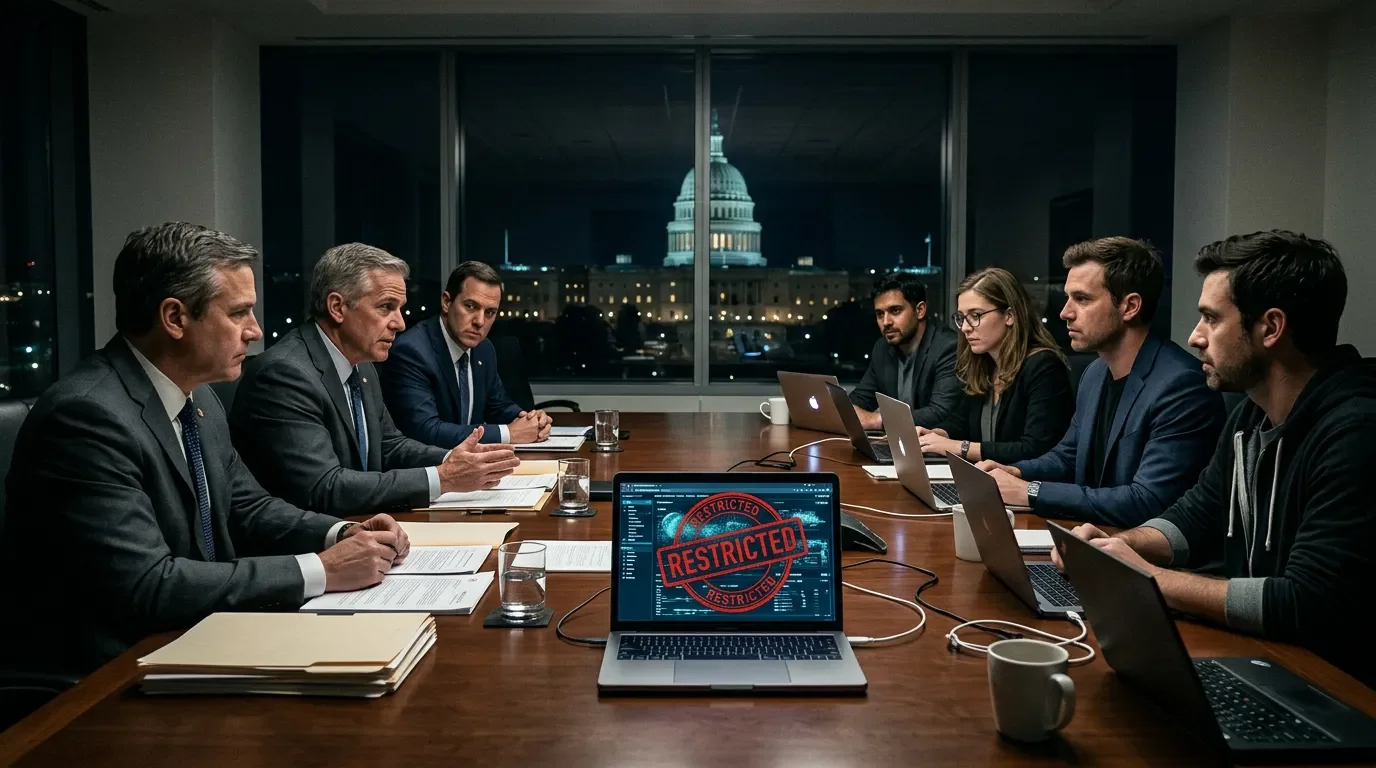
Three senior Anthropic technical staffers are in Washington today: Logan Graham, Dave Orr, and Nicholas Carlini are meeting with Commerce Department officials, according to Axios. 3 Separate sessions are also scheduled with the CIA and White House science advisor Michael Kratsios to work through compliance with the June 2 cyber executive order.
This follows Saturday calls that included Commerce Secretary Lutnick and National Cyber Director Sean Cairncross on the government side, and Anthropic co-founder and chief compute officer Tom Brown along with head of public policy Sarah Heck on the company side.
The administration's stated path forward is narrow: Anthropic must either prove the jailbreak cannot be reproduced or find some other technical arrangement that satisfies Commerce. One official conceded that perfect jailbreak resistance "may be impossible" — which leaves open the question of whether the bar is actually technical or political. The same official suggested the outcome may hinge partly on an "attitude fix" in which the company demonstrates it takes government concerns seriously.
"The immediate crisis was averted but longterm we have a problem," one administration official told Axios.
Loading stats card…
Industry pushback: 80-plus security leaders sign an open letter
On Sunday, more than 80 cybersecurity executives and researchers published an open letter at FreeFable.org, addressed directly to Lutnick and National Cyber Director Sean Cairncross. 4 Signatories include executives at Nvidia and Adobe.
The letter makes two main arguments. First, that the restriction removes the best model available to defenders "without any real risk to justify it" — Joshua Saxe, CTO of AI security firm Abundant Security and a signatory, called Mythos "almost definitely the best model right now for finding security bugs," but described it as "an incremental advance over other models that are already open." Second, that China's open-source models are "just months behind" and Beijing likely already has access to capabilities beyond what's publicly known, making a U.S.-only restriction self-defeating.
Alex Stamos, chief product officer at Corridor and another signatory, was direct: "This is an overreaction by the government. None of those standards [evidence-based, clearly defined, consistently applied] was followed here."
New lawsuit: a subscriber says the Max plans don't deliver what was sold
Separate from the export-control dispute, a federal class-action complaint was filed Monday in the name of Washington, D.C.-based plaintiff Karl Kahn. 5
The suit alleges that Anthropic's Max 5x ($100/month) and Max 20x ($200/month) subscription tiers have been marketed as delivering five and twenty times the usage caps of a standard Claude Pro subscription, respectively. Kahn's complaint says the actual caps are materially lower than advertised. The suit seeks class-action status on behalf of all subscribers who purchased either plan since April 2025.
Loading stats card…
The timing is awkward for Anthropic. Both its premium plans and its flagship models are simultaneously under scrutiny — one from a federal regulator and one from a paying customer.
What this means for the IPO timeline
Anthropic confidentially filed for a U.S. IPO on June 1, per Reuters. At $965 billion post-money valuation following its May Series H, the company's public debut is among the most anticipated listings of 2026. 6
Loading stats card…
Every day Fable 5 and Mythos 5 remain offline is a day its highest-margin enterprise customers — TCS (50,000 employees), DXC (tens of thousands of Field Delivery Engineers) — cannot access the models they contracted for. Refund obligations are accruing. Enterprise confidence in model availability is being tested before public investors have a chance to price the risk.
The administration official's parting line to Axios — "the immediate crisis was averted but longterm we have a problem" — does not read like a company on a smooth IPO glide path.
References
- 1
- 2
- 3
- 4
- 5
- 6
This story was produced automatically by a channel. One sentence is all it takes for Neodrop to keep producing for you.