Spirit Train, The Monolith, and the play tests hiding inside the pitch
A curated desk on two live campaigns, one unusually useful designer diary, and the recent reviews that explain where the real decisions begin after the teach.
The useful board-game signal this Monday is a change in what publishers and designers are making legible. Two campaigns are giving players more to inspect before they pledge, while three recent pieces show where replay value actually comes from: timing, information load, and the willingness to wait for a better tile.
That makes a better desk than a funding leaderboard. The question is what a player can learn before spending money, and what a first session can already reveal about the game underneath the presentation.
The quick desk
| Item | Where it stands | The useful question | Desk call |
|---|---|---|---|
| Spirit Train: The Final Journey | Live on Kickstarter; S$335,292 pledged against a S$12,693 goal, 1,741 backers, with a 15 September 2026 deadline at retrieval | Does the conductor-and-lost-souls premise turn into a system you can understand from the public rulebook? 1 | Open the rulebook before the pledge page |
| The Monolith | Relaunched on Kickstarter; £81,351 pledged against a £36,642 goal, 1,221 backers, with a 17 September 2026 deadline at retrieval | Did the relaunch give the game a clearer reason to buy early? 2 | Follow the relaunch, especially the all-in tier |
| Countryball Cards designer diary | BoardGameGeek diary by Jakov Jandrić; 1v1/2v2, around 25 minutes | How much asymmetric information can a short card game ask players to remember? 3 | Read the cuts, not the theme pitch |
| Into the Machine | Opinionated Gamers review dated 23 August 2026; 2–5 players, 45–60 minutes | Can a race stay tactical when every useful action also grows the machine that supports it? 4 | Strong candidate for an action-timing group |
| Sandcastles | Opinionated Gamers review dated 22 August 2026; 2–6 players, about 20 minutes | Does passing a decent tile create enough tension to carry fifteen rounds? 5 | A promising short filler with visible caveats |
Launches & live campaigns
Spirit Train: the page gives you a reason to read first
Spirit Train: The Final Journey puts each player in the role of a conductor guiding lost souls through the space between worlds. Kickstarter currently exposes a rulebook, a how-to-play section, and campaign updates alongside the pledge tiers. The page also displays a funding total far above its goal and a 15 September deadline. 1
The important part is the order of operations. The campaign has made the rulebook available before the pledge decision, so the next useful click is the rules file rather than another stretch-goal graphic. The public page gives the theme and the component promise; the rulebook is where a player can test whether the central train idea produces meaningful choices across a full turn.
A Sunday crowdfunding roundup places Spirit Train among 21 new campaigns listed for the weekend of 23 August. That makes it a genuinely current browse for this desk, while the Kickstarter page remains the authority for its live state and deadline. 6
What to inspect: find the turn loop, the source of uncertainty, and the point at which a conductor can recover from a poor route or hand. A strong theme earns attention; a readable rules file earns the next ten minutes.
The Monolith: a relaunch built around the reason to pledge early
The Monolith is a three- or four-player battle game played over four rounds. Players spend hearts to move warriors, activate shamans, recruit, or bid on divination cards. After everyone commits, the hidden distribution of hearts determines the coming combat through slay, maneuver, and boast actions. Favor comes from kills, objectives, temple control, and boasting. 2
The current campaign also offers a Bot Pack expansion for one- and two-player games, a sixth shaman, glass blood tokens, metal tokens, and an all-in tier. The page says the game is ready for production and targets November 2026 delivery. 2
That list matters because the first campaign exposed a business problem rather than a rules problem. In a BoardGameWire first-person account published on 19 August, Plaid Hat founder Colby Dauch says the June campaign stalled on its second day and was pulled after it had already passed its $20,000 goal. He links the failure to a campaign that reduced exclusives, bundled the core product too generously, and committed to expensive production before crowdfunding could measure demand. 7
The relaunch answers that diagnosis with a lower price, a more explicit add-on structure, an all-in tier, and a one-to-two-player mini-expansion. Dauch’s follow-up says the all-in pledge was the most popular roughly 24 hours into the relaunch, although the article cannot isolate the effect of each individual change. 7
This is the campaign lesson worth carrying forward: reducing fear of missing out still leaves a campaign needing a clear early-backer proposition. The interesting test for The Monolith is whether the new structure makes that proposition visible without hiding the game behind a pile of upgrades.
The campaign page links Phil Gross’s designer diaries The Tower and Combat Explored. 2 Those are the right follow-up reads for anyone who wants to examine the combat before deciding whether the relaunch’s extras are relevant to their table.
The designer diary worth your time
Countryball Cards: cut the text until the fight can breathe
Jakov Jandrić’s BoardGameGeek diary follows Countryball Cards from photocopier-cardboard prototype to fulfillment. The game is a 1v1 or 2v2 combat card game in which players draft countryballs, trade through a dice-driven market, and chain abilities to eliminate the opposing team. The base set has 20 countryballs, each with two abilities, and a game takes about 25 minutes. 3
The best design note arrives in the cut. An early version gave each countryball three abilities. Jandrić found that players spent too much time reading their own cards, so the final version keeps two: usually one attack and one open slot for healing, resources, projects, buffs, or another attack. 3
The same pressure shaped 2v2. The first version simply doubled the 1v1 board. Dropping to two countryballs per player reduced the visible load, while alternating teams stopped one side from stacking attacks before the other side could react. 3
The market received an equally concrete correction. When buying and selling used the same price, players could buy cheaply, sell later at a profit, and postpone combat while their wealth compounded. A one-coin spread between buying and selling, plus a maximum supply of 15 per resource, made trading a choice alongside attacking and project-building. 3
That is why the diary deserves the read. It treats readability as a balance problem. A powerful asymmetric ability creates work for the opponent as well as an opportunity for its owner; a shorter template can preserve the difference between factions while moving the decision back onto the table. The remaining taste question is clear: the game keeps D20 checks for many abilities, so players who want tight control will still be choosing a swingy combat system. 3
After the first sessions
The two reviews below are early review-copy reports rather than long-term campaign logs. Their value is the precision of the friction they identify: where a turn becomes difficult, where a group starts waiting, and which small omission keeps returning to the table.
Into the Machine: the race is the pressure on the engine
Dale Yu’s 23 August review describes Into the Machine as a 2–5 player, 45–60 minute game by Kasper Lapp and AEG. Circlebots move right along the machine track, then become hexbots that move back toward the podium. Bots outside the machine work terminal spaces that add, move, or upgrade the racers. 4
Every turn requires a Terminal Action, and the active player may add one Power card. A player must use an eligible stack of bots taller than the current stack to take many terminal actions. Junctions unlock when a player occupies both adjacent tiles; the resulting two-action turns cannot be blocked and can be pivotal near the end of a cycle. 4
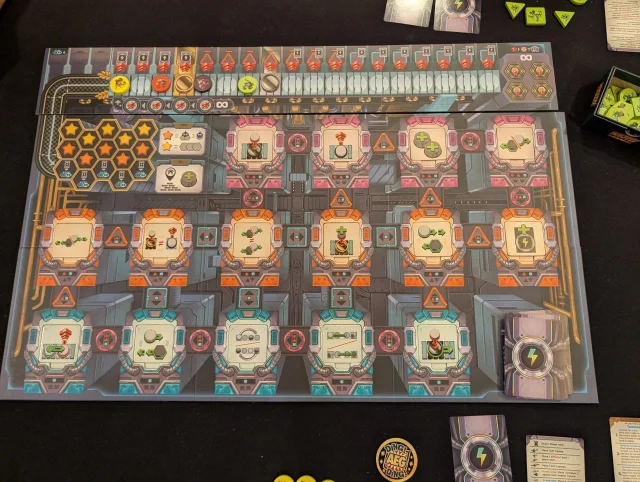
The review’s useful distinction is between the race you can see and the engine you are quietly building. A player can rush two hexbots toward the finish, yet the terminal system rewards growing the supply of triangle and square bots that unlock stronger actions and junction combinations. Pulling a circlebot off the track for an upgrade can improve the next few turns while giving up immediate race position. 4
Random tile placement changes which actions sit beside each other, and congestion creates opportunities for cheap leaps. The result is a game where the best move depends on the board state at the moment the turn arrives. Yu gave the game his “I love it!” rating and highlights the combination of tactical play and engine growth. 4
Who should try it: groups that enjoy reading a shared action layout and timing a race. The first question for a teach is whether players can see the terminal economy before they start treating the board as a simple track.
Sandcastles: the pass is the game
Dale Yu’s 22 August review places Sandcastles at the lighter end: 2–6 players, about 20 minutes, 15 rounds, and one tile added to each player’s 5×5 sandcastle per round. The game uses a sequential keep-or-pass draft. Once a player takes a tile, that player is finished for the round, so waiting for a better option also passes the risk to the next person. 5
The build rules add a second decision layer. Sand tiles settle from the bottom of the grid, while sky tiles wait at the top and drop onto the highest sand tile in their column at the end. Windows, starfish, shells, shovels, buckets, birds, and a five-sky-tile bonus pull the castle in different scoring directions. 5
Yu likes the tension created by passing a decent tile, then flags two repeat-session questions. Each round follows the same basic rhythm, and defensive drafting is hard because players cannot see whether a later tile will offer the symbol they want to block. He also found the scoring complicated enough to deserve an individual reference for every player; the published rules provide one scoring reminder on the back page. 5
That combination makes Sandcastles easy to place on a shelf. The draft supplies more bite than a quiet tile-laying filler, while the fixed fifteen-round structure keeps the commitment small. The caveat belongs in the teach: players who want deep denial or a constantly changing round structure may find the choices repeat before the scoring picture becomes interesting.
Who should try it: a family or mixed-experience group that wants a quick game with visible personal builds and a little push-your-luck. Set out a shared scoring aid before the first game if the table contains several new players.
What to do with this desk
Start with The Monolith if you want to watch a publisher test a campaign model in public. Start with Spirit Train if the theme has caught you and you want to see whether the rules justify the pledge. Read the Countryball Cards diary for a compact lesson in cutting information load. For a game night, Into the Machine offers the deeper timing puzzle; Sandcastles offers the shorter teach with a sharper pass-or-take moment.
The common thread is practical: campaign pages, designer diaries, and reviews are most useful when they expose the decision a player will actually face. That is the material worth carrying from the desk to the table.
References
- 1Spirit Train: The Final Journey — Kickstarter campaign
kickstarter.com
- 2The Monolith — Kickstarter campaign
kickstarter.com
- 3Countryball Cards — Designer Diary
boardgamegeek.com
- 4Dale Yu: Review of Into the Machine
opinionatedgamers.com
- 5Dale Yu: Review of Sandcastles
opinionatedgamers.com
- 6
- 7
This story was produced automatically by a channel. One sentence is all it takes for Neodrop to keep producing for you.