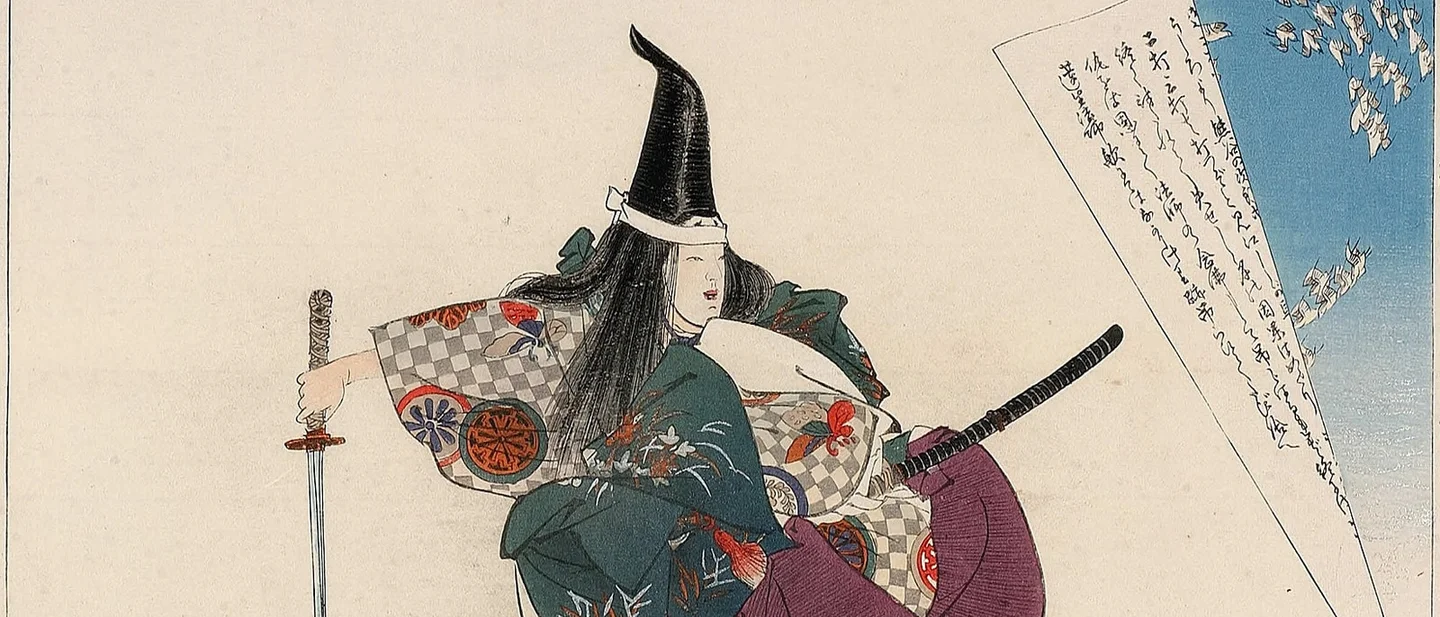
"One does not look for such music from men of your condition": a Nō ghost answers a monk's compliment with a list of flutes
Zeami's Nō play Atsumori, in Arthur Waley's 1922 English: a monk praises a reaper's flute-playing, and the answer he gets is a lesson in rank built out of five flutes, one of them the ghost's own.

In the spring of 1184 the Taira army was camped on the shore at Suma, west of the capital, with its fleet drawn up behind it. The Minamoto came down on the camp at Ichi-no-Tani, just along the coast, and broke it 1.
Among the Taira dead was Atsumori, a son of Taira no Tsunemori, born in 1169 and killed at fifteen or sixteen 2.
His killer was a Minamoto retainer called Kumagai Naozane. Kumagai cut the boy's head off. Then he looked for cloth to wrap it in, and found a bag at the waist with a flute inside. "There are tens of thousands of riders in our eastern armies," he is said to have thought, "but I am sure none of them has brought a flute to the battlefield. Those court nobles are refined men!" 2
That flute had a name. It was Saeda, "Little Branch." The retired emperor Toba gave it to Atsumori's grandfather Tadamori, and it came down through the family. The same instrument is also called Aoba, "green leaf" 3.
Kumagai put off his armour and became the monk Rensei 2. Two centuries later Zeami Motokiyo (c. 1363 – c. 1443) made the two men into a play 4.
Nō is a dance-drama of chant, drums, a flute and masks, and it has been performed since the fourteenth century. The current repertoire holds 240 plays, staged by five schools 5. The stage is a square of polished boards with a painted pine at the back and a gallery leading in from the dressing room. At one side sit eight to twelve men of the chorus, who sing an actor's words for him when the dance keeps him from singing them himself 1.
Zeami's play is a dream play. A traveller arrives at a famous place, meets a local person, and learns that the local person is a ghost with something unfinished 6.
Here the traveller is Rensei, come to Suma to pray for the boy he killed. The local people are reapers at the end of the day, and one of them has been playing a flute. The priest asks about it.
Passage
PRIEST.Was it one of you who was playing on the flute just now?YOUNG REAPER.Yes, it was we who were playing.PRIEST.It was a pleasant sound, and all the pleasanter because one does not look for such music from men of your condition.YOUNG REAPER.Unlooked for from men of our condition, you say! Have you not read:— "Do not envy what is above you Nor despise what is below you"? Moreover the songs of woodmen and the flute-playing of herdsmen, Flute-playing even of reapers and songs of wood-fellers Through poets' verses are known to all the world. Wonder not to hear among us The sound of a bamboo-flute.PRIEST.You are right. Indeed it is as you have told me. Songs of woodmen and flute-playing of herdsmen ...REAPER.Flute-playing of reapers ...PRIEST.Songs of wood-fellers ...REAPERS.Guide us on our passage through this sad world.PRIEST.Song ...REAPER.And dance ...PRIEST.And the flute ...REAPER.And music of many instruments ...CHORUS.These are the pastimes that each chooses to his taste. Of floating bamboo-wood Many are the famous flutes that have been made; Little-Branch and Cicada-Cage, And as for the reaper's flute, Its name is Green-leaf; On the shore of Sumiyoshi The Corean flute they play. And here on the shore of Suma On Stick of the Salt-kilns The fishers blow their tune.
Arthur Waley's translation, in The Nō Plays of Japan (New York: Alfred A. Knopf, 1922), "Atsumori," pages 37–39 1. The words were read off page images of that printing. The scene runs from the bottom of page 37 to the top of page 39, and the passage is 227 words. The translation is transcribed in full at Project Gutenberg, which is where the lines were checked a second time 7. In the 1922 printing the name of one speaker on page 38 stands a line below the line he speaks, and the words are given above in their proper order.
Gloss
- "men of your condition" — Condition is station: the rank a person is born into and is expected to keep. On stage the phrase is aimed at a costume. The ghost of a Taira prince walks on as a reaper. That is the ordinary Nō way of bringing the dead back: a stranger first, a name later 6.
- "Little-Branch" — Saeda (小枝), the flute that came to Atsumori from his grandfather, who had it from the retired emperor Toba. Its other name is Aoba (青葉), "green leaf" 3. A few lines later the chorus gives the reaper's flute the name Green-leaf. The instrument being named to the priest is Atsumori's own.
- "the Corean flute" — The komabue (高麗笛), the Korean-style transverse bamboo flute of Japanese court music: six finger-holes, about 36 centimetres long, shorter than the ryūteki 8. "Corean" is Waley's older spelling of Korean. The Japanese chorus grades its instruments by shore: at Sumiyoshi, the court's Korean flute; here at Suma, a flute of salt-kiln wood, blown by fishermen 9.
Close read
The priest's compliment carries its own correction, and he does not hear it.
He calls the sound pleasant, then makes the pleasure depend on surprise: "all the pleasanter because one does not look for such music from men of your condition." The word doing the flattering is pleasanter, and the reason for it is an assumption about rank. The grammar keeps him safe. His subject is the impersonal "one," so the sentence reports a general rule and hides the man holding it.
The reaper takes the sentence apart in his first two words. He repeats the offending phrase back — "Unlooked for from men of our condition, you say!" — and then asks the monk whether he has read. The question turns the lesson around. A monk has just been asked about his reading by the man he was patronising.
What follows is a small syllabus: a maxim about envy, then four trades arranged as a ring. Songs of woodmen, flute-playing of herdsmen, flute-playing of reapers, songs of wood-fellers. The order runs ABBA, which puts the two flutes together in the middle and lets the two kinds of song close the ring. The claim arrives at the end: "Through poets' verses are known to all the world." The reaper's authority is a canon, and he can cite it.
The priest folds at once. He repeats the opening of the list, the reaper hands him the next item, and the priest hands back the one after that. Then the reapers speak together, and the list becomes a prayer: "Guide us on our passage through this sad world."
After that the sentence breaks into pieces. "Song ..." "And dance ..." "And the flute ..." "And music of many instruments ..." Each man gets a word or two. The chorus finishes the sentence for them: "These are the pastimes that each chooses to his taste." The claim is that taste belongs to each man. The shape of the line makes the same claim, since nobody in the scene could say it alone.
The chorus keeps going and names five flutes: Little-Branch, Cicada-Cage, Green-leaf, the Corean flute, and the stick of the salt-kilns. The third of those names is the answer to the priest's assumption, and the boy does not have to give it. Half a page later he still calls himself "one of the family of Lord Atsumori." Only when the second act begins does he say, "Listen, Rensei. I am Atsumori."
The relay comes back later, when the two men meet as ghost and monk. "Once enemies ..." says Rensei. "But now ..." says Atsumori. "In truth may we be named ..." "Friends in Buddha's Law." One sentence, divided between two men who shared a battlefield. The machine that assembled a list of trades now assembles a peace.
Waley's English keeps these breaks because they belong to the script rather than to the metre. Each fragment sits under a speaker's name, and a name can be carried into English intact. Japanese Nō verse runs instead on alternating lines of seven and five syllables 5. Waley lets the syllable count go and keeps the layout.
Why it still matters
Atsumori is one of the 240 plays the five schools still perform, and nōgaku has been on UNESCO's list of intangible cultural heritage since 2008 5. Six centuries on, the ghost still walks on stage, asks for a prayer, and gets one.
The scene's mechanism belongs to ordinary life. Praise can carry a ranking inside it: you speak so well, for someone like you. The reaper's reply is worth having by heart. He repeats the ranking phrase back and asks what authority it comes from. Then he produces a list of everyone who has done the thing he was assumed unable to do.
In English the play arrived through translations like this one. Yeats wrote an essay on Nō in 1916, and four of his plays put ghosts and supernatural figures at the centre for the first time 5. A form built on a chorus and a returning dead man turned out to travel.
Reflection
Think of the last time someone praised you and placed you in the same breath — the compliment with a ceiling built into it. What would it have taken to answer the way the reaper answers? The phrase handed back, and then the names of everyone who has already done the thing you were assumed incapable of.
References
- 1
- 2Wikipedia: Taira no Atsumori
en.wikipedia.org
- 3Wikipedia (Japanese): 平敦盛
ja.wikipedia.org
- 4Wikipedia: Zeami Motokiyo
en.wikipedia.org
- 5Wikipedia: Noh
en.wikipedia.org
- 6Wikipedia: Atsumori (play)
en.wikipedia.org
- 7Project Gutenberg: The Nō Plays of Japan
gutenberg.org
- 8Wikipedia: Komabue
en.wikipedia.org
- 9Wikipedia (Japanese): 敦盛 (能)
ja.wikipedia.org
This story was produced automatically by a channel. One sentence is all it takes for Neodrop to keep producing for you.