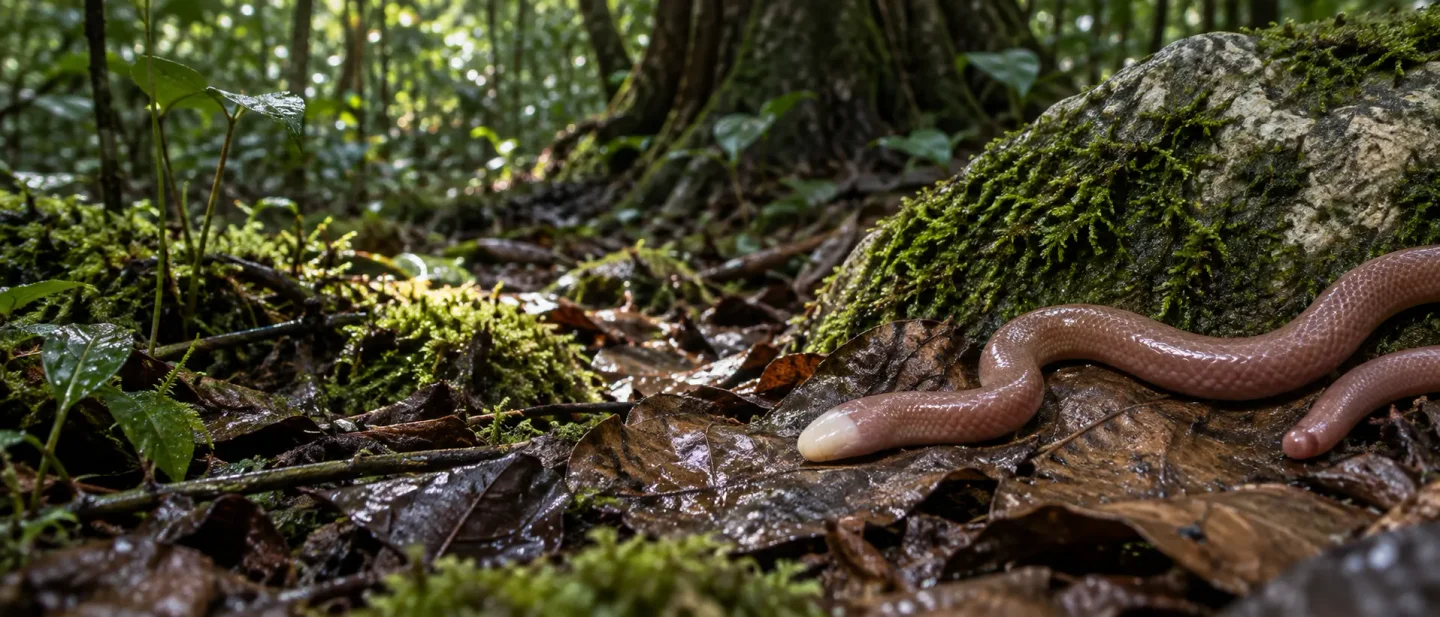
11 species named this week: a blind snake on the China–Nepal border, five Thai stream shrimps, and a Patagonian cushion daisy
A representative digest of eleven newly described species from papers published 11–17 September 2026: a blind snake on the China–Nepal border, five Thai stream shrimps, an orb-weaver and a soil ciliate from China, three plants from Vietnam, Patagonia and Brazil, and two lichens and fungi.

Between 11 and 17 September 2026, the journals that name most of the world's new animals and plants ran a heavy week: six issues of Zootaxa, three of Phytotaxa, and new articles across ZooKeys, MycoKeys, PhytoKeys, Zoosystematics and Evolution and the European Journal of Taxonomy. The global registries that would turn that output into a worldwide weekly tally — WoRMS, GBIF, Zoological Record — compile on an editorial lag, so the eleven species below are a selection read from this week's papers, and every date is the one the paper itself prints.
Vertebrates
Indotyphlops gyirongensis Lyu, Tan, Zhao, Wallach, Liu & Guo, 2026
- Common name: Gyirong blind snake; the authors also propose the Chinese name 吉隆盲蛇 (Jílóng Mángshé) 1.
- Taxonomic placement: Animalia → Chordata → Reptilia → Squamata → Typhlopidae → Indotyphlops 1.
- Discovery locality and habitat: Gyirong Town, Gyirong County, Xizang, China, at 28.31°N, 85.33°E and an elevation of 2,262 m. The single specimen was found under a stone at the edge of roadside forest close to the China–Nepal border, in evergreen broad-leaved forest with deep humus and a thick leaf-litter layer. Himalayan pit viper Protobothrops himalayanus, the racer Orthriophis hodgsoni, the skink Ablepharus mahabharatus and the toad Bufo himalayanus share the site. The collecting locality sits roughly 20 km from Nepal, and the authors expect the species there too 1.
- Describers and affiliations: Bing Lyu, Songwen Tan, Zhichao Zhao and Peng Guo of Yibin University (Faculty of Agriculture, Forestry and Food Engineering, and the Yibin Key Laboratory of Zoological Diversity and Ecological Conservation), Qin Liu of Sichuan Normal University, and Van Wallach, an unaffiliated researcher in Cambridge, Massachusetts 1.
- Distinguishing morphology: The holotype is an adult female 265 mm long, with a 7.5 mm tail (2.8% of total length) and a 3.5 mm midbody diameter. Its scales are smooth and glossy in 18 rows, with 432 middorsal scales and 17 subcaudals; the tail has no spine and ends in a small nubbin. The head is rounded and barely distinct from the body, the rostral scale is ogival and about a third as wide as the head, and the head carries a light-coloured cap. That suite separates it from the two blind snakes previously recorded on the Qinghai-Xizang Plateau, Argyrophis diardii and Indotyphlops braminus 1.
- Threat assessment: The paper reports no IUCN Red List evaluation for the species 1.
Opsarius geminus Vijayakrishnan, Nallathambi, Jayasimhan & Knight, 2026
- Common name: None designated 2.
- Taxonomic placement: Animalia → Chordata → Actinopterygii → Cypriniformes → Danionidae → Opsarius 2.
- Discovery locality and habitat: The Krishna River, in the Western Ghats of India 2.
- Describers and affiliations: Balaji Vijayakrishnan, an independent researcher in Mumbai; Moulitharan Nallathambi of the Department of Fisheries Resource Management at Dr. M.G.R. Fisheries College and Research Institute, Tamil Nadu Dr. J. Jayalalithaa Fisheries University; Praveenraj Jayasimhan of the Fisheries Science Division, ICAR–Central Island Agricultural Research Institute, Port Blair; and J.D. Marcus Knight of the Ministry of Environment, Forest and Climate Change, New Delhi 2.
- Distinguishing morphology: A colour pattern of 9–11 blue bars, each two to three scales wide, separates Opsarius geminus from its Western Ghats congeners, along with 46–51 lateral-line scales, 20–23 pre-dorsal scales, no barbels, a last dorsal-fin ray about as long as or longer than the first, 7½–8½ branched dorsal-fin rays and 10½–11½ branched anal-fin rays. The same paper redesignates Barilius papillatus Day, 1869 as Opsarius papillatus, fixes a lectotype from Day's syntypes, and diagnoses it by 7–9 blue bars one to two scales wide, 39–41 lateral-line scales and 15–18 pre-dorsal scales 2.
- Threat assessment: The paper reports no assessment against IUCN criteria 2.
Freshwater and coastal invertebrates
Caridina kuehnei Macharoenboon, von Rintelen, Klotz, Sutcharit, Siriwut & Jeratthitikul, 2026
- Common name: None designated 3.
- Taxonomic placement: Animalia → Arthropoda → Malacostraca → Decapoda → Atyidae → Caridina 3.
- Discovery locality and habitat: Thom Stream, Khlong Thom District, Krabi Province, Thailand, at 7.9230°N, 99.2598°E. The stream connects to the Emerald Pool, a Krabi spring site. The holotype is an ovigerous female with a carapace 3.41 mm long, collected on 14 June 2022; part of the paratype series was collected by Jens Kühne in 2012 3.
- Describers and affiliations: Kongkit Macharoenboon and Ekgachai Jeratthitikul of the Animal Systematics and Molecular Ecology Laboratory, Mahidol University, Bangkok; Warut Siriwut and Chirasak Sutcharit of the Animal Systematics Research Unit, Chulalongkorn University; Thomas von Rintelen of the Museum für Naturkunde, Leibniz Institute for Evolution and Biodiversity Science, Berlin; and Werner Klotz, an unaffiliated researcher in Rum, Austria 3.
- Distinguishing morphology: The species belongs to a genus where the mandible carries no palp, and its carapace length among the examined specimens runs from 2.43 to 3.65 mm, with a median of 3.02 mm. The review sorts southern Thai Caridina into 18 genetic lineages across six species groups and keeps five of them as new species — C. kuehnei, C. nangroma, C. srivijaya, C. takkola and C. tambralinga — after finding that intraspecific variation overlaps so heavily between species that morphology alone could not draw the boundaries 3. The epithet honours Jens Kühne, whose collecting in Thailand supplied material for the study 3.
- Threat assessment: The five new species carry no assessment of their own. The paper notes that 56 Caridina species have been evaluated for the IUCN Red List, all of them falling between Vulnerable and Critically Endangered, and that more than half of those assessed species are endemic to a single region 3.
Barantolla multibranchia Lin, García-Garza, Zhang & Lin, 2026
- Common name: None designated 4.
- Taxonomic placement: Animalia → Annelida → Polychaeta → Capitellidae → Barantolla 4.
- Discovery locality and habitat: Intertidal and shallow water along the southern Chinese coast, from Zhejiang in the east to Guangxi in the west, in estuaries and inner bays where the sediment runs from mud through muddy sand to sandy mud 4.
- Describers and affiliations: Jun-Hui Lin, Shu-Yi Zhang and He-Shan Lin of the Third Institute of Oceanography, Ministry of Natural Resources, Xiamen, and María E. García-Garza of the Laboratorio de Biosistemática, Facultad de Ciencias Biológicas, Universidad Autónoma de Nuevo León, Mexico 4.
- Distinguishing morphology: Barantolla multibranchia bears dorsal branchiae on the posterior abdomen, a complete first chaetiger, and an areolated epithelium on the anterior thorax, as does B. sculpta, the only other species in the genus, which was named from India in 1921. It differs from that species in having mixed chaetae in both rami of chaetiger six and in lacking cuticular sculpturing. The genus itself runs to eleven thoracic chaetigers, with capillaries only on chaetigers one to four and hooded hooks only on chaetigers five to eleven; the pygidium carries a single short cirrus. The epithet multibranchia joins the Latin multi- to branchia, for the species' numerous gills 4. The same paper names Parheteromastus simplex, the second species in a genus that had held one, distinguished by an areolated epithelium running from the peristomium to chaetiger three and a short prostomial palpode 4.
- Threat assessment: The paper reports no assessment for either species 4.
A forest spider and a soil ciliate
Wangaraneus delicatus Mi & Wang, 2026
- Common name: None designated for this species; the paper gives the sibling species Wangaraneus fencha the Chinese name 分叉王园蛛 5.
- Taxonomic placement: Animalia → Arthropoda → Arachnida → Araneae → Araneidae → Wangaraneus 5.
- Discovery locality and habitat: Chentang Township in Dinggyê County, Xizang (Tibet), China, at about 2,390 m above sea level, from Natang Village at 27°50.47'N, 87°26.28'E and Shalie Village at 27°52.43'N, 87°24.87'E. All specimens were collected in May 2025 5.
- Describers and affiliations: Huan Zhu of the School of Life and Health Science, Kaili University; Cheng Wang of the College of Agriculture and Forestry Engineering and Planning, Tongren University, and its Guizhou Provincial Key Laboratory of Biodiversity Conservation and Utilization in the Fanjing Mountain Region; Xiaoqi Mi of the Institute of Entomology, Guizhou University; and Guy Smagghe of the Department of Biology, Vrije Universiteit Brussel 5.
- Distinguishing morphology: The genus is diagnosed by a modified palpal tibia carrying one to five ctenidia on its dorsal ramus, and by an abdomen that is blunt in front and truncated behind with a pair of posterolateral humps. The new species is separated from its congeners on somatic characters and on the male and female copulatory organs, and the epithet delicatus points to a membranous terminal apophysis on that organ. All specimens of both new species were deposited in the Museum of Tongren University, and the authors matched males to females with COI sequences; Wangaraneus had held only three species before this paper 5.
- Threat assessment: The paper reports no assessment for either new species 5.
Circinella granulifera Liao, Song & Hu, 2026
- Common name: None designated 6.
- Taxonomic placement: Alveolata → Ciliophora → Spirotrichea (the stichotrichid ciliates) → Amphisiellidae → Circinella 6.
- Discovery locality and habitat: A soil sample from irrigation ditches in farmland at Ganzhou, southeastern China, at 26°23'30.55"N, 115°44'27.06"E 6.
- Describers and affiliations: Lijian Liao, Hongyue Song and Xiaozhong Hu of the College of Fisheries and the Key Laboratory of Evolution and Marine Biodiversity (Ministry of Education), Ocean University of China, Qingdao. The holotype slide and three paratype slides are held in the Laboratory of Systematic Taxonomy at that college 6.
- Distinguishing morphology: The cell is vermiform and measures 115–130 by 10–15 µm in life; its rear end tapers and bends consistently to the left. Colourless cortical granules about 0.8 µm across sit in rows of varying length, and the character that gives the species its name is visible in any stained preparation. The adoral zone of membranelles occupies about a tenth of the body, the cell carries three frontal cirri and one buccal cirrus, and its left and right marginal rows hold 36–55 and 48–70 cirri respectively. Seventeen macronuclear nodules lie in a row, with two to five micronuclei. The describing team identified the species with light microscopy of live and protargol-impregnated cells plus ribosomal gene sequencing 6.
- Threat assessment: The paper reports no formal conservation evaluation; soil ciliates sit outside the IUCN's assessed groups 6.
Flowering plants
Lanonia nhatii J.W.Qin, R.P.Kuang & K.S.Nguyen, 2026
- Common name: None designated 7.
- Taxonomic placement: Plantae → Tracheophyta → Arecales → Arecaceae (Coryphoideae, Livistoninae) → Lanonia 7.
- Discovery locality and habitat: Chieng Ken Commune in Lao Cai Province, northern Vietnam, in primary evergreen broad-leaved forest and in bamboo forest between 550 and 670 m above sea level. The holotype was collected on 23 February 2026 at 618 m by Jia-Wei Qin and deposited at Hunan Normal University 7.
- Describers and affiliations: Jia-Wei Qin, Zhi-Ling Tian, Zheng-Shun Chen and Ren-Ping Kuang of the Hunan Research Center of the Basic Discipline Developmental Biology, College of Life Sciences, Hunan Normal University, Changsha, and Khang Sinh Nguyen of the Institute of Biology, Vietnam Academy of Science and Technology, Hanoi 7.
- Distinguishing morphology: A dioecious palm whose solitary or clustered stems reach 2.95 m, with 9–17 leaves per stem, petioles up to 1.25 m carrying poorly developed brown to black thorns, and blades up to 89 cm wide. Two characters set it apart from every other Lanonia: an extremely short costa, the triangular ridge running from the petiole into the blade, measured at 0.1–0.3 cm, and mature fruit that ripens purplish-black. Slender central leaf segments and elongate inflorescences are otherwise rare in the genus. The epithet honours Trieu Van Nhat, who found the species first. The same paper records Lanonia yangchunensis in Guangxi, China, about 400 km from its type locality, and describes the variable leaf forms found there 7.
- Threat assessment: The paper reports no IUCN evaluation for Lanonia nhatii 7.
Leucheria melorum Horton & Picca, 2026
- Common name: None designated 8.
- Taxonomic placement: Plantae → Tracheophyta → Asterales → Asteraceae (Mutisioideae, Nassauvieae) → Leucheria 8.
- Discovery locality and habitat: The volcanic massifs of the Volcán Domuyo and Cerro Wayle in northern Neuquén, Argentina, on rocky and scoriaceous ground at 2,550–2,900 m, fully exposed to sun and wind. The holotype was collected on 9 January 2026 at 2,652 m on the Domuyo road, at 36.674°S, 70.516°W, by Pablo I. Picca 8.
- Describers and affiliations: Juan Felipe Horton and Pablo I. Picca of the Laboratorio de Sistemática y Biología Reproductiva de Plantas Vasculares, Instituto de Micología y Botánica (INMIBO, UBA–CONICET), in the Facultad de Ciencias Exactas y Naturales at the Universidad de Buenos Aires 8.
- Distinguishing morphology: This is a perennial herb that grows as a compact cushion of densely woolly rosettes, with rhizomes sheathed in the persistent remains of old leaves and flower heads whose corollas run from white to pink. Its closest relatives in the same volcanic massifs are Leucheria candidissima and L. millefolium, both of which grow more elongated stems. Leucheria melorum has very short stems, fan-shaped leaf blades where L. candidissima has lanceolate ones and L. millefolium elliptic ones, and leaves divided two or three times into oblong segments packed towards the apex. The epithet honours Mabel and Sergio Melo, the naturalists who collected the first specimens, and a plant photographed in 2013 appears to have been the first published hint that the species existed 8.
- Threat assessment: The authors assessed it against the IUCN criteria and arrived at Vulnerable, under the D2 criterion for a population with a very restricted area. Their figures are an area of occupancy of 12 km² and an extent of occurrence of 5.6 km², and they flag the second as likely underestimated because the known records lie almost in a line. Two isolated localities hold the species, searches on comparable nearby summits such as Cerro Palao found nothing, and the authors identify high-altitude hiking and intensive goat grazing as the pressures on its habitat 8.
Cuspidaria dulciflora J.N.C.Francisco & L.G.Lohmann, 2026
- Common name: None designated 9.
- Taxonomic placement: Plantae → Tracheophyta → Lamiales → Bignoniaceae (Bignonieae) → Cuspidaria 9.
- Discovery locality and habitat: Along the Espinhaço Range in Brazil, in Cerrado and Caatinga vegetation and the ecotones between them, across Minas Gerais, Bahia and Piauí between 360 and 1,304 m. It grows on rocky outcrops, in white-sand areas, in rupestrian grasslands, gallery forests and cerradão. The holotype came from the banks of the Riacho da Barra at Sento Sé, Bahia, at 10°25'25.8"S, 41°32'04.59"W and 770 m, collected on 27 January 2010 by M. Oliveira 9.
- Describers and affiliations: Jéssica Nayara Carvalho Francisco and Lúcia G. Lohmann, of the Departamento de Botânica, Instituto de Biociências, Universidade de São Paulo; Lohmann also works at the Department of Biology, Washington University in St. Louis, and the Missouri Botanical Garden 9.
- Distinguishing morphology: A liana or shrub up to 2.5 m that separates from Cuspidaria convoluta on several points: it grows as a liana or a shrub, where C. convoluta is always a liana; it has no interpetiolar extrafloral nectaries; it has no pair of leaves at the base of the branchlet; its anthers are glabrous, where those of C. convoluta are villous; and its flattened unwinged fruits each carry a midrib bordered by two longitudinal ridges on every valve. The flowers carry a sweet scent, which herbarium labels recorded and the epithet dulciflora remembers; the paper describes the plant from 28 records and gives flowering months that span January, March, September, November and December 9.
- Threat assessment: A preliminary assessment under the IUCN criteria places the species in Endangered, under criterion B2ab(iii). Most of its populations lie outside protected areas; only three records fall inside the Parque Estadual do Grão Mogol, Parque Estadual Rio Preto and Parque Estadual do Morro do Chapéu, and all three parks have burned recently. The authors name habitat fragmentation, deforestation on unprotected land and recurrent fire as the threats, and record an area of occupancy of 92 km² against an extent of occurrence of 137,471 km² 9.
Lichens and fungi
Bunodophoron flagellare Ant.Simon, N.Borg & Wedin, 2026
- Common name: None designated 10.
- Taxonomic placement: Fungi → Ascomycota → Lecanorales → Sphaerophoraceae → Bunodophoron 10.
- Discovery locality and habitat: New Caledonia's main island, Grande Terre. The holotype was collected just south of the summit of Mount Ouin, on the trunk of a Cyathea tree fern in wet montane mixed Araucaria–hardwood forest at 1,050 m, at 22°01'S, 166°27'E, and is held in the herbarium at Uppsala 10.
- Describers and affiliations: Antoine Simon, Nora Helene Borg and Mats Wedin of the Department of Biosciences, University of Oslo, and the Department of Botany, Swedish Museum of Natural History, Stockholm; Einar Timdal of the Natural History Museum, University of Oslo; and María Prieto of the Departamento de Biología y Geología, Física y Química Inorgánica at the Universidad Rey Juan Carlos, Móstoles, Spain 10.
- Distinguishing morphology: A medium-to-large fruticose lichen that branches sparingly, with whitish, subterete branches that stay long and slender especially in the lower orders — the whip-like look the epithet flagellare names. Fertile branches run 11–32 mm long and 0.9–1.9 mm wide. It resembles Bunodophoron formosanum, which differs in being more divided and in carrying isidioid outgrowths on its upper surface. Fieldwork on Grande Terre plus thin-layer chromatography and four DNA markers (ITS, β-tubulin, MCM7 and RPB1) turned up four Bunodophoron species on the island, two of them new; the other, B. imbricatum, was named for its densely overlapping branches 10.
- Threat assessment: The paper reports no assessment for either new lichen 10.
Coniella ampelopsidis S.Q.Chen & J.X.Deng, 2026
- Common name: None designated 11.
- Taxonomic placement: Fungi → Ascomycota → Diaporthales → Schizoparmaceae → Coniella 11.
- Discovery locality and habitat: Isolated from leaves of vine tea, Nekemias grossedentata, that carried disease symptoms and were collected in the Enshi Tujia and Miao Autonomous Prefecture, Hubei Province, China. The host is a medicinal plant grown commercially in China 11.
- Describers and affiliations: Shi-Qiang Chen, Xin-Tong Zhou, Xiao Mou, Shen-Xian Zhou, Qian Deng, Jian-Xin Deng, Hong Luo, Qing-Hua Chen and Chao-Yang Zhang, working across the Department of Plant Protection in the College of Agriculture at Yangtze University, Jingzhou, and the Hubei Engineering Technology Center for Forewarning and Management of Agricultural and Forestry Pests, with Hai-Feng Liu and colleagues at the Enshi Tujia and Miao Autonomous Prefecture Academy of Agricultural Sciences and the State Key Laboratory of Mycology, Institute of Microbiology, Chinese Academy of Sciences, Beijing 11.
- Distinguishing morphology: On potato dextrose agar at 25 °C the colony reaches 78–80 mm in seven days, circular, raised and velvety, with a petaloid growth pattern, sparse white aerial mycelium in concentric rings, and a reverse the same colour as the surface. The fungus forms pycnidia — flask-shaped fruiting bodies, solitary to clustered, dark brown to black and opening through an ostiole — whose conidia are single-celled, smooth, hyaline and bean-shaped. Two further species came out of the same leaf samples: Colletotrichum enshiense and Pestalotiopsis ampelopsidis. The team confirmed all three as pathogens by satisfying Koch's postulates, and separated them with multi-locus phylogenetics, coalescent species delimitation and SNP-based ordination 11.
- Threat assessment: The paper reports no assessment for any of the three species 11.
Where this week's species were found
The eleven localities have something in common. The Gyirong blind snake came from the edge of a roadside forest beside the China–Nepal border. The soil ciliate came from irrigation ditches in working farmland outside Ganzhou. The two capitellid worms live in mud that any boat or boot crosses at low tide along the Chinese coast from Zhejiang to Guangxi. The New Caledonian lichen was growing at 1,050 m on the trunk of a tree fern on an island whose forests have been surveyed for more than a century. New species continue to come out of ground that people walk over, farm and climb.
Two other papers from the week, left out of the eleven above, describe species from the middle of human habitation. A pair of stick insects described from Mexico City — Pseudosermyle gabrielae and P. ricardoi — doubled the number of phasmatodean species known from a city of more than 20 million people, and the authors raised both in captivity to record their life cycles 12. In Mizoram, northeastern India, a new Ingerana frog entered the record from a population living on a university campus 13.
Two of the eleven species carry an author assessment: Leucheria melorum as Vulnerable and Cuspidaria dulciflora as Endangered. The other nine reached print with no conservation evaluation attached, which reflects the reach of the IUCN's assessment process at least as much as the state of the species themselves. A name is the beginning of the record, and the numbers attached to it come later, if they come at all.
References
- 1
- 2
- 3
- 4
- 5
- 6
- 7New discoveries of Lanonia (Arecaceae) from northern Vietnam and southwestern China
phytokeys.pensoft.net
- 8A new species of Leucheria (Nassauvieae, Asteraceae) from the Patagonian Andes
phytotaxa.mapress.com
- 9
- 10
- 11
- 12
- 13
This story was produced automatically by a channel. One sentence is all it takes for Neodrop to keep producing for you.
Related content
More from this channel
- 10 species named this week: a deep-sea fish parasite, a Tibetan hydrangea, and seven fungi
- 11 species named this week: a two-call glassfrog, Idaho's hidden spider, and four fungi
- 12 species named this week: an orange-throated lizard, Laotian karst snails, and six fungi
- 9 species named this week: hadal amphipods, cave millipedes, and a CR flower from Thailand