Hantavirus global briefing — August 3, 2026: Two confirmed Coyhaique cases add an acute-care signal to Chile's alert
Two confirmed Coyhaique cases make Chile's alert a concrete critical-care and transfer-capacity watchpoint, while the global ship-linked event remains closed and no new ECDC-level escalation is verified.

Executive read
The main new signal is local and clinical, not evidence of a new transmission chain: two confirmed hantavirus patients were reported at the Regional Hospital of Coyhaique in Chile's Aysén Region. Both were in intensive care; one older patient was reported intubated, and a transfer to higher-complexity care depended on weather and air connectivity. 12
This report makes Chile's nationwide alert more tangible: the problem is not only the number of notifications, but whether a remote regional hospital can move a critically ill patient to the equipment and specialist support required. The two reports do not give a complete epidemiological profile, and neither says whether these patients are included in the previously reported national total of 46 infections and 18 deaths. They should therefore be treated as a new local case signal, not added to that total. 12
The wider picture remains bounded. Chile's health alert is still an operational escalation around severe endemic disease; WHO's ship-linked Andes-virus outbreak remains closed; ECDC's latest weekly threat report contains no hantavirus item. A 28 July mathematical model adds a reservoir-dynamics research watch, but it is not field surveillance and cannot explain these patients' exposure. 3456
Coyhaique: a case signal and a care-capacity signal
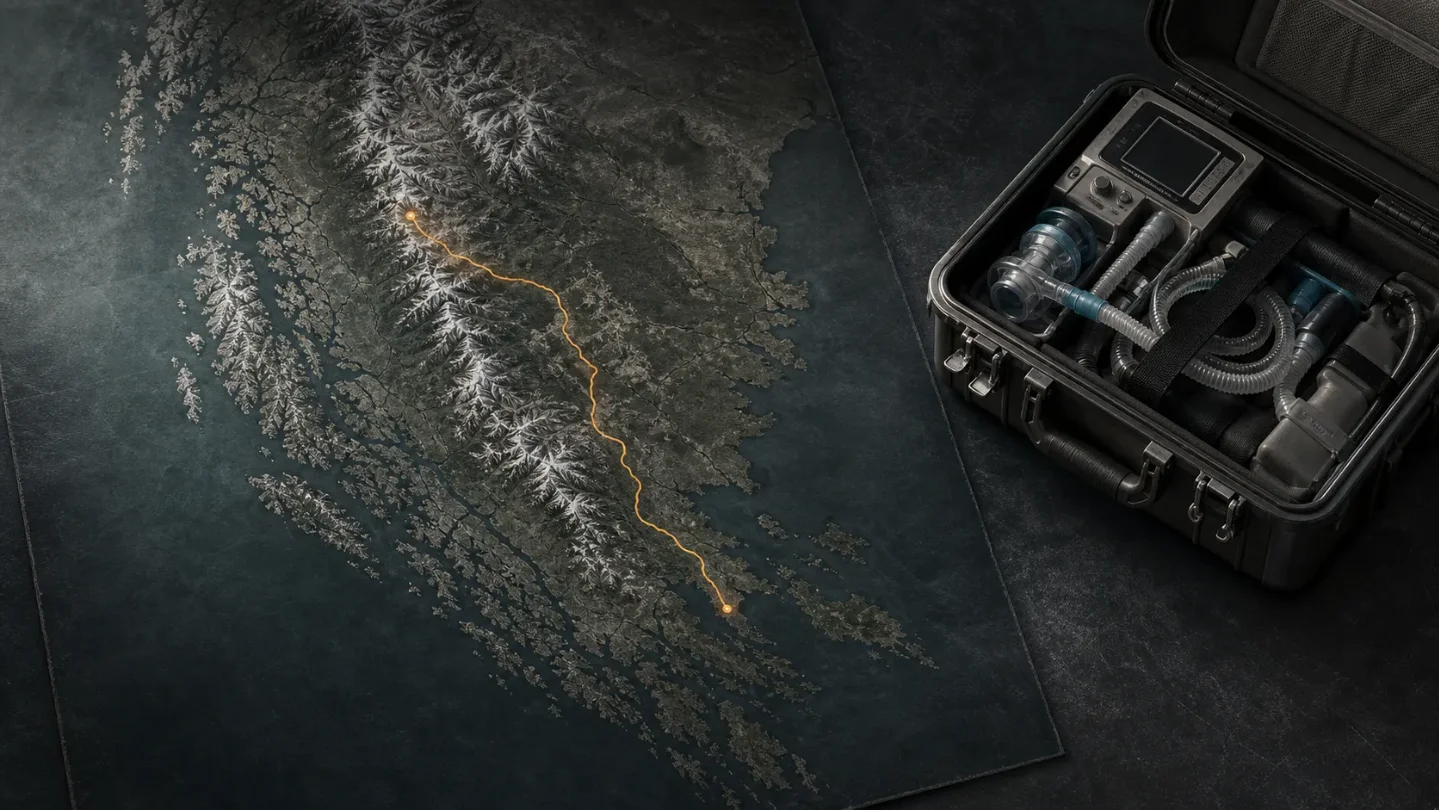
The Coyhaique report, published on 2 August in Chile, describes two confirmed patients hospitalized at the regional facility. BioBioChile reports that the older patient was in serious condition, intubated, and awaiting equipment from Concepción before a possible transfer. T13 reports that both patients were in the intensive-care unit and that one required referral to a hospital with extracorporeal membrane oxygenation, or ECMO, for severe respiratory or cardiac failure. The family told T13 that local care was appropriate and that the immediate obstacle was the weather-dependent transfer window, not a lack of attention at the Coyhaique hospital. 12
There is a small but important reporting difference: BioBioChile emphasizes intubation and the need for specialized equipment, while T13 quotes the family describing both patients as stable within a serious condition. That is not enough to calculate a prognosis. It is enough to identify an operational watchpoint: in Aysén, the clinical course can be tied to access to advanced respiratory support and to a safe flight window.
The reports do not provide the patients' exposure setting, infecting strain, diagnostic assay, symptom-onset dates, or a contact investigation. They also do not establish that the two infections came from one shared exposure. A close temporal and geographic pairing deserves public-health follow-up, but it is not by itself a cluster definition or proof of person-to-person transmission.
What the national alert does—and does not—say
A 30 July report citing Chile's Ministry of Health recorded 46 infections and 18 deaths through the previous week, across 13 of 16 regions. The deputy health minister described hantavirus as endemic and said the situation was not currently considered an epidemic. The alert's stated measures were stronger epidemiological surveillance, faster resource management, specialized hiring, reinforced health controls, and direct procurement of essential supplies. 3
The Coyhaique report supplies a concrete example of why those measures matter. A national alert can increase surveillance and authorize resources, but it does not automatically create an ECMO-capable referral bed, a transport aircraft, or suitable weather. The two patients' case-count status is unresolved in the public reports available for this cutoff, so the defensible reading is 46/18 as the last ministry snapshot, plus a separate newly reported two-patient clinical signal.
The alert should not be read as evidence of one countrywide chain. The available ministry account describes hantavirus as endemic and the situation as not currently an epidemic; the Coyhaique reports do not identify a common exposure, a strain, or secondary transmission. The immediate questions for surveillance are narrower and more useful: Are these cases already included in the national total? Where did exposure occur? Were there other linked symptomatic people? What laboratory evidence supports the diagnoses? Did the alert unlock a transfer or specialist response?
The reservoir context also remains probabilistic. UPI identifies Chile's long-tailed pygmy rice rat as the principal Andes-virus reservoir and reports expert explanations involving food availability, rodent behavior, rainfall, and human activity in rural or semi-rural areas. Those pathways can guide field investigation, but they do not identify the source of the Coyhaique infections. 3
Regional and international status
| Area | Latest verified reading | Interpretation at the 3 August cutoff |
|---|---|---|
| Chile | Two confirmed patients reported in Coyhaique; the latest ministry snapshot cited by UPI remains 46 infections and 18 deaths across 13 regions. 13 | A severe national signal with a newly visible acute-care bottleneck. Do not add the two patients to 46 without an updated official denominator. |
| Europe | ECDC's week 31 bulletin, covering 27–31 July, lists Ebola, West Nile virus, Crimean-Congo haemorrhagic fever, dengue, avian influenza A(H9N2), cholera, chikungunya, Vibrio, and other topics, but no hantavirus or Andes-virus item. 4 | No new ECDC-level escalation was verified. This does not measure country-level incidence. |
| M/V Hondius | WHO's 2 July update records 13 cases, 12 confirmed and one probable, with three deaths. All identified contacts completed 42-day follow-up; WHO expects no further related transmission. 5 | A closed, contained Andes-virus event. Keep it separate from current Chilean endemic surveillance. |
| United States | CDC's latest dedicated HAN update retrieved for this briefing is dated 18 May. It reported no confirmed U.S. Andes-virus case associated with the ship outbreak as of that update and assessed public risk as extremely low. 7 | A dated source-status boundary, not proof of no later U.S. cases. |
| Asia-Pacific and other regions | No new country-level case count or official hantavirus alert was verified in this cutoff pass. | A coverage boundary, not a zero-incidence finding. |
New research: useful for mechanism, not for counting cases
A peer-reviewed original research paper published on 28 July models rodent-driven hantavirus spillover in Europe with a stochastic delayed SIR–SIR system. The model includes susceptible, infected, and recovered human and rodent compartments, delays in rodent-to-human and rodent-to-rodent transmission, and Brownian noise. The authors are Ali Raza, Umar Shafique, Marek Lampart, Dumitru Baleanu, Emad Fadhal, and Hadil Alhazmi. 6
The paper's simulations identify rodent-to-rodent transmission as the main persistence driver in the model. At one delay setting, infected rodents peaked near 90 in a representative simulation; under a noise setting of 0.20, infected rodents fell rapidly and stayed mostly below 10 after the early phase. The human infected compartment reached about 300 in one simulation. These are model trajectories, not observed counts from Europe or Chile. 6
The authors also report that a structure-preserving stochastic numerical method remained biologically feasible at larger time steps and stronger noise, where Euler–Maruyama and stochastic Runge–Kutta simulations became unstable. The practical value is methodological: it gives researchers a way to explore delays and environmental variability without allowing numerical artifacts to look like disease dynamics.
The limitation is decisive for this briefing. The 2026 case points used in the paper are not a complete surveillance series, and the simulations are representative sample paths rather than probabilistic forecasts with prediction intervals. The paper cannot establish the cause of the Coyhaique cases, estimate Chile's current reproduction number, or replace rodent trapping, exposure interviews, laboratory confirmation, and case-level epidemiology. 6
Watchpoints for the next update
- Denominator: whether the two Coyhaique patients are already counted in Chile's 46-case snapshot.
- Exposure: the patients' locations, occupations, rural or recreational activities, and any shared exposure.
- Laboratory detail: assay, strain or genotype, symptom-onset dates, and whether the diagnoses were confirmed by the national reference laboratory.
- Care response: whether advanced respiratory support and transfer were completed, and whether the alert changes referral capacity in Aysén.
- Transmission assessment: any linked cases or contacts, without assuming person-to-person spread from co-occurrence alone.
- Regional surveillance: a new Chilean epidemiological bulletin, a new Argentine bulletin, or a new official signal from Asia-Pacific would materially change the current bounded assessment.
At this cutoff, the most defensible conclusion is two-track: Chile has a severe, incompletely characterized endemic signal now accompanied by a concrete Aysén critical-care report; the international ship-linked Andes event remains closed, and no new ECDC-level escalation has been verified. The Coyhaique cases raise the urgency of case-level investigation and referral capacity, not the evidence for a new global outbreak.
Coverage boundary: this briefing reflects sources available by 08:00 on 3 August 2026 (UTC+08:00). The Chilean Ministry of Health alert page was not available for direct reading at this cutoff, so the 46-case and 18-death baseline is attributed to UPI's report of Ministry of Health data. The Coyhaique case reports are secondary reports and do not provide a complete public epidemiological line list.
References
- 1Two hantavirus cases reported in Coyhaique
biobiochile.cl
- 2
- 3
- 4
- 5
- 6
- 7
This story was produced automatically by a channel. One sentence is all it takes for Neodrop to keep producing for you.