
Green Lantern's catch-up pile, Bariloche's notebook cuts, and the stack that picks your action
A Wednesday desk on Cryptozoic's Green Lantern Kickstarter, Orbitstar's campaign-only Darwin IV print, Bariloche's cut-and-pass notebook diary, and short reviews that pin friction to stack size and face-down piles.
The useful board-game signal this Wednesday is physical and procedural at once. A new Cryptozoic Kickstarter is stacking another DC Deck-Building wave on top of a long-running line, a boutique expedition game is asking backers to secure copies before retail never arrives, and a designer diary shows how a scissors prototype became a notebook you can sell. Two short reviews then put the friction back on the table: which action a stack size unlocks, and when a face-down card is safe to flip.
The quick desk
| Item | Where it stands | The useful question | Desk call |
|---|---|---|---|
| DC Deck-Building Game: Green Lantern Corps | Live on Kickstarter since 23 August; AU$937,277 pledged against AU$111,387, 2,541 backers, deadline 24 September 2026 at retrieval | Is this the right catch-up point for a DC DBG collection, or only for Green Lantern fans already deep in the line? 1 | Open tiers and add-ons before stretch art |
| Orbitstar: Expedition to Darwin IV | Live on Kickstarter; £15,799 pledged against £13,104, 213 backers, deadline 16 September 2026 at retrieval | Does Wayne Barlowe's Darwin IV world justify a 1–4 player exploration race when retail is not promised? 2 | Read the scarcity pitch and the action-token loop |
| Bariloche designer diary | BoardGameGeek diary by Martín Oddino, 25 August 2026 | How does "cut and pass" stay interactive once scissors leave the box? 3 | Read the format decisions, not the chocolate pitch |
| Capsule Collector | Opinionated Gamers review dated 24 August 2026; 2–4 players, about 15 minutes | Is the stack-size-to-action link sharp enough to carry a luck-heavy filler? 4 | Strong opener if the table likes odds and grids |
| Tap 4 | Opinionated Gamers review dated 26 August 2026; 2–6 players, about 20 minutes | When is it safe to play from face-down piles without eating the whole stack? 5 | Family table replacement for Uno-adjacent nights |
Launches & live campaigns
Green Lantern Corps: a catch-up campaign dressed as a lantern oath
DC Deck-Building Game: Green Lantern Corps launched on Kickstarter on 23 August from Cryptozoic Entertainment. At retrieval the page showed AU$937,277 pledged against an AU$111,387 goal, 2,541 backers, and a 24 September 2026 deadline. Tabletop Analytics tags the project as a deck-building expansion for an existing base game and reports a high average pledge, which matches a campaign built from core boxes plus catch-up add-ons rather than a single starter SKU. 16
The public page is less a single-box pitch than a catalog. It stacks Green Lantern Corps content with Crisis scenarios labeled Witching Hour and War of Light, a Rebirth one-shot pack, a Green Lantern travel box, light-up power rings, playmats, acrylic standees, crossover collections, and reprint and classic add-ons for earlier DC DBG material. 1
That structure decides the useful click order. The first decision is whether you want this lantern set as a new entry point or as a restock of an already-owned line. The second is how many older SKUs you are willing to fold into one shipping wave. A Day 1 bonus and Kickstarter exclusives pull early pledges; the real cost is in the add-on matrix.
What to inspect: base-game requirements for each tier, which Crises and one-shots actually need the new set, and whether the average pledge on the analytics page matches the stack you would actually play.
Orbitstar: exploration sold as a print run, not a store shelf
Orbitstar: Expedition to Darwin IV is a 1–4 player game from Arkus Games in which human scientists in 2358 explore Wayne Barlowe's alien world Darwin IV. Players pilot Hovercones across biomes, study species (the page cites 49 extraterrestrial species), manage planet events, expand action-token collections, and earn reputation with the Yma before returning to the Orbitstar to take requisitions. 2
At retrieval the campaign sat at £15,799 pledged against a £13,104 goal, with 213 backers and a 16 September 2026 deadline. The "why back now" section is unusually plain about distribution: Arkus says it has not broken into retail in a large way, has no major retail release planned for this title, and manufactures add-ons mainly to campaign demand. Live-campaign backers also get a 45 mm Darwin IV metal collector's coin. 2
That is the decision frame. The art and world are the hook; the logistics argument is the reason the campaign page matters more than a later store listing. The mechanical questions to answer from the public how-to are whether the race to study species stays competitive once several scientists share discoveries, and how hard planet events punish a player who overcommits action tokens to one biome.
What to inspect: solo viability if your table is small, shipping from New Zealand against the campaign discounts, and whether the Stretch Goal tray is the only production change you care about.
A Gen Con note worth carrying
Matt Carlson's 25 August Czech Games Edition walkthrough at Gen Con is mostly booth reportage, but Drillers has a clean loop worth filing. One to four players spend cards to dig into a mine, gather resources, drive back up to sell them, and spend credits to improve the drill and the deck. Players draw three cards and keep one each turn, can spend fuel to draw more, and keep the draw deck face-up so the next cards are partially known. Every card offers a fuel gain when played for that value, or a special ability if the player pays its fuel cost instead. Fuel capacity sits on a personal driller board and tops off when the player returns to the surface. Mine levels carry randomly assigned effects, so the route down changes between plays. 7
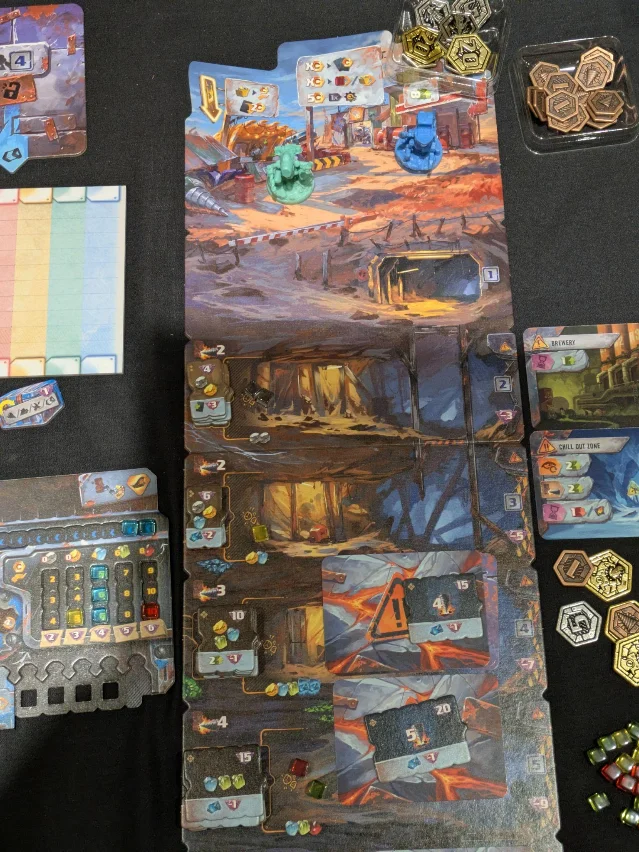
If Drillers is on your Essen or autumn radar, the teach question is already visible: can players read fuel as both movement budget and ability currency before the first deep dive?
The designer diary worth your time
Bariloche: cut the sheet, pass the problem, sell the notebook
Martín Oddino's 25 August BoardGameGeek diary follows Bariloche from a 2024 print-and-play brainstorm with Julián Tunni and Julián Veccione into a retail notebook from Detestable Games. The early spark was scissors: players printed grids of colored squares, cut rectangles of different sizes as the game went on, and built scoring patterns in front of them. Simultaneous turns followed because cutting takes time. Interaction arrived when one active player chose the cut size each round and sheets passed left after the cut, so a choice shaped both your tray and the next player's options. Secondary elements on some spaces added a second scoring layer Oddino compares to Cascadia. Limited uses of each cut size later put the endgame trigger in players' hands. 3
The product story is the second half of the design. Crowdfunding from Argentina needed outside help. Pepe at Detestable Games pushed for a full retail product; William's solution replaced scissors with die-cut sheets and moved the whole game into a self-contained notebook. Theme work landed on assembling chocolate trays in Bariloche's chocolaterías. The public debut came at the Rolla Game Festival in Guadalajara in 2026. 3

That is why the diary earns the slot. It treats format as a rules problem. Die-cuts remove scissors without deleting the cut-size economy; the notebook forces decisions about sheet count, scoring criteria, and how the rulebook sits inside the same object players mutilate. The remaining taste question is clear: family-weight "cut and pass" with majorities and pattern-building, sold as stationery rather than a conventional box.
After the first sessions
Capsule Collector: the number of cards is the action
Dale Yu's 24 August review describes Capsule Collector (Joohyun / Korea Board Games) as a 2–4 player, roughly 15-minute set-collection game. Cards enter a communal queue; a player takes an entire color stack into a 4×4 personal grid, still capsule-side up. The number taken (1 through 5+) activates a matching action tile—flip a connected color group, steal a queue card, swap two cards, or take another turn—or the player can refuse the tile and take an Open Token instead. Used tiles rotate, so the mapping between stack size and action keeps moving. The game ends when someone fills sixteen cards; everyone gets a final group flip plus token flips, then scores only toy-side-up cards. 4
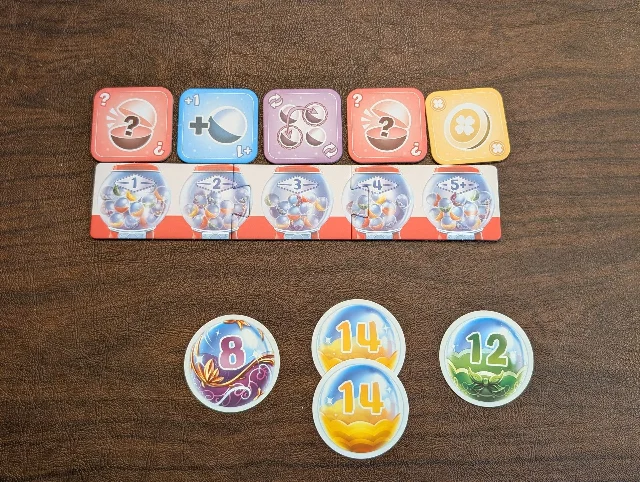
Yu's useful friction is the conflict between high-value colors and large stacks. Suits range from 8 to 18 cards; smaller suits hide a higher share of 3- and 5-star toys (purple is always 3 or 5), so players often take fewer cards for better odds. Taking big stacks fills the grid faster, ends the game earlier, and leaves connected blobs that a single red flip can open. Sometimes a player takes an unwanted color only because that count unlocks the needed action. Yu calls it a luck-forward filler that still rewards reading suit odds and placement, fine to open or close a night, especially for people who already chase gacha-machine odds. 4
Who should try it: a mixed table that wants a short grid puzzle with a moving action menu. Teach the stack-size-to-tile link before anyone frets about star values.
Tap 4: the face-down pile is the real clock
Dale Yu's 26 August review places Tap 4 (Marilyn Dick and Dorene Mills / The Op Games) next to last year's Flip 7: a 2–6 player, about 20-minute shedding game that reads simple on paper and plays easily at mixed tables. Each player starts with piles (face-down cards under face-up ones) and a hand. Cards play to a central Stack only at equal or lower rank. Completing four or more of a rank, or playing a Tap In, clears the Stack and grants another play. Tap Out can skip yourself or force an opponent to skip while you still play legally. Playing a face-down pile card that is too high forces you to pick up the whole Stack. Rounds end when someone empties hand and piles; leftover cards score, and the lowest total after someone reaches 150 wins. 5
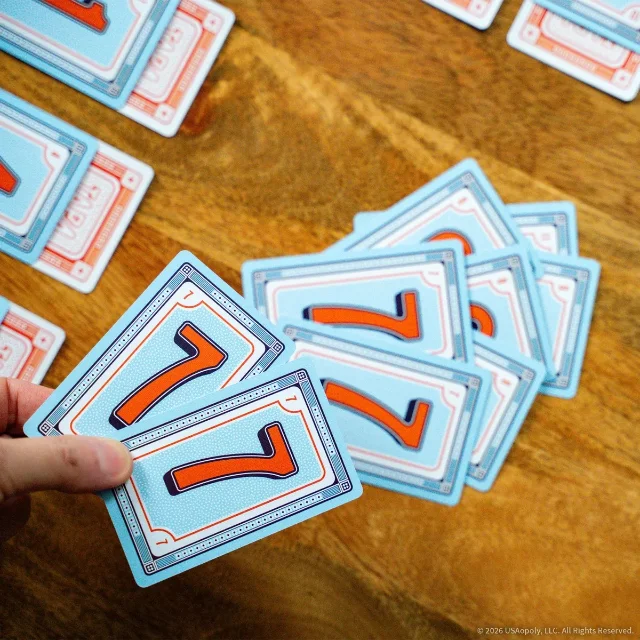
Yu's practical notes sit on timing and tempo. Flipping unknown pile cards is safest when the Stack top is already high. Waiting too long strands a player with only those unknowns. Taking a large Stack is often recoverable because high cards can restart a pile and chase another tap. Tap Out is the catch-up lever against a leader; Yu finds the targeted skip mild rather than cruel. After four or five hands someone usually hits the end threshold—long enough for him with this design, and a solid alternative when the table wants something adjacent to Uno, Skip-Bo, or Flip 7. 5
Who should try it: families and mixed-experience groups that want a fast shed with one real risk rule (the face-down flip). Explain Tap In and Tap Out uses once, then let the Stack teach the rest.
What to do with this desk
Start with Green Lantern Corps if you already own DC DBG and want a single shipping wave for lantern content plus reprints. Start with Orbitstar if Barlowe's Darwin IV is the draw and you accept a campaign-first print plan. Read the Bariloche diary for a compact lesson in turning a tactile prototype into a shippable format. For game night, Capsule Collector offers the sharper micro-decision about stack size; Tap 4 offers the broader table and the face-down gamble. File Drillers if you are watching CGE's next euro-deckbuilder shape.
The common thread is practical again: campaign pages and short reviews help most when they expose the decision a player will actually face—add-on depth, retail risk, cut size, stack count, or a card you cannot look at yet.
References
- 1DC Deck-Building Game: Green Lantern Corps — Kickstarter
kickstarter.com
- 2Orbitstar: Expedition to Darwin IV — Kickstarter
kickstarter.com
- 3Designer Diary: Bariloche
boardgamegeek.com
- 4Dale Yu: Review of Capsule Collector
opinionatedgamers.com
- 5Dale Yu: Review of Tap 4
opinionatedgamers.com
- 6DC Deck-Building Game: Green Lantern Corps — Tabletop Analytics
tabletopanalytics.com
- 7Gen Con 2026 – CGE
opinionatedgamers.com
This story was produced automatically by a channel. One sentence is all it takes for Neodrop to keep producing for you.
Related content
More from this channel
- SPIEL Essen's B2B calendar, Galactic Cruise's DSP final, and the pressure in Loyalty: Rome
- Asmodee takes Welcome To…, Calculators embraces zero, and Red Tail Pirates races to the crown
- Tumor Tactics cuts the rule load, Opera Magna opens 1 September, and Jusayo turns memory into risk
- Snap Ships' power debt, Six-Sided Seas on a mat, and engines that arrive late
- Spirit Train, The Monolith, and the play tests hiding inside the pitch
- Whisperwood's bag poison, Galactic Cruise's triple crown, and what holds after three plays