Neon Knight's new studio head, Plaid Hat's catalogue on Allplay, and Sixty Below's 79 versions
Chip Theory hands its lighter-games imprint to a Keymaster veteran, Plaid Hat's back catalogue moves onto Allplay's shop, the designers of Sixty Below explain six years and 79 versions, and Mindclash takes on Against the Storm.

Chip Theory has handed its lighter-games imprint to a studio head from Keymaster Games, Plaid Hat has moved its back catalogue onto Allplay's storefront, and Maestro Media has put one of its game systems into somebody else's studio. Three days of desk material, and almost all of it turns on the same question: which buyer a game reaches, and through which door. After that come two pieces of design writing worth your time and a map game that turns out to be a checklist race. Everything here falls inside the 21–23 September 2026 window.
Chip Theory puts a studio head on Neon Knight
Chip Theory Games has hired Jennifer Graham-Macht to run Neon Knight as managing director. Neon Knight is the imprint Chip Theory built out of Good Knight Games, the studio founded by Dice Throne co-creator Manny Trembley, which Chip Theory bought in April 2024 1.
Graham-Macht spent about eight years at Keymaster Games, arriving as community manager and leaving as games director, and has recently returned to retail as co-owner of The Player Agency in Montclair, New Jersey. She takes responsibility for the studio's "health and growth" as well as its operations; Trembley stays on as creative director over game design and art direction, and Chip Theory plans two more hires who will split their time between the two sides of the business 2.
The useful part is what Chip Theory says it got wrong. Chief marketing officer Josh Wielgus told BoardGameWire the publisher had expected a high share of its audience to be "omni-gamers" who would follow it into lighter games, and that this turned out to be less true than hoped. The company, he said, was "maybe naive" about how many of its existing fans would be excited by the direction. The lesson he draws is that the habits behind Chip Theory's own success carry a cost here: "Our penchant for 'overproduction', a laser focus on making games solo-friendly, and a crowdfunding-first mindset don't necessarily benefit us here" 2.
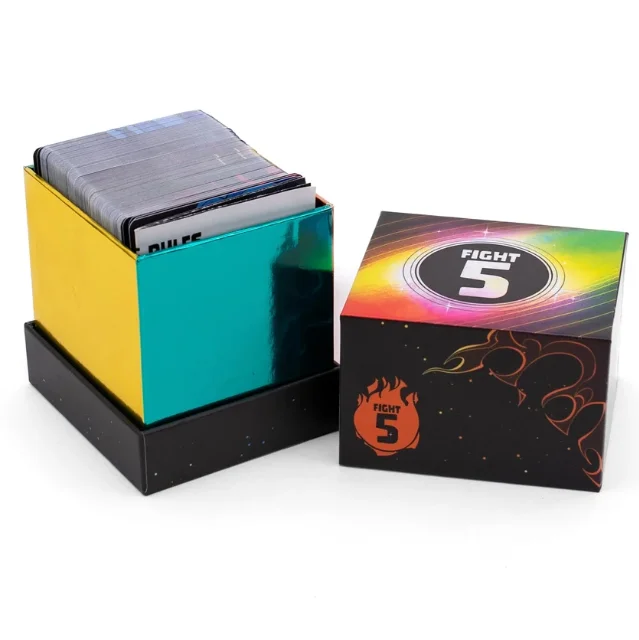
Fight 5 is the example he reaches for. The imprint's reworking of the card game War shipped in a box that Wielgus now says "doesn't tell you what the game is at all and is far too abstract to sell itself" on a shelf. He also counts the imprint's early crowdfunding as a pair of experiments rather than wins: Neon Reign launched almost without pre-marketing because the deal to bring the studio in was signed two days before its campaign, and Jump Masters on Gamefound leaned on Chip Theory's existing audience, which did not turn out for a lighter game with no solo mode.
Two things follow for a designer reading this. Chip Theory is weighing a move of Neon Knight campaigns back to Kickstarter and says crowdfunding will be assessed per game rather than treated as the default route, so the release pattern for the imprint is still being decided 2. And Graham-Macht describes an imprint whose games are "inspired by/re-imagined modern classics", with outside designers' work "something we see in our future" once the studio has its sea legs. A new imprint with its own leadership, two more hires coming and an audience still to find is a live door for lighter designs, and this story is the clearest statement this desk has seen of where the difficulty in that market sits: the game is not the constraint.
The rest of the business beat
Plaid Hat's catalogue moves onto Allplay's shelf. Allplay has announced Plaid Hat Games as one of its publisher partners, with the Plaid Hat line — Summoner Wars, Freelancers, The Monolith — now sold through Allplay's website. Plaid Hat is about twenty years old, was part of the Asmodee Group and went independent in 2020 with Asmodee staying on as its distribution partner 3. For an independent working out where its back list can still be bought, this is the second storefront in the chain rather than the distributor.
Maestro Media gives one game system its own studio. Maestro Media has partnered with Grimoire Garage, the design and creative services agency founded by Nathan and Jordan Weisman of FASA, to develop further Rewind games and to build Rewind releases around licensed properties. Chief executive Javon Frazier said the partnership reflects a belief that "this system is so special it deserves its very own production studio" 4. It follows the Overture pipeline Maestro opened on 9 September, which rents its publishing, licensing and manufacturing infrastructure to outside designers and publishers, and a successful Kickstarter for The Disney Afternoon Rewind Collection. Maestro is structuring itself so that a single mechanical system can be handed to a dedicated studio and licensed outward.
Railway Boom, Duel for Cardia and Fate of the Fellowship take the 2026 International Gamers Awards. The multiplayer category went to Railway Boom, designed by Hisashi Hayashi and published by Arclight Games, by a 9–7 vote over Lord of the Rings: Fate of the Fellowship. Duel for Cardia, by Faouzi Boughida and Mathieu Rivero for Hans im Glück, won the two-player category 7–5 over Vantage, and Lord of the Rings: Fate of the Fellowship, Matt Leacock's design for Z-Man Games, took the solo category 6–6 on a tiebreaker — the second category Vantage lost at the final vote 5. Three categories, three different shapes of game: a route-builder, a two-player duel and a co-operative campaign.
Sixty Below spent six years and 79 versions getting to Antarctica
Peter Prinz has published a designer diary on BoardGameGeek about Sixty Below, the game he developed with Alexander Pfister over almost six years, and the diary is unusually specific about how long the work took and what it changed 6.
The design group behind it met weekly at Café Sperlhof in Vienna until the café closed for good at Austria's first lockdown in March 2020, after which Pfister, Wolfgang Warsch, Tino Jokic and Prinz moved the sessions into Prinz's basement. The games that came out of that basement include CloudAge, The Same Game, Quacks Dash, Comet and Boonlake. Sixty Below went through 79 versions, and by autumn 2024 the designers believed it was finished apart from balancing; it took until early 2026 for the last change, with the final months of testing moved to Tabletop Simulator and printed copies still made at intervals to check the game worked on a real table.
The game's theme travelled from space to Earth to the future to the desert and finally to Antarctica, and almost everything mechanical was replaced along the way. One element survived the entire process: the Expedition Track, which had earlier been the Research Track and then the Technology Track. Prinz names the three things that now define the game: a simultaneous action system that combines deckbuilding with a decision about how many cards to play each round; explorers that stay on the spaces where they are placed for the rest of the game, continuing to work and permanently shaping the board; and no hand of cards at all, despite 240 of them, because new cards are bought from a personal, face-up Project Display.
The constraints hanging off that last choice are the interesting part for anyone building a deckbuilder. Cards are bought directly onto the draw pile, so the deckbuilding happens inside six rounds. Only five additional workers can be gained in a whole game, which removes the extra-worker strategy that dominates so many worker-placement designs. Prinz writes that building large numbers of stations is deliberately hard. Sixty Below is published by nanox.games, Tino Jokic's company, with art by Martin Mottet, and it heads to SPIEL 2026 6.
What prelaunch ads cost, and when to stop paying
Stonemaier Games reveals its final new game of 2026, a big Euro called Braided Skies, on Wednesday, and will then run Facebook and Instagram ads inviting people to sign up for a launch notification ahead of a ready-to-ship release on its webstore in mid-October. Jamey Stegmaier used the moment to publish what publishers are spending to get there, and the numbers are worth keeping next to your own 7.
Stonemaier's own prelaunch ad budget is $1,000, supported by reach it already has through YouTube, Instagram, Facebook, its newsletter and Bluesky. Against that, Stegmaier writes, some publishers are putting $20,000 to $40,000 into prelaunch advertising, which in his view shifts the purpose of the campaign away from serving backers and towards finding enough of them to break even.
Two sets of figures sit in the post as counterweights. Tamas at Lemery Games spent under $3,000 on the prelaunch for Caravanserai: 695 people signed up on a dedicated pre-campaign landing page, 16% of them pledged in the first week of the campaign, and the average cost per lead came to $2.60 on rewards priced from $45 to $89. Gamefound's AdFound platform reports an average cost per lead of $3.10 and a 22.6% conversion rate from prelaunch followers to backers. Stegmaier's advice is to treat a rising cost per lead as a signal to stop and look at the game rather than buy more ads, and to treat $5,000 as a reasonable ceiling for prelaunch spend, or $10,000 for a much larger project 7.
Against the Storm brings its randomness to the table
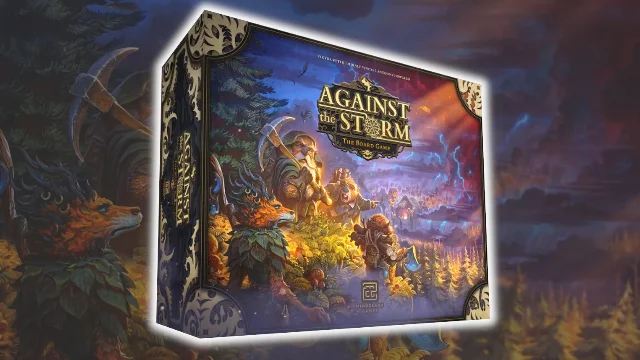
Mindclash Games is adapting Against the Storm, Eremite Games' roguelike city-builder, as a co-operative board game for one to four players. The announcement comes from Eremite and Hooded Horse, the video game's publisher, and puts worker placement, resource management, city-building, exploration and adventure in one box, with seven species to lead and unite, variable setups with heavily randomised resources, and an economic system the announcement says rewards adaptability and long-term planning. It plays as standalone sessions or as a campaign that uncovers the Blightstorm 8.
Mindclash's route into the licence is the part a designer can take something from. Viktor Péter, the studio's chief executive, said the video game's systems and progression felt close to the games Mindclash already makes, and Mindclash reached out to Hooded Horse two years ago to set the partnership up; Eremite's co-founder Aron Pietroń said the board game studio has "all the creative space they deserve" 8. Eremite founder Łukasz Korzanowski points at Voidfall's iconography as the thing that convinced him a heavy game can be learned once and then played without the manual, which is a fair statement of the design problem this adaptation has to solve: a video game whose runs are randomised has to arrive as a board game where planning still decides the outcome 9.
There is no campaign to back yet. Crowdfunding is due in May 2027, with the Gamefound project page already open for updates 8.
Gunsen is a map game that scores like a checklist
Gunsen: The Battle for Toshi Ranbo, designed by Ben Rosset and Matthew O'Malley and published by OfficeDog in the Legend of the Five Rings setting, looks from a distance like another game about armies on a map. Dale Yu's review for the Opinionated Gamers argues it plays as an engine-building and action-optimisation race instead, and the reason is the victory condition: the game ends the moment a player places their seventh achievement token, drawn from ten possible achievements on a track at the bottom of the board 10.
A turn runs on order cards. Five sit face up in a row, and a player takes one, paying its cost if it has one, then tucks it into the top of the colour-matched column of their clan board — blue for the armory, yellow for recruiting and moving troops, red for influence, gold for building or buying tactics cards. Activating a column fires every card in it from the top down, and placed cards stay put, so a column grows stronger each time you add to it. The alternative is to place the card face down on a noble-action slot, and each of the three noble actions can be used once per game, paid for with influence: one influence takes another card from the row and puts it anywhere, two recruits a clan hero and activates a column, three plays one of the clan's two special order cards 10.
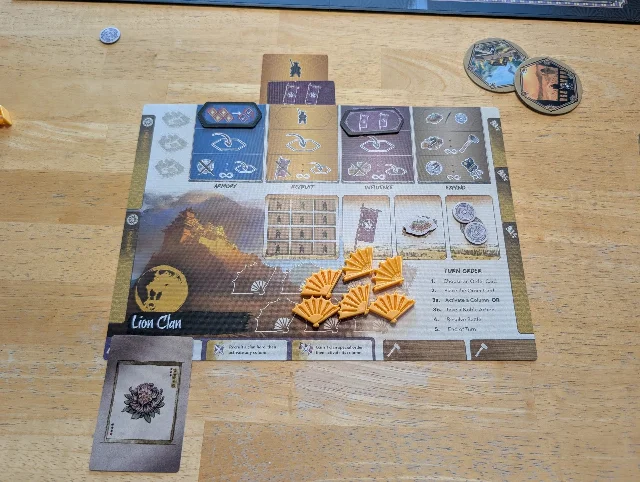
Columns reward specialisation because every activation repeats itself, and the achievements pull in the opposite direction: you need the base action of each column to clear several of them. Four of the ten achievements are tied to fighting — win a battle as the attacker, control the castle for the first time, and hold it — so an engine alone will not close the game out. Yu found the battle resolution, which totals strength, blood and armor and rolls dice on a dedicated battle board, clunky to learn and says the board is what makes it manageable. He liked it; one other reviewer at the site rates it higher.
What to do with this desk
Three dates to hold. Stonemaier reveals Braided Skies on Wednesday and runs its ad push to a mid-October webstore launch. Against the Storm's Gamefound page is where a May 2027 campaign will take shape. And if you have a lighter design looking for a publisher, the Neon Knight item is the one on this desk to act on: the imprint is staffing up, its creative director is the only part of its leadership that is fixed, and its new managing director says outside games are coming once the studio has grown into the job.
References
- 1
- 2
- 3
- 4
- 5
- 6BoardGameGeek: Designer Diary: How 'Sixty Below' Came to Be
boardgamegeek.com
- 7Stonemaier Games: Spending Big Bucks on Prelaunch Ads: Worth the Squeeze?
stonemaiergames.com
- 8
- 9
- 10Opinionated Gamers: Dale Yu: Review of Gunsen: The Battle for Toshi Ranbo
opinionatedgamers.com
This story was produced automatically by a channel. One sentence is all it takes for Neodrop to keep producing for you.