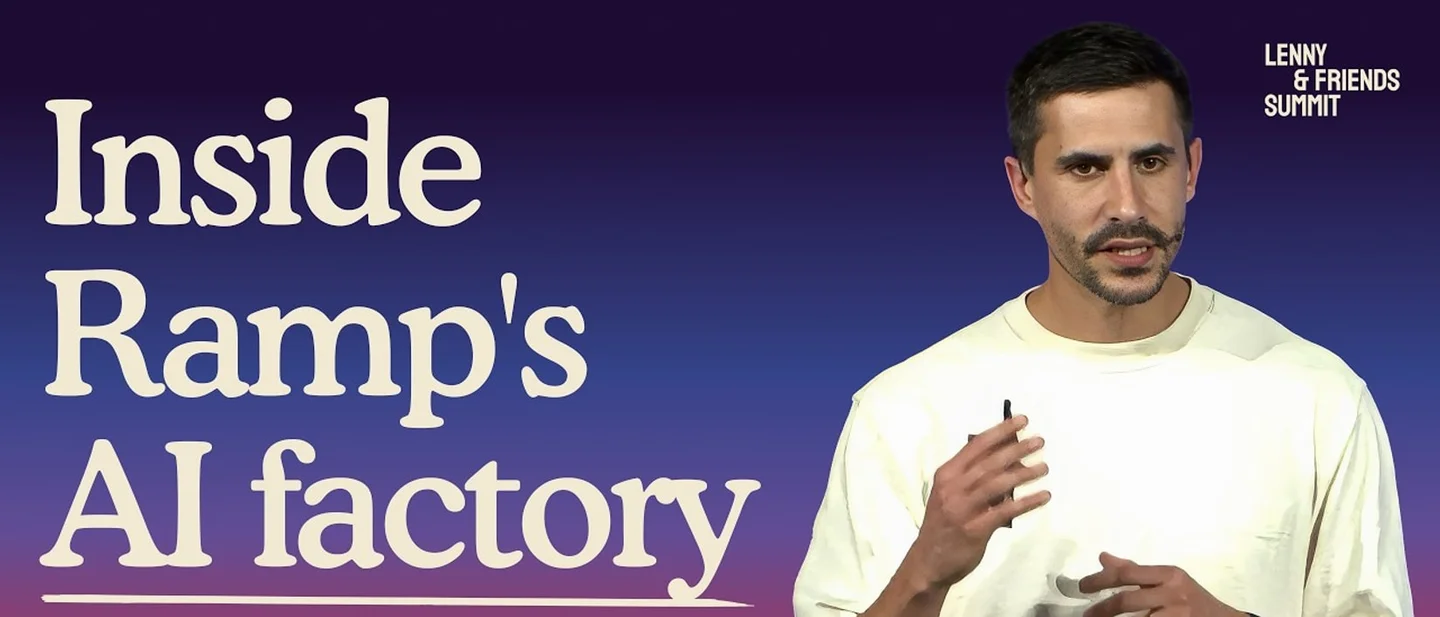
瓶颈会一直往下游移动:Ramp 首席产品官 Geoff Charles 拆开自家的 AI 软件工厂|Lenny's Podcast
Ramp 首席产品官 Geoff Charles 把自家 AI 软件工厂拆开来讲:产品开发五个环节各冒出什么瓶颈、他们为此造了什么工具、跑出什么数字——100 万次会话、75% 的 PR、30 天抓 425 个 bug、60% 的 UX 问题 24 小时内修好;文末附中英双语逐字稿。

Lenny and Friends Summit 是莱尼·拉奇茨基(Lenny Rachitsky)办的年度线下峰会,面向产品与工程负责人,2026 年这一届在 9 月 10 日于旧金山举行1。峰会现场演讲会陆续发在他的播客频道上,这一条 19 分 31 秒的视频就是其中之一,标题是《限制因素:怎么为一个速度而生的 AI 软件工厂做设计》2,2026 年 9 月 25 日上线。
讲话人杰夫·查尔斯(Geoff Charles)是 Ramp 的首席产品官,管产品、运营与支持三块。他在金融服务行业做了十多年,横跨 B 端与 C 端,加入 Ramp 之前参与把 Mission Lane 拆分独立出来并把信贷产品做到数百万消费者规模,更早是给《财富》100 强金融公司做咨询3。Ramp 是 2019 年成立的公司,做企业卡、支付与费用管理,2025 年 11 月完成 3 亿美元融资时估值 320 亿美元4,2026 年 6 月又在新一轮 7.5 亿美元融资里升到 440 亿美元5。
这期视频在做什么:它是一场案例演讲,没有访谈者。查尔斯把 Ramp 内部那套「AI 软件工厂」拆开给人看——产品开发流程的每一个环节各冒出了什么瓶颈、他们为此造了什么工具、跑出什么数字,最后讲他判断产品经理这个岗位会分叉成哪三条路。想决定要不要看这 19 分钟,读完下面这份摘要就够了;想核对原话,文末附了完整的中英双语逐字稿。
他的比喻:赢的不是开得更快的人
他开场讲了一个自己出丑的故事。他热爱速度,签了一个叫「24 Hours of Lemons」的比赛——花 500 美元买一辆车,绕着赛道跑 24 小时6。他的车没撑住,他撞了,撞得挺严重,人没事,车完了。
故事的意义在下一句:这次事故完全是他的错,但在真正的职业赛车场上,车手很少是问题所在——车手对比赛结果的影响只占 15%,真正的影响在车手与车、车与车队之间的交互。用他的话说,世界上最好的车手也只能发挥到系统的上限,赢比赛靠的是把驾驶周围的瓶颈一个个拆掉。
他给的证据是进站换胎:1950 年代换一次胎要 67 秒,今天是 1.8 秒。67 秒变成 1.8 秒,靠的不是让技师把动作做快 37 倍,而是找到瓶颈、反复迭代把它消掉——专职分工、更好的工具、更多的练习。他补了一组 F1 的数字:赛车 90% 的零件每年更换,一辆 F1 赛车约 16000 个零件里只有 10% 会留到下一季。
然后他把话头转向在座的人:你敢不敢让 90% 的代码每年换一遍,那就是这个行业现在的标准。
核心判断:AI 不消除瓶颈,只把瓶颈推给下一个人
他的原话是,AI 会直接拿掉一个瓶颈,同时把它挪到别处。赛车进站从车开进维修区开始计时、出场结束计时;对应到产品上,计时从用户有痛开始,到他手上有一个解决问题的产品结束。赢的团队是那个能更快找到下一个瓶颈、拆掉、再去找下一个的团队。
接着他讲了房间里所有人都熟悉的流程——识别、定义、构建、改进——然后说:工程师已经把自己的活大量自动化了,写代码这件事变容易了,所以瓶颈已经挪到了产品这一侧。他给的结论很直接:要更像工程师一点,要像工程师一样「懒」,因为现在需要定义的东西更多了、需要协作的东西更多了、需要协调和测试和发布的东西更多了。速度取决于这个循环转多快,而问题变成了:你能多快发现瓶颈、并围绕它重新设计工厂。
他把 Ramp 的做法拆成五步讲,每一步都先说瓶颈是什么。
第一步:识别——把噪音里的信号捞出来
痛在哪里?他说痛散得到处都是:Gong 的通话录音、Zendesk 的工单、LogRocket 的日志、问卷、某位高管收到的一封愤怒邮件。问题是上下文碎在各个系统里,孤岛太多、意见太多,第一个瓶颈就是怎么从噪音里把它筛出来。
他先摆了一道算术:大模型的 100 万 token 窗口,装得下 Ramp 的 Gong 通话记录不到 0.5%。所以他们从很小的地方起步——建了一个「吐槽频道」(hate channel),每天自动贴出客户说的那些好听话,他现场放了几句真引用,说自己并不为此骄傲。这个做法很快失控,于是他们从头重做,做了一个真正的客户洞察智能体:它从公司所有数据源拉取信息,用传统的 ETL 与数据管道,用向量检索,把同一个上下文聚类,理解产品、团队和已有功能,并对全公司开放。
工具做完之后,他们又试了一圈把数据送到更多人手上的方式:一个能在 Slack 里提问的智能体、一个可以登录查看的 HTML 看板,还有他自己最喜欢的那个——把客户吐槽做成播客,他说这是开始一天的好方式。他把这一层的原则说得很清楚:让人尽可能快地拿到这些数据,不等于不要跟客户对话,而是让你知道到底该找哪几个客户聊,因为数据是可追溯的。
第二步:定义——把 AI 接到你的系统上
找到该做什么之后,下一步是把一个概念变成一份划清范围的方案。
他对 AI 产品的一句吐槽很到位:所有的 AI 都长得差不多,它们都会问你「你想造什么」,然后你盯着屏幕发愣——一个超级智能在问你这个问题,这真的是最好的起点吗?他认为目标应该是把 AI 接到你自己的系统上,那才是让它变得「可执行」的办法。
Ramp 为此做了自己的智能体,叫 Glass。它连上公司各个系统:通过 Snowflake 理解数据,理解用户研究,因此能准确抓到客户真正要的那个待办(job to be done),同时给出定性与定量的细节;它还理解产品策略、理解他们怎么定义产品规格、理解代码库。于是产品经理不必再去问工程师「这个能不能做、会不会把什么弄坏、我漏了什么」,先问 AI,AI 可以做最好的思考伙伴——用他的话说,AI 成了你的技术负责人。
最后,因为 Glass 还理解产品原则、设计系统和代码库,它可以把原型直接做出来,而且这个原型能跑在自己的产品里。他在这里给出一个很具体的判断:工程师不想要你的原型,也不想要你的长文档,他们要的是三样东西的组合——能说服他们这是个真问题的定性与定量数据、可以喂给编码智能体的需求、以及一个能给他们灵感的原型。他把这称为新的「合同」。
第三步:构建——瓶颈从编码挪到评审
他先承认自己说的「写代码不再是瓶颈」过于简化:解决掉一个瓶颈,下一个就冒出来。第一个瓶颈确实是编码。他说现在每个人都该有一个编码智能体了,而 Ramp 自己做了一个叫 Inspect,原因有两个——他们想要一个强的 harness(约束层),也想要一个真正理解自己代码库的智能体。
Inspect 跑在 Slack 里,资源全部预置好,5 秒以内能跑完,返回的结果是一个能部署的预览,产品经理可以直接上手用一个正在被造的版本。他给的数据是:任何人都能在 Ramp 写代码;Inspect 累计 100 万次会话;75% 的 PR 由它产出;过去一个月里有 1000 个 PR 是工程师以外的人提交的。
他补了一条使用心法:编码智能体在有强架构、强代码库的时候表现特别好——这决定了公司里有多少人真的能用上 AI。
代码写多了,下一个瓶颈就是评审。工程师不断淹没在代码里,于是他们做了 Review Buddy:它完全理解代码库、理解他们的质量检查与安全要求,能找到该拉进来的那个正确的人,也理解当初把你带到这段代码的那些提示词,因此可以回过头审计你是怎么用 AI 的。结论是评审和协作被建立在可见的上下文上,93% 的 PR 由它自动处理,最好的工程师把时间花在那 7% 真正重要的 PR 上。
第四步:测试——让浏览器里的智能体跑 QA
他复述了产品经理都熟悉的那套动作:起一个 QA 环境、调整各种测试数据、一屏屏点过去,确认工程师没有漏掉某个我们很喜欢的功能。
Ramp 把它自动化了,工具叫 Testo:一个基于浏览器的 QA 智能体,用生产数据拉起产品的上百种组合,像用户一样在产品里操作。他们给它下指令——比如「付一张发票,但要把它摊销掉」——它就点来点去并给出反馈,既有阻塞性的 bug 与问题,也有关于设计上让人困惑之处、哪里破坏设计系统的细致定性反馈,这些反馈再回到产品开发循环里。
他给的数据是:Testo 在过去 30 天抓到 425 个 bug。他的说法是,这些 bug 由自己发现总比由客户发现好。
第五步:协调——让组织的状态对智能体可读
产品发得多了,下一个问题是全公司怎么知道发生了什么。他指出下一个瓶颈是人的注意力:产品经理被通知淹没,于是协调本身成了工作。太多流程会拖慢建造的人,流程太少又会让大家一头雾水。
他的解法是一句话:把每一个问题当成一个 API。Ramp 为此做了 Gadget,它理解问题的意图,然后把它接到正式的记录上——Notion 里的路线图、Notion 里的规格、Notion 里的客户通话,Slack、Linear、工单系统。他给出的原则是:要授权给一个智能体,它得能读懂这家公司;而这家公司也得对智能体是可读的。
举的例子很具体:有人问「这个项目什么状态、这个发布什么状态、我们还按时吗」,智能体答得出来,它知道全局、知道下一步归谁、回答时带证据,而且它顺手会更新路线图、发状态更新、去催那些拖了交付的人;销售问某个功能是什么、巴西能不能用、用在哪、多少钱,它也都懂,真不懂就把问题路由给正确的人。再往前一步:一个发布要发出去,Gadget 因为懂产品,可以帮你写帮助中心文章、写博客、写客户邮件。他的数据是:现在问产品经理的问题里,85% 由 AI 回答完毕,剩下那些没被回答的也会回流进系统。
小循环与大循环
他说到这里提醒了一件事:产品经理天然会被那些小的、反应式的、确定性高的、能立刻看到成效的事情吸过去——那种「我们又解决了一个」的多巴胺。他认为这是个巨大的错误,并把同一天台上克莱尔·沃讲的「怎么变得更有野心」搬了出来:你之所以不够有野心,是因为你把注意力放在了小事上。
他们的做法是把小事整条循环交出去:智能体把问题路由到正确的团队,在 Linear 里跟已有待办匹配、去重、计数、排序、跑方案,中间只留一个人通过 Slack 做一次「可以开工了吗」的确认,然后写代码、跑测试和 CI/CD,发布之后再回头更新知识库。人在这条循环里只留了很少的位置。他的说法是:用成千上万个小循环盯住成千上万件小事,人才能腾出手去做大事。
这些自动闭环带来的结果是:由客户、销售、客服或他们自己发现的 UX 问题里,60% 在 24 小时内被修好。
他自问自答的三个问题
第一,怎么知道我们真的变快了?他承认产品速度比赛道上的圈速难量化。他讲了一段 1974 年尼基·劳达(Niki Lauda)的事:劳达开过法拉利的车之后告诉恩佐·法拉利这台车不行——开起来差、操控差、刹车也差——然后下车找工程师把它修好。他说这跟他们公司的文化很接近,并给出判断标准:你会知道自己够不够快,如果你真的请了一个懂速度长什么样的车手,把他放到负责的位置上,并且允许他挑战你。他说这对一些领导者来说会很难。
第二,我们的预算有限怎么办?他讲的是 2006 年的奥迪:当时奥迪的车不快,他们问自己,如果没法比别人开得更快,怎么赢?答案是燃油效率——少进站,多留在赛道上,结果他们连续三年在勒芒拿到冠军。他的结论是,约束会逼你选一个维度做到世界级:拥抱你的约束,但别拥抱你的瓶颈。找到你真正擅长的那一件事,找到那个能把公司放大十倍的瓶颈,从那里开始。
第三,产品这个岗位会变成什么样?他说产品经理从很多事情里退出来是好事,那是杠杆,不必害怕。他判断产品经理会分三条路走:技术型产品经理,负责造工厂本身,发现瓶颈、拆掉组织里的阻力,交付的不是给客户的产品,而是让人(或让 AI)能造出客户产品的那个产品;品味制定者,也就是握着方向盘的那个人,做 AI 做不了的事、守住「什么叫好产品、什么叫好品味」的那条线;总经理(GM),产品经理的职责会从产品组织扩展到市场、销售、增长、运营,最终对业务结果负责、带着整个职能走。
先弄明白几个词
瓶颈(bottleneck):整条流程里决定整体速度的那个环节。他这场演讲的骨架就是「瓶颈会移动」这一件事。
PR / PRD / CI/CD:PR 是提交给代码库、需要被评审的改动;PRD 是产品需求文档;CI/CD 是自动跑测试并把代码发上线的流水线。他讲的第三步到第五步,就是这三样东西被智能体接手的过程。
harness(约束层):包在模型外面、决定它怎么被调用、能看见什么、能做什么的那一层。他说自己造 Inspect 的原因之一就是想要一个强的 harness。
ETL 与向量检索(vector search):ETL 是把散在各系统里的数据抽出来、加工好、再装进一个地方;向量检索是按语义相似度找内容,而不是按关键词匹配。这两样是他们的客户洞察智能体能跨数据源工作的基础。
GM(总经理):在这里指对一整块业务的结果负责、统管多个职能的角色,而不只是产品功能的负责人。他把这当作产品经理未来的一条上升路径。
这一场值不值得看
如果只看一段,看第三步和第四步那几分钟(大约第 8 到 11 分钟):一个编码智能体在真实公司里被用成什么样——100 万次会话、75% 的 PR、有部署预览可以直接上手点——是这场演讲里信息密度最高的部分,也是「AI 原生公司」这个说法少见的可核对样本。
需要说明的是,他给出的所有数字都是他在台上自报的,没有第三方核对;这些工具也都是 Ramp 内部产品,外面看不到。这一场的用法是拿它当一份同行实践记录,而不是当行业基准。
它和同一天其他几场的关系也值得提一句:丹·希珀讲的是怎么在主线之外养一个实验室来迎接模型更新,克莱尔·沃讲的是产能不再稀缺之后判断从哪来,查尔斯讲的是把整条流水线的瓶颈一个个换成系统。三场放在一起,正好是同一件事的组织面、判断面和工程面。
人物背景与外部对照
Ramp:2019 年成立,做企业卡、支付服务与费用管理软件5。2025 年 11 月的融资由 Lightspeed 领投,公司当时的口径是年化收入超过 10 亿美元、服务 5 万多家客户4;到 2026 年 6 月,客户数说到了 7 万家以上5。
F1 换胎纪录的外部对照:他说的「1.8 秒」有公开记录可查。一级方程式官网记录,迈凯伦在 2023 年卡塔尔大奖赛上为兰多·诺里斯的赛车换胎用了 1.80 秒,刷新了此前红牛保持的 1.82 秒7。1950 年代的 67 秒是他在台上的说法。
24 Hours of Lemons:美国的耐力赛系列,规则是买一辆 500 美元以内的车上赛道6。他开场讲的撞车就发生在这里。
尼基·劳达与恩佐·法拉利:他在回答「怎么知道我们变快了」时讲的这段是 1974 年前后的事,他的用法是说明「让懂速度的人来挑战你」这条文化。他最后引的「最好的法拉利永远是下一台」也归给恩佐·法拉利,属于他在台上的表述。
这一场的形态:现场演讲的录像,没有访谈与提问环节。同一批发布的还有克莱尔·沃与丹·希珀两场,本频道都已单独成文。
完整中英双语逐字转录稿
逐字稿说明:本稿取自本期官方视频的英文原始字幕轨(YouTube 的 en-orig 轨),措辞未作改动,仅对少量专名做了订正(如 Ramp、Zendesk、Niki Lauda、Inspect、Glass、Review Buddy、Testo、Gadget),时间码来自官方字幕;中文译文由机器翻译生成,只对专名做了统一。这是一场单人口播演讲,全篇讲话人均为 Geoff Charles,时间轴每 10 分钟标注一次;字幕轨本身只在结尾标出一处 [applause],现场的掌声与观众反应未逐条收入。
00:00 - 10:00
Geoff Charles:
Hello everyone. First off, it's been absolutely amazing to see the speakers before me. I want to give one more round of applause for the incredible amount of content and preparation. I'm inspired. I've written my speech three times. I learned how to do storytelling. And so, here's a story for you. At Ramp, we're known about velocity. We love speed. I love speed. I love speed so much that I once signed up to race cars at Le Mans.中文:大家好。首先,看到在我之前发言的演讲者们真是太棒了。我想再为他们的精彩内容和充分准备鼓掌。我受到了启发。我已经写了三次演讲稿。我学会了如何讲故事。所以,这里有一个故事要讲给你们听。在 Ramp,我们以速度著称。我们热爱速度。我热爱速度。我热爱速度到曾经报名参加过勒的赛车比赛。
Geoff Charles:
I'm just kidding. Lemons. 24 hours of lemons. It's a race where you buy a $500 car and you race around for 24 hours hoping to win. Unfortunately for me, my car did not make it. I crashed. I crashed hard. I was okay. The car unfortunately was not. Now, this crash was entirely my fault as the driver. But in real professional racing, the driver is rarely the problem. In fact, the driver is only 15% of the impact on the race.中文:我只是在开玩笑。柠檬车。24 小时柠檬赛。这是一场比赛,你买一辆 500 美元的车,然后比赛持续 24 小时,希望能获胜。不幸的是,我的车没撑过去。我撞车了。我严重撞车了。我没事,但车不幸没撑过。这次事故完全是我作为司机的错。但在真正的职业比赛中,司机很少是问题所在。事实上,司机对比赛的影响仅占 15%.
Geoff Charles:
The real impact is the interaction between the driver and the car, between the car and the team. In other words, winning isn't just about driving faster. The best drivers in the world can only perform up to the level of the system. Winning the race is about removing the bottlenecks around the driving. That's the key point I want to drive today. Take for example the pit stop. In the 1950s, it took 67 seconds to change tires.中文:真正的影响在于司机与赛车之间、赛车与车队之间的互动。换句话说,获胜不仅仅是开得更快。世界上最好的司机只能发挥到系统的水平。赢得比赛是关于消除驾驶周围的瓶颈。这就是我今天想强调的关键点。以加油站停站为例。在 1950 年代,更换轮胎需要 67 秒。
Geoff Charles:
Today, 1. 8 seconds. How does 67 seconds turn into 1. 8? Certainly not by asking the mechanic to work 37 times harder. All you leaders, you know what I'm talking about. They found the bottleneck and they iterated to remove them. Specialized functions, better technology, more practice. And F1 is relentless. 90% of the parts of a car change every year. only 10% of the 16,000 parts of an F1 vehicle carry over to the next year.中文:今天,1.8 秒。67 秒是如何变成 1.8 秒的?当然不是让机械师工作强度增加 37 倍。所有的领导者,你们知道我在说什么。他们找到了瓶颈,并不断进行迭代以消除它们。专业化的功能,更好的技术,更多的练习。而 F1 是无情的。汽车的 90%零部件每年都在更换。F1 车辆的 16,000 个零件中,只有 10%可以沿用到下一年。
Geoff Charles:
Now, I want you to also think about what if 90% of your code changed every year because that is the bar. Why am I telling you all this? We're in a race. Speed is everything. Execution is everything. And we're in a race to build with AI. For the race car, it starts when the car comes in for new tires and the clock stops when it leaves. For us, the clock starts when there's pain and it leaves when the customer has a product that solves it.中文:现在,我还希望你考虑一下,如果每年你 90%的代码都发生变化,因为那就是标准,会怎样。为什么我要告诉你这些?我们正在一场比赛中。速度就是一切。执行力就是一切。而我们正在一场利用人工智能进行的比赛中。对于赛车来说,比赛从汽车进站换轮胎时开始,结束于汽车离开时。对于我们来说,比赛从出现问题的时候开始,结束于客户拥有一个能解决问题的产品时。
Geoff Charles:
AI simply removes the bottleneck but moves it. And the best team, the winning team is the team that can find the bottleneck faster, remove it, and move on to the next one. Now, we all know the product development life cycle. We identify, we define, we spend a lot of time building and then we improve. Now the engineers, fantastic engineers, they've been able to automate a lot of their work and coding is now much easier.中文:人工智能只是移除了瓶颈,但它会将瓶颈移动。最好的团队、获胜的团队,是能够更快找到瓶颈、移除瓶颈,并继续处理下一个瓶颈的团队。现在,我们都知道产品开发生命周期。我们识别,我们定义,我们花大量时间去构建,然后我们进行改进。现在,工程师们,出色的工程师们,已经能够自动化他们的很多工作,编程现在变得容易得多。
Geoff Charles:
So here's a tip. Be more like engineers. Be as lazy as engineers because the reality is that the bottleneck has now shifted to us. We need more things to define. We need more things to collaborate. We need more things to coordinate. more things to ship, more things to test, more things to release. The bottleneck has shifted to us and so we need to invest in our own factory. The speed of this loop determines the outcome of the race and the question becomes, how quickly can you identify the bottleneck and redesign the factory around it.中文:所以给你一个建议。要更像工程师。要像工程师一样懒,因为现实是瓶颈现在已经转移到我们这里。我们需要定义更多的东西。我们需要合作更多的事情。我们需要协调更多的事情。需要交付更多的东西,测试更多的东西,发布更多的东西。瓶颈已经转移到我们这里,因此我们需要投资自己的工厂。这个循环的速度决定了比赛的结果,问题变成了,你能多快识别瓶颈并围绕它重新设计工厂。
Geoff Charles:
What I'm going to show you today are five of these steps and how ramp has gone far in iterating and automating through it. The first step is identify identify the problem. Identify the pain, right? The issue is that that pain lives somewhere and there's a lot of pain, a lot of data. Gong, Zendesk, log, rocket, a survey, very angry email to an executive. The problem is that context lives all over the place. Too many silos, too many opinions.中文:今天我要向你展示的是这五个步骤,以及 Ramp 在迭代和自动化这些步骤上走了多远。第一步是识别问题。识别痛点,对吗?问题在于这些痛点存在于某个地方,而且有很多痛点、很多数据。Gong、Zendesk、日志、Rocket、调查,以及发给高管的非常愤怒的邮件。问题在于上下文分散在各处。太多孤岛,太多不同意见。
Geoff Charles:
And so the first bottleneck to identify is how to sift through the noise. And LMS are great, but a 1 million token window, that's less than 0. 5% of gong transcripts at ramp. So, we started small. We created a hate channel and it every day it posts all the lovely things that our customers say. And yes, these are real quotes. [snorts] That got out of hand really quickly. [gasps] Yes, I know. I am not proud of it.中文:所以第一个需要识别的瓶颈是如何筛选噪音。而 LLM 很棒,但 100 万 token 的窗口,甚至不到 Ramp 上 Gong 转录的 0.5%。所以,我们从小做起。我们创建了一个 hate 频道,每天它都会发布客户说的所有美好话语。是的,这些都是真实的引用。[哼] 事情很快就失控了。[倒抽一口气] 是的,我知道。我对此并不自豪。
Geoff Charles:
No one's perfect. And so, we had to redesign from scratch. We built an actual customers insight agent. That agent pulls from all the data sources at a company. It uses traditional ETL and pipelines. It uses actual vector search. It has clustering around the same context. It understands our product. It understands our teams. It understands the features that we have and it's accessible to the rest of the organization. Once we had this working, we asked ourselves, how do we get this to as many hands as possible?中文:没有人是完美的。因此,我们不得不从头重新设计。我们构建了一个真正的客户洞察代理。该代理从公司的所有数据源中提取数据。它使用传统的 ETL 和数据管道。它使用真正的向量搜索。它对相同上下文进行聚类。它了解我们的产品。它了解我们的团队。它了解我们拥有的功能,并且对组织的其他成员可访问。一旦这套系统运行起来,我们就问自己,如何让尽可能多的人使用它?
Geoff Charles:
And so we again experimented a Slack agent where you can ask questions, a nice HTML dashboard that people can log in and read. My favorite one was the podcast, the hate podcast. Great way to start your day. You listen in 100 customers yelling at you about all the ways your product is broken. The concept is simple, right? Get people access to this data as fast as possible. That doesn't mean don't talk to customers. It means you actually identify exactly which customers to talk to because the data is traceable.中文:于是我们又尝试了一个 Slack 代理,你可以在那里提问,还有一个漂亮的 HTML 仪表板,人们可以登录并查看。我最喜欢的是播客,仇恨播客。开始你一天的好方法。你会听到 100 个客户对你大喊,抱怨你的产品哪里坏了。这个概念很简单,对吧?尽快让人们访问这些数据。这并不意味着不与客户交流。这意味着你实际上可以准确识别要与哪些客户交谈,因为数据是可追踪的。
Geoff Charles:
Okay. Once you've found what to focus on, the next step is to define your product. How do you go from a concept to a fully scoped idea? And so we turn to AI, right? And the AIs all kind of look the same. They ask you, "What do you want to build? " And you stare. You have this super intelligent being asking you what you want to build. Is that really the best question to ask? Is that really the best starting point?中文:好的。一旦你找到了要关注的重点,下一步就是定义你的产品。你如何从一个概念走向一个完整的、范围清晰的想法呢?于是我们就转向人工智能,对吧?而这些人工智能看起来都差不多。它们会问你,“你想构建什么?”然后你就发愣了。一个超级智能的存在在问你想构建什么。这真的是最好的问题吗?这真的是最好的起点吗?
Geoff Charles:
Right. The goal with AI is to connect it to your systems. That is how you're going to make AI extremely extremely actionable. And so we did that. We built our own AI agent called Glass. And we gave it all the context it needs to do the work. It connects to all our systems. So it understands both the data with Snowflake. It understands our user research and it can nail exactly the job to be done that our customers are asking for.中文:对的。使用人工智能的目标是将其连接到你的系统。这就是你让人工智能变得非常非常可操作的方式。因此,我们做到了这一点。我们构建了自己的人工智能代理,叫做 Glass。我们给了它完成工作所需的所有上下文。它连接到我们所有的系统。因此,它既能理解 Snowflake 的数据,也能理解我们的用户研究,并且能够准确完成客户所要求的任务。
Geoff Charles:
That gives us specificity with both qualitative and quantitative data. Glass also understands our product strategy. It understands how we define product specs. It understands our codebase. And so instead of a PM bothering an engineer asking them, is this possible? Would this break something? What am I missing? You ask AI. AI can be your best thought partner. So now AI is your tech lead. And finally, you can build a prototype because it understands our product principles.中文:这让我们能够同时获得定性和定量数据的具体性。Glass 也理解我们的产品策略。它理解我们如何定义产品规格。它理解我们的代码库。因此,不再需要产品经理去打扰工程师问,‘这个可行吗?会不会破坏某些功能?我遗漏了什么?’你可以直接问 AI。AI 可以成为你最好的思维伙伴。所以现在 AI 就是你的技术负责人。最后,你可以构建一个原型,因为它理解我们的产品原则。
Geoff Charles:
It understands our design system. It understands our codebase. You can actually define and build a prototype that actually works within your product. Your engineering team don't want any of these individual things. They don't want your prototype. It's useless. They don't want your long spec. That's useless. They want the combination of qualitative and quantitative data to convince them that this is a problem. The actual requirements that they can use for their coding agents and a prototype that they can actually get inspired by.中文:它理解我们的设计系统。它理解我们的代码库。你实际上可以定义并构建一个能够在你的产品中真正运行的原型。你的工程团队不需要这些单独的东西。他们不需要你的原型。那是无用的。他们不需要你的详细规格。那也是无用的。他们需要的是定性和定量数据的结合,以说服他们这是一个问题。他们需要实际的需求,可以用于他们的编码代理,并且一个能够真正激发他们灵感的原型。
Geoff Charles:
That is the next contract. So now you have a strong foundation for which to go. The next step is to build. I mentioned that building is no longer the bottleneck. Obviously it's a bit more nuanced than that. When we focus on one bottleneck, the next one appears. The first bottleneck was coding. Everyone should have a coding agent at this point. We built Inspect. Inspect is our own coding agent. And the re reason why we built it ourselves was because we wanted to have a strong harness and we wanted to make sure that our coding agent really understood our codebase.中文:那是下一个合同。所以现在你有了一个坚实的基础可以前进。下一步是建设。我提到过建设不再是瓶颈。显然,这比那更复杂一些。当我们关注一个瓶颈时,下一个瓶颈就会出现。第一个瓶颈是编码。此时每个人都应该有一个编码代理。我们开发了 Inspect。Inspect 是我们自己的编码代理。我们自己开发它的原因是因为我们希望有一个强大的工具,并且希望确保我们的编码代理真正理解我们的代码库。
Geoff Charles:
It works inside of Slack. It's fully provisioned. It can run under 5 seconds and it can return an actual product in a deploy preview so that the actual product manager can actually use and interact with the code that's being built. Anyone at Ramp can now code. Inspect has a million sessions. 75% of our PRs is actually built by Inspect and a thousand of those PRs over the last month was submitted by a non-engineer. One tip here though is that coding agents are really good when you have a strong architecture and a strong code base.中文:它可以在 Slack 内部工作。它已经完全配置好。它可以在不到 5 秒的时间内运行,并且可以在部署预览中返回实际产品,这样实际的产品经理就可以实际使用和互动正在构建的代码。RampP 的任何人现在都可以编写代码。Inspect 有一百万个会话。我们 75% 的 PR 实际上是由 Inspect 构建的,而在上个月,这些 PR 中有一千个是由非工程师提交的。不过这里有一个提示,当你有强大的架构和强大的代码库时,编码代理会非常出色。
Geoff Charles:
This expands how much of your company can actually use AI. You now are shipping a lot of code. The next step is code reviews becomes the next bottleneck. Engineers are just constantly combing through a ton of code. And so we focused on that. We built Review Buddy. Review buddy fully understands our codebase, fully understands our actual uh quality checks, our security concerns. It finds the right human reviewer to loop in and it also understands the context, all the prompts that led you to build that code.中文:这扩展了贵公司实际上可以使用人工智能的范围。你现在正在交付大量代码。下一步就是代码审查将成为下一个瓶颈。工程师们只是不断地梳理大量代码。因此我们专注于这一点。我们开发了审查助手(Review Buddy)。审查助手完全了解我们的代码库,完全了解我们的实际质量检查和安全问题。它找到合适的人类审查者参与其中,同时也理解上下文,理解促使你编写该代码的所有提示。
Geoff Charles:
So it can actually audit how you used AI in the first place. So the review and the collaboration is now grounded in visible context. 93% of our PRs are now automatically handled by Review Buddy. So that the highest quality engineers are spending time on the 7% of PRs that truly matter that have a lot of questions around are we building this correctly? Are there any risks? The next bottleneck is testing. Previously PMs, I'm sure you're familiar with this.中文:因此它实际上可以审计你最初是如何使用 AI 的。因此,审查和协作现在都基于可见的上下文。我们 93% 的 PR 现在都是由 Review Buddy 自动处理的。因此,最优秀的工程师可以将时间花在真正重要的那 7% 的 PR 上,这些 PR 有很多关于我们是否正确构建、有无风险的问题。下一个瓶颈是测试。以前,PM 们,我相信你们对此很熟悉。
Geoff Charles:
We spin up a QA environment. We try to tweak different fixtures. We click through the screens. We make sure that the engineer didn't skip out on that one feature we really liked. We automated that. We built Testo. Testo is a browserbased QA agent. It spins up the product in a 100 different combinations based on the actual production data that we have access to. and it runs in the product like a user. We give it instructions.中文:我们启动了一个 QA 环境。我们尝试调整不同的夹具。我们点击浏览各个界面。我们确保工程师没有跳过我们非常喜欢的那个功能。我们对它进行了自动化。我们构建了 Testo。Testo 是一个基于浏览器的 QA 代理。它根据我们可以访问的实际生产数据以 100 种不同的组合启动产品。它像用户一样在产品中运行。我们给它指令。
10:00 - 20:00
Geoff Charles:
We say, "Hey, pay an invoice, but amortize it. " And it clicks around and actually gives us feedback. Both blocking feedback, bugs, issues, blockers, and honestly extremely thoughtful design and qualitative feedback around things that were confusing, things that break our design system or breaks our design language. And that goes back into the product development life cycle. Testo in the last 30 days caught 425 bugs. I think these are bugs better caught by us than our customers and they send it back through the loop to fix.中文:我们说:“嘿,支付发票,但要宣传它。” 它会运行并实际给我们反馈。包括阻塞性反馈、漏洞、问题、障碍,坦率地说,还有对令人困惑的事情、打破我们设计系统或设计语言的事项的极具深思熟虑的设计和定性反馈。这些反馈会回到产品开发生命周期中。在过去的 30 天里,Testo 发现了 425 个漏洞。我认为这些漏洞最好由我们而不是客户发现,并且它们会通过循环返回进行修复。
Geoff Charles:
So now you're shipping a lot of product. The next step is to coordinate. How do you make sure that everyone in your company is in the loop? Things are moving so fast. You're shipping so many different things. The next bottleneck becomes human attention. We've all been there. PMS being inundated with notifications. And so our job becomes coordination. I see a few people coordinating right now. Too much process, right? And slows down the builders. Too little process and everyone is confused.中文:所以现在你们正在运送大量产品。下一步是协调。你如何确保公司里的每个人都了解情况?事情发展得太快,你运送的东西种类也很多。下一个瓶颈就是人的注意力。我们都经历过这种情况。产品经理被各种通知淹没。所以我们的工作就变成了协调。我现在看到有几个人正在进行协调。过程太多了,对吧?会拖慢开发者的速度。过程太少了,每个人又会感到困惑。
Geoff Charles:
And so human attention becomes that bottleneck. How do you solve this? Well, every question is an API. Every question is an API. And you architect a system. We build Gadget. Gadget essentially understands the intent of these questions and connects it to the formal record. The road map in notion, the specs in notion, the customer calls in notion, slack, linear, our tickets. The principle here is simple. For you to empower an agent, the agent needs to be able to understand and read the organization.中文:因此,人类注意力就成了瓶颈。你如何解决这个问题?每个问题都是一个 API。每个问题都是一个 API。然后你设计一个系统。我们制造小工具。小工具本质上理解这些问题的意图,并将其连接到正式的记录中。Notion 中的路线图,Notion 中的规格,客户电话记录在 Notion、Slack、Linear,我们的工单。这里的原则很简单。为了赋能一个代理,代理需要能够理解和读取组织结构。
Geoff Charles:
And the organization needs to be legible to your agents. I'll give you an example. A question is like what's the status of this project? What's the status of this launch? Are we on track? An agent handles that. It understands the full picture. It understands who owns the next steps. It answers with evidence. But not only that, the agent updates our road map. The the agent gives status updates. The agent pings people who are late on their deliverables.中文:而且组织需要对你的代理可读。我给你举个例子。一个问题就像‘这个项目的进展如何?’‘这个发布的状态如何?’‘我们是否按计划进行?’代理会处理这些问题。它理解整体情况。它知道谁负责下一步工作。它会提供有依据的答案。但不仅如此,代理还会更新我们的路线图。代理提供状态更新。代理会提醒那些未按时完成任务的人。
Geoff Charles:
There's a lot of fun ways you can actually scale. Or another question, sales, asking questions about, you know, what is this feature? How do I sell it? Is it available in Brazil? What's the use case? What's the price? All of these things are fully understood. And Gadget, if it does not understand, routes it to the right person. But we can take a step further. A launch. Gadget understands the product. And so it can write the help center article.中文:实际上,有很多有趣的方式可以进行扩展。或者换一个问题,销售,询问关于,您知道,这个功能是什么?我该如何销售它?在巴西有吗?使用场景是什么?价格是多少?所有这些事情都能够被完全理解。而如果 Gadget 不理解,它会将问题转给合适的人。但我们可以更进一步。产品发布时,Gadget 了解产品,因此它可以编写帮助中心的文章。
Geoff Charles:
It can help write the blog post. It can help write the customer email. So on and so forth. Again, start one place. You'll see how far it expands. 85% of questions that are being asked to PMs now are fully answered with AI and those that are not are answered and fed back into the system. So you're shipping a lot of products now. Everyone's fully aware and coordinated. Everything is perfect. But that's just the start, right?中文:它可以帮助写博客文章。它可以帮助写客户邮件。诸如此类。再次,从一个地方开始。你会看到它扩展得有多远。现在向产品经理提出的问题中有 85%可以完全由人工智能回答,而那些不能完全回答的问题也会得到解答并反馈回系统。所以你现在可以发布很多产品。每个人都完全了解并协调一致。一切都很完美。但那只是开始,对吧?
Geoff Charles:
You are constantly improving on the product and the loop starts again. Now PMs, we we naturally gravitate towards the small reactive things, the things that we have high confidence in, the things that are easy, that are visible, the dopamine hit. Oh, we've solved something. I think that is a huge mistake. Claire, I think, had a great talk around how to be ambitious. You don't be you're not ambitious because you're focusing on small things. You need to automate your way out of these small loops.中文:你们不断改进产品,然后循环再次开始。现在作为产品经理,我们自然会倾向于那些小的、被动的事情,那些我们高度自信的、容易的、可见的事情,以及带来多巴胺快感的事情——哦,我们解决了某些问题。我认为这是一个巨大的错误。我觉得 Claire 做了一场很棒的关于如何有抱负的演讲。你之所以不具有抱负,是因为你专注于小事情。你需要通过自动化方式摆脱这些小循环。
Geoff Charles:
And so we did just that. For most small things, an AI fully runs the loop. It routes it to the right team. It matches it with your backlog in linear. It ddups. It counts. It ranks. It runs the plan. It has a human in loop through Slack around, hey, is this ready to go? I'm ready to code. It writes the code. It runs through test and CI/CD just like we talked about. And when it launches, it runs through the knowledge base.中文:于是我们就照做了。对于大多数小事情,人工智能可以完全运行整个流程。它会把任务分配到正确的团队。它会在 Linear 中与您的待办事项匹配。它会去重。它会计数。它会排名。它会执行计划。通过 Slack,它会有一个人工参与的环节,比如“这个准备好了吗?我准备好编码了”。它会编写代码。它会像我们讨论的那样,进行测试和 CI/CD 流程。当它上线时,它会浏览知识库。
Geoff Charles:
These are small loops. And humans are in the loop only just barely. Thousands of little loops with thousands of little things so you can focus on the big ones. Thanks to these autonomous loops, 60% 60% of UX issues that are identified by either a customer or a salesperson or a CX person or ourselves are fixed within 24 hours. So, at this stage, you're probably asking yourselves three questions. The first question is, okay, how do we know we're moving faster, right?中文:这些是小循环。人类只勉强处于循环中。成千上万个小循环,包含成千上万的小事,这样你就可以专注于大事。得益于这些自主循环,由顾客、销售人员、客户体验人员或我们自己发现的 60% 的用户体验问题在 24 小时内得到解决。所以,在这个阶段,你们可能会问自己三个问题。第一个问题是,好吧,我们怎么知道我们的进展更快,对吧?
Geoff Charles:
How do we move faster with quality? After all, you know, we talk about product velocity. How do you measure it? certainly harder than, you know, a lap time at a racetrack. Well, some things are not easily quantifiable. Niki Lauda in 1974 took a lap with the Ferrari car and told Enzo, "This car is a piece of It drives poorly. It handles poorly. It breaks poorly. " Got out of the car, went to the engineer, fixed it.中文:我们如何在保持质量的前提下加快速度?毕竟,你知道,我们谈论的是产品的速度。你如何衡量它?当然比在赛车场上计圈更难。一些事情是很难量化的。1974 年,Nikki Laa 驾驶一辆法拉利跑了一圈,然后告诉恩佐:“这辆车糟透了,开得很差,操控很差,容易坏。”她下车,去找工程师,把它修好了。
Geoff Charles:
That is not dissimilar to the culture at Ramp. I'll start there. But the point I'm trying to make here is that you you will know if you're moving fast enough if you actually hire a driver that knows what speed looks like and you put them in charge and you actually allow them to challenge you. That might be hard for some leaders, but that's what we need to do to be challenged by people who know what great speed looks like.中文:这与 RampP 的文化并不完全不同。我就从那里开始。但我想要表达的重点是,如果你真正雇佣一个了解速度的人,并让他们负责,并且真正允许他们挑战你,你就会知道自己是否动作够快。这对某些领导者来说可能很难,但我们需要这样做,以便受到那些知道什么是真正高速的人挑战。
Geoff Charles:
The second question might be what about our budget? We have limited resources. We have limit resources in terms of engineers or simply with tokens. How do we compete with companies with no constraints? In 2006, Audi asked Audi had a bad car, a very slow car. And so they asked themselves, how can we win if we can't go faster than anyone else? Their answer, fuel efficiency, fewer stops, more time on the track. And they won LA three years in a row.中文:第二个问题可能是我们的预算怎么办?我们的资源有限。无论是在工程师方面还是仅仅在代币方面,我们的资源都是有限的。我们如何与没有任何限制的公司竞争?2006 年,奥迪遇到了一辆糟糕的车,一辆非常慢的车。因此他们问自己,如果我们无法比别人开得更快,我们如何获胜?他们的答案是,燃油效率,更少的停站,在赛道上更多的时间。结果他们连续三年赢得了洛杉矶赛道的胜利。
Geoff Charles:
So constraints force you to choose a dimension in which you can be world class. So embrace your constraints but not your bottlenecks. Find the one thing that you're really really good at. Find that one bottleneck that you think can 10x your company and just start there. And the last question, something that we've talked a lot about today is the future role of product. Are we automating our jobs? What's going to happen if these loops are running without PMs?中文:所以约束迫使你选择一个你可以达到世界级水平的维度。所以要接受你的约束,但不要接受你的瓶颈。找到你真正非常擅长的一件事。找到那个你认为可以让你的公司增长十倍的瓶颈,然后从那里开始。最后一个问题,也是我们今天讨论了很多的,是产品的未来角色。我们是在自动化我们的工作吗?如果这些循环在没有产品经理的情况下运行,会发生什么?
Geoff Charles:
Well, the first thing I'll say is I think it's amazing for for product managers to be out of the loop for a lot of things that engineers can drive. This helps us get a ton of leverage and I don't think we should be scared about that. Our jobs though I think will evolve in three ways. There's three tracks that I see for product managers. The first track is the technical track and something that I don't think we are investing nearly enough.中文:嗯,我首先要说的是,我认为产品经理在很多工程师可以推动的事情上不必总是知情,这非常棒。这帮助我们获得了大量杠杆作用,我认为我们不应该对此感到害怕。不过,我认为我们的工作将会以三种方式发展。我看到产品经理有三条发展路径。第一条是技术路径,而这是我认为我们投入远远不够的一方面。
Geoff Charles:
It's the PM that's building the actual factory, the technical product manager that is identifying bottlenecks and removing the drag in your organization. They're not shipping products for the customer. They're shipping the product that helps you build the product for the customer or helps AI do so. The second role, arguably one of the most important roles, certainly the one that gets the most limelight, is the taste maker. It's the driver. Ultimately, you need someone who's holding the steering wheel and doing things that AI cannot do and holding the bar for what great product, great taste looks like.中文:实际上是项目经理在建造真正的工厂,技术产品经理在识别瓶颈并消除组织中的拖累。他们不是为客户交付产品。他们交付的是帮助你为客户构建产品的产品,或者帮助人工智能做到这一点。第二个角色,可以说是最重要的角色之一,当然也是最受关注的角色,是品味制定者。那是驱动力。最终,你需要有人握着方向盘,做人工智能无法做到的事情,并为优秀的产品、出色的品味设立标准。
Geoff Charles:
And finally, the GM. I think PMs will absolutely evolve and expand their role to not just the product organization, but the marketing organization, the sales organization, the growth organizations, the operational organizations. PMs will become GMs and they will own the actual business outcome and lead the entire function. So, we walked through a lot I'll recap three main takeaways. The first is that speed is not about just coding faster. It's identifying and removing the bottleneck in your build process.中文:最后,谈谈总经理。我认为产品经理(PM)的角色将会不断发展和扩展,不仅限于产品部门,还会扩展到市场部门、销售部门、增长部门、运营部门。产品经理将成为总经理,他们将负责实际的业务结果,并领导整个职能部门。所以,我们讨论了很多内容,我将总结三个主要收获。第一个是速度不仅仅是更快地编码,而是识别并消除构建流程中的瓶颈。
Geoff Charles:
And everyone has one scientifically. There is always one two as you as you actually saw that first bottleneck, the next one appears. And your job is to move through them as fast as possible. And lastly, us as product leaders, we need to obsess a little bit less about the product that we're delivering and a little bit more about the factory that helps us build products faster. Now, I just walked through a lot here, a lot of great things that we built.中文:从科学的角度来看,每个人都有一个瓶颈。总会有一个,你实际上第一个看到的瓶颈,接着下一个就会出现。你的工作就是尽可能快速地通过这些瓶颈。最后,作为产品负责人,我们需要少一些对所交付产品的痴迷,多一些关注帮助我们更快地构建产品的工厂。现在,我刚刚讲了很多内容,讲了很多我们所构建的优秀事物。
Geoff Charles:
And I did so because the reality is that everything you've seen here is outdated. Just like F1, teams will copy each other. I want you to copy us. I want you to actually hopefully surpass many of the things you see today. And I'm sure people here have gone much further. The reality is that it's all about the next season. And so I'll leave with this. Enzo Ferrari said, "The best Ferrari ever built is the next one.中文:我之所以这样做,是因为现实情况是,你在这里看到的一切都是过时的。就像一级方程式赛车一样,车队会互相模仿。我希望你们模仿我们。我希望你们实际上能够超越今天看到的许多东西。我相信在座的人已经走得更远了。现实是,这一切都是为了下一赛季。所以我想以这句话结束。恩佐·法拉利曾说:“有史以来最好的法拉利,是下一辆。”
Geoff Charles:
The best product you'll ever build is the next product that you'll launch. That begins in the factory. That begins in the software factory that you built today. I hope you copy us. I hope we get to copy you. Let's share more together as a community around how we are building these products so we can deliver more for our customers. And I hope you all stay stay safe out there. Thank you. [applause]中文:你将要打造的最好的产品,就是你接下来要推出的产品。这一切从工厂开始。这一切从你今天建立的软件工厂开始。我希望你们能模仿我们。我也希望我们能模仿你们。让我们作为一个社区更多地分享我们如何构建这些产品,这样我们就能为客户提供更多。我也希望你们大家在外面都保持安全。谢谢。[掌声]
References
- 1The Lenny and Friends Summit is back!|Lenny's Newsletter
lennysnewsletter.com
- 2
- 3
- 4
- 5
- 624 Hours of Lemons 官方站
24hoursoflemons.com
- 7
This story was produced automatically by a channel. One sentence is all it takes for Neodrop to keep producing for you.