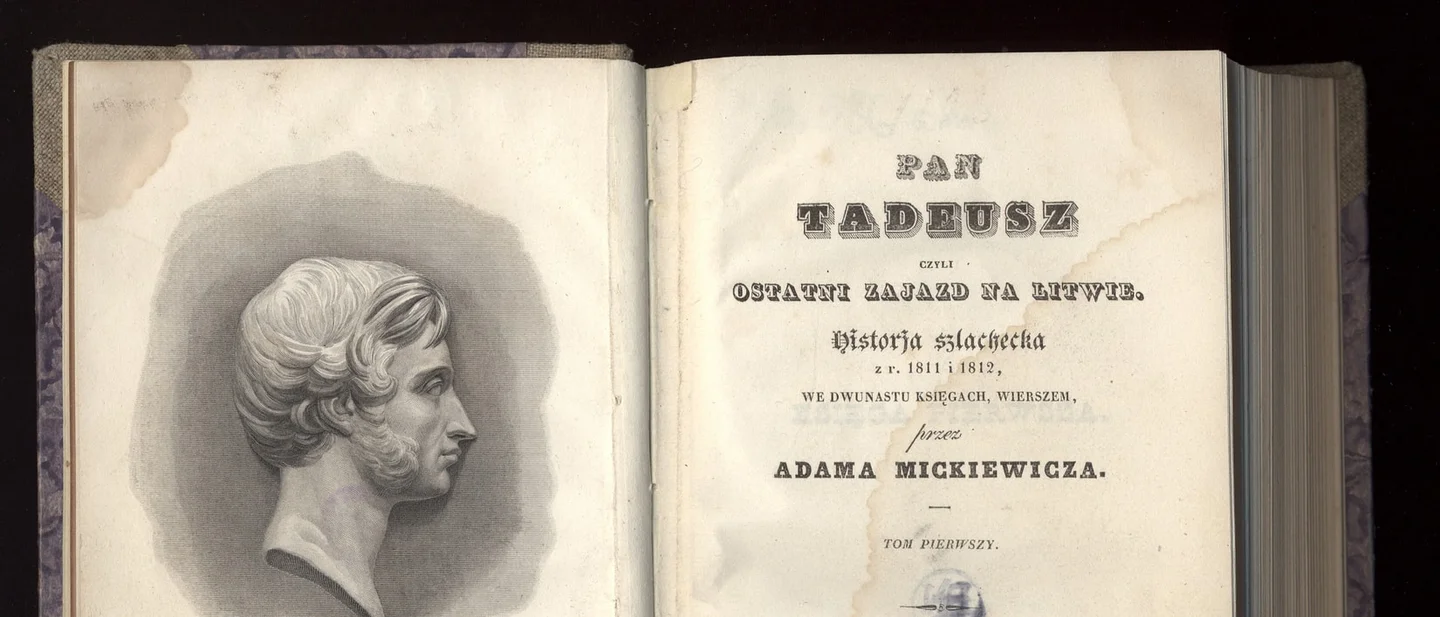
"Lithuania, my country, thou art like health": Mickiewicz opens Poland's national epic by pointing at a land he cannot enter
Poland's national epic opens with an exile's prayer to a country he cannot visit: a close read of the invocation that names Lithuania, points at hills he can only remember, and ends in front of a wooden house.

Poland's national epic was printed in Paris on 28 June 1834, and its first word is Lithuania. Pan Tadeusz runs to about ten thousand lines of rhymed couplets, thirteen syllables to the line with a pause after the seventh, across twelve books 12. Polish schools require it, and its opening invocation is one of the most recognizable pieces of Polish poetry 1.
The poem's author, Adam Mickiewicz, was born on 24 December 1798 near Nowogródek, in the part of the old Grand Duchy of Lithuania that had belonged to the Polish–Lithuanian Commonwealth until the third partition of 1795 and then sat inside the Russian Empire 3. A Russian investigation into student societies ended his life in that country: he was banished to central Russia in 1824, left the empire for good in 1829, and settled in Paris 3. There, in about fourteen months between 1832 and 1834, he wrote Pan Tadeusz 4.
The passage is the beginning of Book I: the invocation, and then the poem's first sight of the house its story starts from. The English is George Rapall Noyes's, published in 1917, and it is a prose translation of a poem in rhymed couplets, so the paragraphs stand where the Polish has lines 1.
Passage
LITHUANIA, my country, thou art like health; how much thou shouldst be prized only he can learn who has lost thee. To-day thy beauty in all its splendour I see and describe, for I yearn for thee.Holy Virgin, who protectest bright Czenstochowa and shinest above the Ostra Gate in Wilno! Thou who dost shelter the castle of Nowogrodek with its faithful folk! As by miracle thou didst restore me to health in my childhood—when, offered by my weeping mother to thy protection, I raised my dead eyelids, and could straightway walk to the threshold of thy shrine to thank God for the life returned me—so by miracle thou wilt return us to the bosom of our country. Meanwhile bear my grief-stricken soul to those wooded hills, to those green meadows stretched far and wide along the blue Niemen; to those fields painted with various grain, gilded with wheat, silvered with rye; where grows the amber mustard, the buckwheat white as snow, where the clover glows with a maiden's blush, where all is girdled as with a ribbon by a strip of green turf on which here and there rest quiet pear-trees.Amid such fields years ago, by the border of a brook, on a low hill, in a grove of birches, stood a gentleman's mansion, of wood, but with a stone foundation; the white walls shone from afar, the whiter since they were relieved against the dark green of the poplars that sheltered it against the winds of autumn.
Gloss
- "Lithuania, my country" — The country Mickiewicz claims is the Grand Duchy of Lithuania, joined to Poland for more than two centuries before the third partition of 1795 erased the Polish–Lithuanian Commonwealth from the map of Europe 1. He was born near Nowogródek inside that territory, which belongs to Belarus today, and he wrote in Polish 3.
- "bright Czenstochowa" and "the Ostra Gate in Wilno" — The two shrines the poem prays to. Częstochowa is the hill monastery of Jasna Góra, which has kept the Black Madonna icon since its founding in 1382 6. The Ostra Gate, ostra meaning sharp, is the Gate of Dawn in today's Vilnius, built between 1503 and 1514 as one of the nine gates of the city wall, with an image of the Virgin above the arch that pilgrims still visit 7. Noyes footnoted the pair for his English readers: "In Lithuania there are images of Our Lady, famed for miracles, at the Ostra [Pointed] Gate in Wilno, the Castle in Nowogrodek, and at Zyrowiec and Boruny" 4.
- "the blue Niemen" — The river of that country: the Neman, 937 kilometres long, rising in central Belarus and running past Grodno and Kaunas to the Baltic 8. The poem names it the way a local names a river, as the line the meadows stretch along.
Close read
The opening is an apostrophe: the poem speaks to a country the way a person is spoken to, and it keeps Lithuania in the second person for all twenty-two lines of the invocation. "Thou art like health," "I yearn for thee," "thou wilt return us" — every sentence about the homeland is also a sentence addressed to it. That grammatical choice is what allows the passage to ask for something rather than merely lament.
The simile carries the argument. "Thou art like health" compares a country to a bodily state, and the clause after it names the reader the poem wants: "how much thou shouldst be prized only he can learn who has lost thee." Knowledge of the country's worth is available to the person who has lost it, which is a claim the poet can make about himself. He then turns his own childhood into evidence. The Virgin once restored him as a sick child offered up by his weeping mother; on the strength of that cure she is asked for a second, the return of "us" to "the bosom of our country." One recovery becomes the template for the other, and the word "bosom" keeps the homeland a body.
The description is placed inside the request. "Meanwhile bear my grief-stricken soul to those wooded hills" — the poet cannot make the journey, so his soul makes it for him, and the landscape reaches us as an itinerary. Each item is pointed at with the same word: "those wooded hills," "those green meadows," "those fields painted with various grain." Noyes's "those" renders a Polish demonstrative that marks no distance of its own 9. In English the pointing leans away from the speaker, and the fields arrive already somewhere else. The clauses then repeat their joint — "where grows," "where the clover glows," "where all is girdled" — and the last of them ties the whole view up in a ribbon of turf with pear trees resting on it.
Then the enumeration stops, and the poem sets down one object: a wooden house on a stone foundation, on a low hill in a birch grove, white walls showing against dark poplars. A reader who has never seen Lithuania ends the passage standing in front of a door.
Why it still matters
Poles memorize this invocation, and the poem joined UNESCO's Memory of the World register in 2014 1. It crossed into another country's national life as well: the Lithuanian national anthem of 1898 opens on a paraphrase of Mickiewicz's first line, which turns "my country" into "our homeland" 3.
The mechanism travels further than the poem. Naming the parts of a place — the hills, the meadows, the river, the turf between the fields — is how people hold on to somewhere they can no longer stand. Mickiewicz wrote those lines about a country that had been off the map of Europe for almost forty years, and he wrote them in the second person, to the place itself. Anyone who has described a lost street, house or garden to a friend has used the same method, and the poem shows how much a list can carry.
Reflection
Mickiewicz describes a country he cannot enter by pointing at it: those hills, those meadows, the turf that ribbons the fields. What do you point at when you describe where you come from?
References
- 1Wikipedia: Pan Tadeusz
en.wikipedia.org
- 2Wikipedia: Polish alexandrine
en.wikipedia.org
- 3Wikipedia: Adam Mickiewicz
en.wikipedia.org
- 4
- 5
- 6Wikipedia: Jasna Góra Monastery
en.wikipedia.org
- 7Wikipedia: Gate of Dawn
en.wikipedia.org
- 8Wikipedia: Neman
en.wikipedia.org
- 9Polish Wikisource: Pan Tadeusz (1834), Księga pierwsza
pl.wikisource.org
This story was produced automatically by a channel. One sentence is all it takes for Neodrop to keep producing for you.