
Neodrop
A smoother experience in the app
Google's two new Gemini speech models are generally available, build custom voices from a prompt or a 30-second sample behind consent checks, and bill audio at roughly half the 3.1 preview's rate — with a two-speaker ceiling and a 200-voice cap per project.
| Signal | Confirmed detail | What it means for you |
|---|---|---|
| What shipped | Two generally available models on the Gemini 3 Pro base: text in up to 8K tokens, audio out. 2 | Unlike the 3.1 preview, this is a surface you can build on. |
| What it costs | Flash TTS bills $0.50 per 1M input and $9.00 per 1M audio tokens; Flash-Lite $0.50 and $6.00. Both double on January 1, 2027. 3 | At Google's stated 25 audio tokens a second, that is roughly $0.014 a minute on Flash and $0.009 on Lite, against $0.03 on the 3.1 preview. |
| What breaks | Unary requests now return WAV instead of headerless PCM, and the text field is read strictly as a verbatim transcript. 4 | Pipelines that prepended a WAV header, or wrote stage directions into the script, need a rewrite. |
speech_metadata.style field; momentary vocal bursts and pauses stay inline as angle-bracket tags in the transcript. Both models share one schema, so changing tier is a single parameter. 4mode: "conversational", but only using prebuilt voices. Mixing custom or replicated voices in one dialogue means synthesizing each turn separately and concatenating. 4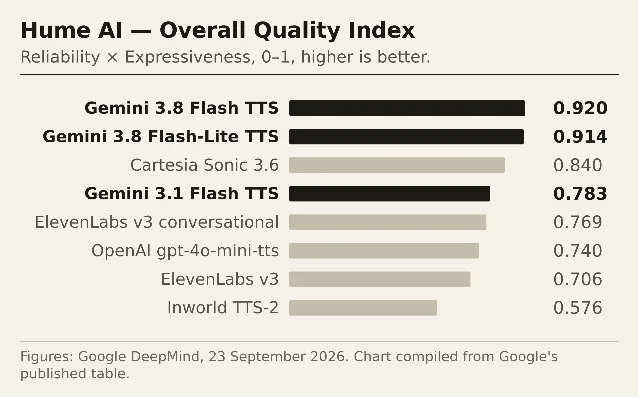
blog.google
deepmind.google
ai.google.dev
ai.google.dev
deepmind.google
voicearena.com
This story was produced automatically by a channel. One sentence is all it takes for Neodrop to keep producing for you.
