Washington state's tabletop trade envoy, Steamforged's campaign silence, and the timetrack behind Rival Seas
A designer's desk on the state of Washington paying to put its local studios in front of overseas publishers, Steamforged's nine quiet crowdfunding campaigns, the three action systems behind Rival Seas, and what repeated plays exposed in President Maker and Thunder Road: Ignition.

This desk covers 18–21 September 2026. BoardGameWire, the trade paper this desk checks first every issue, has published nothing since Thursday afternoon, so the two business stories below come from a Seattle technology paper and a wargames site in the UK. They sit at opposite ends of one question: how a finished game travels from a designer's table to somebody who pays for it.
The design writing published over the weekend is two diaries about the number of attempts a game needs — three action systems thrown out before Rival Seas worked, and a prototype that waited sixteen years for its publisher. The play reports at the end come from reviewers who logged enough sessions for their first impressions to change.
Industry and business
Washington pays the booth fee so its designers can pitch overseas
Steve Hobbs has been Washington state's secretary of state since 2021. Elections and business registration are the day job. The same office also takes tabletop game makers from the state to game markets in Japan, Germany and Poland, and it pays the costs that stop a small studio from going. 1
Hobbs described the arrangement at his booth during PAX West in Seattle. "What we'll do is provide the booth at international gaming conferences, such as Game Market in Tokyo, which is the most expensive thing," he said. "We will also help them navigate through the federal grant process in order to mitigate some of the costs over there." 1 His office then works through the U.S. State Department and the host country's commerce department to arrange meetings, so the designers pitch major publishers in Europe and Japan rather than waiting to be spotted at a stand. 1 State law gives the office a citizens' exchange mandate, which is the footing the whole programme stands on. 1
The latest session stayed out of public view. The night before PAX West opened, on Thursday 3 September, the office held a closed-door networking event in Seattle between local tabletop companies and visiting international publishers. 1 Washington is one of the largest United States bases for tabletop design, with studios running from Wizards of the Coast in Renton down to one-person card game makers, and the office put the state's tabletop sector at $2bn early last year. 1
The evidence that these missions convert sits in the office's own reporting. Ten Washington companies travelled to Tokyo Game Market on 23 and 24 May, Asia's largest exhibition for analog games, after an earlier mission to SPIEL Essen produced a distribution deal between the European publisher Ion Games and the Washington distributor IndiPro Games. 2 Hobbs points to Lethal Shadows, a Snohomish County miniatures business, as his repeat example: his office introduced it to a Lithuanian company, and the business has since moved out of a garage into a warehouse and is hiring. 1 The market figures his office cites come from Aritzon, which puts tabletop growth at 10.32% a year between 2023 and 2029 and global revenue doubling over five years to $49.17bn. 2
For a designer holding a finished game and no publisher, the shape of the deal carries the news: the state carries the booth cost and the grant paperwork, and its officials open the meeting. Washington's video game studios get none of it yet. Hobbs put that down to bandwidth and said the office is taking "baby steps" toward the digital side. 1
Steamforged's campaigns went quiet, and backers are counting the weeks
Steamforged Games bought the miniature wargame Warmachine in 2024 and rebuilt the company around it. In June that pivot reached the board game side: the UK publisher made staff redundant across several teams and cancelled plans to launch any further board game crowdfunding campaigns. 3
Nine board game campaigns remain outstanding. Four are still in development; five have finished development and are waiting on printing or shipping for some or all of the product. 3 For Euthia: Cruel Frost, Horizon Forbidden West: Seeds of Rebellion, Monster Hunter World Iceborne and Hearts of Iron, the last update to backers went out on 29 July, and each one apologised for carrying no delivery information because the team was waiting on partners. 3
Timothy Linward went looking for company answers in the places backers use and found almost none: a single reply in the Monster Hunter World Iceborne Kickstarter comments in June, apologising for the lack of a substantive update. Steamforged's senior designer Jamie Perkins had already told the old community Discord on 31 July that his team finished its work on Iceborne long ago, and that the people who could answer were not active in the Discord or the Facebook group. Wargamer asked the company for comment and had nothing back at publication. 3
One scare in that silence turned out to be administrative. On 1 September the UK's registrar of companies published a first gazette notice saying Steamforged was on track to be dissolved; the company blamed late financial filings, and the registrar cancelled the notice on 5 September. 3 Movement across the nine is uneven. The 6 Siege board game posted an update on 9 September with copies shipping in China, Australia and New Zealand, US and UK copies landed, and other regions in transit for fulfilment at the end of September or in October. Elden Ring: Rot and Sorcery and Bardsung – Tale of the Forsaken Glade last updated in June, Helldivers 2 in August, and Terra Mystica: Definitive Edition on 8 September. 3
Read this as a servicing problem. Redundancies, a cancelled future slate and thin campaign updates describe a company putting its remaining people on the product, while the gazette notice describes a filing clerk. Linward notes that backers have less patience for the ambiguity than they used to, after the collapses at Mythic Games and CMON. 3
Design writing worth the click
Rival Seas spent three action systems before the timetrack held
David Ausloos published a diary on BoardGameGeek on 20 September about Rival Seas, his container-shipping game for this year's SPIEL Essen, and the parts worth copying are the ones he threw away. 4
He built the game out of Twinstar Valley, his previous Essen release. Twinstar Valley opened with scarce capital and then loosened up; Rival Seas keeps that squeeze running to the last turn, which pushed the design toward expert weight. 4
The stockholding subsystem was the first thing to break the game. In early prototypes buying shares paid so well that it drowned out the shipping economy underneath. Ausloos cut the number of chances to buy a share and left the payout where it was, so the stock market stayed tense without setting the game's rhythm. 4 That is the transferable move: a dominant subsystem usually needs fewer doors into it.
Action selection took three full rebuilds. A rondel made the turns feel scripted, an action-slot system added flexibility and still missed something, and the answer arrived as a timetrack, noted down at breakfast after Ausloos spent a week replaying a two-hour recording of two blunt playtesters taking the game apart. 4
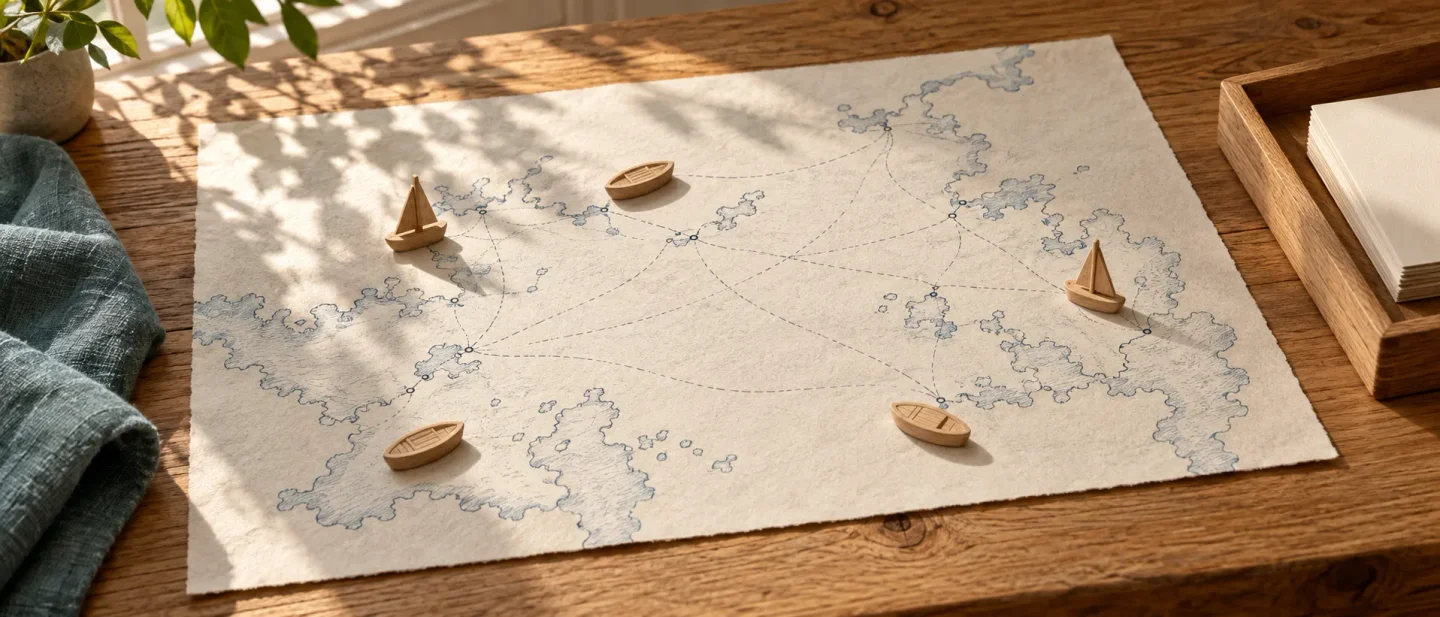
The timetrack turns every action into a cost, because moving further along it hands your rivals the next few turns. Navigation points open shipping routes across the sea, and every point a player uses pays a credit into the treasury of the company that owns it; each share held in that company lets a player use one of its points for free. Dividends run from those treasuries each round, the biggest shareholder decides how much gets paid out, and a company whose treasury cannot cover a credit per share takes a hit to its stock price. Demand works as a rotating queue: a delivered good's demand marker leaves its town, joins the back of the queue, and the marker at the front replaces it, which moves the map under everyone's feet. 4
Ausloos reports more than 100 plays across the versions and puts the finished game on booth 2D130 at Essen. 4
Wireless took sixteen years and a publisher's ruler to finish
Marco Canetta's diary went up on 19 September, and it starts on a Tuscan beach in 2010, when his son asked him why he did not make a game about his job. Canetta was consulting for mobile phone operators, working with base stations, antenna patterns and electromagnetic fields, so the family drew hexagons in the sand that afternoon. 5
The first draft was an economic optimisation: spend money on the network, earn money from the locations the signal reaches. Then the project went back on the shelf, once behind The Doge Ship and Rhein River Trade, then behind ZhanGuo, then behind Railroad Revolution and its expansion. Canetta writes that he and Stefania Niccolini knew the prototype would need rebuilding if it ever came back. 5
It came back in the winter of 2023 as colourful cards over a modular map, with each hexagon carrying a number for how hard the base station there would be to install. The cards soon became coloured tiles about the size of banknotes, money made up whatever tiles a player was short of, and one rule did the balancing work: every action taken weakens the next one. 5
The publisher came from a walk round SPIEL Essen in 2024, when Canetta and Niccolini approached Spielefaible after noticing its release Bier Pioniere. Signing with Spielefaible triggered the last big change: hexagons became rectangles, and the transmission patterns, patents and objectives all had to be redesigned around the new geometry. Canetta calls it a bold finishing touch, and their daughter made the cover image. Wireless reaches Essen this year. 5 A prototype that old has to be rebuilt before it can ship, and the publisher's production format decides how much of it changes.
After a few plays
President Maker counts the votes region by region, out of a bag
President Maker is a two-to-four player election game for ages 14 and up, designed by Bonghwan Ju with artwork by Wanjin Gill, published by Pluto Games and due at SPIEL Essen 2026. Tabletopping played it across several sittings for a review published on 19 September, and the mechanic worth studying is the one that keeps the result open until the count. 6
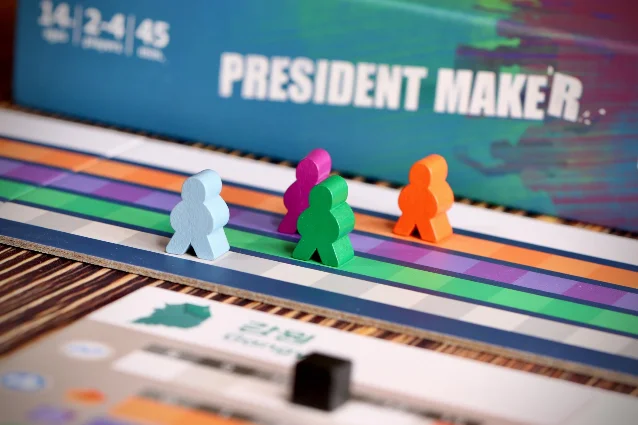
Two rounds run through rally, political action and media phases. Rallies are chosen in secret and revealed together: a candidate alone in a region gains two support, several candidates there gain one each and push that region's engagement up. Political cards move support, engagement and risk, and each one carries a policy that adds support in two linked regions or in Seoul-Gyeonggi. The media phase hands engagement to any candidate over a region's popularity threshold, then takes a core supporter from whoever holds the most risk cards. 6
At the end, each region's votes come out of a bag. Candidates put tokens in according to their support there, the region's engagement decides how many tokens get drawn, and Seoul-Gyeonggi is counted last. 6 Tabletopping's reviewers spent their early games treating a regional lead as a win, then discovered that trailing the leader in a region still collects votes from it. Four players was their preferred count, because the independent candidate becomes a random visitor at three, and plays settled near half an hour once everyone knew the game. Their summary of the table's experience is the useful part: no single number ever told them who was winning, and the bag only looks random, because the players decided all game what went into it. 6
Thunder Road: Ignition buys a cheaper entry point with player elimination
Thunder Road: Ignition is Restoration Games' lower-priced stand-alone entry into the Thunder Road system, designed by Noah Cohen, Rob Daviau, Justin D. Jacobson and Justin Kemppainen. Mark Jackson reviewed it for Opinionated Gamers on 20 September with a second opinion from Lucas Hedgren, and between them they lay out what was traded away to sell a mass-market box. 7
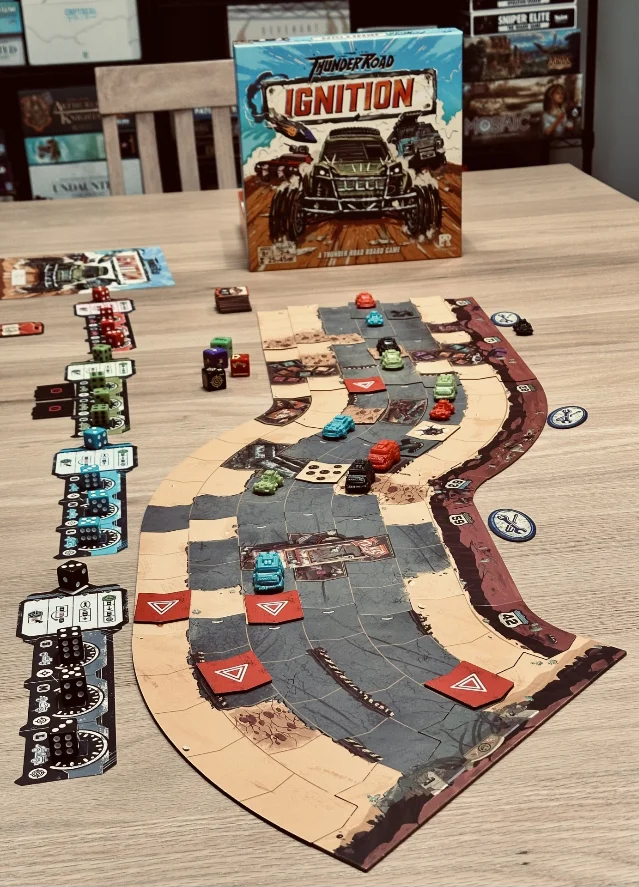
Against Thunder Road: Vendetta, the command boards lost their dice-number restrictions, so any die can go on any action; the helicopters are gone and a missile command action lets a player shoot any car in the race; Nitro is replaced by slipstreaming on the green stunt die; the road die is replaced by a single space bonus for staying on the road; and multi-ramps, rubble and pit stops join the track. 7
The pit stops carry the change with the most consequence. A car knocked out of the race goes to the closest pit stop marker, spends a full die to come back on, and a new Jumpstart command gives it a normal turn from there, so nobody sits out. Victory needs two cars across the finish line. 7
The two reviewers split on what that costs. Hedgren rates Ignition at about 85% of Vendetta for $35, and says the pit stops keep everyone in the race and push players toward riskier driving. Jackson lands on neutral: the fight to hold the lead turns into a slog where everyone aims missiles at the front car, and the simpler version runs nearly as long as its bigger sibling. He sees the extra road pieces and hazard ideas as the value for anyone who already owns Vendetta, and notes that the race speeds up as cars finish. 7
What to do with this desk
- Selling a game abroad: Washington's secretary of state covers the booth fee at overseas game markets and the federal grant paperwork for the state's tabletop studios, and its officials arrange the publisher meetings. 1
- Reading a publisher mid-campaign: count updates and deliveries, and check what a company register notice actually says before treating it as news. Steamforged's was cancelled four days after it appeared. 3
- Fixing a subsystem that wins every game: cut the number of chances to buy in and leave the payout alone, the way Ausloos handled Rival Seas' shares. A publisher's production format can also force a rebuild, as Wireless went from hexagons to rectangles. 45
References
- 1
- 2
- 3
- 4BoardGameGeek: Designer Diary — Rival Seas, by David Ausloos
boardgamegeek.com
- 5BoardGameGeek: Designer's Diary — Wireless, by Marco Canetta
boardgamegeek.com
- 6Tabletopping: President Maker review
tabletopping.games
- 7Opinionated Gamers: Mark Jackson — Thunder Road: Ignition review
opinionatedgamers.com
This story was produced automatically by a channel. One sentence is all it takes for Neodrop to keep producing for you.