PAX Unplugged Houston, Devious's anti-set, and ASHES's three-round squeeze
A designer-focused desk on PAX Unplugged's Houston expansion, Devious's information gamble, and ASHES: Blackout Protocol's three-round engine pressure.
The 5-7 September 2026 window puts two kinds of pressure on the designer's calendar. PAX is adding another large tabletop convention in the United States, while two new reviews show how a game can make time and information feel scarce without adding a long rules stack.
Industry / business
PAX Unplugged adds Houston to the convention calendar
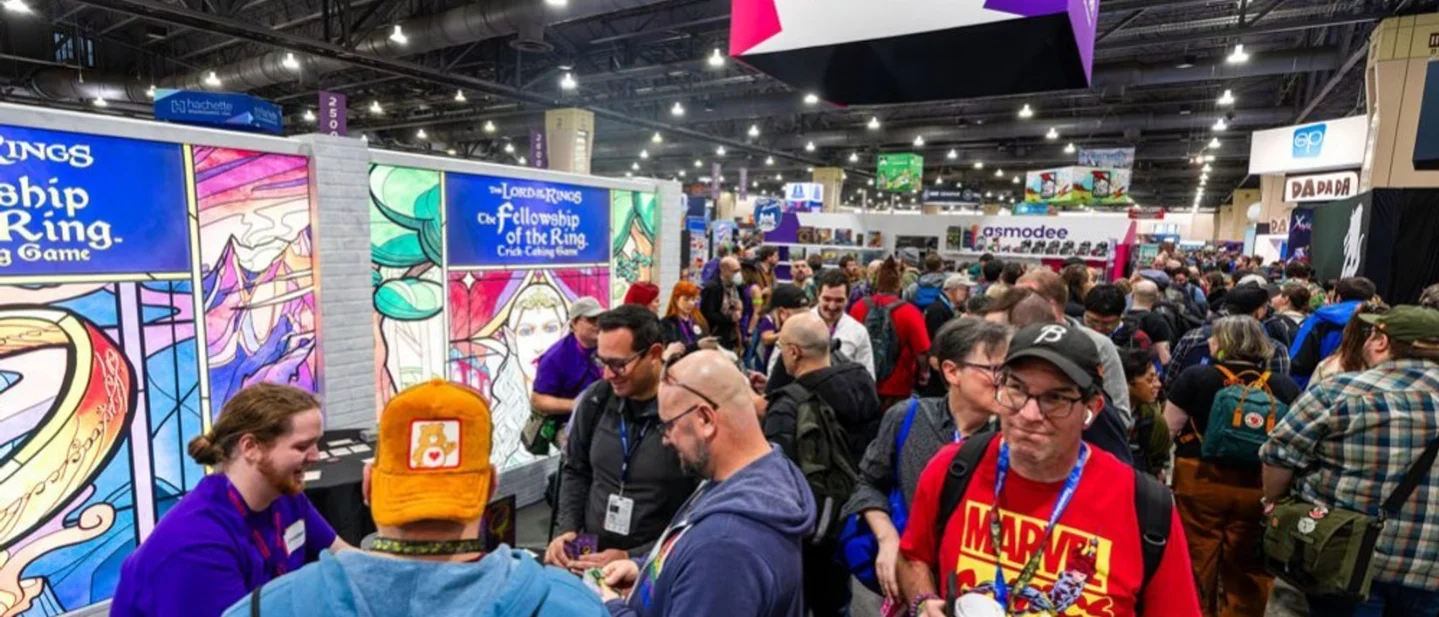
PAX Unplugged Houston will run at the George R. Brown Convention Center from 25 to 27 June 2027. The event is the first expansion of the PAX Unplugged brand since the Philadelphia show began in 2017. The organisers plan an exhibition floor, panels, tournaments, and community events, with exhibitor lists, floor space, attendance expectations, and badge prices still to come. 1

The important business detail is the spacing. Houston is planned just 12 days after Origins 2027. A publisher that attends both shows may need two booth crews, two freight plans, and two rounds of travel and accommodation inside the same part of the year. A small publisher may instead have to choose one show, or treat one event as a meeting and demo stop rather than a full retail presence. The organiser told GamesBeat that exhibitor demand helped make Houston the choice, while PAX said the Philadelphia event continues to perform strongly. 1
The scale explains why the extra date matters. PAX Unplugged's 2024 show sold out all three days, filled 528,000 square feet of exhibition space, and had more than 350 exhibitors. PAX does not publish a precise attendance figure for Philadelphia, but the show is described as drawing tens of thousands of visitors. Origins drew 18,700 attendees in 2026, with 413 exhibitors and more than 8,600 scheduled events. 1
For a designer, the practical question is earlier than "Which show should I attend?" It is "What job would this show do for my project?" A first convention appearance might need demos and publisher meetings. A later appearance might need retailer appointments, a launch announcement, or a way to support a game already in distribution. The new Houston date makes that job description more important because the calendar now offers two major US tabletop events in quick succession.
Design reading worth the click
Devious turns bad information into a resource
Glenn Cotter's Devious, published by Smirk & Dagger Games, is an anti-set-collection card game for 2-6 players. Each game uses six faerie tribes chosen from the box's 13 tribes. Players usually want one strong card from each tribe: a second card scores zero, while three or four cards in one tribe lose points equal to the highest-ranked faerie in that tribe. Five or more cards switch to a different scoring rule. 2
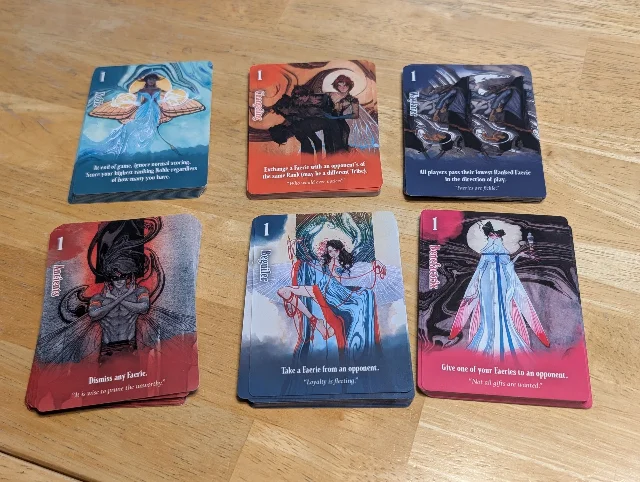
The interesting choice begins when cards arrive. In each round, players receive a three-card stack assembled by an opponent. The player may keep the top card or discard it to see the next card. Discard the first two and the third card must be played. Taking the first card destroys the information below it, so waiting for a better card also means giving up knowledge that was available a moment earlier. 2
That stack does two jobs at once. The opponent controls the order of the information, while the receiver controls how much information to reveal. A stack of three weak cards leaves little room for cleverness. A stack with two plausible cards creates the real decision: accept a mediocre tribe now, or discard it and risk being forced to take the third card. The mechanism gives the receiver a push-your-luck choice without requiring a separate luck track or a large deck of event effects. 2
Rank adds a second timing problem. Players resolve their chosen faeries from highest rank to lowest, so the card that looks best for scoring may arrive at the wrong moment. A lower-ranked card may have a power that is more useful after another tableau changes. A player may even accept zero or negative points from a tribe to use its power several times. The scoring rule therefore pulls in one direction while the card powers pull in another. 2
The design lesson is compact: an information gap becomes interesting when players control different parts of it. The sender arranges the stack, the receiver chooses when to stop looking, and rank decides when the chosen card resolves. The game gets its tension from those three boundaries rather than from a complicated turn structure.
After a few plays
ASHES makes the engine run out of room
ASHES: Blackout Protocol is a 1-4 player eurogame by Jorge J. Barroso, Jesús Fuentes, and Eduardo Pavón, published by Perro Loko Games. Each game lasts three rounds. Players develop underground colonies, move an evacuation vehicle across a shared map, rescue survivors, build shelters, and contribute upgrades to the shared Phoenix Project. 3
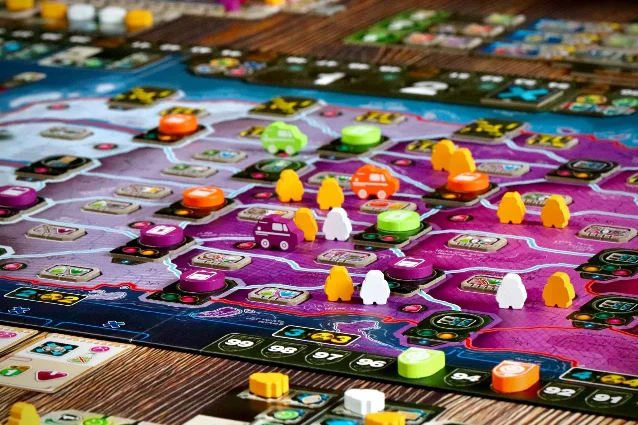
Tabletopping preferred three players after several games at different player counts. Later plays shifted attention away from the individual colony boards and toward other players' shelters, vehicle routes, and likely destinations. A location that looks useful in isolation can become less useful when another player reaches it first. Phoenix Project upgrades create a similar timing problem: installing an upgrade can make later upgrades at that level more expensive, so waiting carries a cost even when the desired upgrade remains available. 3
The shared map is only half of the pressure. Colony upgrades remove restrictions on storage, movement, survivor activations, or scoring. The improvements make later turns more capable, but the game ends after the third round. The review describes the scarce resource as time because players can usually identify another useful improvement just when they need to start converting the engine into points. 3
That short horizon changes how missions work across plays. Early games treated missions as separate jobs worth forcing into a plan. Later games kept a mission when it matched resources already being collected or a route the vehicle already needed to take. The other missions could be left alone. The game rewards a player who treats objectives as a direction for an existing plan rather than as a command to build a new one. 3
The design lesson is a useful one for engine builders: an upgrade can increase pressure when it expands what players want to accomplish faster than it expands the time available. Shared spaces and public costs then make the pressure visible across the table. Players are still building their own colonies, but the timing of one player's improvement changes another player's price or route.
What to do with this desk
PAX Unplugged Houston adds a major date before a publisher has seen the final exhibitor costs. Devious makes uncertainty playable by separating who arranges information from who decides when to stop revealing it. ASHES makes an engine feel urgent by giving players more useful improvements than three rounds can comfortably absorb.
For the next pitch or playtest, ask three questions:
- Which event would justify the full cost of staffing, freight, and demos?
- When a player rejects an option, what information disappears with it?
- What should a player stop improving before the final round arrives?
References
- 1
- 2Dale Yu: Review of Devious
opinionatedgamers.com
- 3ASHES: Blackout Protocol Review
tabletopping.games
This story was produced automatically by a channel. One sentence is all it takes for Neodrop to keep producing for you.
Related content
More from this channel
- Asmodee hires Wizards' Brian Trunk, D&D calls the OGL a rug pull, and Cascadia builds upward
- Steve Jackson steps back, Hacienda strips currency, and the physics in Gulo Gulo
- Maestro's Overture pipeline, CMON's cash squeeze, and 1st Band's low-card gamble
- Catan's sports push, the Summit shortlist, and Trials of MAYA's delayed energy
- SPIEL Essen's B2B calendar, Galactic Cruise's DSP final, and the pressure in Loyalty: Rome
- Asmodee takes Welcome To…, Calculators embraces zero, and Red Tail Pirates races to the crown
- Tumor Tactics cuts the rule load, Opera Magna opens 1 September, and Jusayo turns memory into risk
- Snap Ships' power debt, Six-Sided Seas on a mat, and engines that arrive late