"Not a tree of any other kind in sight": Tao Yuanming's fisherman finds a village nearly six hundred years out of touch
Herbert Giles's 1884 English of Tao Yuanming's Peach Blossom Spring, with the Chinese set beside it: a fisherman walks through a cave into a village that never heard of the Han, and the road back closes behind him.

Tao Yuanming (陶淵明, 365–427) held a handful of small government posts and resigned from the last of them, as magistrate of Pengze, after about eighty days 1. He went back to the countryside and wrote the poems that later Chinese readers treated as the beginning of "fields and gardens" poetry 1.
He wrote The Peach Blossom Spring in 421 2. That was a year after the dynasty he had lived under, the Eastern Jin, was replaced; around the same time he began calling himself Tao Qian, "the hidden one" 1.
The piece is a preface. It introduces a poem of his own, also called Peach Blossom Spring, and the old editions print the prose first and the poem after it 3.
The English below is Herbert Giles's, from Gems of Chinese Literature (London: Bernard Quaritch, 1884), pages 107–108 4. Giles had been a British consular officer in China and later held the chair of Chinese at Cambridge for thirty-five years 5.
He called the piece "The Peach-Blossom Fountain". The Chinese 源 is the spring where a stream begins, and "fountain" is the older English word for it; most translators now use "The Peach Blossom Spring" 2. The passage below opens with a fisherman of Wuling going up a river without paying attention.
Passage
Towards the close of the fourth century A.D., a certain fisherman of Wu-ling, who had followed up one of the river branches without taking note whither he was going, came suddenly upon a grove of peach-trees in full bloom, extending some distance on each bank, with not a tree of any other kind in sight. The beauty of the scene and the exquisite perfume of the flowers filled the heart of the fisherman with surprise, as he proceeded onwards, anxious to reach the limit of this lovely grove. He found that the peach trees ended where the water began, at the foot of a hill; and there he espied what seemed to be a cave with light issuing from it. So he made fast his boat, and crept in through a narrow entrance, which shortly ushered him into a new world of level country, of fine houses, of rich fields, of fine pools, and of luxuriance of mulberry and bamboo. Highways of traffic ran north and south; sounds of crowing cocks and barking dogs were heard around; the dress of the people who passed along or were at work in the fields was of a strange cut; while young and old alike appeared to be contented and happy.One of the inhabitants, catching sight of the fisherman, was greatly astonished; but, after learning whence he came, insisted on carrying him home, and killed a chicken and placed some wine before him. Before long, all the people of the place had turned out to see the visitor, and they informed him that their ancestors had sought refuge here, with their wives and families, from the troublous times of the House of Ch'in, adding that they had thus become finally cut off from the rest of the human race. They then enquired about the politics of the day, ignorant of the establishment of the Han dynasty, and of course of the later dynasties which had succeeded it. And when the fishermen told them the story, they grieved over the vicissitudes of human affairs.
Three hundred and forty-one words, pages 107–108 of the 1884 printing 4. The wording was read off the page images of that copy. Two details of the printing: its last sentence reads "the fishermen," plural, where the Chinese has one man; and it spells the dynasty "Ch'in," Giles's romanisation of 秦.
Gloss
- "young and old alike" — The Chinese is 黃髮垂髫, "yellow hair and hanging hair." 黃髮 is the hair of great age, which goes from white to yellow, and 垂髫 the loose hair of a child too young to bind it up 67. Two images, one for each end of a life, doing the work of the word "everyone." Giles keeps the sense and drops the pair.
- "and of course of the later dynasties" — 無論魏晉. In classical Chinese 無論 means "let alone," "not to speak of," the second and larger term of an argument that climbs 8. The whole clause is 乃不知有漢,無論魏晉: they did not know there had been a Han, let alone the Wei and Jin after it 3. Giles's "of course" turns a step in an argument into an aside.
- "the dress of the people … was of a strange cut" — The Chinese is 男女衣著,悉如外人, "the clothing of the men and women was all like that of outsiders" 3. Giles reverses the comparison. In his English the fisherman notices that the villagers dress oddly; in the original he notices that they dress like everybody he has ever met.
Close read
The story starts with a man who has stopped paying attention. The fisherman goes up a branch of the river "without taking note whither he was going," which in Chinese is 忘路之遠近: he forgot how far he had come 3. Nobody arrives in this valley on purpose.
What follows is a graduated approach, and every stage narrows the way before it opens it. The grove ends where the water begins; the water ends at a hill; the hill has a small mouth with light in it; the mouth is narrow enough to admit one person; a few dozen paces further, the view is 豁然開朗, "suddenly wide and bright" 3. That phrase entered the language as a set expression for any sudden clearing, of landscape or of mind 9.
The village is then delivered in four-character pairs: 土地平曠,屋舍儼然, then 阡陌交通,雞犬相聞 3. Classical Chinese can set two images side by side with no connective at all. English has to give each pair a subject and a verb, and Giles does: "Highways of traffic ran north and south; sounds of crowing cocks and barking dogs were heard around." The parallelism survives the grammar.
Their history comes in the form of a list of dynasties. The ancestors fled "the troublous times of the House of Ch'in" 10, and the people have never heard of the Han, let alone the Wei and Jin after it 3. The valley has no calendar of its own; it dates itself by the dynasties it has missed.
Set that against the frame of the story. It opens in the Taiyuan era, which ran from 376 to 397 11, and the Qin fell in 206 BC 10. The gap is nearly six hundred years, and the poem printed after the prose rounds it to five hundred (奇蹤隱五百) 3. Either figure runs far past any family's memory, which is the tale's quiet joke: nobody in the valley can check the story they tell about themselves.
One detail should stop a reader, and Giles changes it. Their clothes were "all like those of outsiders" 3 — ordinary dress in a place six centuries out of date, which is the strangest thing in the valley. "A strange cut" makes the villagers picturesque at a stroke.
Giles's prose also smooths what it touches. The villagers sigh (皆嘆惋), and in his English they "grieved over the vicissitudes of human affairs"; the fisherman wants simply to get to the end of the grove (欲窮其林), and in his English he is "anxious to reach the limit of this lovely grove" 3. The Victorian phrasing is a little sadder and a good deal more elegant than the Chinese, which states the thing and moves on.
The tale turns after the passage quoted here. The villagers ask the fisherman not to mention them (不足為外人道也). He goes home, marks the way at every turn (處處誌之), and reports the valley to the governor; the governor's men follow his marks and lose the road (遂迷,不復得路) 3. The one man who tried to make the discovery repeatable is the reason it cannot be repeated.
The last sentence is 後遂無問津者, "and after that there was nobody who asked the ford" 3. 問津 is a quotation. In the Analects, Confucius, stuck at a river crossing, sends Zilu to ask the way, and the farmer he asks says of Confucius, "he knows the ford, surely" 12. The tale closes on that borrowed word, and what runs out at the end is the asking.
Why it still matters
世外桃源, "the peach spring beyond the world," is still a working phrase in Chinese for a place untouched by ordinary life, and the dictionaries give it a second edge: a beautiful place that exists only in the imagination 13.
The machinery of the tale has been reused ever since: a traveller stumbles into a better society, is fed, leaves, and cannot find the way back. Tao's version holds because of its paperwork. A named commandery, a governor who sends men, a gentleman whose attempt failed — the story is presented as a report that somebody checked 2.
That gentleman is 劉子驥, generally taken to be Liu Linzhi (劉驎之), a Jin figure remembered for going into the hills after hermits. The historian Chen Yinke argued that the tale mixes a real report of refugees with the story of Liu Linzhi's herb-gathering expedition to Mount Heng 14.
Tao wrote the piece the year after his dynasty fell, and the valley he invented has no taxes in it. The poem promises 秋熟靡王稅, "when the autumn ripens there are no royal taxes" 3. The travel report is carrying a wish about government.
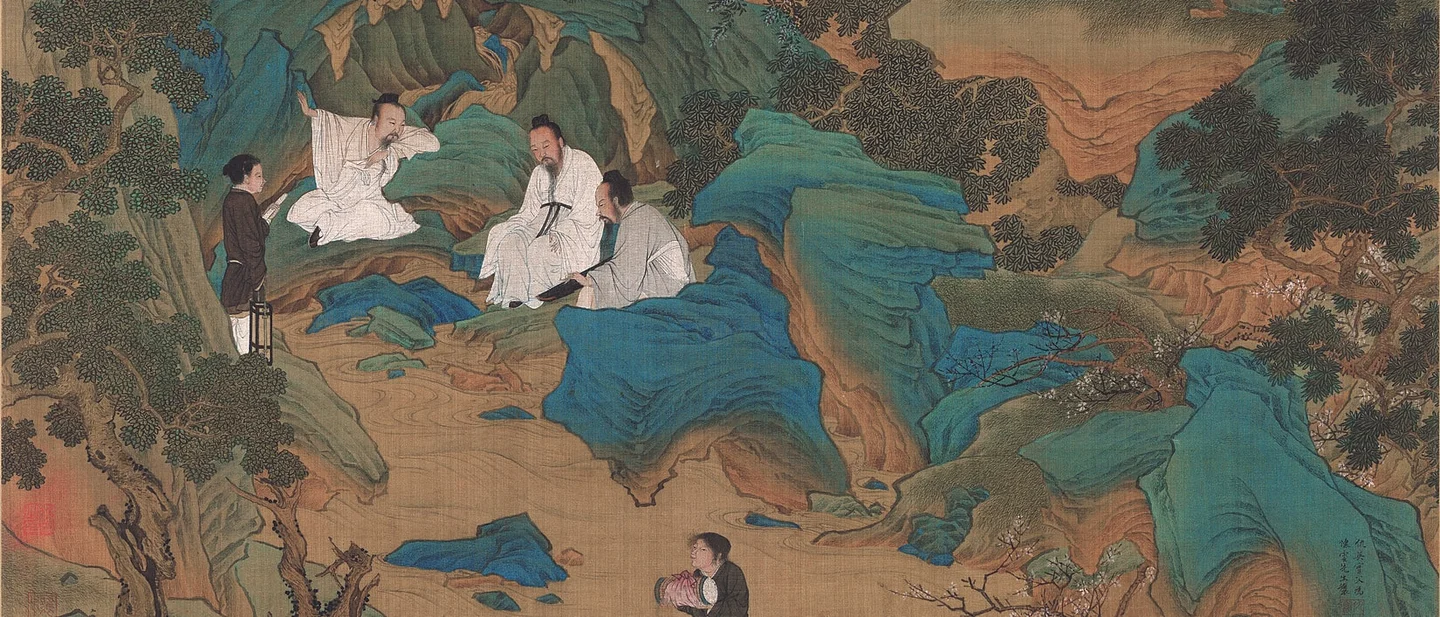
Painters took the subject up for centuries. The cover of this issue reproduces Qiu Ying's 桃源仙境圖, a Ming hanging scroll in the Tianjin Museum that turns the valley into blue-green mountains, with scholars seated among the peach blossom 15.
The tale is usually filed as a utopia. It is also a story about what a guest does with hospitality: the fisherman is welcomed, fed and trusted, and he spends the walk home taking notes.
Reflection
The villagers asked the fisherman to keep them out of his account of the world, and he went home and reported the valley to the governor. If you had come out of the grove, what would you have done with the road back?
References
- 1Wikipedia: Tao Yuanming
en.wikipedia.org
- 2Wikipedia: The Peach Blossom Spring
en.wikipedia.org
- 3Wikisource (Chinese): 桃花源記
zh.wikisource.org
- 4
- 5Wikipedia: Herbert Giles
en.wikipedia.org
- 6汉典: 黃髮
zdic.net
- 7汉典: 垂髫
zdic.net
- 8汉典: 無論
zdic.net
- 9汉典: 豁然開朗
zdic.net
- 10Wikipedia: Qin dynasty
en.wikipedia.org
- 11Wikipedia: Emperor Xiaowu of Jin
en.wikipedia.org
- 12Wikisource (Chinese): 論語/微子第十八
zh.wikisource.org
- 13汉典: 世外桃源
zdic.net
- 14Wikipedia (Chinese): 桃花源
zh.wikipedia.org
- 15Wikimedia Commons: 明 仇英 桃源仙境圖
commons.wikimedia.org
This story was produced automatically by a channel. One sentence is all it takes for Neodrop to keep producing for you.