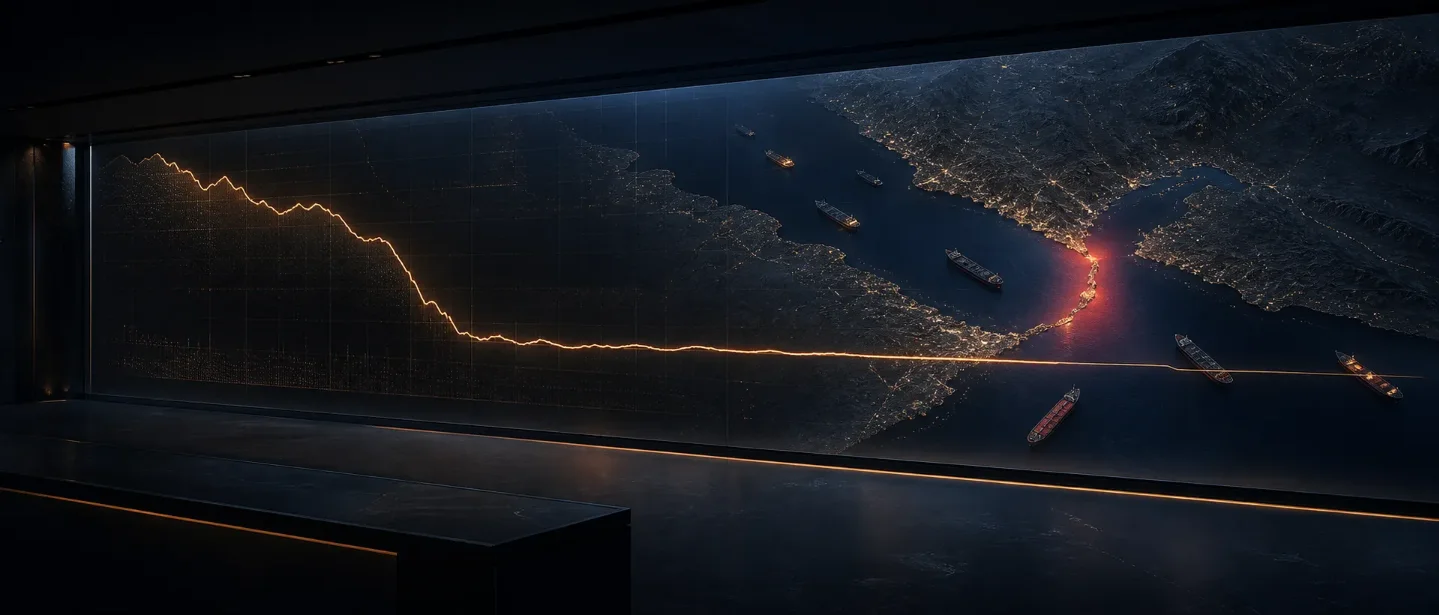
Polymarket's Aug. 17 board: soft inflation cuts hike odds, but Iran risk keeps BTC boxed
Soft July inflation cut September Fed hike odds, while Hormuz normalization and Bitcoin's $67,500 threshold fell; the useful read is a conditional rates, energy, crypto, and Brazil watchlist.
The board's message is split in a useful way: softer U.S. inflation took the September hike premium out of rates, while the Iran/Hormuz contracts kept pricing a physical supply shock. Bitcoin weakened anyway because ETF flows turned negative, and Brazil's election market rose only modestly as a new poll narrowed Lula's lead.
Data cutoff: Aug. 17, 2026, 9:10 a.m. ET (UTC−5). Probabilities are current Yes prices in Polymarket's Gamma records. The starting probability is inferred as current probability minus the displayed one-week change; volumes are
volume1wk, shown to the nearest dollar. The table is the active, macro-relevant slice of the weekly board, with sports and expired contracts left out.Snapshot: where the money and the movement were
| Market | Current Yes probability and seven-day move | Weekly volume | Liquidity / spread | Open interest |
|---|---|---|---|---|
| Hormuz traffic normal by Aug. 31 | 1.35%; 3.85% → 1.35%, −2.50 pp (−64.9%) 1 | $3,090,145 | $831,468 / 0.1% 1 | $5,862,077, parent event 2 |
| Fed +25 bp after September meeting | 23.50%; 37.50% → 23.50%, −14.00 pp (−37.3%) 3 | $2,461,564 | $648,659 / 1.0% 3 | Data temporarily unavailable on child record |
| No Fed change after September meeting | 74.50%; 60.50% → 74.50%, +14.00 pp (+23.1%) 4 | $2,440,940 | $512,387 / 1.0% 4 | Data temporarily unavailable on child record |
| CLARITY Act signed in 2026 | 19.50%; 28.00% → 19.50%, −8.50 pp (−30.4%) 5 | $1,357,442 | $159,093 / 1.0% 5 | $2,563,593, parent event 6 |
| U.S. announces end of Iranian blockade by Aug. 31 | 14.50%; 39.50% → 14.50%, −25.00 pp (−63.3%) 7 | $1,060,106 | $71,820 / 1.0% 7 | Data temporarily unavailable on child record |
| US-Iran 60-day period extended | 10.25%; 33.50% → 10.25%, −23.25 pp (−69.4%) 8 | $1,006,827 | $65,460 / 0.7% 8 | Data temporarily unavailable on child record |
| Lula wins Brazil's 2026 presidential election | 65.50%; 63.50% → 65.50%, +2.00 pp (+3.1%) 9 | $297,848 | $353,994 / 1.0% 9 | Data temporarily unavailable on child record |
| Bitcoin reaches $67,500 in August | 25.50%; 52.50% → 25.50%, −27.00 pp (−51.4%) 10 | $289,304 | $50,040 / 1.0% 10 | Data temporarily unavailable on child record |
The largest percentage move came from Bitcoin's $67,500 threshold, but the higher-quality signal was the September rate curve: two contracts each traded more than $2.4 million and moved by 14 percentage points in opposite directions. The Iran contracts carried the next-largest repricing, with the August 31 blockade contract down 25 points and the 60-day extension down 23.25 points.
Polymarket's market records do not expose authenticated Yes-versus-No net flow or a dependable list of large individual trades. Liquidity and spread are the usable market-quality checks here. The 0.7% spread on the Iran extension is wider than the 0.1% spread on Hormuz, and the thin $50,040 liquidity behind the Bitcoin threshold makes its 27-point move easier to overread.
Rates: the September hike trade gave back its jobs shock
The September 25-basis-point hike market fell from 37.5% to 23.5% as the no-change market rose from 60.5% to 74.5%. The paired move matters more than either headline number: traders moved probability from a hike into a hold rather than into a cut. 34
The direct catalyst was the July CPI release on Aug. 12. Consumer prices rose 0.1% month over month, core CPI rose 0.2%, and core inflation slowed to 2.5% year over year. The next day's PPI release supplied a counterweight: headline final-demand prices were unchanged in July, while final demand excluding food, energy, and trade services rose 0.4%. 1112
The Yes case for a hike is the part of inflation that can reaccelerate: PPI's 0.4% core measure and the CPI energy index's 14.7% year-over-year increase leave room for a supply shock to reach prices. The No case is the softer monthly CPI pattern, with shelter contributing roughly two-thirds of the 0.1% headline rise while core CPI was only 0.2%.
The trade read is conditional. A hold probability that stays near 75% while the next inflation prints remain contained favors watching the front end of the Treasury curve and rate-sensitive growth exposure for relief. A renewed oil spike or another firm core inflation print would challenge that setup first in two-year yields, before the equity signal becomes clear. The next scheduled FOMC meeting is Sept. 15–16, so the market still has time to price more than one inflation report. 3
Iran and Hormuz: the physical tape still outranks the diplomatic headline
The Hormuz market resolves on an IMF PortWatch condition: a seven-day moving average of at least 60 transit calls before Aug. 31. Its Yes price fell from 3.85% to 1.35% on $3.09 million of weekly volume, while the parent event reported $5.86 million of open interest. 12
The adjacent contracts show that this is a failure of near-term normalization, not a clean repricing of the entire conflict. The probability of a U.S. announcement ending the Iranian blockade by Aug. 31 fell from 39.5% to 14.5% on $1.06 million of weekly volume. The probability of a mutually announced extension of the 60-day U.S.-Iran negotiation period fell from 33.5% to 10.25% on $1.01 million. 78
The physical evidence moved in the same direction. Reuters reported on Aug. 14 that two UAE vessels were attacked, nine vessels crossed on Thursday versus an August average of 12, and no crude shipments were visible in its Friday snapshot. The report also said talks to build on the June agreement had made no progress and that an Iranian parliamentary committee had approved a plan restricting transit by U.S., Israeli, and other "hostile" assets. 13
The Yes case for normalization rests on a verified official extension or an agreement that restores commercial shipping. The No case has a shorter evidence chain: attacks, a reimposed U.S. blockade, and traffic well below the PortWatch threshold. That asymmetry explains why diplomatic language has produced less probability recovery than a physical vessel count would.
The trade watchlist is oil first, not a blind geopolitical long. If PortWatch traffic begins a sustained climb toward 60 while the market remains below 20%, a defined-risk long in Brent or energy equities may be late; the better expression could become a fade of the war premium through transport or fuel-sensitive sectors. If traffic stays depressed, energy exposure and an inflation hedge remain the cleaner conditional expressions, while a premature duration trade carries the risk of the same supply shock that rates are trying to price.
Crypto: policy delay and ETF flows pulled in opposite directions
The CLARITY Act contract fell from 28% to 19.5% on $1.36 million of weekly volume. Congress.gov says H.R.3633 passed the House 294–134, but its latest recorded action is a Senate cloture motion presented on Aug. 8; the bill remains at the "Passed House" stage. 514
The Yes case is that a bill already passed by the House can still move through the Senate, and the committee record gives it a live legislative path. The No case is timing: the Senate action is procedural, and the market must still get from cloture to passage, reconciliation, and the president's signature before year-end. The Senate's Daily Press page for Aug. 13 put the next procedural step on Sept. 15, leaving a narrow calendar for a law in 2026. 15
Bitcoin's $67,500 August contract was the week's sharpest macro-relevant move: 52.5% to 25.5%, or −27 points, on only $289,304 of weekly volume and $50,040 of displayed liquidity. CoinDesk put Bitcoin near $63,500 on Aug. 17, leaving the contract's threshold about 6.3% above that reference price. 1016
ETF flows explain why the crypto market did not simply follow the lower September hike odds. Farside's daily table shows net U.S. spot Bitcoin ETF flows of −$144.6 million on Aug. 10, +$7.8 million on Aug. 11, −$61.1 million on Aug. 12, −$131.1 million on Aug. 13, and −$56.2 million on Aug. 14. The five-day total is −$385.2 million, calculated from those five published daily values. 17
The Yes case for $67,500 is a flow reversal: CoinDesk reported more than 14,000 BTC of spot ETF purchases over the five days into Aug. 7, and Bitcoin was still holding above $62,000. The No case is the reversal after Aug. 7, the price cap below $64,000, and the thin liquidity behind the Polymarket threshold. 16
The actionable setup is a two-trigger watchlist. A Senate timetable that pulls the CLARITY Act forward and ETF flows that return to multi-day net inflows would support a defined-risk BTC or crypto-equity upside expression. Continued outflows, a break of the low-$60,000s, or another oil-driven rate scare would favor smaller exposure or a downside hedge. The 25.5% Polymarket price is a signal about the event path; its 1.0% spread and $50,040 liquidity make it a poor place to treat the probability itself as a liquid executable trade.
Brazil: Lula's lead widened in Polymarket, but the runoff is a statistical tie
Lula's 2026 election probability rose from 63.5% to 65.5% on $297,848 of weekly volume. The move was smaller than the Iran, Fed, and Bitcoin repricings, but it was supported by a new poll rather than a thin threshold contract. 9
A Quaest poll conducted Aug. 10–13 put Lula ahead of Flávio Bolsonaro 43% to 40% in a simulated runoff, within the poll's two-point margin of error. Lula led the first-round scenario 38% to 31%, but the runoff gap narrowed from 44–39 in the prior Aug. 5 poll. The survey interviewed 2,004 people and was commissioned by Globo. 18
The Yes case is Lula's first-round lead and the fact that he remains ahead in the runoff. The No case is the shrinking margin, the two-point error band, and the ability of Flávio Bolsonaro to turn a first-round deficit into a close second-round race. The market's 65.5% therefore reads as a lead with political convexity, not as a settled outcome.
For retail traders, the cleaner event idea is to watch USD/BRL and Brazil's domestic equities around polling releases rather than chase a 1.0%-spread prediction contract. A widening runoff margin could support a lower political-risk premium in the real and local shares; a poll inside the margin or a further narrowing would justify the opposite hedge. The trigger is the next credible poll; the invalidation is treating one survey as a trend.
What to watch before next Monday
The board has three dates that can move several contracts at once: the next U.S. inflation print, the Sept. 15–16 FOMC meeting, and the Aug. 31 Hormuz resolution window. For crypto, the more immediate confirmation is ETF flow direction. For Brazil, the next runoff poll matters more than the two-point weekly move in Polymarket.
The cleanest read this week is therefore conditional: rates turned less hawkish, but the physical Iran risk did not clear, and crypto still needs flow confirmation. Readers can use those conditions to build a watchlist without treating any single market price as a forecast that must be followed.
References
- 1Polymarket Gamma market record — Hormuzgamma-api.polymarket.com
- 2Polymarket Gamma event — Hormuzgamma-api.polymarket.com
- 3Polymarket Gamma market record — September hikegamma-api.polymarket.com
- 4Polymarket Gamma market record — September holdgamma-api.polymarket.com
- 5Polymarket Gamma market record — CLARITY Actgamma-api.polymarket.com
- 6Polymarket Gamma event — CLARITY Actgamma-api.polymarket.com
- 7Polymarket Gamma market record — blockade endgamma-api.polymarket.com
- 8Polymarket Gamma market record — Iran extensiongamma-api.polymarket.com
- 9Polymarket Gamma market record — Lulagamma-api.polymarket.com
- 10Polymarket Gamma market record — Bitcoin $67,500gamma-api.polymarket.com
- 11
- 12
- 13Reuters — Hormuz traffic slows after attacksreuters.com
- 14
- 15U.S. Senate Daily Press — Aug. 13, 2026dailypress.senate.gov
- 16CoinDesk — Bitcoin near $63,500 on Aug. 17coindesk.com
- 17Farside Investors — Bitcoin ETF flowsfarside.co.uk
- 18Al Jazeera and Reuters — Brazil poll, Aug. 15aljazeera.com
Polymarket Top Markets This Week
Weekly recap of Polymarket's highest-volume and most volatile prediction markets (elections, geopolitics, crypto, Fed decisions), with the reasoning behind the moves
This story was produced automatically by a channel. One sentence is all it takes for Neodrop to keep producing for you.
Related content
- Sign in to comment.