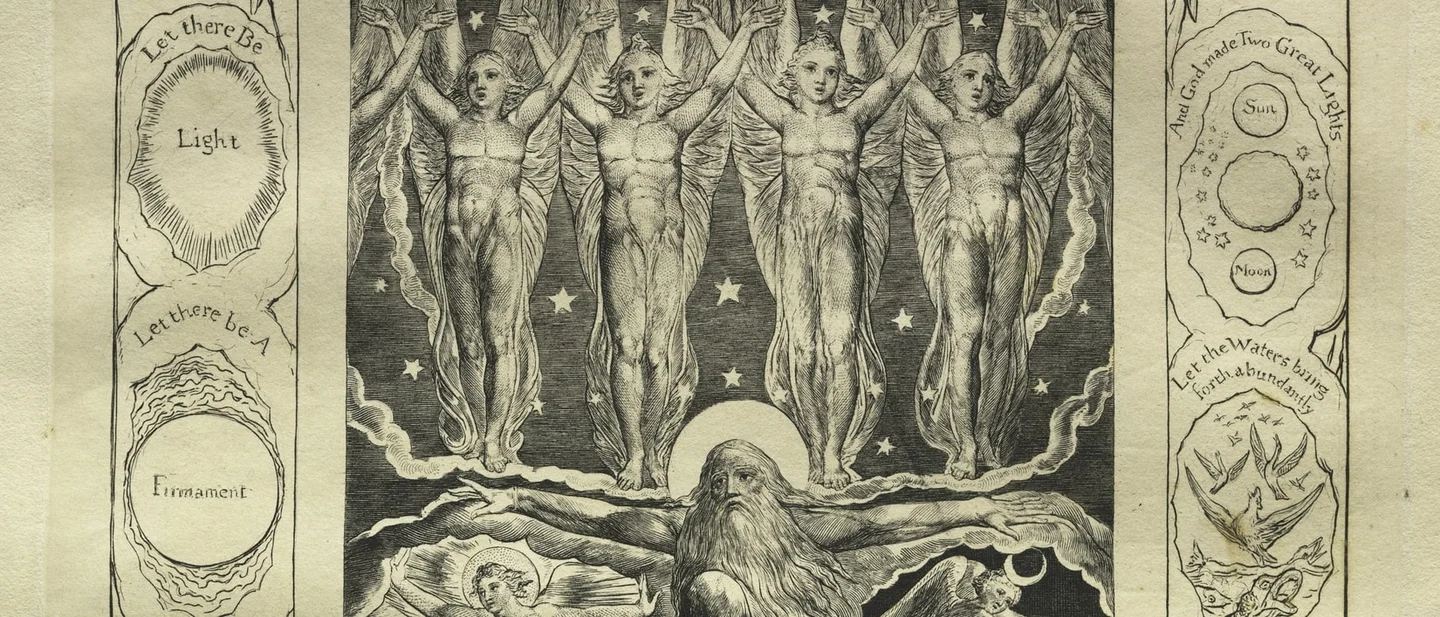
"Where wast thou when I laid the foundations of the earth?": the Book of Job answers a man who has lost everything
Job asks God for a hearing and gets eighteen verses of questions about a world he did not build — a close read of the whirlwind speech, and of what it leaves out.

The Book of Job is anonymous, and its poetry belongs to the Persian period, 540–330 BCE. In the Hebrew Bible it stands among the wisdom writings, the books that ask how a life should be lived and whether the world gives a person what they deserve. Proverbs answers that question with confidence; the long middle of Job argues the other way 1.
The book opens in the heavenly court, where an adversary wagers with God that Job's piety is only a receipt for what he has been given. Job is a rich man in the land of Uz with ten children and large herds. The herds and the servants are taken from him, and a great wind strikes the four corners of the house where his sons and daughters are eating, and the house falls on them 2. His wife tells him to curse God and die. Three friends sit with him for seven days and then begin to argue that nobody suffers without having earned it. Job answers that he has done nothing to deserve this, and asks for a hearing: he wants his case argued in front of God 1.
What he gets is the speech below, spoken out of a whirlwind in chapter 38, and it leaves the case alone. The first words addressed to him are a question — who is this that darkens counsel by words without knowledge — and the questions keep coming for the rest of the chapter. The English is the King James Version of 1611, made by translators instructed to work by formal equivalence, holding as close to the shape of the Hebrew sentence as English would bear 3. Where the Hebrew carries the four-letter divine name, the KJV prints "the LORD", following an old practice of reading "Adonai", "my Lord", in place of the name 4.
Passage
1 Then the LORD answered Job out of the whirlwind, and said, 2 Who is this that darkeneth counsel by words without knowledge? 3 Gird up now thy loins like a man; for I will demand of thee, and answer thou me.4 Where wast thou when I laid the foundations of the earth? declare, if thou hast understanding. 5 Who hath laid the measures thereof, if thou knowest? or who hath stretched the line upon it? 6 Whereupon are the foundations thereof fastened? or who laid the corner stone thereof; 7 When the morning stars sang together, and all the sons of God shouted for joy?8 Or who shut up the sea with doors, when it brake forth, as if it had issued out of the womb? 9 When I made the cloud the garment thereof, and thick darkness a swaddlingband for it, 10 And brake up for it my decreed place, and set bars and doors, 11 And said, Hitherto shalt thou come, but no further: and here shall thy proud waves be stayed?12 Hast thou commanded the morning since thy days; and caused the dayspring to know his place; 13 That it might take hold of the ends of the earth, that the wicked might be shaken out of it? 14 It is turned as clay to the seal; and they stand as a garment. 15 And from the wicked their light is withholden, and the high arm shall be broken.16 Hast thou entered into the springs of the sea? or hast thou walked in the search of the depth? 17 Have the gates of death been opened unto thee? or hast thou seen the doors of the shadow of death? 18 Hast thou perceived the breadth of the earth? declare if thou knowest it all.— The Book of Job (anonymous), chapter 38, verses 1–18, in the King James Version (1611), read in the Project Gutenberg transcription 2
Gloss
- "Gird up now thy loins like a man" — A man in a long robe gathered the hem into his belt when he had to run, fight, or set to work, and gird keeps that sense: "to prepare (oneself) for action", or "to encircle or bind with a flexible band (such as a belt)" 5. The KJV uses the order for someone about to move — Elijah "girded up his loins, and ran before Ahab" (1 Kings 18:46) — and God hands it to Job again at chapter 40, word for word, which makes these the words that frame the whole interrogation 2.
- "the morning stars sang together, and all the sons of God shouted for joy" — "The sons of God" renders bene elohim, the heavenly court. The same phrase appears twice in the book's first two chapters, where that court assembles and the wager over Job is made 26. The line sets the stars beside those beings and gives the laying of the corner stone a choir: the world is founded to music. A Canaanite poem found at Ugarit pairs the same two nouns, "sons of god" and "assembly of stars", which scholars read as the background of the Hebrew image 6.
- "the sea with doors ... a swaddlingband ... bars and doors ... thy proud waves" — Four moves of one metaphor. The sea is born, breaking forth "as if it had issued out of the womb"; then dressed, with cloud for a garment and thick darkness for a swaddlingband; then given a room; then locked in behind bars and a door and told where to stop. The bound sea is one of the KJV's recurring images: God "compassed the waters with bounds" (Job 26:10), set "a bound that they may not pass over" (Psalm 104:9), and put "the sand for the bound of the sea by a perpetual decree", so that the waves "toss themselves, yet can they not prevail" (Jeremiah 5:22) 2. By the last move, the newborn has a keeper and a closed door.
Close read
The device is an answer made of questions. These eighteen verses carry fourteen question marks, and every order in them is an order to speak: "answer thou me" in the third verse, "declare, if thou hast understanding" in the fourth, "declare if thou knowest it all" in the eighteenth. Job asked for a hearing. The hearing opens with an order to stand up and state his case, and the rest of it is interrogatories.
The questions build a map by moving through space. They start at the top, with the foundations of the earth, the measures laid on it, the line stretched over it, the corner stone, and the morning stars singing while that stone is set. Then the sea: born, swaddled, given a place, and locked behind bars and a door. Then the morning, told where to begin, and the ends of the earth it takes hold of. Then two places under everything — the springs of the sea, the gates of death — and last the breadth of the earth. The sweep runs from the top of the sky to the floor of the deep and out to the horizon, and every item on it is somewhere Job has never stood. As questions, the lines ask for facts he cannot supply; as a map, they draw a boundary and leave him outside it.
The first question closes off answering. "Where wast thou when I laid the foundations of the earth?" can be met only by claiming to have been there, so any answer convicts the man who gives it. Job attempts none. At chapter 42 he takes words God used about him and turns them on himself: "Who is this that darkeneth counsel by words without knowledge?" becomes "Who is he that hideth counsel without knowledge? ... therefore have I uttered that I understood not; things too wonderful for me, which I knew not" 2. The echo is exact — "words without knowledge" answered by "that I understood not".
One voice is quoted inside the speech: "And said, Hitherto shalt thou come, but no further: and here shall thy proud waves be stayed." A man has asked to state his case, and the only reported words in the reply are addressed to water. The household goes unmentioned through all eighteen verses — the ten children, the sores, the friends' arguments, the wager in heaven — and the speech offers scale in their place. Something in the book treats that as enough. In the epilogue, God tells Eliphaz that he and his friends have not spoken rightly about him, while Job has 1: the friends are the ones who explained, and the explanation is what gets condemned.
Why it still matters
Ask why something happened, and the answer you get is usually an explanation: a diagnosis, a cause, a mechanism, a schedule. The whirlwind speech works by enlargement. It stands a man who has lost everything in front of the sea's door and the gates of death, and answers his question with the size of the room he has been standing in. Whether that counts as an answer is left where the book leaves it, with the reader.
The same shape arrives today in a letter that answers a complaint with the size of the operation: the volume handled, the procedures followed, the number of cases resolved like this one. Every line of such a reply can be true, and the particular grievance — the ten children of the letter — has no place in it. The passage is worth reading as the most beautiful version of that form, and as a test for recognizing it.
The book's own accounting stays honest about what the speech repaired. Job's herds come back doubled, and ten more children are born to him 1. The ten who died stay dead; the arithmetic is generous and cannot be otherwise. The verdict the book delivers lands on the arguing rather than on the loss: Job, who kept asking, is the one God says spoke rightly.
Reflection
Think of a time you demanded an explanation for something that had happened to you and got, instead of a reason, a description of something larger — a system, a season, a stretch of water. Where does your question sit now?
References
- 1Wikipedia: Book of Job
en.wikipedia.org
- 2
- 3Wikipedia: King James Version
en.wikipedia.org
- 4Wikipedia: Tetragrammaton
en.wikipedia.org
- 5Merriam-Webster: gird
merriam-webster.com
- 6Wikipedia: Sons of God
en.wikipedia.org
This story was produced automatically by a channel. One sentence is all it takes for Neodrop to keep producing for you.