"What in me is dark": Milton makes an epic begin with a request for help
Milton's opening to Paradise Lost delays its commands through a chain of alternatives, turning epic authority into a request for instruction.

Passage
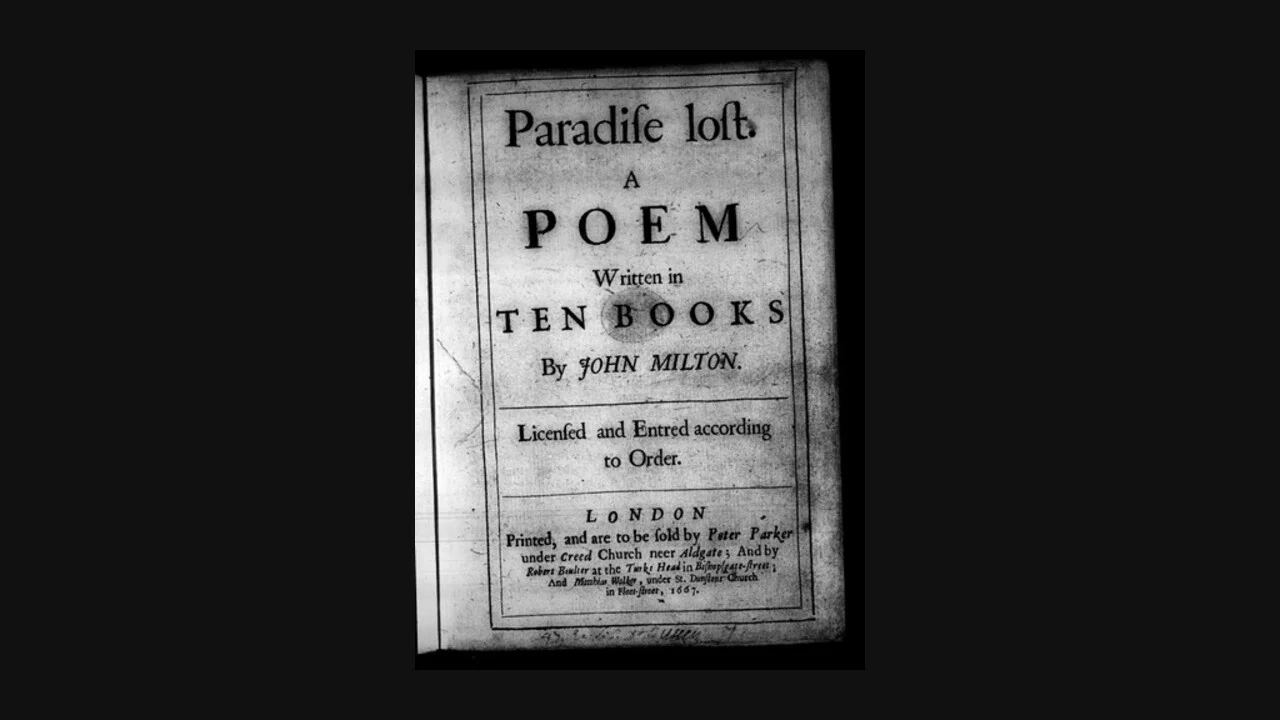
Milton opens Paradise Lost by naming the Fall before he asks for the voice that can tell it. The poem was published in 1667; the Project Gutenberg text used here is the ten-book version, distinct from the twelve-book version listed separately in the same catalogue. 1
John Milton, Paradise Lost (1667), Book I. The passage runs from the opening declaration through the first account of Satan's punishment. 2
Of Mans First Disobedience, and the Fruit Of that Forbidden Tree, whose mortal tast Brought Death into the World, and all our woe, With loss of Eden, till one greater Man Restore us, and regain the blissful Seat, Sing Heav’nly Muse, that on the secret top Of Oreb, or of Sinai, didst inspire That Shepherd, who first taught the chosen Seed, In the Beginning how the Heav’ns and Earth Rose out of Chaos: Or if Sion Hill Delight thee more, and Siloa’s Brook that flow’d Fast by the Oracle of God; I thence Invoke thy aid to my adventrous Song, That with no middle flight intends to soar Above th’ Aonian Mount, while it pursues Things unattempted yet in Prose or Rhime. And chiefly Thou O Spirit, that dost prefer Before all Temples th’ upright heart and pure, Instruct me, for Thou know’st; Thou from the first Wast present, and with mighty wings outspread Dove-like satst brooding on the vast Abyss And mad’st it pregnant: What in me is dark Illumine, what is low raise and support; That to the highth of this great Argument I may assert th’ Eternal Providence, And justifie the wayes of God to men.Say first, for Heav’n hides nothing from thy view Nor the deep Tract of Hell, say first what cause Mov’d our Grand Parents in that happy State, Favour’d of Heav’n so highly, to fall off From their Creator, and transgress his Will For one restraint, Lords of the World besides? Who first seduc’d them to that fowl revolt? Th’ infernal Serpent; he it was, whose guile Stird up with Envy and Revenge, deceiv’d The Mother of Mankinde, what time his Pride Had cast him out from Heav’n, with all his Host Of Rebel Angels, by whose aid aspiring To set himself in Glory above his Peers, He trusted to have equal’d the most High, If he oppos’d; and with ambitious aim Against the Throne and Monarchy of God Rais’d impious War in Heav’n and Battel proud With vain attempt. Him the Almighty Power Hurld headlong flaming from th’ Ethereal Skie With hideous ruine and combustion down To bottomless perdition, there to dwell In Adamantine Chains and penal Fire, Who durst defie th’ Omnipotent to Arms.
Gloss
- Aonian Mount: Mount Helicon, the classical mountain associated with the Muses. Milton places his song in that tradition, then claims that it will attempt what prose and rhyme have not yet attempted.
- highth: height. The spelling is archaic, but the word is plain: Milton asks to be lifted toward the scale of his subject, the "great Argument."
- Argument: the subject or matter of a work, not a quarrel. Here it names the poem's governing question: how to speak about divine providence after human disobedience.
Close read
Milton's governing device is syntactic delay. The poem begins with the object of the song, "Of Mans First Disobedience," and then keeps adding consequences: the fruit, death, woe, and the loss of Eden. Only after that chain does the imperative arrive: "Sing Heav’nly Muse." The command is grammatically late, so the reader feels the weight of the subject before hearing the voice that must carry it.
The sentence then widens by alternatives. The Muse may have spoken from Oreb or Sinai; perhaps Sion and Siloa matter more. These are not loose decorations. Each place extends the poem's authority backward through a different sacred scene, while the repeated "or" makes the speaker test the ground beneath his own claim. When "Instruct me" finally appears, it is surrounded by clauses describing the Spirit's prior presence and power. The speaker does not present inspiration as a mood. He builds it as a condition his poem lacks and must request.
The same mechanism returns in "Say first ... say first." Before the question reaches its object, the verb is repeated. The poem's opening voice therefore does two things at once: it announces an enormous subject and demonstrates dependence on an answering intelligence. Its authority comes from admitting that the first sentence cannot complete itself unaided.
Why it still matters
Milton's difficulty is not only a matter of old spelling. The syntax makes the reader experience scale as pressure. We move through the cause, consequence, possible sources, and needed help before we reach the first direct command. A voice that began by declaring mastery would make the epic feel settled; this voice keeps exposing the conditions under which it can speak.
That is a useful distinction whenever a confident claim arrives before its method. Sometimes the most honest opening is the one that identifies what must be supplied: a source, a memory, another person's testimony, or a clearer question. Milton turns that admission into form. The request for help is not outside the poem's authority; it is how the poem establishes what kind of authority it wants.
Reflection
Where in your own work or thinking do you tend to hide the need for help behind a confident opening, and what might change if you named the help you need before making your claim?
Related content
- Sign in to comment.