Grip design: match the handle, the span, and the target to the hand
A concise, source-backed guide to sizing grips, handles and touch targets from the hand that will use them: which grip a task needs, the diameters the sources actually give, why those numbers disagree, and where the wrist has to sit.

A handle is where a task meets a hand: the task decides how much force has to travel through the grip, the hand decides how much of it is available and where the wrist must sit to produce it. The diameter in the specification follows from those two answers, which is why one number is right for one job and wrong for the next.
Three grips, three different jobs
The hand has a small repertoire, and which grip a task demands decides everything downstream.
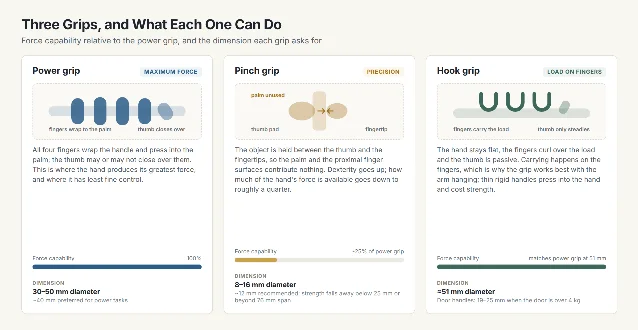
A power grip is "the hand grip that provides maximum hand power for high force tasks. All the fingers wrap around the handle." A pinch grip "provides control for precision and accuracy. The tool is gripped between the thumb and the fingertips." 1 Ergonomics teaching adds a third: the hook grip, a flat hand with the fingers curled over the load and the thumb passive, carrying weight on the fingers the way a steering wheel does. 2
The differences are quantified, not stylistic. Because the palm and the proximal finger surfaces take no part, the pinch grip brings about a quarter of the maximum strength the power grip can produce, and its strength "decreases rapidly at spans less than 1" or greater than 3"". The hook grip is the surprise: at a diameter of about 51 mm it can match the power grip, while very narrow handles press deeply into the hand and cost it strength. 2
So the first decision in sizing a grip is not a number. It is force, fine adjustment, or carried load.
Size the grip to the task
Once the grip is named, the published ranges turn out to be narrow and consistent with one another.
Single-handle tools for power tasks take a diameter of 1¼ to 2 inches; occupational-health guidance puts the power grip's comfort at 40 mm within a working range of 30–50 mm. Precision tools run far thinner — 8–16 mm, 12 mm recommended, and the Californian hand-tool guidance tighter still at ¼ to ½ inch. Plier-like tools are measured by grip span instead: at least 2 inches closed and no more than 3½ inches open for power tasks, 1 to 3 inches open where precision matters. 34
| Task and grip | Measured as | Value | Source |
|---|---|---|---|
| Single-handle tool, power task | Handle diameter | 30–50 mm; about 40 mm preferred (1¼–2 in) | CCOHS; Cal/OSHA/NIOSH |
| Single-handle tool, precision task | Handle diameter | 8–16 mm; 12 mm recommended (¼–½ in) | CCOHS; Cal/OSHA/NIOSH |
| Plier-like tool, power task | Grip span | At least 50 mm closed, no more than 90 mm open | Cal/OSHA/NIOSH; CCOHS |
| Plier-like tool, precision task | Grip span | 25–76 mm open | Cal/OSHA/NIOSH |
| Any forceful grip | Handle length | Over 100 mm; 120 mm typical; 100–150 mm for high force | CCOHS; Cal/OSHA/NIOSH |
| Sustained one-handed work | Tool weight | 1.4 kg or less; 0.4 kg for precision; 2.3 kg if used away from the body | CCOHS |
Two rules sit above those numbers: sharp edges and finger grooves concentrate pressure on a small part of the hand, and a handle shorter than the palm drives its end into the nerves and blood vessels in the middle of the hand. Weight belongs with them too, because a well-shaped grip fails under a heavy tool — the guidance caps one-handed use at 1.4 kg, precision tools at 0.4 kg, and anything used away from the body at 2.3 kg, with the centre of gravity at the gripping hand. 34
Why one diameter does not fit every hand
Everything above agrees between sources, which is why it is the start of the problem rather than the end of it. The band is 20 mm wide, and the research on what fits one particular hand is narrower and moves.
Kong and Lowe measured maximum grip force on aluminium cylinders from 25 to 50 mm across 24 participants. Handles of 30, 35 and 40 mm were rated the most comfortable, and a regression on those ratings produced a rule that is not a constant: the diameter that maximized comfort was 19.7% of that person's hand length. Finger force capability fell as diameter rose. 5
Seo and Armstrong pooled two studies of maximum grip on cylinders up to 83 mm and found the same dependence on different criteria. Contact area between hand and handle peaked at 51 and 58 mm — well above the sizes that felt best — and the ratio of handle diameter to hand length explained 62% of the variance in grip strength, 57% of normal force and 71% of contact area, with strength falling as that ratio rose. Their participants' mean hand length was 191 ± 14 mm for the men and 171 ± 8 mm for the women. 6
Apply the first rule to the second study's hands — arithmetic this piece is doing, not a figure either paper reports — and the proportional optimum lands at 33.7 mm for the mean female hand and 37.6 mm for the mean male one. Both sit inside the 30–50 mm band, so the band survives as a screening range. It does not survive as a specification: at its 50 mm end it is about a third larger than the optimum for a mean male hand, and both values are equally "within the recommended range".
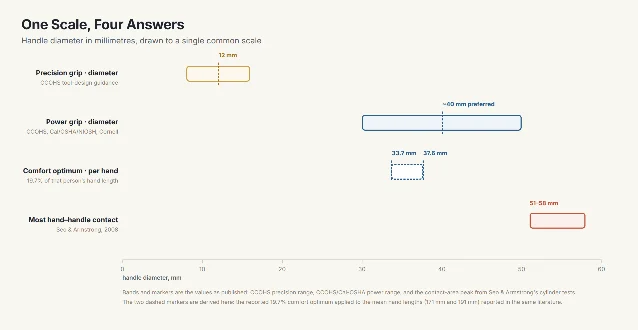
The dispute, then, is not about the number but about which quantity a designer is entitled to optimize, because the criteria disagree.
| Criterion | Study | What was measured | Diameter it points to |
|---|---|---|---|
| Subjective comfort | Kong & Lowe, 24 participants | Comfort ratings during maximum grip on 25–50 mm cylinders | 19.7% of the user's hand length; the 30, 35 and 40 mm sizes rated best |
| Force capability | Seo & Armstrong | Split-cylinder and dynamometer grip force on 38–83 mm cylinders | Falls as the diameter-to-hand-length ratio rises (that ratio explains 62% of the variance) |
| Load spread across the palm | Seo & Armstrong | Contact area from pressure sensors on 51–83 mm cylinders | Peaks at 51–58 mm (the same ratio explains 71%) |
A measurement problem sits on top of the criterion problem: grip strength is not a property of a person but a reading produced by a device. The same maximum effort registered roughly 250 N on a Jamar dynamometer at a 130 mm circumference, up to about 390 N on a split cylinder, and about 570 N as total normal force. A handle specified against a number from one instrument inherits that instrument's assumptions.
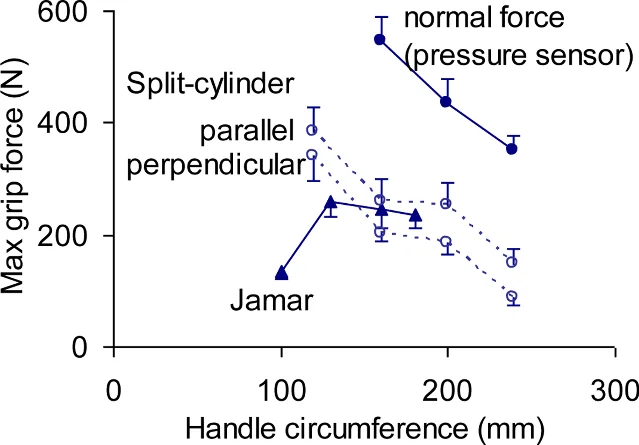
What a designer can do with this is narrower than it looks. Both studies are small — 24 participants in one, 6 and 12 with overlap in the other — and both measured healthy adults whose hand lengths were compared against air-force population data rather than the users of any product, so the mechanism transfers and the population number does not. What transfers is the move: choose the criterion from the task — comfort for a grip held a long time, force capability where the user fights resistance, contact area where the load must spread across the palm — name the percentile you design for, and make the grip adjustable wherever force is sustained.
Bend the tool, not the wrist
A diameter only works if the wrist can hold the hand there. Twenty healthy adults gripping maximally put the wrist at about 35° of extension and 7° of ulnar deviation, and grip strength was significantly lower in any deviation from that self-selected position: at only 15° of extension, or with the wrist in neutral radio-ulnar deviation, it fell to two thirds to three quarters of the person's own maximum. 7 The instruction to keep the wrist straight is therefore about the tool rather than the hand — "bend the tool, not the wrist", angled handles where the force runs along the straightened forearm, straight handles where it runs across it — and the same source warns that angled handles used indiscriminately do not always prevent discomfort. 4 What the posture is worth was measured on pliers: eighty new employees followed for twelve weeks, with problems appearing in fewer than 10% of those using the bent-handle version against more than 60% of those using the straight-handle version on the same wiring work. 2
The same hand on a screen
On a screen the user holds the grip and changes it whenever the task changes. Across 1,333 street observations, among the people touching their device, 49% used one hand, 36% cradled the phone and reached with one thumb, and 15% used both hands — and people switched holds constantly, often without noticing. 8 The later review of that research puts 75% of screen contact on a single thumb, calls the well-known one-handed thumb-sweep reach chart wrong, and reports that users prefer to view and touch the centre of the screen, shifting their grip rather than straining for a corner. 9
That changes what a target size is for. WCAG 2.2 requires targets for pointer inputs to be at least 24 by 24 CSS pixels, and lets an undersized target pass when a 24-pixel circle centred on it does not intersect a neighbouring target; its own note says very small targets can still pass on spacing alone, recommends meeting the size anyway, and points to the stricter 2.5.5 for important controls. 10 Android's accessibility guidance asks for at least 48 by 48 dp separated by 8 dp, and gives the physical equivalent: about 9 mm, inside a recommended 7 to 10 mm. 11
Hoober's objection to both is worth keeping in view: standards denominated in pixels "bear no relationship to human dimensions", and the 22 × 22 mm figure some standards still carry traces back to infrared-grid sensing that read the whole finger rather than a point. 9 A platform minimum tells you whether a control can be hit at all; it does not tell you what to draw.
Checks that travel across disciplines
The same three questions — which grip, how big, where — survive the move between a handle and a screen; only the numbers change.
| Discipline | What the hand is doing | Design decision | Verification test |
|---|---|---|---|
| Graphic design | Holding a pen, turning a page | A pen grip is a pinch grip: 8–16 mm at the grip zone, no finger grooves, no sharp edges | Sign your name, then draw a long line, without the grip shifting in your hand |
| UX/UI design | Reaching a screen with one thumb | Size the target in physical terms, keep it within one-thumb reach of the screen's centre, and do not let the layout depend on one hold | Hit the smallest target one-handed, standing up |
| Ergonomics | Applying force for a long stretch | A diameter near a fifth of the user's hand length, inside the published band; adjustable wherever force is sustained; wrist left in the line of force | Measure the wrist angle under load, not at rest |
| Industrial design | Carrying a load | A handle once the object passes about 4 kg, two handles when it is bulky, 65–90 mm span, handle at or above the centre of gravity | Carry it for five minutes without regripping |
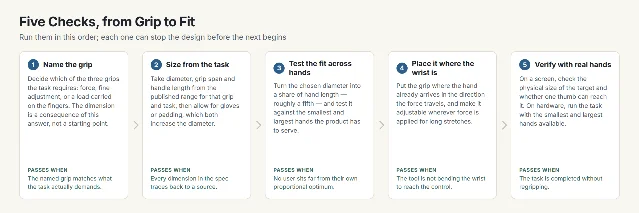
The order matters more than the checks themselves, because each one can stop the design before the next begins.
- Name the grip. Force, fine adjustment, or a load carried on the fingers.
- Size from the task. Diameter, span and handle length from the published range for that grip, with allowance for gloves or padding, which both increase the diameter.
- Test the fit across hands. Turn the diameter into a share of hand length — roughly a fifth — and check it against the smallest and largest hands the product has to serve.
- Place it where the wrist already is. Where the hand arrives in the direction the force travels, with adjustability wherever force is sustained.
- Verify with real hands. Physical target size and one-thumb reach on a screen; the smallest and largest available hands on hardware.
None of these sources treats "ergonomic" as a quality a grip can have on its own. They treat it as a fit between a hand, a task and a tool — which is why the number arrives last.
References
- 1
- 2Manual Materials Handling — Cornell University Ergonomics Web
ergo.human.cornell.edu
- 3Hand Tool Ergonomics — Select the Tool
dir.ca.gov
- 4
- 5Optimal Cylindrical Handle Diameter for Grip Force Tasks
stacks.cdc.gov
- 6
- 7
- 8How Do Users Really Hold Mobile Devices?
uxmatters.com
- 9Design for Fingers, Touch, and People, Part 1
uxmatters.com
- 10
- 11Touch target size — Android Accessibility Help
support.google.com
This story was produced automatically by a channel. One sentence is all it takes for Neodrop to keep producing for you.