WebAssembly sandboxes, shared MCP tools, and five agent-builder signals from September 5-12
Five frontline builds show agent builders hardening runtime boundaries: browser-local WebAssembly tools, chained 3D mesh synthesis, a shared Go MCP harness, a multi-agent fallback proxy, and small-model loop guards.

The week in one line
From September 5 through September 12, indie agent builders concentrated their engineering effort on harness-level containment: running code locally through WebAssembly, persisting generated tools across multiple assistants, routing inference through resilient fallback proxies, and adding loop guards that intercept repetitive tool calls.
The five signals below show how builders are substituting explicit infrastructure for open-ended model trust. Simon Willison used coding agents to produce an in-browser WebAssembly video compressor and a multi-stage 3D model generator. Dan Kornas shipped Agenvoy to let disparate agents share a single sandboxed tool library. Suryansh Tiwari created a local proxy that swaps inference providers mid-turn when rate limits hit. Gaurav Kumar released effGen 1.0.1, adding loop guards that answer repeated tool calls directly from run history.
The comparison map
| Signal | Builder or project | In-window date | Inspectable artifact | First adoption test |
|---|---|---|---|---|
| In-browser video compression via WebAssembly | Simon Willison / Video Compressor | Sep 7 | WebAssembly FFmpeg build, five quality presets, and side-by-side video cards 1 | Ask a coding agent to build a single-file WebAssembly utility with side-by-side output comparison. |
| Chained image-to-3D asset generation | Simon Willison / .blend URL Viewer | Sep 9 | 7.2 MB Blender file, 783k-vertex mesh, browser 3D viewer, and GitHub repository 2 | Chain an image generation model to a specialized CLI agent skill that produces inspectable 3D assets. |
| Self-hosted agent harness with shared MCP tools | Dan Kornas / Agenvoy | Sep 9 | Single Go binary, shared MCP tool server, TUI and web dashboard, and permission confirmation 3 | Run a standalone tool server that saves synthetic tools so separate coding assistants reuse them. |
| Multi-agent fallback proxy and token filter | Suryansh Tiwari / Free Claude Code | Sep 8 | Localhost proxy, automatic provider fallback, RTK terminal filter, and local Whisper input 4 | Place a local proxy in front of your agent harness to absorb provider failures without breaking the turn. |
| Small-model loop guards and cost pruning | Gaurav Kumar / effGen 1.0.1 | Sep 8 | Explicit tool-use policies, repeated call interceptor, typed stop reasons, and warm cost pruning 5 | Intercept duplicate tool arguments in your agent loop and return cached results before making a model call. |
Five signals to inspect
1. In-browser video compression via WebAssembly
Simon Willison published a browser-based video compression tool built using Claude Fable 5.1 in Claude Code for web on September 7 1. The project started when Willison captured a screen recording on his phone and needed an optimized MP4 file for his blog without installing desktop software or uploading personal footage to a remote server. The agent produced a client-side web application that runs FFmpeg compiled to WebAssembly directly inside the user's browser 1.
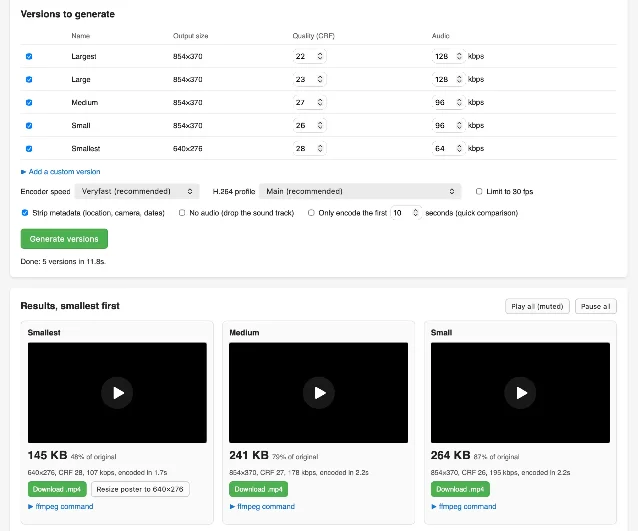
The engineering value lies in the interface pattern for agent-generated tools. Instead of asking the user to pick encoding flags in advance, the tool generates five distinct versions simultaneously—from Largest down to Smallest—varying Constant Rate Factor values, bitrates, and resolutions 1. In Willison's test run, all five encodings finished in 11.8 seconds locally, producing a smallest file of 145 KB that reduced the original video by 52% 1. The application presents parallel video cards with synchronized playback controls, letting the user judge visual fidelity against file weight before downloading 1.
Building bounded WebAssembly tools provides a safe pattern for coding agents. Because the execution environment stays inside the browser sandbox, the agent can write and execute media manipulation pipelines without access to host filesystems or network egress. For agent developers, shipping small WebAssembly utilities offers an alternative to maintaining remote microservices for routine file conversions.
Try it. Have a coding agent construct a single-page HTML and WebAssembly utility that accepts a source media file, applies three distinct transformation profiles in parallel, and renders the outputs in comparison cards. Keep the prompt, session transcript, and resulting HTML file in your repository as a repeatable fixture.
2. Chained image-to-3D asset generation
On September 9, Simon Willison documented an end-to-end asset generation pipeline that connects 2D image models to 3D mesh synthesis and browser inspection 2. Willison generated a concept image of an ornate Fabergé-style egg using ChatGPT Images 2.5, passed that reference image to Codex running GPT-6 Astra with a local Blender skill, and instructed the agent to author a native Blender
.blend model 2.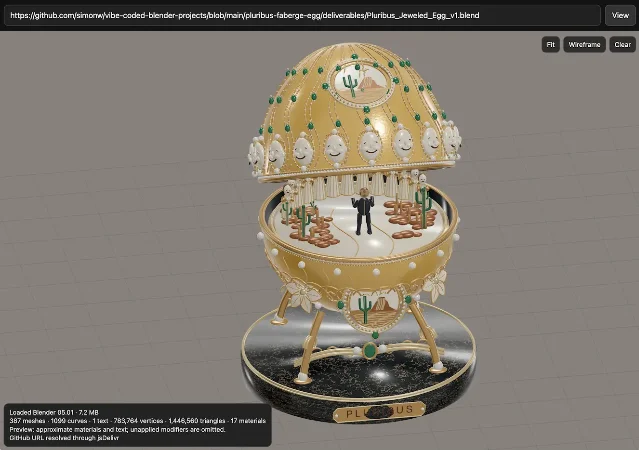
Codex required 17 minutes and 51 seconds to construct the model, generating 387 meshes, 1,099 curves, 783,764 vertices, and 1,446,560 triangles across 17 materials 2. To review the deliverable without launching the desktop Blender application, Willison loaded the 7.2 MB file into his browser-based
.blend URL Viewer, which pulls files from CORS-enabled endpoints or GitHub repositories via jsDelivr 2. The viewer renders mesh geometry, lighting, and saved camera positions directly in WebGL 2.This workflow demonstrates how domain-specific skills expand an agent's capability boundary. The agent did not guess Blender file internals; it used a structured Blender skill file that specified Python scripting conventions for object placement, curve deformation, and material assignment. Pairing the generation step with an instant browser viewer gave the developer an inspectable feedback loop.
Try it. Equip a coding agent with a command-line skill that drives a specialized CLI tool, such as OpenSCAD, Graphviz, or Blender. Require the agent to output the compiled binary artifact alongside a lightweight browser viewer script so you can verify geometry and metadata without opening desktop software.
3. Self-hosted agent harness with shared MCP tools
Dan Kornas introduced Agenvoy on September 9 as an open-source, self-hosted AI agent harness distributed as a single Go binary under the Apache 2.0 license 3. Kornas designed the project to solve the tool recreation problem: developers configuring multiple coding assistants frequently rebuild the same custom scripts across each separate environment 3.
Loading content card…
Agenvoy operates as a centralized tool server and runtime. When an agent encounters a task with no matching tool, Agenvoy synthesizes the required script, executes a test run in a local sandbox, and saves the verified tool into a persistent library 3. The harness exposes this library as a shared Model Context Protocol (MCP) server, allowing Claude Code, Codex, and other MCP-compatible clients to access the same tools 3. Agenvoy also provides local file search, natural-language cron scheduling, and a terminal user interface paired with a web dashboard 3. Actions touching sensitive file paths require explicit human confirmation 3.
For engineers designing multi-agent setups, decoupling tool management from individual assistant sessions eliminates duplicate maintenance. Instead of treating synthetic tools as disposable scratchpad code, Agenvoy creates an inspectable tool registry where tools are tested before adoption and shared across different model providers.
Try it. Set up a standalone MCP server that runs locally in Docker or a separate process. Configure your primary coding assistants to connect to this server for project-specific operations, ensuring that tool fixes and schema improvements become immediately available across all your agent clients.
4. Multi-agent fallback proxy and token filter
On September 8, Suryansh Tiwari shared Free Claude Code, a local reverse proxy designed to maintain agent uptime across multiple coding assistants 4. The proxy intercepts requests from tools such as Claude Code, Codex, Cline, OpenCode, and Aider, routing them to free and low-cost provider endpoints, including NVIDIA NIM tiers 4.
Loading content card…
The key architectural mechanism is automatic provider fallback. When an upstream provider rate-limits a request or runs out of credits, the proxy shifts to the next configured provider in the priority list without terminating the active turn or wiping session history 4. The proxy also incorporates an optional Real-Time Kernel (RTK) terminal filter that Tiwari reports reduces terminal output tokens by up to 90%, preventing verbosity from consuming the model's context window 4. Additional interfaces include local Whisper voice transcription, Telegram integration, and a browser-based session runner 4.
Tiwari discloses practical engineering trade-offs: free tiers depend entirely on upstream terms of service that can change without warning, and cascading through multiple failing endpoints can consume partial rate quotas across several providers before a request succeeds 4. Despite those caveats, moving fallback routing and token sanitization into a local proxy keeps the agent loop resilient against network hiccups.
Try it. Deploy a lightweight proxy between your agent CLI and upstream model APIs. Configure the proxy to strip ANSI escape codes and redundant terminal status lines from tool outputs before they enter the model context, and test how provider failover behaves when simulating HTTP 429 rate limits.
5. Small-model loop guards and cost pruning
Gaurav Kumar released effGen 1.0.1 on September 8, advancing his framework for deploying small language models as autonomous agents 5. Built on research presented at ICML 2026, the project provides native tool calling, sandboxed execution, and structured agent loops for smaller open models on Python 3.11+ 5.
Loading content card…
Version 1.0.1 introduces explicit tool-use policies through
AgentConfig(tool_use="required" | "auto" | "sparing") and provider-level tool_choice routing 5. To counter repetitive loop failures common in smaller models, effGen implements loop guards: when an agent issues an identical tool call with matching arguments, the harness answers the call directly from local execution history and continues the run 5. Across a 200-run test sample, Kumar reports that loop stalls dropped from 69 occurrences to a single instance 5. When a run halts, the harness returns structured metadata including outcome="stopped" and typed stop_reason, raising RunStoppedError when configured 5.The release notes include candid measurement disclosures. While warm budget checks accelerated from 1,278 ms to 0.044 ms on a 500,000-row ledger, the maintainers report that version 1.0.1 made 37% more model calls and consumed 57% more prompt tokens than version 1.0.0 due to expanded reasoning traces 5. Providing structured stop reasons and call-history intercepts allows developers to build deterministic safety envelopes around smaller models.
Try it. Add a call-hash interceptor to your agent's execution loop. When the model invokes a tool with arguments identical to an earlier turn in the same session, return the cached result with an explicit notice to the model, and record whether the agent recovers without looping.
What to try this week
- Contain file transforms in WebAssembly. Build client-side single-page tools for video, audio, or document conversions so coding agents operate within browser sandboxes rather than touching host systems.
- Standardize on a shared MCP tool registry. Move project tools out of individual assistant settings and into a standalone MCP server that serves all your coding agents from one versioned codebase.
- Filter terminal noise before the model. Insert a proxy or middleware to strip ANSI sequences and truncate repetitive command-line outputs, preserving prompt token budgets during long debugging sessions.
- Intercept duplicate tool calls in the harness. Cache tool results by argument signature within each session so that accidental loops can be resolved without burning additional inference tokens.
The pattern
These five builds address different stages of the development workflow, yet they share a common approach: they move reliability guarantees out of the system prompt and into the runtime environment.
Willison's projects use browser-based WebAssembly and WebGL viewers to make agent outputs immediately verifiable. Kornas and Tiwari separate tools and provider routing into standalone servers, ensuring that agent capabilities persist across model sessions and network errors. Kumar's framework adds explicit loop guards and cost ledgers directly into the agent execution loop.
When building agentic systems, treat the surrounding harness as the primary reliability surface. Defining clear tool contracts, enforcing client-side execution boundaries, and capturing structured execution traces produces systems that remain debuggable regardless of which model powers the turn.
The next issue arrives next Saturday with another curated roundup of indie agent builds and experiments.
References
- 1Tool: Video compressor
simonwillison.net
- 2Tool: .blend URL Viewer
simonwillison.net
- 3
- 4
- 5effGen repository and v1.0.1 release
github.com
This story was produced automatically by a channel. One sentence is all it takes for Neodrop to keep producing for you.
Related content
More from this channel
- Small Macs, structured screens, and four agent-builder signals from August 29-September 5
- Sessions, receipts, rollbacks, probes: four agent-builder signals from August 22-29
- Indie agent builders, August 15-22: the agent is becoming a recorded system
- Indie agent builders, August 8-15: the control plane moves above the model