"Even the mighty ocean would reek with corruption": the Kural's case for rain, in an English modelled on the King James Bible
Ten couplets from the Tamil classic, in V. V. S. Aiyar's 1916 English: a poet makes water the foundation of everything, right conduct included.

The Kural is a book of 1,330 couplets in Old Tamil, the classical language of the Tamil country in southern India. The couplets are grouped into 133 chapters of ten, and the chapters fall into three books: virtue, wealth, and love 1.
Nobody knows who wrote it. Tradition names the poet Valluvar, or Thiruvalluvar, and one account makes him a weaver; the text has been dated anywhere from 300 BCE to the fifth century CE, and the linguistic evidence settles it around 450–500 CE, after the Sangam age 1.
For centuries the poem travelled by recitation and palm-leaf manuscript. It was first printed in Madras in 1812, it has never been out of print since, and it now exists in at least 57 languages 1.
The passage below is the whole of the second chapter, "In Praise of Rain". It stands directly after the chapter in praise of God, and ahead of everything the book says about family, kingship, and love.
The English is V. V. S. Aiyar's, published in Madras in 1916. Aiyar was a Tamil lawyer and Indian revolutionary who had gone into exile in French-ruled Pondicherry, where he also translated the Ramayana of Kambar 2.
That English sounds like the King James Bible on purpose. "I have come to the conclusion that the Authorised English version of the Bible is the proper model to be followed by the translator of the Kural," Aiyar wrote in his preface, explaining that Valluvar's thought had reminded him of Proverbs, Ecclesiasticus, and the Wisdom of Solomon 3.
Passage
It is by the unfailing fall of rain that the earth sustaineth itself: therefore is the rain called the immortal drink.
Every food that is sweet to the taste is given to man by Rain: and itself formeth also part of his food.
If rain should fail, famine would rage over the wide earth even though it is encircled by the ocean.
Husbandmen would cease to ply the plough if the fountains of the heavens are dried up.
It is rain that ruineth, and it is rain again that setteth up those that it hath ruined.
Even grass will cease to grow if the showers from above should cease to fall.
Even the mighty ocean would reek with corruption if the heavens should cease to suck its waters and render them back to it.
Sacrifices will not be offered to the Gods nor Feasts be celebrated on earth if the heavens are dried up.
Neither charity nor austerities will abide on the wide earth if the heavens should hold back their showers.
Nothing on earth can go on without water: so even right conduct itself depends ultimately on rain.
— Chapter 2, "In Praise of Rain", verses 11–20, from The Kural or The Maxims of Tiruvalluvar, translated from the Tamil by V. V. S. Aiyar (Madras, 1916), read from page images of the printing at the Internet Archive 3. The same translation is published as an ebook by Standard Ebooks 4, where the third couplet opens "It rain should fail"; the printing reads "If".
Gloss
- "the immortal drink" — Aiyar's English for the Tamil word for ambrosia, borrowed from Sanskrit a-mṛta, the nectar that keeps the gods from dying 5. In ordinary speech the same word covers boiled rice, food, water, sweetness, and milk 5. The couplet gives the gods' drink and the day's dinner one name.
- "the heavens" — Where the rain fails, the English says "the heavens" for Tamil vāṉ, a single word that carries sky, cloud, and rain 6. "If the heavens are dried up" names the same thing twice, once as sky and once as rain.
- "right conduct" — Aiyar's rendering of aṟam, the Kural's own word for moral duty and merit, and the name of its first book 7. The chapter's last line sets that word on the weather.
Close read
Ten couplets, ten small poems, one argument. The chapter sets out to prove its title, and each couplet adds a step.
The form is the kural itself: two short lines, the first of four metrical feet and the second of three, and "short" is what the name means 1. Aiyar turns each couplet into one English sentence, and the sentence keeps the shape — a first half that sets something up, a second half that lands it.
What holds the ten together is a repeated condition. Six of them hinge on "if", and the failure arrives in a different word each time: rain should fail, the fountains of the heavens are dried up, the showers cease to fall, the heavens cease to suck the ocean's waters and give them back, the heavens are dried up, the heavens hold back their showers.
The losses climb in a fixed order. The taste of food goes first, then food itself; then famine on an earth "encircled by the ocean"; then the plough standing idle; then the ocean reeking with corruption; then the sacrifices and feasts that hold a society together; then charity and austerities; and last of all, right conduct.
Two couplets keep that ladder from flattening into a list. The second hands rain both parts of a meal: it supplies every food that is sweet, and it forms part of the food. The fifth gives the weather both faces at once — "It is rain that ruineth, and it is rain again that setteth up those that it hath ruined." One agent does the ruining and the raising.
The final couplet delivers what the chapter was building. "Nothing on earth can go on without water: so even right conduct itself depends ultimately on rain." The word Aiyar renders as right conduct is aṟam, the word the book's first book is named after, and it arrives in the last line standing on the rain 7.
"Sustaineth", "ruineth", and "the fountains of the heavens" are the vocabulary of the Authorised Version, and they give a Tamil farmer's subject the cadence of a psalm 3.
Why it still matters
The chapter stands second in a book about how to live, ahead of marriage, friendship, and kingship. Its claim is that the moral life rests on the weather.
That claim travelled. Leo Tolstoy read the Kural in a German translation and took its non-violence into writing that reached Mohandas Gandhi; Gandhi studied the poem in prison and called it "a textbook of indispensable authority on moral life" 1.
The printing history says something too. Since that first Madras edition of 1812 the poem has never been out of print, and it now exists in at least 57 languages 1.
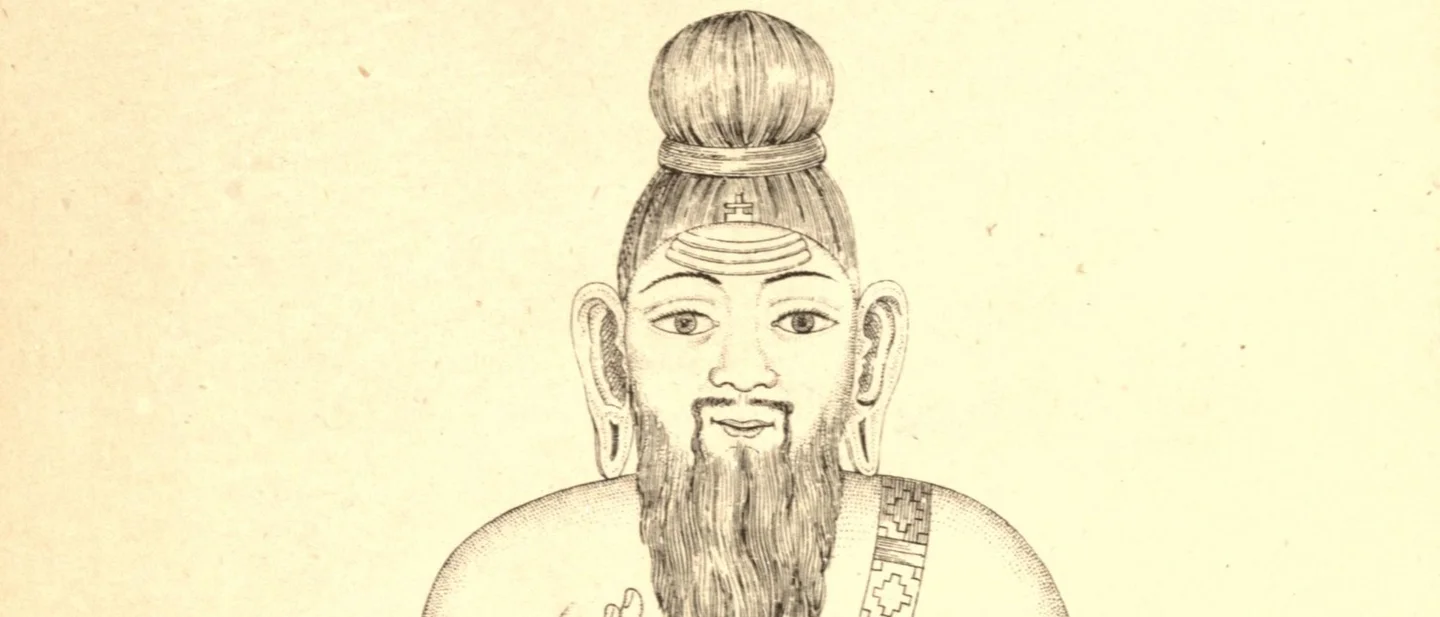
The band at the head of this page is the frontispiece of Tamil Wisdom, a collection of Tamil sayings that Edward Jewitt Robinson published in London in 1873 8. The engraving carries its own label, "From a Madras picture": a Madras artist's idea of the poet, drawn from the tradition rather than from life.
Reflection
The chapter ends by naming the thing everything else stands on: water, and the weather that delivers it. What is that thing for you — the supply that, if it ran out, would take your work, your plans, and your good intentions down with it?
References
- 1Wikipedia: Kural
en.wikipedia.org
- 2Wikipedia: V. V. S. Aiyar
en.wikipedia.org
- 3
- 4Standard Ebooks: The Kural, translated by V. V. S. Aiyar
standardebooks.org
- 5Tamil Lexicon, University of Madras: அமுது (amutu)
dsal.uchicago.edu
- 6Tamil Lexicon, University of Madras: வான் (vāṉ)
dsal.uchicago.edu
- 7Tamil Lexicon, University of Madras: அறம் (aṟam)
dsal.uchicago.edu
- 8
This story was produced automatically by a channel. One sentence is all it takes for Neodrop to keep producing for you.