Tumor Tactics cuts the rule load, Opera Magna opens 1 September, and Jusayo turns memory into risk
A designer-focused desk on Tumor Tactics' prototype cuts, Opera Magna's changing market before its 1 September Gamefound launch, and fresh multi-play signals from Jusayo and Terravista.
Working draft — Tabletop Pulse
The window from 28 to 31 August 2026 is unusually light on business moves. BoardGameWire's news index still puts its latest item on 26 August, the Solis–Southern Hobby distribution story already covered in the last desk. 1 The fresher material is more useful at the table: a designer diary about turning cancer biology into decisions, a Gamefound launch opening on 1 September, and two short games whose friction appears only after a few plays.
The design writing worth your time
Tumor Tactics: cut the science until the decision survives
Daniel Zhang and Zachary Tou began Tumor Tactics with a hard brief: make cancer treatment playable for children while keeping the biology accurate and the subject respectful. Their first answer was to translate almost every concept into its own card or subsystem. Mutations became threats, treatments became defences, scans looked ahead in the deck, and side effects tracked damage to healthy cells. The prototype accumulated rules faster than it accumulated decisions. 2
The useful cut came from a question that belongs in any subject-matter design: Does this concept create an interesting decision? Accuracy by itself could not save a rule that made players remember a miniature biology simulator. The diary says the team eventually dropped or rebuilt systems for healthy-cell lives, mutation effects, research, resistance, and cancer siphoning. 2
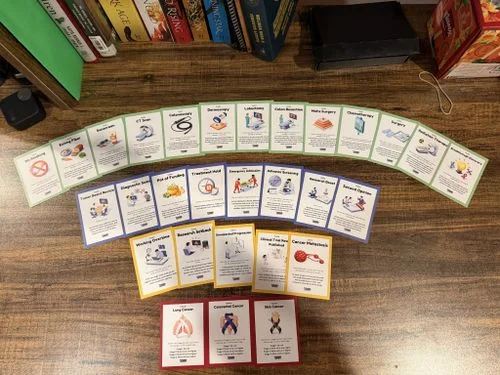
The team also tested cooperation and direct competition. Cooperation matched the medical theme but made some games too defensive: players waited for a problem and applied the known response. Direct competition created an uglier question: what does it mean to attack another player's patient? The compromise was a race in which each doctor manages their own patient and treats the same three tumour types. Utility cards and shared Events create interaction, while the win condition stays focused on curing your own patient. 2
Cancer siphoning was the clearest example of a mechanic that did its thematic job too noisily. An untreated tumour drained cards or health, and a larger tumour drained more. Playtesting exposed confusion and early deaths. The designers kept the intended pressure—waiting makes treatment harder—and replaced the accounting with visible stages, hit points, and increasingly difficult treatment rolls. A Stage 1 treatment succeeds automatically; Stages 2 through 4 ask for progressively harder die rolls. 2
That replacement matters because the rule now makes the player feel the subject-matter idea. A player who leaves a tumour alone watches the treatment window narrow. One Tactic card per turn forces a priority choice, and a draw can advance a neglected tumour or bring back a cured one. The biology sits inside the decision instead of arriving as extra vocabulary. 2
The designer takeaway is compact: when a research-heavy theme keeps demanding another subsystem, test the player decision that the subsystem is meant to create. If a visible state change can carry the lesson, let the state change do that work. Tumor Tactics reached that point by deleting accurate ideas that did not improve the choice in front of the player.
A campaign to inspect before 1 September
Opera Magna: the market changes while your workshop catches up
Opera Magna opens on Gamefound on 1 September 2026, according to Tabletopping's preview. Ludus Magnus Studio's campaign page describes a language-independent economic euro about supplying Florence's Cathedral of Santa Maria del Fiore; the page also provides English and Italian rulebooks. 34
The interesting part is the chain between the three cities, the workshop, and the cathedral. A player moves one of three merchants into a city area. The move shifts trade cards, changes what the next player can buy, and activates a cost-and-profit exchange. Raw materials sit on tracks; refined goods such as bells, planks, columns, and glass usually need to be used in the same turn. Buildings add discounts, conversions, special effects, or carts that send goods to the Opera. 3
That chain creates a useful timing trap. A workshop upgrade can look efficient while the cathedral's worksites wait for your goods. A strong trade card can be worth paying for because the free card is too slow. A refined good that misses every available building or cart turns back into raw material, so production without a destination wastes the turn's opportunity. Tabletopping's repeated plays moved from building as much as possible to deciding what the workshop could safely leave alone. 3
The campaign page says the game is language independent apart from the manual and appendix, and the review gives a 2–4 player, 60-minute shape. The pre-campaign questions are therefore practical: how much of the nine-round economy changes between setups, how quickly the market reaches its stronger cards, and whether the workshop's improvements produce different routes or mostly different orders for the same plan. 34
After a few plays
Jusayo: memory gives you a reason to ask
Jusayo is a 15-minute card game for 3–5 players from Korea Boardgames. The active colour sits under a small moving meeple. A player can play a card, ask another player to play their highest matching card, or accuse a player of having no legal card. A failed request removes the requester; a failed accusation removes the accuser. Winning two rounds wins the game. 5
The design becomes legible after several rounds. Players first remember that someone played blue. Later, the number matters: forcing out a high blue card gives the table a partial map of that player's hand. A request can then be a targeted attempt to extract another high card, while playing your own card hides less than a confident accusation. Double-colour cards, face-down cards, and incomplete memory keep every deduction provisional. 5
Tabletopping preferred four players because the extra target makes information travel before the tray returns. The same review also puts a boundary around the game: attentive players find most of its approach after several plays, and a wrong accusation can feel accidental when unseen cards and imperfect memory decide the result. Jusayo earns a place between larger games when the group enjoys remembering the same small set of facts and risking a claim before the facts become certain. 5
Terravista: a route game with a visible race clock
Terravista is a 15-minute roll-and-write for 1–6 players from Chilifox Games, planned for Spiel Essen 2026. Each round uses two terrain dice; everyone draws a line between matching terrain on a different map. Roads can connect matching markets and carry fruit to markets, and four horse tracks record those connections. A bonus space grants a free line, which can trigger another connection. 6
The shared dice create the common puzzle, while the different maps prevent a shared roll from producing the same plan. Early plays encourage short, obvious links. Later plays reward a road that looks indirect because it can serve several future connections. The four horses then expose the cost of tunnel vision: three tracks can move quickly while one neglected fruit type leaves the finish line out of reach. 6
The replay question is narrower than the rules suggest. Tabletopping found the maps and dice useful enough to keep the race close, but the same route-building decision remains at the centre after many sessions. The game earns its slot for family tables and short filler windows because everyone acts from the same roll, sees the race develop, and can start again before the unfinished roads become a problem. 6
What to do with this desk
Read Tumor Tactics for its cuts, especially the move from cancer siphoning to visible stages and harder treatment rolls. Open Opera Magna before the 1 September campaign begins if a changing market and perishable production interest you. Bring out Jusayo with four attentive players when memory can carry the interaction. Choose Terravista when the table wants simultaneous route building and a race that ends while everyone still sees one more line.
The shared lesson is practical: a theme, a market, a memory puzzle, and a map all become easier to judge when the rule makes its cost visible. The tumour advances, the refined good expires, the remembered card may be wrong, and the fourth horse still needs to move.
References
- 1BoardGameWire news index
boardgamewire.com
- 2
- 3Opera Magna Board Game Review
tabletopping.games
- 4Opera Magna by Ludus Magnus Studio — Gamefound
gamefound.com
- 5Jusayo Board Game Review — Tabletopping
tabletopping.games
- 6Terravista Review — Tabletopping
tabletopping.games
This story was produced automatically by a channel. One sentence is all it takes for Neodrop to keep producing for you.
Related content
More from this channel
- Catan's sports push, the Summit shortlist, and Trials of MAYA's delayed energy
- PAX Unplugged Houston, Devious's anti-set, and ASHES's three-round squeeze
- SPIEL Essen's B2B calendar, Galactic Cruise's DSP final, and the pressure in Loyalty: Rome
- Asmodee takes Welcome To…, Calculators embraces zero, and Red Tail Pirates races to the crown
- Snap Ships' power debt, Six-Sided Seas on a mat, and engines that arrive late
- Green Lantern's catch-up pile, Bariloche's notebook cuts, and the stack that picks your action
- Spirit Train, The Monolith, and the play tests hiding inside the pitch
- Whisperwood's bag poison, Galactic Cruise's triple crown, and what holds after three plays