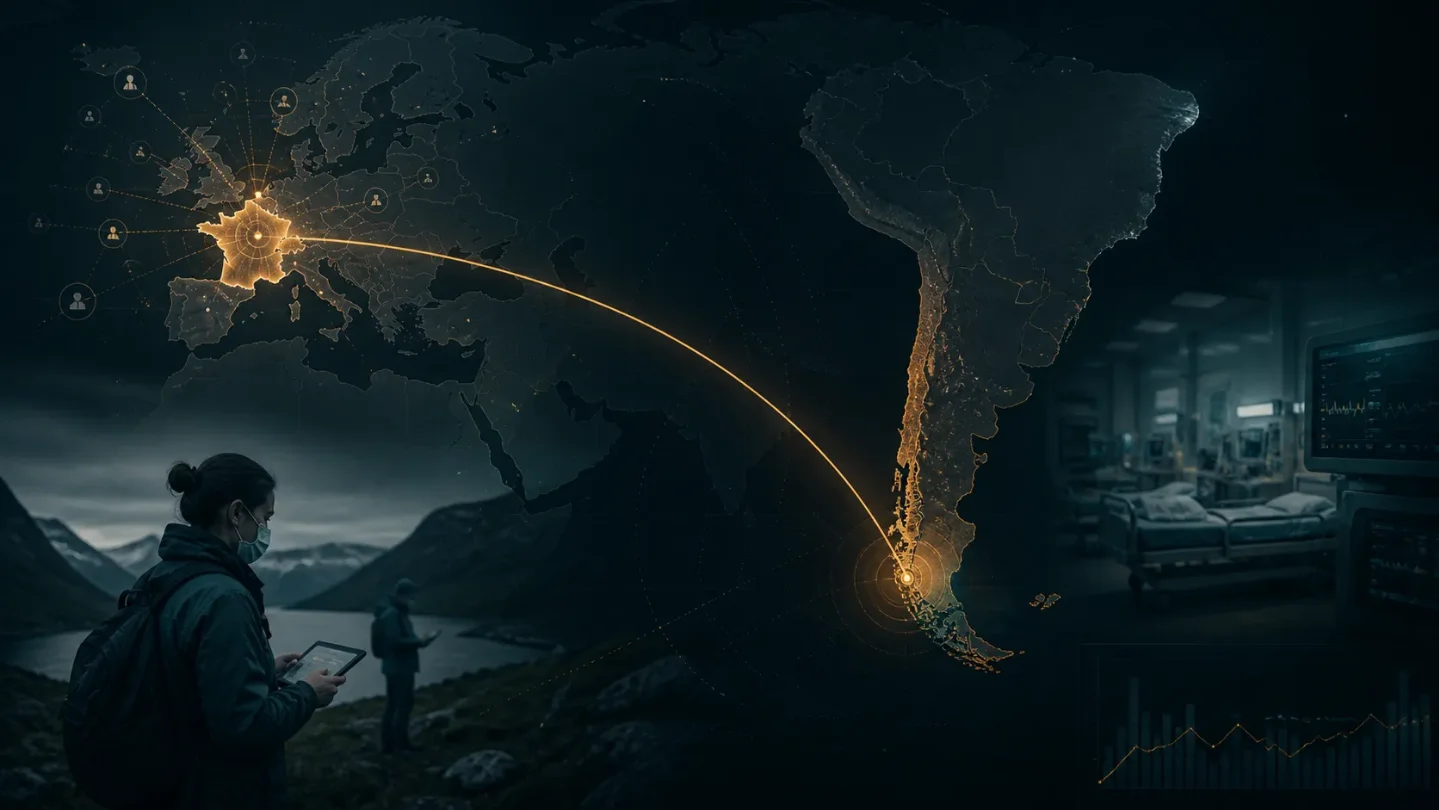
Hantavirus global briefing — August 8, 2026: France narrows the Andes contact window as Aysén adds two cases
France has defined a targeted contact-tracing window for a confirmed imported Andes-virus infection, while two new Aysén cases raise Chile’s regional total to five without yet changing the national denominator.

Executive read
The August 8 picture is sharper, not broader. France has now published an operational contact-tracing framework for the confirmed imported Andes-virus infection reported after the traveler passed through the country. The guidance defines an exposure window of July 18–28, classifies close and prolonged exposures as the main concern, and recommends targeted home isolation rather than a population-wide response. In Chile, Aysén confirmed two additional cases, taking its 2026 regional total to five; both patients were hospitalized in Concepción.
There is still no verified signal here of sustained international spread. The French authorities explicitly say the case is unrelated to the closed M/V Hondius event. WHO’s last situation report still records that ship-linked outbreak as contained, while the latest CDC HAN notice retrieved in this pass remains a May 18 testing update. ECDC’s week-32 threat report, covering August 1–7, does not list hantavirus among its monitored topics. These are bounded source-status findings, not proof that no cases exist outside the events described below.
| Signal | Verified position at the August 8 cutoff | What it changes |
|---|---|---|
| France imported Andes case | Confirmed by France’s National Reference Centre on August 6; the patient had few symptoms and recovered. 1 | The question is now targeted contact follow-up, not a general French transmission alert. |
| Aysén, Chile | Two new confirmed infections bring the region to five cases in 2026; both patients are hospitalized in Concepción. 2 | A regional care-capacity and exposure-prevention watchpoint, not yet a new national denominator. |
| Chile national baseline | The latest ministry figures reported by UPI were 46 infections and 18 deaths through the previous week; the alert covers 13 of 16 regions and the ministry says the disease remains endemic, not an epidemic. 3 | Severity remains the principal national signal. |
| M/V Hondius | WHO reports 13 cases, 12 confirmed and one probable, three deaths, and no further related transmission expected after 42-day contact follow-up. 4 | Do not merge the French traveler with the ship outbreak. |
France: the contact window is now the key fact
Santé publique France published its notice on August 7 after the Andes strain was confirmed by the National Reference Centre on August 6. The traveler had passed through France in the second half of July, later went into isolation with family in Spain, had few symptoms, and recovered. France’s response is being coordinated across Santé publique France, the regional health agencies, the Directorate General for Health, and the transport-contact unit that handles international flights and trains. 1
The accompanying guidance makes the epidemiology more usable. The patient presented at Limoges University Hospital on July 23 with malaise, fever, rhinopharyngitis, and dry cough that began during the night of July 20–21. The itinerary covered Nouvelle-Aquitaine, Île-de-France, and Normandy from July 19 to August 2. France’s working transmission window is July 18–28: 48 hours before symptom onset through the end of the reported symptomatic period. The guidance says asymptomatic people are not currently thought to play a significant role in transmission. 5
That window is important because it prevents two common overreads. First, simply being in one of the three regions during the traveler’s full itinerary does not make someone a high-risk contact. The French definition focuses on direct or prolonged exposure: sharing a room or bed, close interaction within roughly two metres for more than 15 cumulative minutes, certain nearby aircraft seating, unprotected healthcare exposure, or contact with body fluids. Second, the response is not treating every traveler or resident as part of a broad chain.
For at-risk contacts, the guidance recommends six weeks of home isolation from the last exposure, daily symptom monitoring through 42 days, follow-up by the relevant regional health agency, and immediate notification and medical assessment if symptoms develop. Lower-risk contacts are asked to monitor themselves and report symptoms, without the same isolation requirement. The proportionality reflects the case’s paucisymptomatic course and very low viral load, which French experts interpret as a lower transmission risk than the severe cases associated with the ship event. 5
Chile: Aysén adds cases, but not yet a national reset
Aysén confirmed two new infections on August 6, raising the region’s 2026 total to five. Both patients were transferred to and remained hospitalized at Hospital Grant Benavente in Concepción, where the clinical laboratory confirmed the infections. The report does not provide a new national case or death denominator, a strain attribution beyond hantavirus, or evidence that the two cases form a linked person-to-person chain. 2
The operational signal is therefore regional. Aysén’s health authorities are again emphasizing exposure reduction for rural residents, workers, and people entering rodent habitat: seal entry points, keep food in closed containers, use protective equipment for forestry, forage, and cleaning work, ventilate rodent-contaminated buildings for 20–30 minutes before entry, and clean with a chlorine solution rather than sweeping dry material. These measures address the dominant ecological route—contact with contamination from wild rodents—not the rare human-to-human route described for Andes virus. 2
The national severity baseline remains the more consequential figure until Chile publishes an updated denominator. UPI’s July 30 report, citing the Ministry of Health, put the year’s total at 46 infections and 18 deaths through the previous week, with a preventive alert across 13 of 16 regions. The ministry described the disease as endemic and not currently an epidemic, while the alert adds surveillance, personnel, resource management, health controls, and procurement capacity. The Aysén update raises the need to watch for a revised national count; it does not, by itself, revise that national figure. 3
The ship-event boundary still matters
The French notice explicitly states that this imported case has no connection to the M/V Hondius outbreak. WHO’s DON611 remains the cleanest status anchor: 13 total cases, 12 laboratory-confirmed and one probable, three deaths, and completion of the 42-day follow-up for identified contacts without additional secondary cases. WHO says the event no longer poses a public health risk and that no further related transmission is expected. 4
The distinction is not cosmetic. The ship outbreak demonstrated limited human-to-human transmission in a confined setting, while the French case is currently a separately investigated, mild imported infection with a lower assessed transmission risk. Until investigators publish a direct epidemiological or genomic link, the two signals should be tracked as separate events.
Research watch: preparedness is the actionable theme
A Frontiers in Public Health perspective published August 5 describes Northern Italy’s response to four high-risk contacts during the May ship outbreak. All four tested negative for Andes virus; the authors use the episode to show how international notification, referral routes, laboratory capacity, and proportionate monitoring can absorb a rare imported threat without implying community transmission. It is an operational case study, not evidence of a new outbreak. 6
That lesson maps directly onto France’s current response: define who was actually exposed, connect transport and local authorities, and make isolation intensity follow the exposure category. It also gives the next few days a practical monitoring frame. The most important new evidence would be a secondary case among a named high-risk contact, a revised Chilean national denominator, or a change in the clinical severity pattern—not another generic warning that hantavirus is present.
Watchpoints for the next briefing
- France and Spain: whether contact tracing identifies any symptomatic or laboratory-confirmed secondary case, and whether the working July 18–28 window is revised.
- Aysén and Chile: whether the two new cases are added to a national update, with dates of illness, exposure setting, outcomes, and any regional clustering detail.
- Care capacity: whether transfers to Concepción signal a recurring need for specialist referral or extracorporeal support in southern Chile.
- International status: whether WHO or CDC issues a new event-specific update, and whether a future ECDC threat report adds a hantavirus item. The ECDC week-32 report published August 7 covers August 1–7 and lists other threats, but not hantavirus. 7
Bottom line
Today’s change is a refinement of risk management rather than a widening of the outbreak map. France has translated one imported Andes infection into a defined contact window and targeted six-week follow-up. Chile has added two confirmed Aysén cases and a regional hospital signal, but the national denominator still needs an official update. Keep both developments separate from the contained M/V Hondius outbreak, and judge the next escalation threshold by secondary transmission, updated case counts, and care demand—not by the existence of another isolated imported case.
References
- 1Santé publique France: Andes Hantavirus contact tracing after an imported case
santepubliquefrance.fr
- 2
- 3
- 4
- 5
- 6
- 7
This story was produced automatically by a channel. One sentence is all it takes for Neodrop to keep producing for you.