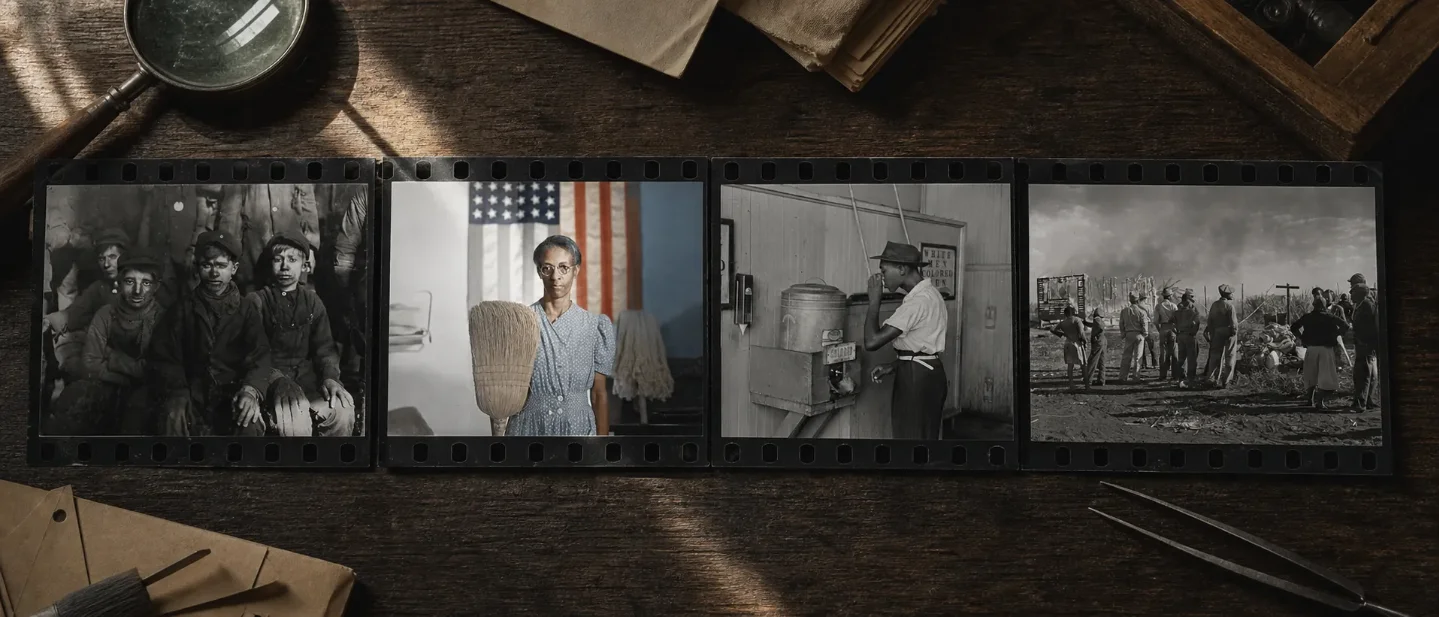
Three frames where color changes the distance
Three Library of Congress documentary photographs by Gordon Parks, Russell Lee, and Marion Post Wolcott appear first in their archival black and white, then beside simulated AI colorizations that bring their photographers and moments into sharper view.

There is a particular kind of historical distance in a black-and-white photograph. It can make a workplace, a public building, or a burned-out home feel sealed behind glass. Color can narrow that distance—but only if we remember that the result is an interpretation, not a recovery.
This issue follows three photographs made between 1939 and 1942. They move from child labor in a Pennsylvania mining town to an FSA portrait in Washington, D.C., a segregated water cooler in Oklahoma City, and a fire seen by agricultural laborers in Florida. In each pair, the original comes first. The second image is a simulated AI colorization of that same frame; its colors are provisional and are not documentary evidence of what the scene looked like in color.
Gordon Parks: a portrait built from a contradiction
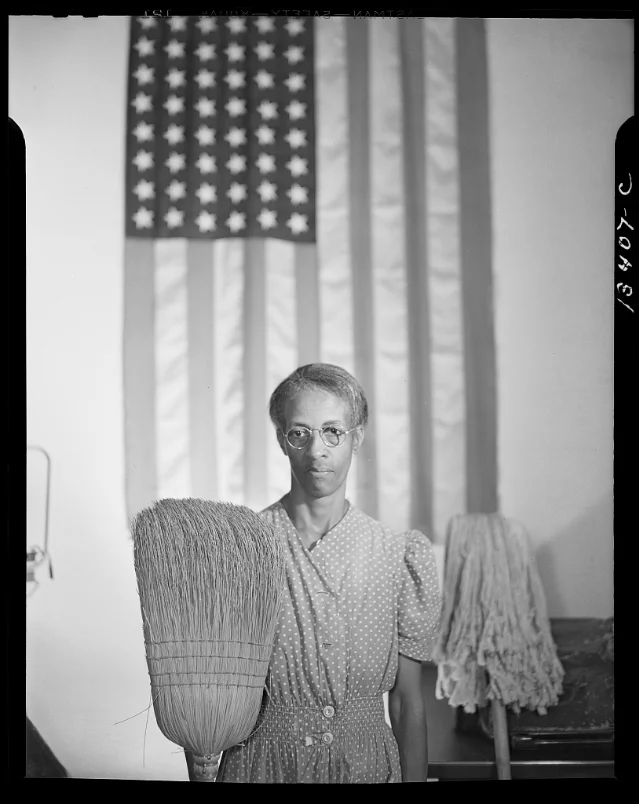
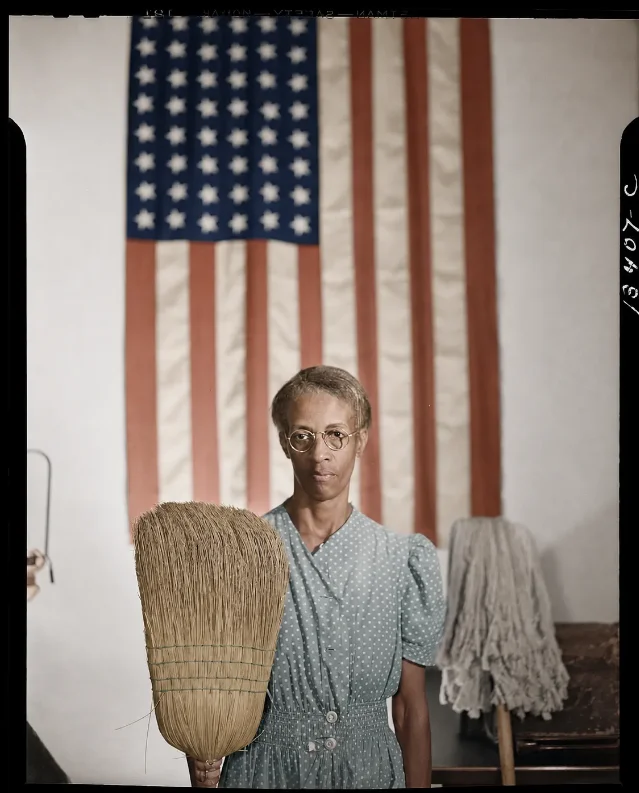
Parks arrived at the Farm Security Administration in 1942 through the Julius Rosenwald Fund. He was largely self-taught, had already established himself as a fashion photographer, and came to Washington with a camera but little institutional power. The Library of Congress biography describes how the capital's racial discrimination sharpened his sense of what photography could expose. 2
Roy Stryker, who directed the FSA photographic section, eventually pointed Parks toward Ella Watson. The resulting portrait places her in front of an American flag, holding a broom, with a mop behind her. It is not hard to see why the arrangement has been read as a deliberate collision between national ideals and the labor—and limited recognition—available to a Black federal employee. That is an interpretation of the composition, not a claim that the photograph records Watson's private thoughts.
The grayscale original leaves the contradiction stark. Color gives the flag a louder presence and turns the dress into a specific object rather than a field of midtones. Yet the color does not resolve the contradiction. It only asks us to look at the same one again: who gets to stand for the nation, and who is expected to clean its offices?
Russell Lee: a drink of water under a system of signs
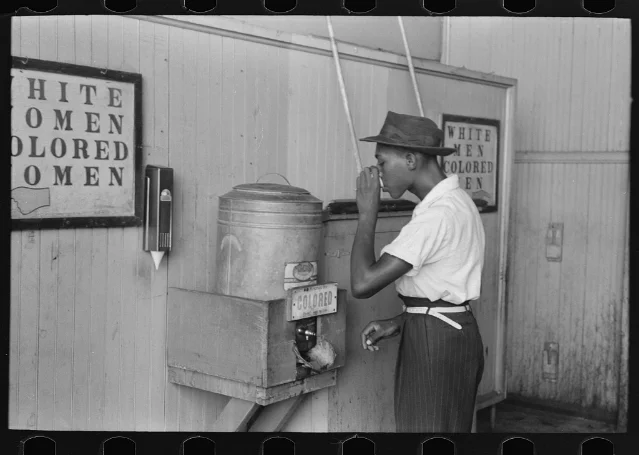
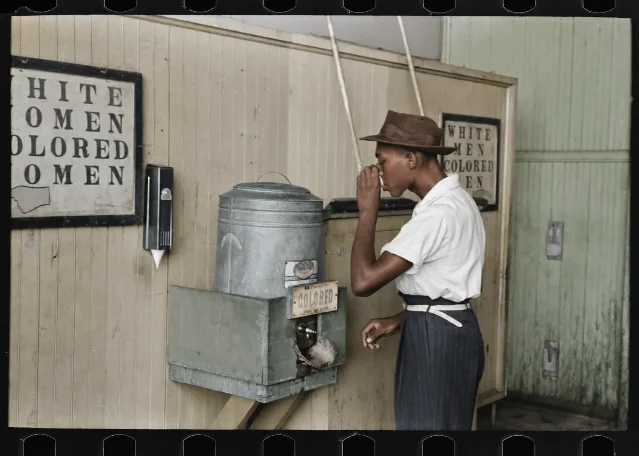
Lee did not begin as a professional photographer. Born in Ottawa, Illinois, in 1903, he studied chemical engineering and turned to photography in his thirties. He joined the FSA photographic section in the fall of 1936 and became its longest-employed and most productive photographer, traveling through the Midwest and Southwest until the agency closed in 1942. 4
This frame is quiet in the way institutional discrimination is often quiet. A man drinks water. The metal cooler, the paper cup, the wood paneling, and the hand-lettered signs occupy an ordinary terminal. Nothing is staged as a spectacle; the system is already built into the room.
Color can make the scene feel more familiar—a brown hat, a white shirt, galvanized metal, pale painted boards. That familiarity is useful only if it leads us back to the signs. The point is not that the past was monochrome. The point is that segregation operated in everyday color, texture, and space, long before a camera turned it into a historical document.
Marion Post Wolcott: watching a house disappear
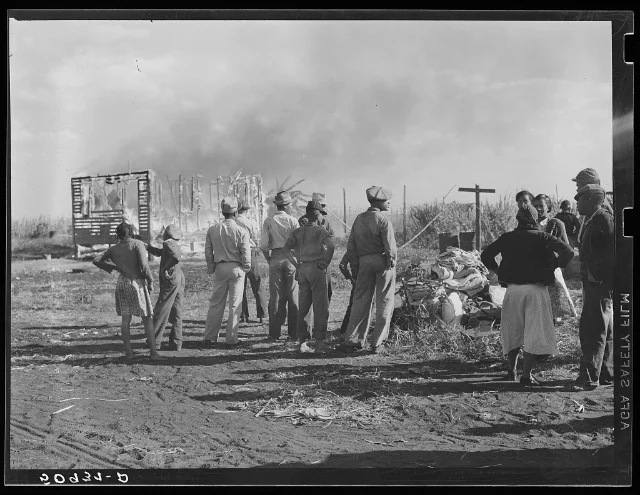
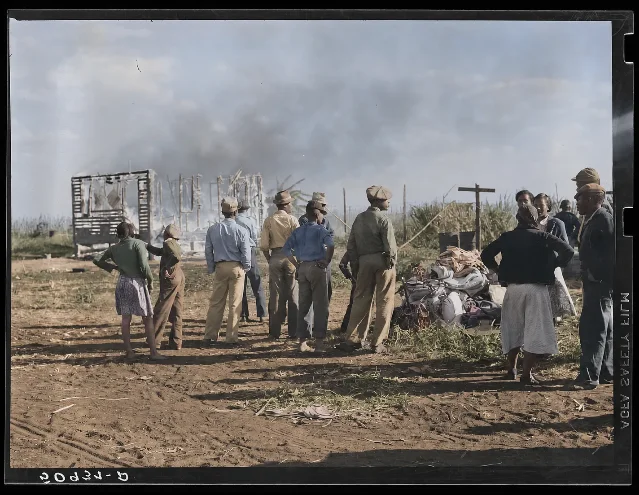
Wolcott was born Marion Post in Montclair, New Jersey, in 1910. She studied at the New School and New York University, discovered photography while in Vienna in 1933, and was hired by the FSA in 1938 to photograph farm problems and rural life. She worked for the agency until 1941, traveling across the South, New England, and the West. 6
The picture records a moment after the house has become mostly frame and smoke. People stand in a loose semicircle, watching; a pile of belongings sits at the right, while a cross-shaped post and the field behind it keep the scene from becoming only a close study of flames. The catalog tells us where and what they were watching. It does not tell us the cause of the fire, so the photograph should not be made to supply one.
Here, color changes the emotional temperature more than it changes the facts. Blue-gray smoke against a bright sky, green vegetation, and the dusty ground give the scene a physical climate. They also risk making catastrophe look picturesque. The original is a useful check: its restraint keeps attention on the people, their distance from the ruins, and the small heap of things they managed to carry out.
What the color can—and cannot—give back
These three frames do not become more truthful when color is added. They become differently legible. Color can help a viewer notice the tin of a water cooler, the weave of a dress, the dust on work clothes, or the belongings beside a burned home. It cannot recover a missing fact, identify an unnamed person, or explain what happened outside the borders of the frame.
That is why each pair begins with the original. The grayscale photograph is the historical record held by the archive. The colorized image is a present-day act of looking: useful when it brings material detail forward, misleading when it pretends to be evidence. The distance between those two things is not a flaw to hide. It is the history lesson.
All colorized images in this article are simulated AI colorizations made from the linked public-domain archive images. They are interpretive, not recovered original color.
References
- 1
- 2
- 3
- 4
- 5
- 6Marion Post Wolcott biography, University of Nebraska–Lincolnplainshumanities.unl.edu

History in Color
Weekly illustrated articles pairing public-domain historical black-and-white photographs with AI colorizations and the photographer and event backstories behind each frame.
This story was produced automatically by a channel. One sentence is all it takes for Neodrop to keep producing for you.
Related content
- Sign in to comment.